
As an avid observer and participant in the unmanned aerial systems domain, I have witnessed the rapid proliferation of drones across military, commercial, and civilian spheres. The quest for platforms that are intelligent, versatile, and efficient remains the driving force behind innovation. Among the diverse array of unmanned aerial vehicles, the Vertical Take-Off and Landing Fixed-Wing Unmanned Aerial Vehicle, or VTOL UAV, stands out as a transformative solution. This article delves into the technical intricacies, current developments, and projected trends of VTOL UAVs, employing analytical frameworks, formulas, and comparative tables to elucidate their significance. The convergence of rotary-wing agility and fixed-wing endurance in VTOL UAVs represents a paradigm shift, and I aim to explore this synthesis in detail.
The fundamental taxonomy of UAVs typically encompasses fixed-wing, rotary-wing (including helicopters and multi-rotors), and hybrid configurations. Each variant possesses distinct aerodynamic principles and operational envelopes. Fixed-wing UAVs generate lift primarily through their airfoil-shaped wings when propelled forward, adhering to the fundamental lift equation: $$L = \frac{1}{2} \rho v^2 S C_L$$ where \(L\) is lift, \(\rho\) is air density, \(v\) is airspeed, \(S\) is wing area, and \(C_L\) is the lift coefficient. This design yields high aerodynamic efficiency, enabling extended range and endurance, often expressed as: $$E = \frac{C \cdot L/D}{g \cdot TSFC}$$ for endurance, where \(C\) is energy capacity, \(L/D\) is lift-to-drag ratio, \(g\) is gravity, and \(TSFC\) is thrust-specific fuel consumption. However, their requirement for runways or launchers limits deployment flexibility. Conversely, rotary-wing UAVs produce lift via rotating blades, allowing vertical take-off, landing, and hover. Their power requirement is substantial, as thrust must continually exceed weight: $$T > W = mg$$ leading to higher energy consumption and shorter flight times. The emergence of VTOL UAVs seeks to amalgamate the virtues of both, creating a platform with minimal infrastructure dependence and superior cruise efficiency.
| Configuration | Lift Generation Mechanism | Key Advantages | Key Limitations | Typical Endurance Range | Typical Applications |
|---|---|---|---|---|---|
| Fixed-Wing UAV | Aerodynamic lift from fixed wings | High speed, long range, energy-efficient cruise | Requires runway/catapult; cannot hover | Mapping, surveillance, cargo delivery over distance | |
| Multi-Rotor UAV | Thrust from multiple vertical rotors | VTOL capability, precise hover, simple control | Low speed, short endurance, high energy consumption | 20-60 minutes | Aerial photography, inspection, close-range monitoring |
| Unmanned Helicopter | Thrust from main rotor(s) | VTOL, good payload capacity, moderate speed | Mechanical complexity, moderate endurance | 1-6 hours | Heavy-lift operations, tactical missions |
| VTOL UAV (Hybrid) | Combination: rotary for VTOL, fixed-wing for cruise | VTOL convenience with fixed-wing efficiency | Design complexity, transition phase challenges | 2-20 hours | Wide-area ISR, logistics in constrained environments, emergency response |
The evolution of VTOL UAVs has been marked by two predominant architectural philosophies: tilt-rotor systems and composite fixed-wing/multi-rotor designs. Tilt-rotor VTOL UAVs, such as historical concepts like the Bell Eagle Eye and modern demonstrations like the CH-10, feature rotors that pivot from a vertical orientation for VTOL to a horizontal orientation for forward flight. This approach aims to optimize the propulsion system for both regimes. The dynamics during transition involve complex control laws to manage the changing moment arms and aerodynamic forces. The power required during hover (\(P_{hover}\)) can be estimated using momentum theory: $$P_{hover} = \frac{T^{3/2}}{\sqrt{2 \rho A}}$$ where \(T\) is thrust and \(A\) is rotor disk area. In cruise, the power required (\(P_{cruise}\)) follows fixed-wing drag polar relationships: $$P_{cruise} = D \cdot v = \left( \frac{1}{2} \rho v^2 S C_D \right) \cdot v$$ where \(C_D\) is the drag coefficient. The mechanical complexity of tilt mechanisms, however, often leads to increased cost and maintenance demands, a significant consideration for widespread VTOL UAV adoption.
In contrast, composite VTOL UAVs employ distinct propulsion sets for vertical and horizontal flight. A common configuration involves a quadcopter-style arrangement for VTOL mounted atop a conventional fixed-wing airframe, with a separate forward-facing propeller for cruise. Examples include modified platforms like the Stalker XE. This decouples the design challenges but introduces weight penalties and requires robust control algorithms for mode transition. The total energy capacity (\(E_{total}\)) of such a hybrid electric VTOL UAV can be modeled as: $$E_{total} = E_{battery} + E_{fuel\,cell}$$ if hybridized. The transition phase is critical; the aircraft must reduce vertical thrust while increasing forward thrust and wing-borne lift, maintaining stability as it passes through low-speed regimes where control authority is marginal. The condition for successful transition is that lift from the wings (\(L_w\)) must equal weight before vertical thrust (\(T_v\)) is entirely eliminated: $$L_w = \frac{1}{2} \rho v_{transition}^2 S C_L \geq W – T_v$$ where \(v_{transition}\) is the airspeed during transition. Advances in flight control systems, particularly using adaptive nonlinear controllers, have made these transitions increasingly seamless and reliable for modern VTOL UAVs.
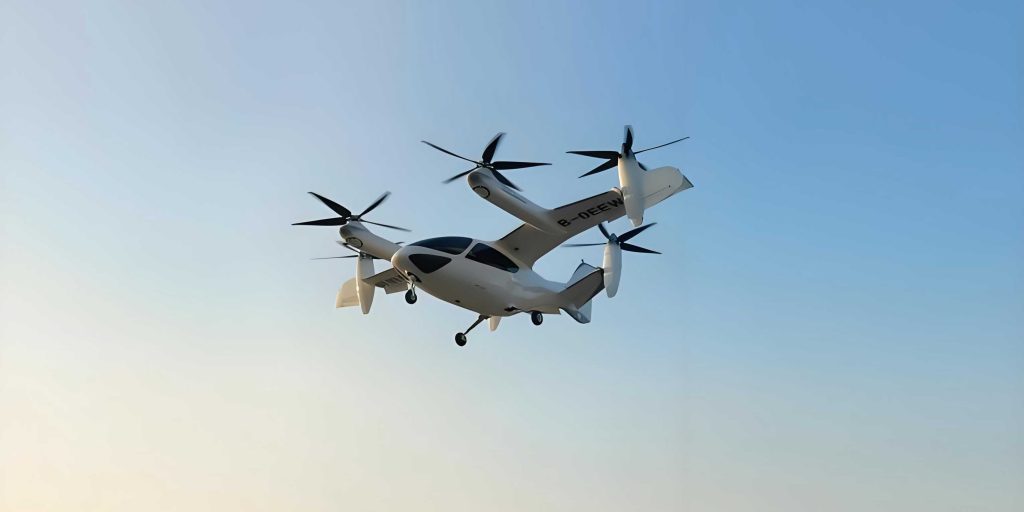
The strategic advantages of VTOL UAVs are multifaceted, driving their accelerated development. Primarily, they eliminate the need for prepared runways or recovery systems, enabling operations from ships, rugged terrain, or urban settings. This flexibility drastically expands the operational envelope. Secondly, by cruising as a fixed-wing aircraft, a VTOL UAV achieves significantly better range and endurance compared to pure rotary-wing counterparts. The benefit can be quantified by the Breguet range equation for propeller aircraft: $$R = \frac{\eta}{g \cdot TSFC} \cdot \frac{L}{D} \cdot \ln \left( \frac{W_{initial}}{W_{final}} \right)$$ where \(\eta\) is propeller efficiency. For electric VTOL UAVs, the range simplifies to: $$R = \frac{E_{battery} \cdot \eta_{total}}{D \cdot v}$$ where \(\eta_{total}\) is the overall powertrain efficiency. This efficiency makes VTOL UAVs ideal for persistent wide-area surveillance, long-endurance cargo delivery, and environmental monitoring missions. Furthermore, the ability to hover briefly or perform vertical maneuvers adds a layer of mission versatility not found in conventional fixed-wing UAVs.
| Metric | Typical Multi-Rotor UAV | Typical Fixed-Wing UAV | Advanced VTOL UAV (Projected) | Improvement Factor (VTOL vs. Multi-Rotor) |
|---|---|---|---|---|
| Endurance (hours) | 0.5-1 | 10-30 | 5-20 | 5x to 20x |
| Range (km) | 5-20 | 500-2000 | 200-1000 | 10x to 50x |
| Cruise Speed (km/h) | 20-60 | 80-200 | 60-180 | 2x to 3x |
| Payload Capacity (kg) | 1-10 | 5-50 | 3-30 | Comparable or better |
| Launch/Recovery Needs | None (VTOL) | Runway/Net/Parachute | None (VTOL) | Absolute advantage over fixed-wing |
Current trends in VTOL UAV development are shaped by advancements in several key technological areas. Propulsion system innovation is paramount. The shift towards hybrid-electric and full-electric powertrains addresses endurance limitations. For instance, a hybrid VTOL UAV might use a gasoline generator to charge batteries that power electric motors, optimizing for both high-power VTOL and efficient cruise. The energy management strategy can be formulated as an optimization problem: $$\min \int_{0}^{t_{mission}} \dot{m}_{fuel}(t) dt \quad \text{subject to} \quad SOC_{battery}(t) \geq SOC_{min}$$ where \(SOC\) is state of charge. Another trend is miniaturization and swarming capabilities. Small, affordable VTOL UAVs can be deployed in clusters for distributed sensing or communication relays. The dynamics of a VTOL UAV swarm can be described using agent-based models with interaction potentials: $$\ddot{\mathbf{r}}_i = -\nabla_i \sum_{j \neq i} U(|\mathbf{r}_i – \mathbf{r}_j|) + \mathbf{F}_{ext}$$ where \(\mathbf{r}_i\) is the position of the i-th VTOL UAV, \(U\) is an interaction potential, and \(\mathbf{F}_{ext}\) represents external forces like wind. Additionally, autonomy and AI integration are progressing rapidly, enabling VTOL UAVs to perform complex tasks like autonomous navigation in GNSS-denied environments using sensor fusion (LiDAR, vision, IMU).
Material science and manufacturing techniques, such as composite layups and 3D printing, are reducing airframe weight and cost, further enhancing the performance metrics of VTOL UAVs. The structural weight fraction, a critical design parameter, is given by: $$W_{structure} = k \cdot S_{wet}^{1.5}$$ where \(S_{wet}\) is the wetted area and \(k\) is a material-dependent constant. Advanced composites lower \(k\), allowing for more payload or energy storage. Moreover, regulatory frameworks are evolving to integrate VTOL UAVs into shared airspace, focusing on detect-and-avoid systems and reliable communication links, which will unlock urban air mobility and automated logistics applications for these platforms.
Looking forward, the trajectory for VTOL UAVs appears overwhelmingly positive. I anticipate consolidation around certain optimal configurations, likely favoring simpler composite designs for mass-market applications and tilt-rotors for high-performance military roles. The convergence of energy-dense batteries (e.g., solid-state), efficient electric motors, and advanced flight controllers will push endurance boundaries. A plausible future endurance equation for an electric VTOL UAV considering technological projections is: $$E = \frac{\lambda_{battery} \cdot \eta_{sys}}{P_{avg}}$$ where \(\lambda_{battery}\) is the specific energy (Wh/kg), \(\eta_{sys}\) is system efficiency, and \(P_{avg}\) is average power draw. With \(\lambda_{battery}\) potentially reaching 500 Wh/kg, a 20 kg VTOL UAV could achieve over 15 hours of endurance. Furthermore, the concept of “VTOL UAV airports” or vertiports in urban centers will become commonplace, supporting passenger and cargo transit. The economic model for VTOL UAV-based delivery services can be expressed as cost per ton-kilometer: $$C = \frac{C_{acq} / L + C_{energy} + C_{maintenance} + C_{labor}}{m_{payload} \cdot R}$$ where \(C_{acq}\) is acquisition cost, \(L\) is operational life, and other terms are per-operation costs. As volumes increase, \(C\) is expected to fall significantly, enabling widespread adoption.
| Aspect | Current State (2023-2025) | Near-Term Trend (2026-2030) | Long-Term Vision (2031-2035) |
|---|---|---|---|
| Propulsion Dominance | Hybrid-electric; advanced Li-ion batteries | Proliferation of full-electric for light roles; hydrogen fuel cells for heavy | High-specific energy batteries (e.g., Li-Air); distributed electric propulsion |
| Primary Design | Composite fixed-wing + multi-rotor dominant | Increased tilt-rotor adoption for performance; simplified lift+cruise designs | Morphing wings; biomimetic designs; ultra-reliable transition autonomy |
| Endurance (typical, hours) | 3-8 hours for medium-sized VTOL UAV | 8-15 hours | 15-30+ hours |
| Key Applications | Military ISR, precision agriculture, infrastructure inspection | Urban air mobility (UAM) start, automated logistics, emergency medical delivery | Integrated UAM networks, autonomous long-haul cargo, persistent atmospheric monitoring |
| Regulatory Status | Limited beyond visual line of sight (BVLOS) waivers; evolving standards | Widespread BVLOS approvals; initial UAM corridor regulations | Fully integrated into air traffic management (ATM) for dense operations |
| Cost Driver | R&D and low-volume production | Scale manufacturing; reduced battery costs | Completely automated manufacturing and maintenance |
In conclusion, the VTOL UAV represents a seminal advancement in unmanned aviation, effectively bridging the gap between convenience and capability. From my perspective, the ongoing research in aerodynamics, propulsion, and autonomy will continue to refine these platforms, making them more robust, accessible, and integral to our technological ecosystem. The inherent advantages of vertical take-off and landing coupled with fixed-wing efficiency align perfectly with the enduring human pursuit of smarter, more adaptable tools. As challenges in energy storage, control complexity, and regulatory integration are surmounted, I am confident that VTOL UAVs will not merely be a niche offering but will ascend to dominate significant segments of the unmanned aerial vehicle market, revolutionizing how we perceive and utilize aerial robotics for decades to come. The journey of the VTOL UAV is emblematic of innovation’s trajectory—convergent, iterative, and boundlessly promising.