
In recent years, the rapid advancement of drone technology has revolutionized various sectors, particularly in law enforcement, where drone training has become essential for operational efficiency and public safety. As a researcher in this field, I have extensively studied the development and implementation of virtual simulation systems for drone training, focusing on their role in enhancing pilot skills and reducing real-world risks. This article delves into the current state of these systems, their applications, inherent challenges, and potential solutions, with an emphasis on the keyword “drone training” to underscore its significance. Virtual simulation systems offer a cost-effective and safe environment for drone training, allowing trainees to practice complex maneuvers without the dangers associated with physical flights. Through this first-person perspective, I aim to provide a comprehensive analysis that highlights the transformative impact of these systems on drone training methodologies.
The core of virtual simulation systems for drone training lies in their ability to replicate real-world scenarios through advanced technologies. These systems typically consist of three key functional elements: virtual motion scenes, simulated physical systems, and emulated motion control. Each element plays a crucial role in creating an immersive drone training experience. For instance, virtual motion scenes simulate diverse environments, such as urban landscapes or natural terrains, to challenge trainees with varying obstacles. The simulated physical system models interactions between the drone and its surroundings, including collisions and wind effects, using physics-based algorithms. Emulated motion control replicates the drone’s flight dynamics, such as takeoff, hovering, and navigation, enabling precise control practice. To summarize these elements, Table 1 provides a detailed breakdown.
| Element | Description | Role in Drone Training |
|---|---|---|
| Virtual Motion Scenes | Simulates realistic environments with varying complexity levels, including obstacles and weather conditions. | Enhances situational awareness and adaptability during drone training. |
| Simulated Physical System | Models physical interactions using equations like $$ F = m \cdot a $$ for force and acceleration, ensuring realistic feedback. | Provides authentic tactile responses, improving skill acquisition in drone training. |
| Emulated Motion Control | Replicates flight mechanics through control algorithms, such as PID controllers represented by $$ u(t) = K_p e(t) + K_i \int e(t) dt + K_d \frac{de(t)}{dt} $$. | Facilitates mastery of drone操控 techniques during drone training sessions. |
In addition to these functional elements, drone training systems offer two primary操控 methods: keyboard-based input and remote controller operation. Keyboard操控 allows for basic training through computer interfaces, while remote controllers, such as those using PIXHAWK flight controllers, provide a more hands-on experience that mirrors actual drone operations. This duality in操控 methods caters to different learning stages in drone training, from novice to advanced levels. To illustrate the differences, Table 2 compares these操控 approaches, emphasizing their impact on drone training effectiveness.
| 操控 Method | Hardware Used | Advantages for Drone Training | Limitations |
|---|---|---|---|
| Keyboard操控 | Standard computer keyboard | Easy access and low cost, suitable for introductory drone training. | Lacks realism and may not translate well to physical drone操控. |
| Remote Controller操控 | PIXHAWK controllers, gamepads, or专用遥控器 | Offers realistic tactile feedback, enhancing muscle memory in drone training. | Higher cost and requires additional setup for drone training simulations. |
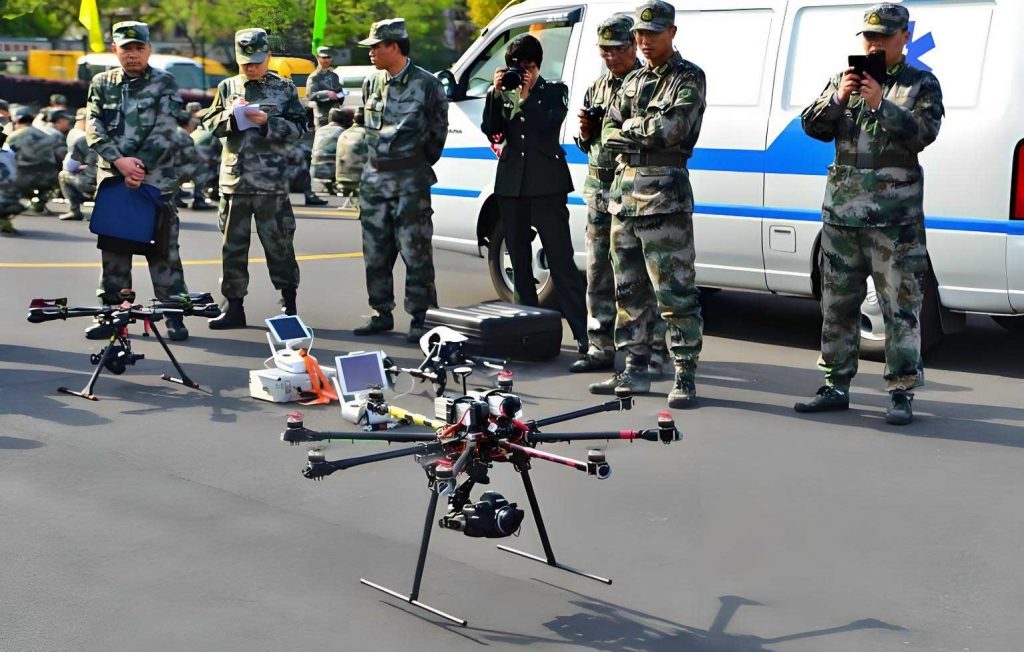
The integration of these elements and methods has led to widespread adoption of virtual simulation systems for drone training across various regions. In my research, I have observed that these systems are particularly prevalent in law enforcement agencies, where drone training is critical for missions like surveillance, search and rescue, and crowd monitoring. For example, in China, numerous police departments have implemented virtual仿真 platforms to train officers in drone操控, resulting in improved operational readiness. The applications extend beyond basic flight practice to include scenario-based drone training exercises, such as simulating emergency responses or complex aerial maneuvers. To capture this breadth, Table 3 summarizes the key application areas and their benefits for drone training.
| Application Area | Specific Use Cases | Impact on Drone Training |
|---|---|---|
| Law Enforcement | Patrol simulations, suspect tracking, and disaster response drills. | Enhances tactical skills and decision-making in high-stakes drone training. |
| Civilian Training | Recreational flight practice, commercial drone certification courses. | Provides accessible and scalable drone training options for diverse learners. |
| Research and Development | Testing new drone algorithms or sensor integrations in virtual environments. | Accelerates innovation by reducing risks in drone training prototypes. |
Despite these advancements, virtual simulation systems for drone training face several limitations that hinder their effectiveness. Through my analysis, I have identified common issues related to system complexity, environmental realism, performance constraints, and functional gaps. For instance, many systems suffer from cluttered interfaces that complicate drone training workflows, while others fail to simulate realistic weather conditions or terrain variations. These shortcomings can be quantified using performance metrics, such as the training efficiency formula $$ E = \frac{S \cdot T}{C} $$, where E represents training efficiency, S is the simulation realism score, T is the training time, and C is the complexity factor. Lower values of C indicate more user-friendly systems, which are crucial for effective drone training. To address these challenges, I propose targeted solutions that leverage emerging technologies. Table 4 outlines the primary defects and corresponding solutions, with a focus on enhancing drone training outcomes.
| Defect Category | Specific Issues | Proposed Solutions | Expected Improvement in Drone Training |
|---|---|---|---|
| System Complexity | Cumbersome interfaces and difficult command inputs during drone training. | Simplify interfaces using AI-driven assistants or gesture-based controls. | Reduces learning curves and increases engagement in drone training. |
| Environmental Realism | Limited simulation of real-world conditions like wind or obstacles. | Incorporate VR technology and dynamic environment generators. | Boosts immersion and adaptability in drone training scenarios. |
| Performance Shortcomings | Slow processing speeds or unreliable hardware affecting drone training. | Optimize software algorithms and upgrade to high-performance GPUs. | Enhances responsiveness and realism in drone training sessions. |
| Functional Limitations | Lack of advanced features for complex drone training exercises. | Integrate multi-agent simulations and real-time data analytics. | Expands the scope of drone training to include collaborative missions. |
To further elaborate on the technical aspects, mathematical models play a vital role in refining virtual simulation systems for drone training. For example, the drone’s flight dynamics can be represented by a set of differential equations, such as $$ \dot{x} = v \cos(\theta), \quad \dot{y} = v \sin(\theta), \quad \dot{\theta} = \omega $$, where (x, y) denotes position, v is velocity, θ is heading angle, and ω is angular velocity. These equations are integral to simulating realistic motion in drone training systems. Additionally, the effectiveness of drone training can be assessed using a composite score formula: $$ \text{Training Score} = \alpha \cdot \text{Accuracy} + \beta \cdot \text{Speed} + \gamma \cdot \text{Safety} $$, where α, β, and γ are weighting coefficients that reflect the priorities of a given drone training program. By optimizing these parameters, systems can tailor drone training experiences to individual needs, ensuring that each session maximizes skill development. This mathematical approach underscores the importance of precision in drone training, as even minor errors in simulation can lead to significant gaps in real-world performance.
The evolution of virtual simulation systems for drone training is also influenced by broader technological trends, such as the Internet of Things (IoT) and artificial intelligence (AI). In my view, integrating IoT sensors into these systems can enable real-time data exchange between virtual and physical drones, creating hybrid drone training environments that bridge the gap between simulation and reality. For instance, data from actual flight logs can be fed into simulations to replicate past missions for analysis and practice. Similarly, AI algorithms can personalize drone training curricula by analyzing trainee performance and suggesting targeted exercises. This adaptive learning approach, modeled by $$ L(t+1) = L(t) + \eta \cdot \nabla J(\theta) $$ where L is the learning level, η is the learning rate, and J is the cost function, can dynamically adjust drone training难度 to match proficiency gains. Such innovations promise to make drone training more efficient and accessible, particularly for law enforcement agencies with limited resources.
Looking ahead, the future of virtual simulation systems for drone training holds immense potential, driven by ongoing research and development. Key areas for exploration include enhancing network security to protect drone training data, expanding cross-platform compatibility for seamless integration, and fostering international collaboration to standardize drone training protocols. In my research, I have proposed a framework for evaluating these systems based on metrics like scalability, represented by $$ S = \frac{N_{\text{users}}}{C_{\text{system}}} $$, where S is scalability, N is the number of concurrent users, and C is the system capacity. Higher scalability ensures that drone training programs can accommodate growing demand without compromising quality. Furthermore, the integration of blockchain technology could secure training records, adding transparency and trust to drone certification processes. As these advancements unfold, virtual simulation systems will continue to redefine drone training, making it more immersive, effective, and aligned with real-world demands.
In conclusion, virtual simulation systems for drone training represent a pivotal innovation in the realm of unmanned aerial vehicle education, particularly for critical fields like law enforcement. Through my first-hand analysis, I have highlighted their functional components, widespread applications, and persistent challenges, all while emphasizing the central theme of drone training. The use of tables and formulas throughout this article aims to provide a structured and quantitative perspective on how these systems can be optimized. As technology progresses, addressing the identified defects through targeted solutions will be essential for unlocking the full potential of drone training. Ultimately, the goal is to create virtual environments that not only mimic reality but also inspire confidence and competence in drone pilots, ensuring that drone training evolves in tandem with the dynamic needs of modern society.