
In the evolving landscape of technical education, drone training has emerged as a critical discipline that blends theoretical knowledge with hands-on practice. As an educator in this field, I face the constant challenge of ensuring students master complex aeronautical principles and operational skills within limited instructional hours. The integration of virtual simulation technology offers a transformative solution, creating immersive, repeatable, and safe environments for drone training. This article delves into the application, construction, and evaluation of virtual simulation platforms specifically designed for drone training, aiming to enhance both student engagement and competency.
Virtual simulation technology, often abbreviated as VSM, is an information technology that leverages computer science, multimedia, and modeling to generate interactive virtual environments. It allows users to simulate real-world scenarios through human-computer interaction, facilitating learning, experimentation, and training. Historically rooted in defense research from the 1960s, virtual simulation has evolved into a versatile tool across industries. In educational contexts, it enables the creation of digital twins of physical systems, such as drones, providing a sandbox for exploration without real-world risks. For drone training, this means students can repeatedly practice flights, understand aerodynamics, and troubleshoot systems in a controlled digital space, thereby accelerating their learning curve and reducing reliance on costly physical equipment.
The advantages of incorporating virtual simulation into drone training are multifaceted. Below is a summary table highlighting key benefits:
| Advantage | Description | Impact on Drone Training |
|---|---|---|
| Cost Reduction | Eliminates need for physical drones and dedicated flight spaces, lowering material and logistical expenses. | Makes drone training more accessible and scalable, allowing institutions to allocate resources to advanced modules. |
| Enhanced Safety | Provides a risk-free environment for practicing maneuvers, crash scenarios, and emergency procedures. | Minimizes accidents and damage during initial learning phases, fostering confidence in drone training. |
| Skill Acceleration | Offers real-time feedback on flight performance, enabling immediate correction and mastery of techniques. | Improves proficiency in drone control, navigation, and mission execution through iterative simulation. |
| Scenario Diversity | Simulates various operational contexts (e.g., agriculture, surveillance, rescue) under different environmental conditions. | Prepares trainees for real-world drone applications, enhancing adaptability and problem-solving skills. |
| Autonomous Learning | Supports self-paced exploration of drone mechanics and flight dynamics via interactive modules. | Empowers students to deepen their understanding beyond classroom hours, personalizing their drone training journey. |
From my experience, these advantages translate directly into more effective drone training programs. For instance, the cost savings can be quantified using a simple cost-benefit ratio formula: $$ CBR = \frac{B_v}{C_v} $$ where \( B_v \) represents the benefits of virtual drone training (e.g., reduced equipment wear, lower insurance costs) and \( C_v \) denotes the initial investment in simulation software and hardware. In many cases, \( CBR > 1 \) indicates a favorable return, making virtual simulation a prudent choice for institutions. Moreover, the safety aspect is paramount; by practicing in a virtual realm, trainees can make mistakes without consequences, which is crucial for building foundational skills in drone training.
To harness these benefits, I have been involved in developing a comprehensive virtual simulation teaching platform tailored for drone training. This platform is built in three progressive phases, each designed to incrementally enhance educational outcomes.
Phase 1: Activating Teacher Research and Creation Capabilities. The initial step focuses on empowering educators with user-friendly tools. We selected a WebGL-based VR editor that requires no coding expertise, allowing instructors to create immersive drone training scenarios through text-driven interfaces. This editor supports multiple devices, including PCs and VR headsets, and facilitates rapid resource sharing. Through project-based workshops, teachers learn to design interactive modules covering drone flight principles, assembly procedures, and maintenance protocols. For example, a module might simulate the aerodynamic forces on a drone wing using the lift equation: $$ L = \frac{1}{2} \rho v^2 S C_L $$ where \( L \) is lift, \( \rho \) is air density, \( v \) is velocity, \( S \) is wing area, and \( C_L \) is the lift coefficient. By manipulating these variables in a virtual environment, students gain intuitive understanding, reinforcing theoretical drone training.
Phase 2: Fostering a Creative Atmosphere for Teachers and Students. This phase involves upgrading infrastructure and introducing diverse editing tools to spur innovation. We established a dedicated lab with advanced hardware to support drone training development. The table below lists the key equipment:
| Equipment Name | Purpose | Quantity |
|---|---|---|
| Touch Interactive Display | Demonstrating digital resources and flight simulations. | 1 set |
| VR Headsets | Providing immersive experiences for drone flight practice. | 2 sets |
| High-Performance Computers | Running virtual simulation software and 3D modeling tools. | 10 units |
| 3D Scanners | Capturing real-world objects for integration into virtual drone environments. | 2 units |
| 360-Degree Aerial Cameras | Creating panoramic backgrounds for scenario-based drone training. | 2 sets |
Additionally, we integrated B/S architecture editors for AR, digital museums, and interactive media, enabling “zero-start” creation without programming. For instance, the AR engine allows trainees to overlay virtual drone paths onto physical maps, enhancing spatial awareness. The digital museum tool lets students curate exhibits on drone history, while the interactive media editor supports building clickable simulations of drone components. These tools democratize content creation, encouraging students to actively contribute to drone training resources. To illustrate the learning progression, we often use a skill acquisition formula: $$ P(t) = P_0 + k \ln(1 + t) $$ where \( P(t) \) represents proficiency at time \( t \), \( P_0 \) is initial skill level, and \( k \) is a constant based on simulation quality. This model shows how repeated virtual practice accelerates competence in drone training.
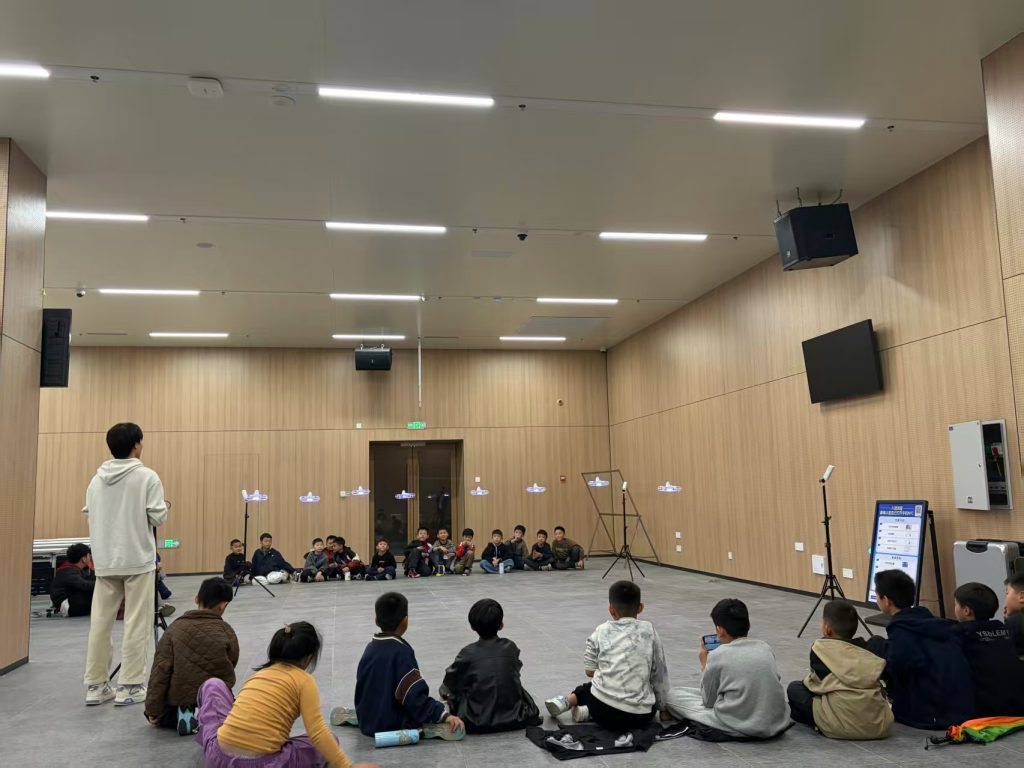
Phase 3: Creating Landmark Achievements. The final phase aims to produce tangible outcomes by linking the platform with industry and research. We collaborate with drone companies to customize simulations for specific tasks, such as crop monitoring or infrastructure inspection. Students participate in internships where they develop virtual training modules for corporate use, fostering a “learn-by-creating” approach. This synergy benefits all parties: schools enhance their drone training curricula, students gain employable skills, and enterprises reduce onboarding costs. For assessment, we track metrics like completion rates and skill transfer, often modeled as: $$ T = \alpha S_v + \beta S_p $$ where \( T \) is overall training effectiveness, \( S_v \) is virtual simulation score, \( S_p \) is practical performance, and \( \alpha, \beta \) are weighting factors. Empirical data from our drone training programs show that \( \alpha \) and \( \beta \) tend to equalize over time, indicating the complementary roles of virtual and real-world practice.
The effectiveness of this virtual simulation platform for drone training can be evaluated through both projected and applied metrics. In terms of expected effects, we anticipate significant improvements in educational outcomes. For example, we aim to develop over 20 virtual drone training modules, cover 10 core courses, and benefit more than 1,000 students annually. These modules will incorporate interactive assessments, such as quizzes on drone regulations, which can be scored using: $$ Score = \frac{C}{N} \times 100 $$ where \( C \) is correct answers and \( N \) is total questions. Additionally, we project cost savings from reduced physical drone usage. If a traditional drone training session costs \( C_t \) per student and a virtual session costs \( C_v \), the annual saving for \( n \) students is: $$ S = n (C_t – C_v) $$ Assuming \( C_t = \$500 \) and \( C_v = \$100 \), with \( n = 100 \), savings amount to \$40,000, highlighting the economic efficiency of virtual drone training.
Application assessment reveals several key insights. First, safety and risk control are greatly enhanced; since all initial flights occur virtually, incident rates have dropped to near zero in our drone training programs. Second, cost-benefit analysis confirms the platform’s value, as shown in the formula above. Third, real-time feedback mechanisms allow for continuous skill improvement. For instance, flight stability can be measured using a deviation index: $$ D = \sqrt{\frac{1}{N} \sum_{i=1}^{N} (x_i – x_t)^2 } $$ where \( x_i \) is actual position and \( x_t \) is target position during a simulated drone mission. Lower \( D \) values indicate better control, and students can adjust techniques immediately based on this feedback. Fourth, diverse scenario simulation boosts practical ability; trainees encounter weather variations, obstacle courses, and equipment failures in a controlled manner, preparing them for field challenges. We often simulate battery drain dynamics with: $$ B(t) = B_0 e^{-\lambda t} $$ where \( B(t) \) is remaining battery at time \( t \), \( B_0 \) is initial charge, and \( \lambda \) is discharge rate. This teaches energy management, a critical aspect of drone training.
In conclusion, virtual simulation technology is reshaping drone training by providing an accessible, safe, and effective pedagogical tool. From my perspective as an educator, the three-phase platform development model has proven successful in activating creativity, fostering innovation, and yielding measurable outcomes. The integration of tables and formulas helps systematize the advantages and assessments, offering a clear framework for implementation. As technology advances, I foresee even more immersive simulations incorporating AI and real-time data, further blurring the lines between virtual and physical drone training. Ultimately, this approach not only elevates student competence but also contributes to the broader adoption of drones across industries, ensuring that the next generation of operators is well-equipped for the challenges ahead.