
In modern education, integrating artificial intelligence (AI) with practical applications is crucial for fostering interdisciplinary skills. One of the most captivating examples is the drone show, where multiple unmanned aerial vehicles (UAVs) perform synchronized maneuvers, demonstrating principles of multi-agent systems, path planning, and real-time control. However, conducting physical drone show experiments poses significant challenges, including airspace restrictions, safety concerns, and high costs. To address these issues, we developed a virtual simulation platform that allows students to design, optimize, and visualize drone swarm performances in a risk-free environment. This project leverages 3D modeling, animation, and interactive programming to replicate the entire drone show workflow, from formation design to collision avoidance. By engaging in this immersive experience, learners gain hands-on insights into AI-driven coordination, enhancing their problem-solving abilities and innovation potential in robotics and intelligent systems.
The core objective of this simulation is to demystify complex AI concepts through the engaging context of a drone show. Students assume the role of system designers, tasked with creating dynamic formations, programming flight paths, and coordinating light displays for a virtual UAV fleet. The platform emphasizes the importance of collaboration across disciplines—such as computer science, engineering, and design—mirroring real-world AI projects. For instance, participants can experiment with genetic algorithms to minimize collision risks or use sensor data simulations to refine trajectory accuracy. Through iterative testing and visualization, they develop a deeper understanding of distributed intelligence, all while avoiding the logistical hurdles of physical drone deployments. This approach not only makes learning more accessible but also inspires creativity in applying AI to large-scale performances.
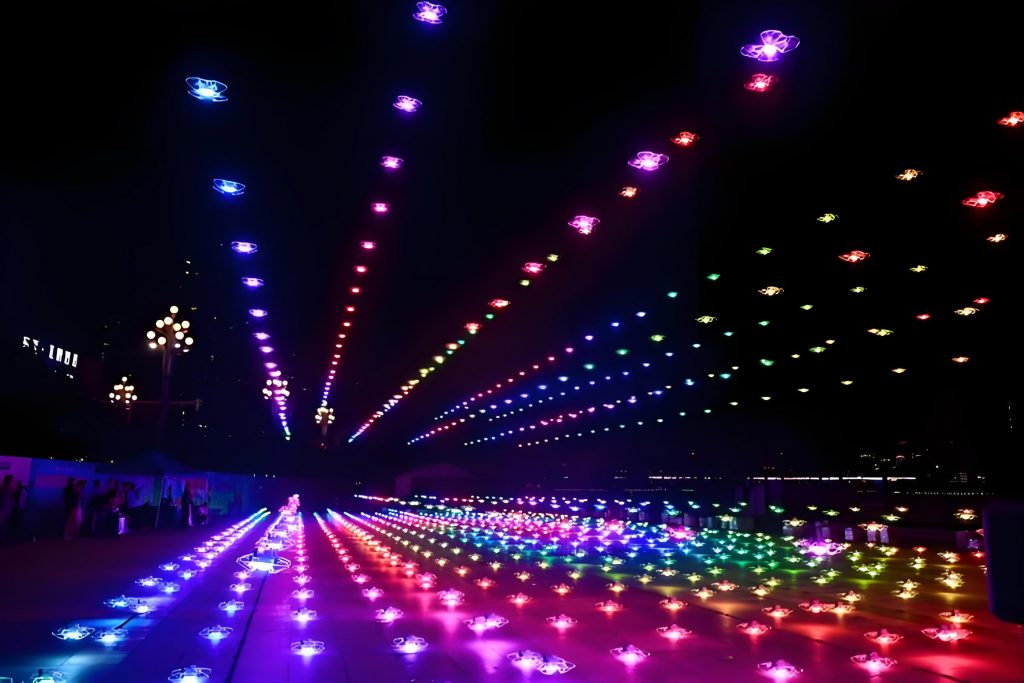
To achieve realistic drone show emulation, the simulation incorporates detailed models of UAV components and control systems. Each virtual drone is built using 3D-scanned parts, ensuring high fidelity to real-world counterparts. Key elements like flight controllers, sensors, and communication modules are simulated to mimic their physical behaviors. For example, the flight control system processes data from virtual accelerometers, gyroscopes, and pressure sensors to maintain stability during maneuvers. The positioning system employs a differential GPS simulation, converting latitude and longitude into 3D coordinates for precise navigation. Communication between drones and the central control platform is modeled after token-ring networks, ensuring orderly data exchange. These components work in tandem to replicate the orchestration of a live drone show, providing users with an authentic engineering experience.
Central to the drone show simulation is the programmable interface that enables users to dictate UAV behaviors. Through a set of control functions, students can command individual or group actions, such as adjusting position, speed, or lighting patterns. The table below summarizes the primary programming interfaces available in the virtual environment:
| Function Name | Description |
|---|---|
| getX, getY, getZ | Retrieve current coordinates in 3D space |
| getAcc | Obtain real-time acceleration data |
| getSpeed | Fetch current velocity metrics |
| setLight | Configure LED light sequences for visual effects |
| moveX, moveY, moveZ | Execute directional movements (e.g., ascend, translate) |
| Move | Navigate to target coordinates at specified speed |
| Stay | Maintain hover position |
These functions allow for precise control over the drone show dynamics. For instance, users can script a transition from a geometric pattern to a spiral formation by invoking Move commands with optimized waypoints. Additionally, the setLight function enables the creation of mesmerizing visual displays, syncing color changes with flight paths to enhance the artistic impact of the drone show. By experimenting with these interfaces, learners grasp how software instructions translate into physical actions, bridging the gap between coding and robotics.
A critical aspect of drone show management is collision risk optimization. In dense formations, the probability of mid-air incidents must be minimized to ensure safety and performance continuity. The simulation models this using probabilistic methods, where the collision likelihood between any two drones follows a normal distribution based on their proximity. The key formula is:
$$ p_{i,j} = \frac{1}{\sqrt{2\pi}\sigma} \exp\left(-\frac{(\text{dis}(i,j) – \mu)^2}{2\sigma^2}\right) $$
Here, \( p_{i,j} \) represents the collision probability between drones \( i \) and \( j \), \( \mu \) is the mean distance, \( \sigma \) denotes the standard deviation, and \( \text{dis}(i,j) \) is the minimum Euclidean distance during the flight. This distance is computed as:
$$ \text{dis}(i,j) = \min_{t=1}^{T} \sqrt{(x^i_t – x^j_t)^2 + (y^i_t – y^j_t)^2 + (z^i_t – z^j_t)^2} $$
where \( T \) is the total time for formation change, and \( (x^i_t, y^i_t, z^i_t) \) are the coordinates of drone \( i \) at time \( t \). To prevent accidents, the system enforces \( p_{i,j} < 10^{-6} \) for all pairs. Simultaneously, energy efficiency is considered by constraining the flight distance per drone:
$$ d_i = \sum_{n=1}^{N} \sqrt{(x^i_n – x^i_{n-1})^2 + (y^i_n – y^i_{n-1})^2 + (z^i_n – z^i_{n-1})^2} $$
where \( N \) is the number of waypoints, and \( d_i \) must not exceed a maximum value \( d_{\text{max}} \). This multi-objective optimization is solved using genetic algorithms, allowing students to explore AI techniques for balancing safety and performance in a drone show. The table below outlines parameters used in collision avoidance:
| Parameter | Symbol | Typical Value |
|---|---|---|
| Mean Distance | \( \mu \) | 5 meters |
| Standard Deviation | \( \sigma \) | 1 meter |
| Max Flight Distance | \( d_{\text{max}} \) | 100 meters |
| Time Intervals | \( T \) | 60 seconds |
Through iterative simulations, users can adjust these parameters to achieve optimal paths for their drone show, learning how AI-driven decision-making enhances system reliability.
The virtual platform’s architecture combines cloud-based servers with local processing to deliver seamless performance. Developed using Unity 3D and WebGL for 3D rendering, the simulation runs on standard browsers, making it accessible without specialized hardware. Key components include:
- Resource Management: Handles 3D assets, such as drone models and environmental elements, ensuring smooth animation during the drone show.
- Data Processing: Computes flight trajectories, collision probabilities, and lighting effects in real-time.
- System Control: Integrates user inputs from the programmable interface to update drone behaviors.
This setup supports collaborative projects, where teams can co-design a drone show and evaluate outcomes through shared dashboards. The immersive visuals and interactive controls empower students to experiment freely, fostering a deeper appreciation for the engineering behind large-scale drone performances.
In practice, the drone show simulation follows a structured workflow. First, users design formations by plotting 3D waypoints for each UAV, often starting with simple shapes like circles or grids before advancing to complex patterns. Next, they assign light sequences using RGB values to create dynamic displays synchronized with movement. The programming interface then translates these designs into flight commands, which are simulated with physics-based animations. During execution, the system monitors critical metrics—such as inter-drone distances and battery usage—providing feedback for refinements. For example, if a proposed path results in a high collision probability, students must revisit their design and apply optimization algorithms. This iterative process mirrors real-world drone show development, emphasizing the importance of testing and validation in AI applications.
To quantify performance, the simulation outputs analytics on each drone show attempt. Metrics include total flight time, energy consumption, and collision risk scores. The formula for overall efficiency combines these factors:
$$ E_{\text{show}} = \frac{1}{M} \sum_{i=1}^{M} \left( \frac{d_{\text{max}} – d_i}{d_{\text{max}}} + \frac{1 – \max(p_{i,j})}{1} \right) $$
where \( M \) is the number of drones, and higher \( E_{\text{show}} \) values indicate better optimization. Students can compare results across different strategies, encouraging competition and innovation. Moreover, the platform includes scenario-based challenges, such as coordinating a drone show in windy conditions or with limited communication bandwidth, to simulate real-world constraints.
Feedback from users highlights the educational benefits of this virtual approach. By engaging with every aspect of a drone show—from conceptual design to risk management—learners develop a holistic understanding of multi-agent systems. The hands-on experience with AI tools, such as genetic algorithms for path planning, prepares them for careers in robotics and automation. Furthermore, the ability to visualize outcomes in 3D reinforces theoretical concepts, making abstract algorithms more tangible. As drone shows continue to gain popularity in entertainment and advertising, this simulation equips students with the skills to contribute to future innovations in the field.
In conclusion, virtual simulation transforms the way we teach and learn about drone swarms. By replicating the intricacies of a live drone show, it provides a safe, cost-effective environment for experimentation. Through programmable interfaces, probabilistic modeling, and interactive design, students gain practical insights into AI coordination and optimization. This project not only enhances technical proficiency but also inspires creativity, demonstrating how virtual tools can bridge the gap between classroom theory and real-world application. As technology evolves, such simulations will play a pivotal role in nurturing the next generation of engineers and AI enthusiasts, ready to tackle the challenges of intelligent systems.