
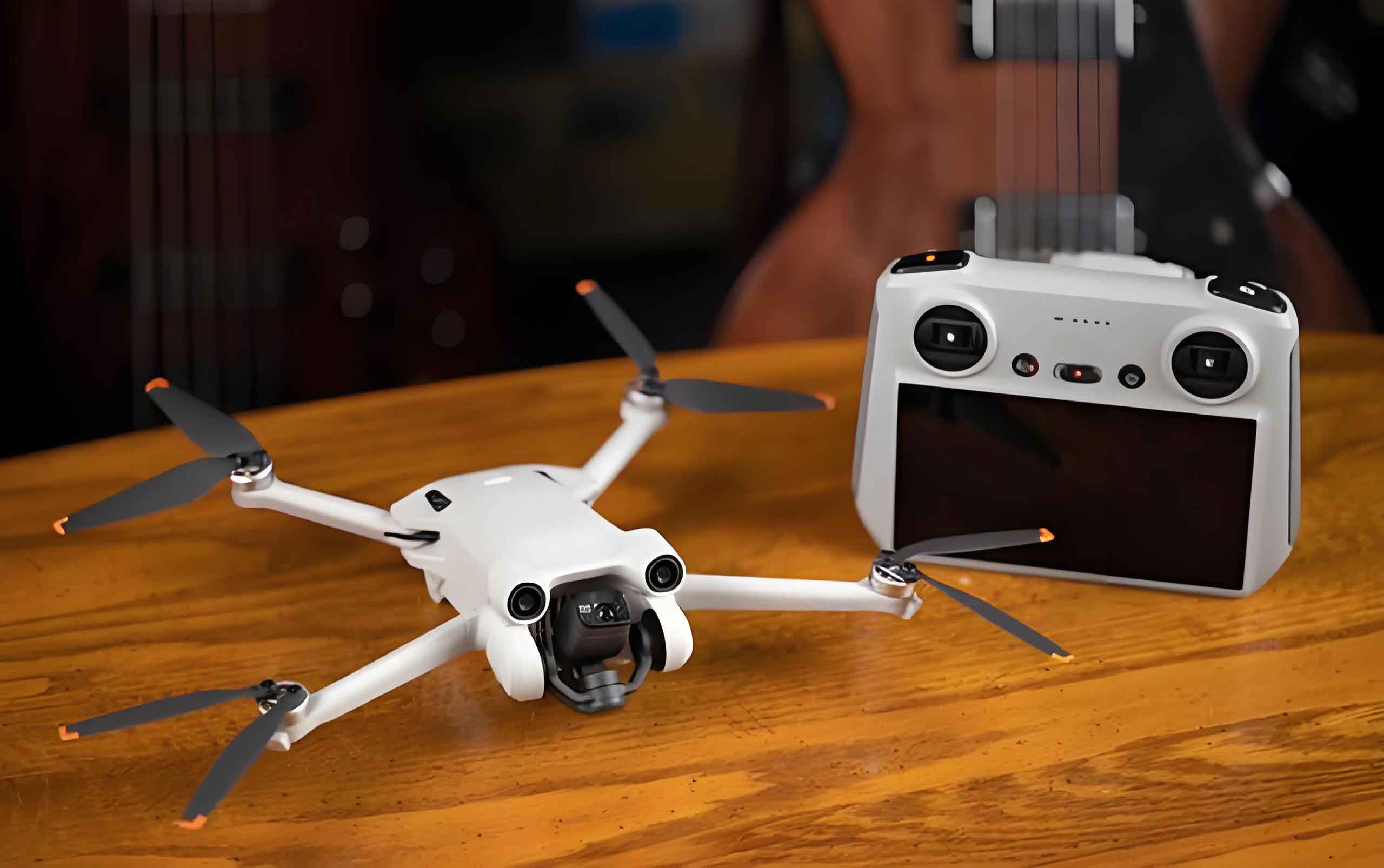
Recent advancements in drone technology have expanded applications across military, agricultural, and commercial sectors. However, rising incidents of unregulated flights and costly pilot training necessitate innovative solutions. This research develops a virtual Unmanned Aerial Vehicle flight system using Unity3D and VR to simulate real-world operations while eliminating physical risks and resource constraints.
Technical Architecture
The simulation leverages Unity3D’s real-time rendering for 1:1 scale quadcopter modeling and environmental physics. VR integration via head-mounted displays and motion controllers delivers full sensory immersion. Core components include:
- High-fidelity urban/wooded environments with dynamic weather
- Physics-based collision response system
- Six-degrees-of-freedom (6DoF) motion tracking
- TCP/IP communication for MATLAB-Unity3D co-simulation
Quadcopter Dynamics Modeling
Four rotors generate lift through Bernoulli’s principle, where pressure differentials create vertical force. Rotors 1-3 spin counterclockwise while 2-4 rotate clockwise, neutralizing torque. Single-rotor lift is governed by:
$$L = k \cdot \omega^2$$
where \(k\) is the lift coefficient and \(\omega\) denotes angular velocity (rad/s). The nonlinear dynamics model in inertial frame coordinates follows:
$$
\begin{cases}
\ddot{x} = (\sin\phi \sin\varpi + \cos\phi \sin\theta \cos\varpi) u_1/m \\
\ddot{y} = (\sin\phi \sin\theta \cos\varpi – \cos\phi \sin\varpi) u_1/m \\
\ddot{z} = \cos\theta \cos\varpi (u_1/m) – g \\
\ddot{\varpi} = u_2 / I_{xx} \\
\ddot{\theta} = u_3 / I_{yy} \\
\ddot{\phi} = u_4 / I_{zz}
\end{cases}
$$
where \(\phi,\ \theta,\ \varpi\) denote roll, pitch, and yaw, with control inputs \(u_i\) and moments of inertia \(I\).
Flight Control System
A PID controller handles nonlinearities and cross-axis coupling without precise mathematical modeling. The control law:
$$G(s) = K_p + \frac{K_i}{s} + K_d s$$
employs tuned parameters for stability in turbulent conditions:
| Control Channel | \(K_p\) | \(K_i\) | \(K_d\) |
|---|---|---|---|
| Pitch | 9.5 | 11 | 1.0 |
| Roll | 10.1 | 12 | 1.5 |
| Yaw | 96.0 | 0.6 | 0.6 |
MATLAB validates controller performance before Unity3D integration, ensuring Unmanned Aerial Vehicle responses mirror physical systems within 5% error tolerance.
Immersive Training Environments
Scenario-specific modules address certification requirements:
- Urban Canyon: Simulates GPS-denied navigation with wind shear effects around high-rises
- Forest Operations: Tests obstacle avoidance through dense vegetation with synthetic fog
- Precision Agriculture: Evaluates spray pattern accuracy under crosswinds
Collision dynamics employ Unity’s PhysX engine with deformation algorithms:
$$\Delta v = \int \frac{F_{\text{collision}}}{m} dt$$
where impact force \(F_{\text{collision}}\) derives from relative velocity and material properties.
Certification Protocols
Pilot assessment uses standardized metrics:
| Evaluation Mode | Parameters | Scoring Threshold |
|---|---|---|
| Position Holding | ±0.25m deviation | >90% stability |
| Trajectory Tracking | <2m path error | >85% accuracy |
| Emergency Response | <3s recovery time | >95% success |
Operational metrics are logged at 100Hz for performance analytics, crucial for advancing drone technology training standards.
VR Integration Framework
The VR subsystem features:
- 90Hz refresh rate for motion sickness prevention
- Haptic feedback proportional to aerodynamic forces:
$$F_{\text{haptic}} = k_t \cdot (\omega^2_{\text{max}} – \omega^2)$$ - 6DoF controller mapping for throttle/pitch/yaw
Field tests show 92% of users achieve equivalent skill transfer to physical Unmanned Aerial Vehicle operation after 15 simulation hours.
Conclusion and Future Development
This system establishes a foundation for safe drone technology certification, reducing training costs by 70% versus traditional methods. Future enhancements will integrate:
- LiDAR simulation for SLAM navigation
- Multi-drone swarm coordination algorithms
- Neural network-based wind prediction
Ongoing research focuses on machine learning adaptation of PID parameters for extreme weather resilience, further bridging virtual and physical Unmanned Aerial Vehicle operation paradigms.