
In recent years, vertical take-off and landing (VTOL) drones have gained significant attention due to their versatility in applications such as surveillance, cargo delivery, and environmental monitoring. Among these, composite-wing VTOL drones, which combine fixed-wing efficiency with rotary-wing vertical maneuverability, offer a promising solution for extended-range missions. However, a critical limitation persists: traditional composite-wing VTOL drones often suffer from short vertical maneuver times, primarily because their vertical operations rely solely on battery power, which is constrained by low energy density. To address this inherent flaw, we propose a direct-drive hybrid power system topology that integrates gasoline-electric hybrid technology. This system aims to enhance vertical maneuver duration and overall energy utilization by leveraging an internal combustion engine (ICE) as the primary power source, directly driving a generator to supply electricity for vertical lift, while a lithium battery acts as a secondary energy buffer. In this paper, we present a comprehensive verification design, experimental modeling, and testing methodology for this direct-drive hybrid power system tailored for VTOL drones with a takeoff mass of 15–20 kg. Our work encompasses system development, ground validation platform construction, steady-state and dynamic characteristic analysis, mathematical model establishment, and flight testing, all conducted from a first-person perspective as a research team.
The core innovation lies in the direct-drive hybrid power system architecture, which deviates from conventional designs where ICE and battery operate independently. Instead, our topology features an ICE whose crankshaft directly drives both a variable-pitch propulsion propeller and a generator. The generator’s rectified DC output is paralleled with a lithium battery, forming an integrated power hub. This configuration allows the ICE to provide continuous power during all flight phases, including vertical maneuvers, while the battery supplements peak power demands and absorbs excess energy, functioning as a “peak shaving and valley filling” unit. For VTOL drones, this approach mitigates the dependency on battery capacity for vertical operations, thereby extending hover and takeoff/landing times. The system is designed for a composite-wing VTOL drone with a target takeoff mass of 15–20 kg, ensuring sufficient power output for vertical lift forces up to 200 N. Key components include a small displacement ICE, a brushless generator, a lithium battery pack, electronic speed controllers (ESCs), lift rotors, and a variable-pitch propeller, all selected based on power requirements and control responsiveness. The design prioritizes reliability, efficiency, and adaptability to the VTOL drone’s dual flight modes: vertical maneuvers (e.g., hover) and forward flight.
To validate this design and explore the system’s characteristics, we developed a ground-based integrated verification platform that simulates the flight conditions and operational modes of a VTOL drone equipped with the direct-drive hybrid power system. This platform incorporates mechanical assemblies, sensors, and a control system with a human-machine interface, enabling real-time data acquisition and remote operation. It serves as a testbed for conducting steady-state and dynamic experiments, from which we derive mathematical models that capture the system’s behavior. The modeling approach employs experimental data fitting and system identification techniques, resulting in simplified steady-state maps and dynamic transfer functions. These models are essential for future control strategy development and energy management optimization for VTOL drones. Furthermore, we coupled the direct-drive hybrid power system with a modified composite-wing VTOL drone to perform flight tests, assessing its performance in real-world scenarios. The results demonstrate that our system significantly improves vertical maneuver time, exceeding traditional limitations, while maintaining stable power output. This paper details each step of our methodology, emphasizing the integration of verification design, experimental modeling, and practical validation for VTOL drones.
The direct-drive hybrid power system topology is central to our solution for VTOL drones. As shown in the conceptual diagram, the ICE’s crankshaft is connected to two loads: a variable-pitch propeller at one end and a generator at the other. The propeller adjusts its pitch based on flight mode—low pitch for vertical maneuvers to minimize drag and provide cooling, and high pitch for forward flight to generate thrust. The generator produces AC power, which is rectified to DC and paralleled with the battery. This parallel connection ensures that the power demand from the lift rotors (via ESCs) is met by either the generator alone, the battery alone, or both in combination, depending on the operational point. The system’s operating principles can be summarized with key equations. For instance, the lift force F required for vertical maneuvers is related to the VTOL drone’s mass m and gravitational acceleration g (approximated as 10 m/s² for simplicity):
$$ F = m \times g $$
In our design, F ranges from 0 to 240 N, corresponding to a VTOL drone mass of 0–24 kg. The power balance in the system is governed by:
$$ P_{\text{gen}} + P_{\text{batt}} = P_{\text{motor}} + P_{\text{losses}} $$
where \( P_{\text{gen}} \) is the generator output power, \( P_{\text{batt}} \) is the battery power (positive for discharge, negative for charge), and \( P_{\text{motor}} \) is the power consumed by the lift rotors. The ICE’s fuel consumption rate \( B \) is a critical performance metric, typically expressed in kg/(kW·h). The system’s efficiency is optimized when the generator power matches the motor demand, minimizing battery involvement. This topology addresses the soft external characteristic of generators—where voltage drops under load—by using the battery to stabilize the DC bus, ensuring rapid response to power changes, which is crucial for VTOL drones during dynamic maneuvers.
For hardware implementation, we selected components based on the VTOL drone’s power needs. The ICE is a small, two-stroke engine with a maximum power output of approximately 2.5 kW, suitable for continuous operation. The generator is a brushless type with a rated power of 2 kW, chosen for its lightweight and compatibility with the ICE’s speed range. The lithium battery has a capacity of 6 Ah and a nominal voltage of 48 V, providing adequate energy buffer. ESCs control the brushless motors driving the lift rotors, each capable of producing up to 60 N of thrust. Sensors include RPM sensors, temperature probes, fuel flow meters, voltage and current sensors, and load cells for thrust measurement. The control system is built around an Arduino MEGA2560 microcontroller, which manages data acquisition and actuator control, while a LabVIEW-based上位机 (human-machine interface) enables remote monitoring and command input. This integrated design ensures that the direct-drive hybrid power system can be tested under various conditions mimicking VTOL drone flights.
The ground verification platform is constructed to replicate the VTOL drone’s operational environment. It consists of a rigid frame supporting the ICE-generator assembly, the battery pack, and the lift rotors mounted on a thrust stand. The variable-pitch propeller is attached to the ICE’s front output shaft, but for vertical maneuver simulations, it is set to low pitch and remains fixed, as in actual VTOL drone hover phases. The platform’s control network follows a layered topology: management layer (PC with LabVIEW), control layer (Arduino microcontroller), and device layer (sensors and actuators). This structure allows for centralized control and real-time data logging. The LabVIEW interface displays parameters such as ICE speed, fuel consumption, generator power, battery power, and lift force, while also providing controls for throttle inputs. This platform facilitates systematic experimentation, enabling us to collect data for modeling the direct-drive hybrid power system’s characteristics. For VTOL drones, such ground testing is vital to ensure reliability before flight trials.
To investigate the steady-state characteristics of the direct-drive hybrid power system, we designed an integrated experimental scheme focusing on the vertical maneuver regime. The input variables are ICE throttle position \( T \) (from 30% to 100%) and lift force \( F \) (from 0 to 240 N), representing the VTOL drone’s mass range. Output variables include ICE speed \( N \), fuel consumption rate \( B \), generator power \( P_g \), and battery power \( P_b \). Experiments involve setting a constant lift force (simulating a specific VTOL drone mass) and varying the ICE throttle in steps, allowing the system to stabilize for one minute at each point before recording data. This process is repeated across multiple lift force levels. The collected data are then fitted using least-squares regression in MATLAB to generate three-dimensional maps (MAPs) and universal characteristic curves. These curves illustrate the system’s performance across the operational envelope, highlighting efficient zones where the generator power meets the lift rotor demand without battery assistance. For VTOL drones, this information is crucial for optimizing energy management during hover and takeoff/landing.
A subset of steady-state experimental data for a lift force around 180 N (corresponding to a VTOL drone mass of 18 kg) is summarized in the table below. This demonstrates how the system parameters vary with ICE throttle, emphasizing the battery’s role in supplementing or absorbing power.
| ICE Throttle \( T \) (%) | Lift Force \( F \) (N) | ICE Speed \( N \) (rpm) | Fuel Consumption Rate \( B \) (kg/(kW·h)) | Generator Power \( P_g \) (W) | Battery Power \( P_b \) (W) |
|---|---|---|---|---|---|
| 30 | 176 | 5734 | 17.50 | 31 | 1969 |
| 40 | 180 | 5742 | 9.12 | 54 | 2022 |
| 50 | 177 | 6386 | 3.63 | 526 | 1470 |
| 60 | 185 | 6524 | 2.32 | 806 | 1261 |
| 70 | 184 | 6794 | 2.37 | 1176 | 1077 |
| 80 | 187 | 6980 | 2.58 | 1326 | 824 |
| 90 | 188 | 7270 | 1.56 | 1698 | 528 |
| 100 | 188 | 7342 | 1.44 | 1815 | 444 |
From this data, we observe that as ICE throttle increases, generator power rises, and battery power decreases, indicating a transition from battery-dominated to generator-dominated supply. At higher throttles, fuel consumption improves, showcasing the system’s efficiency. The universal characteristic curves derived from all data points reveal two regions: a battery charging zone and a battery discharging zone, separated by a curve where \( P_b = 0 \). For VTOL drones, the efficient operational zone lies within ICE throttle of 70–100% and lift forces of 120–160 N (12–16 kg mass), where the generator can power the lift rotors independently, minimizing fuel use. This insight guides the design of energy management strategies for VTOL drones to extend vertical maneuver times.
Based on the steady-state data, we developed a simplified mathematical model in Simulink using a lookup table approach. The model takes \( T \) and \( F \) as inputs and outputs \( N \), \( B \), \( P_g \), and \( P_b \). It is represented as a two-input, four-output system where the relationships are defined by interpolated MAPs. For example, the fuel consumption rate is modeled as a function of throttle and lift force:
$$ B = f(T, F) $$
Similarly, other outputs are expressed as:
$$ N = g(T, F), \quad P_g = h(T, F), \quad P_b = k(T, F) $$
These functions are implemented via 2D lookup tables populated with experimental data. This steady-state model serves as a foundation for simulating the direct-drive hybrid power system’s performance in VTOL drone applications, allowing for rapid evaluation of different operational points without physical testing.
To capture the dynamic behavior of the direct-drive hybrid power system, essential for VTOL drones during transient maneuvers like throttle changes or load variations, we conducted step-response experiments. Focusing on the efficient operational zone (ICE throttle 60–90%, lift force 140–200 N), we performed small-disturbance step tests for both ICE throttle and ESC throttle (controlling lift force). The procedure involves stabilizing the system at an initial operating point, then stepping one input while holding the other constant, and recording the outputs over time. For instance, with ESC throttle fixed at 50% (lift force ~140 N), the ICE throttle is stepped from 60% to 90%, and responses of ICE speed, generator power, and battery power are measured. Conversely, with ICE throttle fixed at 60%, the ESC throttle is stepped from 50% to 60% (lift force ~140 N to ~200 N). Each test is repeated three times, and averaged data is used for analysis. The dynamic responses exhibit first-order inertia characteristics, suitable for system identification.
From the step-response data, we identified first-order transfer functions using MATLAB’s System Identification Toolbox. For steps in ICE throttle \( \Delta T \), the transfer functions to outputs are:
$$ G_{\Delta T \to \Delta N}(s) = \frac{\Delta N(s)}{\Delta T(s)} = \frac{25.3}{1.132s + 1} $$
$$ G_{\Delta T \to \Delta P_b}(s) = \frac{\Delta P_b(s)}{\Delta T(s)} = \frac{-22.73}{1.719s + 1} $$
$$ G_{\Delta T \to \Delta P_g}(s) = \frac{\Delta P_g(s)}{\Delta T(s)} = \frac{25.6}{1.488s + 1} $$
For steps in ESC throttle \( \Delta \sigma \), the transfer functions are:
$$ G_{\Delta \sigma \to \Delta N}(s) = \frac{\Delta N(s)}{\Delta \sigma(s)} = \frac{-14.5}{1.517s + 1} $$
$$ G_{\Delta \sigma \to \Delta P_b}(s) = \frac{\Delta P_b(s)}{\Delta \sigma(s)} = \frac{93.9}{1.314s + 1} $$
$$ G_{\Delta \sigma \to \Delta P_g}(s) = \frac{\Delta P_g(s)}{\Delta \sigma(s)} = \frac{-7.8}{1.517s + 1} $$
Here, \( s \) is the Laplace variable, and the time constants reflect the system’s inertia. The negative signs indicate inverse relationships; for example, an increase in ESC throttle (higher lift demand) causes a decrease in ICE speed due to increased load. These transfer functions are incorporated into a Simulink dynamic model, which includes time-delay blocks (0.2 s) to account for ICE response lag. The model is a two-input, three-output system, providing insights into how the direct-drive hybrid power system responds to control inputs during VTOL drone operations.
To validate the accuracy of our models, we compared simulation results with physical test data from the ground verification platform. For steady-state validation, we randomly selected operating points within the VTOL drone’s mass range and measured discrepancies. The relative error \( e_r \) is calculated as:
$$ e_r = \frac{|x_s – x_e|}{x_e} \times 100\% $$
where \( x_s \) is the simulated value and \( x_e \) is the experimental value. Across multiple points, errors remained below 5%, confirming the steady-state model’s fidelity. For example, at a lift force of 150 N (15 kg VTOL drone mass), the comparison for ICE throttle from 40% to 100% showed close alignment in fuel consumption and generator power. Similarly, dynamic validation involved step tests not used in identification, such as a 25% ICE throttle step or an 8% ESC throttle step. The simulated responses of ICE speed, battery power, and generator power matched the experimental trajectories with high consistency, as shown in overlay plots. This validates that our experimental modeling approach effectively captures the direct-drive hybrid power system’s behavior, making it reliable for VTOL drone application studies.
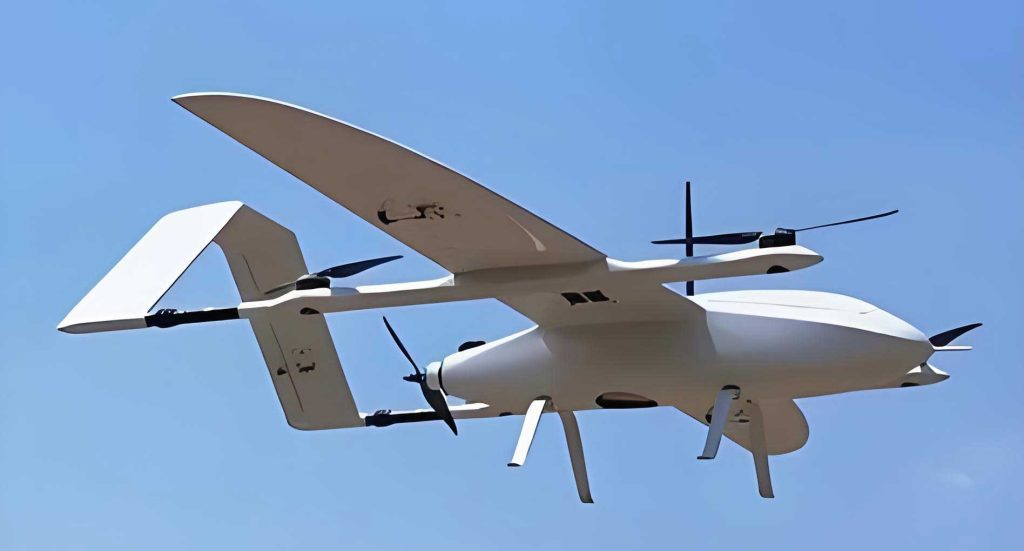
The direct-drive hybrid power system was then integrated into a modified composite-wing VTOL drone for flight testing. The drone has a takeoff mass of 18 kg and is equipped with the hybrid system, including the ICE-generator unit, battery, and control electronics. Flight tests focused on vertical maneuvers: takeoff, hover, and landing. With 1 L of fuel, the VTOL drone achieved a vertical maneuver time of 25 minutes, far exceeding the typical 5-minute limit of battery-only systems. During tests, all subsystems operated normally, and the power output remained stable, demonstrating the system’s ability to overcome the short vertical maneuver time inherent in traditional VTOL drones. The flight data corroborated ground test predictions, showing that the ICE could sustain generator power to meet lift demands, with the battery handling transient peaks. This successful verification underscores the practicality of our design for enhancing VTOL drone endurance and operational flexibility.
In conclusion, our work presents a holistic methodology for verifying and modeling a direct-drive hybrid power system for VTOL drones. The system topology leverages gasoline-electric hybridization to extend vertical maneuver times, addressing a key limitation in composite-wing VTOL drones. Through ground-based experimentation, we characterized steady-state and dynamic behaviors, deriving mathematical models that accurately represent the system. Validation via simulation and flight tests confirms the design’s effectiveness, with the VTOL drone achieving over 25 minutes of vertical operation. Future work will focus on optimizing energy management strategies and expanding the system to larger VTOL drones. This research contributes to the advancement of hybrid propulsion technologies for unmanned aerial vehicles, paving the way for more capable and versatile VTOL drones in diverse missions.