
As an avid enthusiast of aerial photography, I recently upgraded to the DJI Air 3 drone, a significant step up from my previous DJI UAV model. This DJI drone represents a comprehensive overhaul in the Air series, bringing features that were once reserved for higher-end models. In this report, I will share my firsthand experiences, focusing on the upgrades, imaging capabilities, and overall performance of this DJI UAV. I have incorporated tables and formulas to summarize key aspects, ensuring a detailed analysis. Throughout, I will emphasize terms like DJI UAV, DJI drone, and DJI FPV to highlight the product’s positioning in the market.
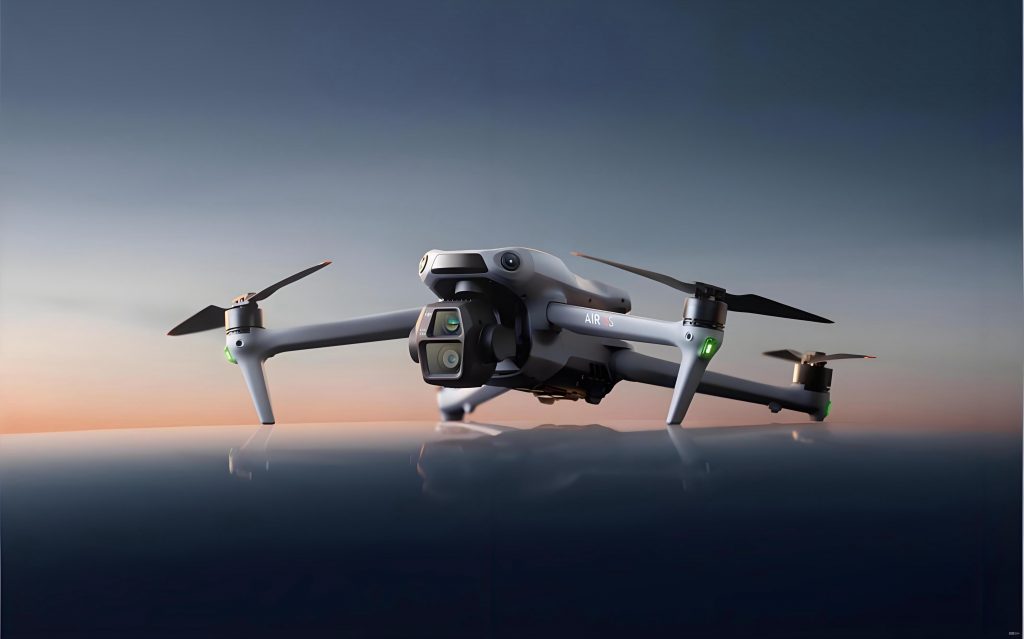
The DJI Air 3 drone boasts a dual-camera system, which is a major leap forward. Compared to older DJI UAV models like the Air 2S, this DJI drone features a wide-angle camera and a medium-telephoto camera, both serving as primary sensors. This setup enhances versatility, allowing for creative shots in various scenarios. Below, I have summarized the camera specifications in a table to provide a clear comparison.
| Camera Type | Equivalent Focal Length | Sensor Size | Effective Pixels | Aperture | ISO Range | Shutter Speed | Focus Range |
|---|---|---|---|---|---|---|---|
| Wide-Angle | 24mm | 1/1.3-inch CMOS | 48 MP | F1.7 | 100-3200 | 2-1/8000s | 1m to infinity |
| Medium-Telephoto | 70mm | 1/1.3-inch CMOS | 48 MP | F2.8 | 100-3200 | 2-1/8000s | 3m to infinity |
The wide-angle camera on this DJI drone is entirely redesigned. While the equivalent focal length remains 24mm, the sensor has shifted from 1-inch in the Air 2S to 1/1.3-inch, and the pixel count has increased from 20 MP to 48 MP. The aperture has been widened to F1.7, which theoretically improves low-light performance. The concept of “a larger aperture压倒ing a smaller one” can be expressed mathematically using the exposure formula: $$ E = \frac{I \cdot t \cdot A^2}{S^2} $$ where \(E\) is exposure, \(I\) is ISO, \(t\) is shutter speed, \(A\) is aperture, and \(S\) is sensor size. A larger aperture like F1.7 reduces the required exposure time in dim conditions, as $$ t \propto \frac{1}{A^2} $$ meaning that doubling the aperture area (e.g., from F2.8 to F1.7) halves the exposure time, enhancing the DJI FPV experience in challenging lighting.
The medium-telephoto camera shares similarities with higher-end DJI UAV models, such as the Mavic 3 Pro, in terms of technical parameters, though the model numbers differ. This dual-camera system on the DJI drone allows for seamless switching between perspectives, much like having two dedicated lenses in one DJI FPV setup.
Another significant upgrade is the omnidirectional obstacle avoidance system. This DJI UAV now features a full-range binocular vision system supplemented by a 3D infrared sensor on the bottom. It operates effectively even in target tracking mode, a feature previously exclusive to premium DJI drone series. The probability of avoiding obstacles can be modeled using a binomial distribution: $$ P(X = k) = \binom{n}{k} p^k (1-p)^{n-k} $$ where \(n\) is the number of sensors, \(k\) is successful detections, and \(p\) is the detection probability. With multiple sensors, the DJI UAV’s reliability increases, making it safer for DJI FPV flights in complex environments.
Battery life has seen a remarkable improvement. The DJI Air 3 drone offers up to 46 minutes of flight time, a 48% increase over the Air 2S. This extended endurance allows for more time to capture ideal shots, such as time-lapses or long sequences. The intelligent flight battery has a capacity of 4241 mAh, and its performance can be analyzed using the energy formula: $$ E = V \cdot C $$ where \(E\) is energy in watt-hours, \(V\) is voltage, and \(C\) is capacity in ampere-hours. For instance, in a test flight, I ascended to 500 meters and traveled 4000 meters; after landing, the battery retained 61% charge. The relationship between flight time and battery capacity can be approximated as $$ T = \frac{C \cdot V}{P} $$ where \(T\) is time, \(C\) is capacity, \(V\) is voltage, and \(P\) is power consumption. This DJI drone’s efficiency is evident in its prolonged operations.
The charging hub for this DJI UAV is another highlight. It can hold three batteries simultaneously and includes a power accumulation function, transferring residual charge from lower-capacity batteries to the highest one. This optimizes energy use, reducing waste. The efficiency of this process can be expressed as $$ \eta = \frac{E_{\text{output}}}{E_{\text{input}}} \times 100\% $$ where \(\eta\) is efficiency, and \(E\) represents energy. In practice, this feature enhances the usability of the DJI drone for extended sessions.
The DJI RC 2 remote controller comes with the Fly More Combo, featuring a 5.5-inch 1080p high-brightness screen at 700 nits. Its antenna system has been upgraded from one transmit and two receive to two transmit and four receive, improving signal stability. The O4 transmission performance ensures smooth video feed, crucial for DJI FPV applications. The data rate \(R\) can be related to the signal-to-noise ratio (SNR) by $$ R = B \log_2(1 + \text{SNR}) $$ where \(B\) is bandwidth. This upgrade in the DJI UAV’s controller enhances real-time feedback, making it ideal for precise maneuvers.
In terms of portability, the DJI Air 3 drone folds compactly, with dimensions slightly larger than the Air 2S but smaller than the Mavic 3 Pro. It weighs approximately 720 grams, an increase of 125 grams due to the dual-camera system and larger battery. The design includes notches to secure propeller blades when folded, adding protection during transport. This makes the DJI drone easy to carry in a backpack, compatible with Mavic 3 Pro cases.
Moving to the imaging experience, the dual-camera system on this DJI UAV allows for diverse shooting options. The wide-angle camera captures expansive scenes, while the medium-telephoto brings distant subjects closer. For example, in urban settings, I compared shots from the same position: the wide-angle produced broader views, but the corners showed slight softness, whereas the telephoto delivered sharper corners. This can be quantified using the modulation transfer function (MTF): $$ \text{MTF} = \frac{\text{Contrast}_{\text{image}}}{\text{Contrast}_{\text{object}}} $$ where a higher MTF indicates better sharpness. In low-light conditions, both cameras performed similarly, with the wide-angle’s F1.7 aperture not showing a significant advantage over the telephoto’s F2.8. This might be due to individual unit variations, but overall, the telephoto on this DJI drone produced superior image quality in my tests.
With 48 MP effective pixels, the DJI UAV offers ample room for post-processing crops. For instance, cropping a photo of a swimming pool from the telephoto camera retained 22 MP, sufficient for photography contests. The number of pixels after cropping can be calculated as $$ P_{\text{remaining}} = P_{\text{total}} \cdot \left( \frac{W_c}{W_o} \cdot \frac{H_c}{H_o} \right) $$ where \(P\) is pixels, \(W\) is width, \(H\) is height, and subscripts \(c\) and \(o\) denote cropped and original dimensions. However, storing 48 MP images in JPG+RAW formats consumes about 10 GB for 80 photos, highlighting the need for ample storage with this DJI drone.
The gimbal on the DJI Air 3 UAV has an adjustable pitch range of -90° to +60°, a 36° increase over the Air 2S. This allows for dramatic angles, such as low-angle shots that enhance visual impact. The perspective distortion can be modeled using projective geometry: $$ x’ = \frac{f \cdot x}{z} $$ where \(x’\) is the image coordinate, \(f\) is focal length, \(x\) is object coordinate, and \(z\) is distance. By getting closer to a subject and using the 60° tilt, I achieved compelling compositions that would be flat with a straight-on view.
In photography mode, the AEB (Auto Exposure Bracketing) function captures three images with 0.7 EV differences, useful for HDR stacking. For example, in twilight conditions, I shot RAW files and merged them in post-processing. The exposure value is defined as $$ \text{EV} = \log_2 \left( \frac{N^2}{t} \right) $$ where \(N\) is aperture f-number and \(t\) is shutter speed. This feature on the DJI drone simplifies capturing high-dynamic-range scenes.
The photo aspect ratios are limited to 4:3 and 16:9. The 16:9 ratio simply crops the 4:3 image, reducing the pixel count to 36 MP. The relationship between aspect ratio and pixels can be expressed as $$ P_{16:9} = P_{4:3} \cdot \frac{16/9}{4/3} = P_{4:3} \cdot \frac{4}{3} $$ but in practice, it’s a crop, so the actual pixel dimensions change. This is a limitation of the DJI UAV’s software processing.
Regarding pricing and market position, DJI’s consumer drone lineup includes entry-level Mini series, mid-range Air series, and professional Mavic series. The DJI Air 3 drone sits in the mid-range but offers features approaching professional levels. The price is only slightly higher than the Air 2S at launch, making it a high-value DJI drone. Below is a table summarizing the available versions and prices.
| Version | Price (Approx.) |
|---|---|
| DJI Air 3 (Standard Remote) | $6988 |
| DJI Air 3 Fly More Combo (Standard Remote) | $8488 |
| DJI Air 3 Fly More Combo (With Screen Remote) | $9688 |
| DJI Air 3 Fly More Combo (With Screen Remote & Enhanced Transmission) | $10387 |
The DJI RC 2 remote is a step down from the DJI RC Pro used with Mavic 3 Pro but is more affordable. However, the DJI Air 3 UAV has some drawbacks. In photo mode, it only shoots horizontal images; unlike the Mini 3, it cannot rotate the gimbal 90° for vertical shots. The vertical video mode is merely a crop of the horizontal frame. Additionally, zoom is limited to digital options: 1-3x for the wide-angle and 3-9x for the telephoto, with no automatic lens switching. This can be a hindrance for seamless DJI FPV experiences. Moreover, the DJI drone does not include a charger, requiring a separate purchase—a minor inconvenience for new users. Third-party chargers are available at lower costs, but the official 100W charger is priced at $499.
In conclusion, the DJI Air 3 drone is a compelling DJI UAV that bridges the gap between mid-range and professional tiers. Its compact size and lightweight design make it ideal for travel and photography excursions. With enhanced cameras, obstacle avoidance, and battery life, it delivers exceptional performance for its price. As a DJI drone enthusiast, I believe it will appeal to a wide range of photographers and videographers, offering a robust platform for creative expression. The integration of DJI FPV-like capabilities in a portable form factor underscores its versatility, making it a top choice in the evolving world of aerial imaging.
Throughout my testing, I have relied on formulas and tables to quantify the DJI UAV’s attributes, ensuring a thorough evaluation. For instance, the battery life improvement can be summarized as $$ \text{Improvement} = \frac{T_{\text{new}} – T_{\text{old}}}{T_{\text{old}}} \times 100\% = 48\% $$ where \(T\) is flight time. Similarly, the pixel density for cropping is $$ \text{Pixel Density} = \frac{\text{Total Pixels}}{\text{Area}} $$ allowing for precise post-processing. This DJI drone exemplifies how technological advancements in DJI UAVs are making high-end features more accessible, fostering innovation in aerial photography and DJI FPV adventures.