
The evolution of modern urban landscapes, characterized by dense clusters of high-rise and super-tall structures, presents unprecedented challenges for firefighting and emergency response. Traditional firefighting methodologies, reliant on ground-based apparatus and human ingress, often reach their operational limits when confronting blazes dozens of stories above ground level. The limitations of aerial ladder trucks and the immense risks to firefighter safety in such complex, volatile environments necessitate a paradigm shift in tactical approach. In this context, the integration of Unmanned Aerial Vehicles (UAVs), specifically engineered for firefighting—hereafter referred to as fire UAV systems—emerges as a critical technological frontier. This article, from my perspective as an analyst in this field, delves into the architecture, operational rationale, and multifaceted applications of fire UAV platforms in revolutionizing high-rise rescue operations.
A fire UAV is fundamentally an unmanned aircraft system, but one meticulously designed for the harsh demands of fireground operations. Its value proposition lies in overcoming the inherent limitations of human responders in extreme environments. The core system integration can be summarized by the following functional architecture:
| System Module | Core Components & Technologies | Primary Function in Firefighting |
|---|---|---|
| Airframe & Platform | Carbon-fiber composites, heat-resistant materials, multi-rotor/eVTOL configurations. | Provides stable, maneuverable flight in turbulent, high-temperature air currents near structures. |
| Flight Control & Navigation | Integrated GNSS (GPS/BeiDou), IMU, obstacle avoidance sensors, autonomous flight algorithms. | Enables precise positioning, stable hovering at target windows/floors, and automated patrol routes. |
| Power & Propulsion | High-capacity lithium-polymer/solid-state batteries, gas-electric hybrids, fault-tolerant motor systems. | Delivers extended flight endurance and sufficient thrust for payload carriage (water, equipment). |
| Data Link & Communication | Secure digital radio, 4G/5G mesh networks, dual-frequency video transmission. | Ensures real-time, low-latency telemetry, HD video feed, and command/control signal integrity. |
| Mission Payload | Gimbal-stabilized EO/IR cameras, multi-gas sensors, loudspeakers, payload release mechanisms. | Executes core missions: reconnaissance, detection, communication, and direct intervention. |
| Ground Control Station (GCS) | Portable consoles with video monitors, data fusion software, mission planning interfaces. | Serves as the command hub for piloting, data analysis, and strategic decision-making. |
The operational advantage of a fire UAV is not merely in replacing a human but in creating a persistent, intelligent sensory and intervention node in the fourth dimension—the airspace surrounding an incident. The technical rationale for its adoption is compelling and multi-faceted.
The Imperative for Technological Intervention
The drive towards adopting fire UAV technology stems from a confluence of persistent challenges and technological maturation.
1. The Intractable Problem of High-Rise Fires
High-rise building fires represent a “world-class challenge” due to vertical fire spread, stack effect, complex egress, and limited external access. The effective reach of the world’s most advanced aerial platforms rarely exceeds 60-80 meters for water discharge, leaving a vast portion of modern skyscrapers beyond direct external attack. Internal firefighting is perilously slow and hazardous. The potential energy contained in a high-rise incident can be conceptualized as a function of height, fuel load, and ventilation:
$$ E_{fire} \propto \int_{0}^{H} (q_{f}(z) \cdot A_{f}(z) \cdot \Delta T(z)) \, dz $$
where \( E_{fire} \) is the relative fire energy potential, \( H \) is the building height, \( q_{f}(z) \) is the fuel load density at height \( z \), \( A_{f}(z) \) is the floor area involved, and \( \Delta T(z) \) is the temperature differential driving the stack effect. This equation highlights how risk escalates with height, demanding a response system that operates effectively across the entire vertical profile.
2. Limitations of Human Responders
Firefighters operate at the physical and cognitive limits of human endurance. Exposure to extreme heat, toxic smoke, structural instability, and psychological stress leads to unavoidable risks. The integration of a fire UAV creates a force-multiplier effect, acting as a forward-deployed scout and tool-bearer that reduces the “time-to-knowledge” and “time-to-action” for ground teams, thereby enhancing both effectiveness and safety. The risk mitigation can be modeled as a reduction in the exposure integral for personnel:
$$ R_{reduction} = \int_{t_{0}}^{t_{f}} ( \lambda_{hazard}(t) – \lambda_{UAV}(t) ) \, dt $$
Here, \( R_{reduction} \) is the cumulative risk reduction, \( \lambda_{hazard}(t) \) is the time-varying hazard intensity a human would face, and \( \lambda_{UAV}(t) \) is the lower hazard faced by the fire UAV performing initial reconnaissance.
3. Convergence of Enabling Technologies
The feasibility of robust fire UAV systems is underpinned by advancements in adjacent fields: lightweight composite materials, high-energy-density batteries, miniaturized sensors, machine vision, and crucially, high-bandwidth/low-latency communications like 5G. This ecosystem enables the reliable, real-time operation of complex unmanned systems in mission-critical scenarios.
Core Functional Applications of Fire UAVs in High-Rise Operations
The utility of a fire UAV in high-rise emergency response is not singular but spans a continuum from intelligence gathering to direct action.
1. Advanced Situational Awareness & Reconnaissance
This is the foundational application. A fire UAV, equipped with a dual electro-optical (EO) and thermal infrared (IR) camera, provides an immediate “eye in the sky.” It can safely approach a burning floor, peer through windows obscured by smoke, and map the thermal profile of the structure. Key reconnaissance parameters include:
– Fire Origin & Spread: Identifying the seat of the fire and tracking its horizontal and vertical progression via thermal imaging.
– Structural Integrity: Monitoring for signs of impending collapse (e.g., heated steel beams) invisible to the naked eye.
– Victim Location: Using IR sensors to detect human heat signatures behind smoke or windows.
The data collected transforms decision-making from assumption-based to evidence-based.
2. Persistent Monitoring and Command Support
Beyond initial scouting, a fire UAV can maintain a fixed observational position, providing a live, panoramic feed to incident command. This enables:
– Real-time assessment of tactical effectiveness (e.g., water stream impact).
– Monitoring of changing conditions like wind direction, flashover potential, or secondary ignitions.
– Creating a common operational picture for all responding units.
The effective data throughput required for command-quality video can be expressed as:
$$ C = n \cdot (R_{vid} + R_{tele}) $$
where \( C \) is the total channel capacity needed, \( n \) is the number of simultaneous fire UAV feeds, \( R_{vid} \) is the bitrate for HD/4K video (with compression), and \( R_{tele} \) is the bitrate for telemetry and sensor data. 5G networks are pivotal in satisfying this demand.
3. Direct Auxiliary Rescue & Intervention
This is where the fire UAV transitions from a sensor platform to an active intervention tool. Capabilities are rapidly evolving:
– Communication Relay: Deploying a UAV as an airborne communication node to boost radio signals within the steel-and-concrete building, which often acts as a Faraday cage.
– Loudspeaker & Guidance: Using an onboard loudspeaker to deliver calm instructions to trapped occupants, guiding them to safer areas or instructing them on how to signal rescuers.
– Light Payload Delivery: Transporting critical survival equipment—such as compact breathing apparatus, water, radios, or thermal blankets—to trapped individuals on inaccessible balconies or roofs.
– Aerial Rope Deployment: For scenarios where rooftop rescue is impossible, a heavy-lift fire UAV could potentially deploy and tension an initial rescue line between buildings for horizontal evacuation.
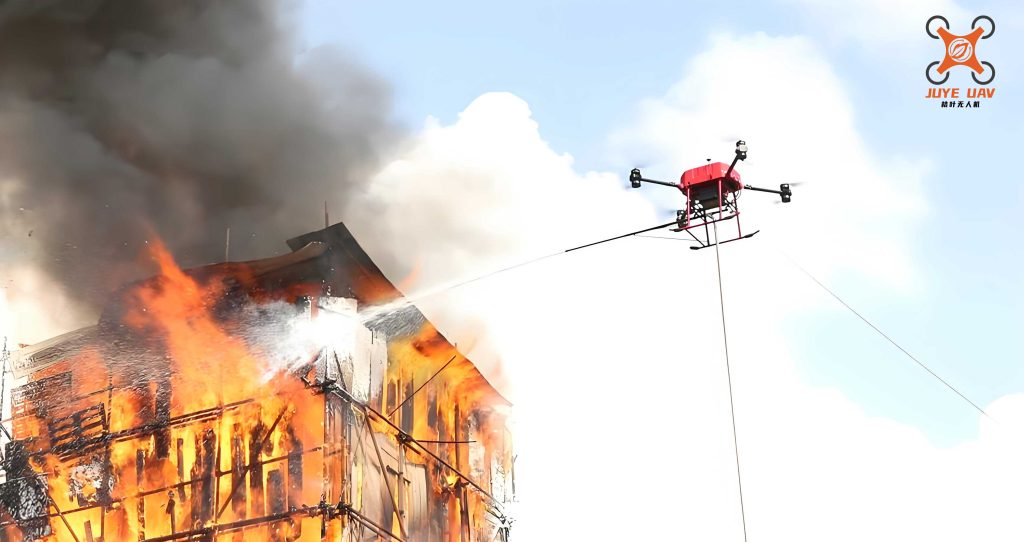
– Targeted Suppression & Access: The most technologically advanced concept involves fire UAV platforms equipped with specialized agents. They could use compact, kinetic “break-and-entry” projectiles to shatter a specific window, followed by the precise discharge of a fire-suppressant (e.g., compressed air foam, dry chemical, or phase-change coolants) directly into the compartment of origin. This targeted, external application tackles the fire at its early stage in locations unreachable by traditional means.
| Intervention Type | Payload Example | Technical Challenge | Potential Impact |
|---|---|---|---|
| Emergency Supply Drop | EPIRB, smoke hood, water bottle | Precision hover & release in windy conditions | Sustains life until rescue |
| Precision Breach & Attack | Kinetic penetrator + micro-encapsulated extinguisher | Stability during recoil, agent mixing & dispersal physics | Rapid, localized fire knockdown |
| Aerial Hose Deployment | High-pressure micro-hose reel & nozzle | Managing reaction forces, hose management | Provides direct external attack vector |
4. Automated Inspection and Atmospheric Monitoring
A fire UAV can be integrated into a larger smart city framework for prevention and post-incident analysis:
– Pre-fire Risk Assessment: Automated, periodic inspections of building facades, identifying compromised fire barriers or hazardous material storage.
– Post-fire Structural Survey: Safely mapping damage and identifying stability hazards for engineers.
– Hazardous Atmosphere Analysis: Flying a pre-programmed grid pattern while equipped with a multi-gas detector (e.g., for CO, HCN, VOC, O₂) and particulate sensors. This creates a 3D contaminant plume model, essential for predicting gas spread and ensuring responder safety. The concentration \( C(x,y,z,t) \) of a toxic gas can be sampled discretely by the UAV and modeled.
Pathways for Advancement and Integration
For the full potential of fire UAV technology to be realized in high-rise firefighting, a coordinated strategy encompassing development, training, and regulation is essential.
1. Dedicated Platform Development: The market needs purpose-built fire UAV designs, not repurposed commercial units. Key focus areas include:
– Enhanced thermal resilience for airframes and electronics.
– Sealed systems for operation in heavy rain and smoke.
– Standardized, quick-swap payload interfaces.
– Advanced autonomy for navigation in GPS-denied, smoky environments using LiDAR or visual SLAM.
2. Tactical Integration & Training: The fire UAV must be woven into standard operating procedures (SOPs). This requires:
– Developing doctrine for single and multi-UAV operations at major incidents.
– Intensive training for pilot/operators, focusing on flight skills under stress and data interpretation.
– Joint exercises with aerial ladder and interior fire attack teams to deconflict airspace and synchronize actions.
3. Regulatory and Logistical Framework: Safe and legal operation in urban airspace is paramount:
– Establishing pre-approved emergency flight corridors and protocols with local aviation authorities.
– Developing secure, jam-resistant C2 data links to prevent malicious interference.
– Creating robust maintenance and logistics chains to ensure fleet readiness.
Conclusion
The integration of Unmanned Aerial Vehicles into high-rise firefighting and rescue represents a transformative leap forward. The fire UAV is more than a simple tool; it is a scalable, intelligent system that extends the senses and capabilities of the fire service into previously inaccessible and lethally dangerous zones. By providing real-time, bird’s-eye-view intelligence, enabling new forms of communication and supply, and paving the way for novel external attack methods, these systems directly address the core challenges of vertical firefighting. The trajectory is clear: from a supportive reconnaissance asset, the fire UAV is evolving into an integral, active component of the fireground arsenal. Its continued development and thoughtful integration hold the promise of significantly reducing responder risk, improving operational efficiency, and ultimately saving more lives and property in the complex vertical cities of the 21st century. The future of high-rise rescue is not just on the ground or at the end of a ladder—it is increasingly in the dynamic, responsive airspace managed by advanced fire UAV systems.