
In recent years, the application of UAV drones has become increasingly widespread in fields such as aerial photography, drone performances, power line inspections, agricultural plant protection, forest firefighting, and emergency rescue. As UAV drones undertake long-distance flight missions, factors like Earth’s curvature, obstacle blockage, and environmental conditions necessitate the use of relay devices. These relay devices, serving as a critical component of UAV drone communication systems, are responsible for receiving and forwarding various signals, including images, voice, and data, enabling communication with ground control stations or other UAV drones via radio signals. The performance of these relay devices directly impacts the operation of the entire UAV drone system. However, with the extensive deployment of UAV drone relay equipment, interference issues with the radio spectrum have become increasingly prominent. This article delves into the interference problems caused by UAV drone relay devices, presenting a detailed analysis, case study, and recommendations for mitigation.
UAV drones rely on radio frequencies for command, control, and data transmission. The relay devices amplify and retransmit signals to extend operational range. The fundamental principle involves receiving weak signals from UAV drones, processing them, and transmitting them at higher power. This process can inadvertently cause harmful interference to other licensed services, such as satellite Earth exploration services, if operating in unauthorized frequency bands. The interference scenario often arises when UAV drone relay devices use frequencies outside the allocated bands, leading to conflicts with sensitive systems like satellite receivers.
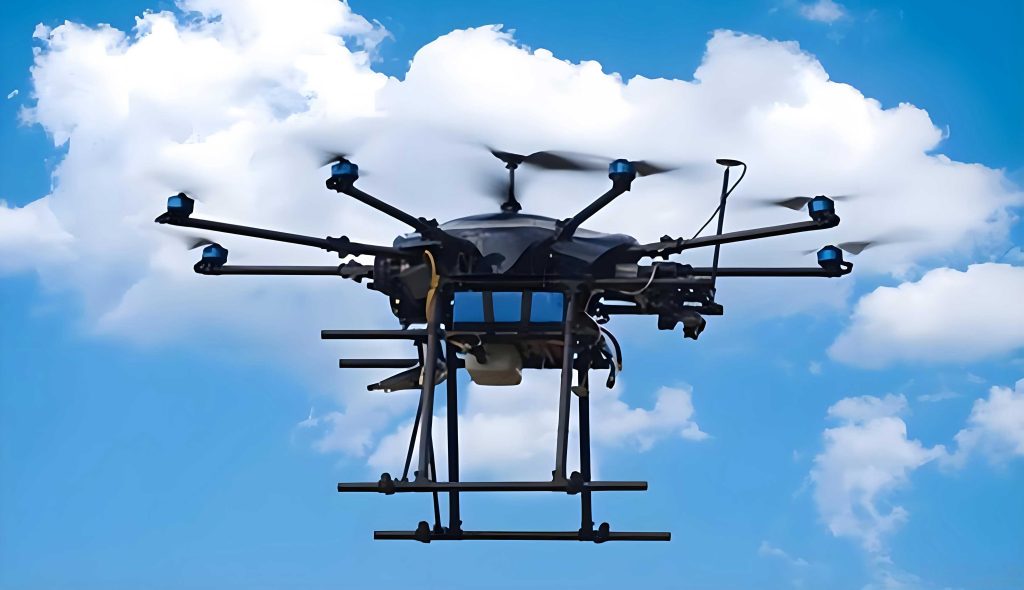
To understand the interference mechanism, consider a simplified model. Let the transmitted signal power from a UAV drone relay device be \( P_t \), and the gain of its antenna be \( G_t \). The effective isotropic radiated power (EIRP) is given by:
$$ \text{EIRP} = P_t \cdot G_t $$
At a distance \( d \) from the transmitter, the received power \( P_r \) at a victim receiver (e.g., a satellite Earth station) can be approximated using the free-space path loss model:
$$ P_r = \frac{P_t G_t G_r \lambda^2}{(4\pi d)^2} $$
where \( G_r \) is the gain of the victim receiver antenna, and \( \lambda \) is the wavelength of the signal. If \( P_r \) exceeds the noise floor of the victim system, it can cause degradation or complete disruption of the intended signals. For satellite services operating in bands like 1400-1427 MHz, even low-power interference from UAV drone relays can be detrimental due to the high sensitivity of satellite receivers.
A notable interference incident involved a UAV drone relay device operating in the 1396-1416 MHz band, which interfered with satellite Earth exploration services in the 1400-1427 MHz band. The interference was detected through complaints from regulatory bodies, prompting an investigation. Radio monitoring teams used mobile monitoring vehicles and spectrum analyzers to locate the source. The process involved measuring signal strength and direction, culminating in the identification of a relay device installed on a high-rise building. Subsequent tests confirmed the device as the source, and it was shut down, eliminating the interference. This case highlights the challenges in managing UAV drone spectrum usage.
The interference detection process relies on spectrum analysis. Let \( S(f) \) represent the power spectral density of the received signal. The interference signal \( I(f) \) appears as a peak above the noise floor \( N(f) \). The signal-to-interference-plus-noise ratio (SINR) for the victim receiver is:
$$ \text{SINR} = \frac{P_s}{P_i + N} $$
where \( P_s \) is the desired signal power, \( P_i \) is the interference power from the UAV drone relay, and \( N \) is the noise power. When SINR falls below a threshold \( \gamma \), communication quality degrades. For satellite services, \( \gamma \) is often stringent, making them vulnerable to interference from UAV drones.
To mitigate such issues, a comprehensive approach to UAV drone communication system management is essential. Below is a table summarizing key problems identified in current practices and proposed solutions:
| Problem Area | Description | Proposed Solution |
|---|---|---|
| Frequency Band Misuse | UAV drone relay devices operating outside allocated bands (e.g., 1396-1416 MHz vs. authorized 1430-1444 MHz, 2400-2476 MHz, 5725-5829 MHz). | Enforce strict adherence to national frequency allocations; conduct regular spectrum monitoring. |
| Device Proliferation and Sales | Diverse UAV drones sold via e-commerce platforms with lax regulatory oversight, leading to unapproved devices. | Strengthen type approval and sales备案 management for UAV drone radio transmission equipment. |
| Regulatory Blind Spots | Infrequent monitoring of less-used bands, allowing illegal occupancy until complaints arise. | Implement proactive spectrum surveillance programs targeting all bands, especially those vulnerable to UAV drone interference. |
| Awareness and Education | Users unaware of radio regulations and the harms of frequency abuse, resulting in recurrent interference. | Enhance宣传 campaigns on UAV drone radio management policies, targeting key industries like power, water, agriculture, emergency, and firefighting. |
From a technical perspective, the interference potential of UAV drone relays can be quantified using interference metrics. Consider a scenario with multiple UAV drones operating simultaneously. The aggregate interference power \( I_{\text{total}} \) at a victim receiver is the sum of individual contributions:
$$ I_{\text{total}} = \sum_{k=1}^{N} P_{r,k} $$
where \( N \) is the number of interfering UAV drone relays, and \( P_{r,k} \) is the received power from the \( k \)-th relay. To ensure compliance, regulatory bodies can set limits on EIRP for UAV drone devices. For instance, in the 1400 MHz band, the maximum permitted EIRP might be defined as \( \text{EIRP}_{\text{max}} \). Devices exceeding this should be flagged. The compliance check is:
$$ \text{EIRP} \leq \text{EIRP}_{\text{max}} $$
If violated, interference becomes likely. Additionally, the frequency stability of UAV drone relays is crucial. Drift in operating frequency \( f_0 \) can cause out-of-band emissions. The frequency error \( \Delta f \) should satisfy:
$$ |\Delta f| \leq f_{\text{tol}} $$
where \( f_{\text{tol}} \) is the tolerance specified by regulations. Non-compliance can lead to interference in adjacent bands.
The management of UAV drone spectrum requires collaboration among stakeholders. Radio regulatory agencies must work with industries deploying UAV drones, such as utilities and emergency services. A coordinated framework can include shared databases of authorized devices and frequencies. Below is a table outlining recommended actions for radio management bodies:
| Action Item | Details | Expected Outcome |
|---|---|---|
| Enhanced Monitoring | Deploy fixed and mobile monitoring stations to scan UAV drone frequency bands continuously; use automated detection algorithms. | Early identification of illegal transmissions from UAV drones, reducing response time. |
| Industry Engagement | Establish communication channels with key UAV drone user sectors (e.g., power, water) to preempt interference risks. | Better awareness of UAV drone deployments, facilitating quick resolution of interference cases. |
| Policy Enforcement | Implement the latest UAV drone radio management regulations, conducting inspections and issuing corrections for violations. | Deterrence against frequency abuse by UAV drone operators, ensuring合规 operation. |
| Public Outreach | Conduct workshops and disseminate materials on UAV drone frequency rules, emphasizing legal consequences. | Increased compliance among UAV drone users, minimizing interference incidents. |
In the context of spectrum efficiency, UAV drone communications must coexist with other services. The capacity \( C \) of a channel affected by interference is given by Shannon’s formula:
$$ C = B \log_2 \left(1 + \frac{P_s}{P_i + N}\right) $$
where \( B \) is the bandwidth. Interference from UAV drone relays reduces \( P_s / (P_i + N) \), thus lowering capacity. To optimize spectrum use, dynamic frequency selection (DFS) can be employed for UAV drones, allowing them to avoid occupied bands. However, this requires intelligent systems that sense the spectrum, which may not be present in all UAV drone models.
The proliferation of UAV drones poses unique challenges due to their mobility and varying operational patterns. A statistical model can describe the probability of interference. Let \( \lambda_{\text{UAV}} \) be the spatial density of UAV drone relays in a region. The probability \( P_{\text{int}} \) that at least one relay causes interference to a victim receiver within range \( R \) is:
$$ P_{\text{int}} = 1 – e^{-\lambda_{\text{UAV}} \pi R^2} $$
This shows that as UAV drone density increases, interference risks grow exponentially. Hence, regulating the deployment density of UAV drones in sensitive areas is crucial.
Furthermore, the technical specifications of UAV drone relay devices need standardization. Parameters such as output power, modulation scheme, and spurious emissions should be capped. For example, the spurious emission level \( L_{\text{spur}} \) in dBm should satisfy:
$$ L_{\text{spur}} \leq -40 \text{ dBm} \quad \text{for frequencies outside the allocated band} $$
Non-compliance can lead to out-of-band interference, affecting services like satellite Earth exploration. Regular testing of UAV drone equipment against these standards is essential.
To address the sales channel issue, a lifecycle approach to UAV drone management is proposed. From manufacturing to decommissioning, each stage should involve regulatory checks. The table below summarizes key stages and controls:
| Lifecycle Stage | Regulatory Control | Impact on Interference Reduction |
|---|---|---|
| Design and Manufacturing | Type approval for radio transmission equipment; ensure frequencies are within authorized bands for UAV drones. | Prevents non-compliant UAV drones from entering the market, reducing源头 interference risks. |
| Import and Sales | Mandatory sales备案; verification of device specifications against approved models. | Limits circulation of illegal UAV drone devices, easing monitoring efforts. |
| Deployment and Operation | Licensing or registration for UAV drone systems; periodic inspections of relay installations. | Ensures operational UAV drones adhere to frequency plans, minimizing on-site interference. |
| End-of-Life | Proper disposal procedures to prevent reuse of non-compliant UAV drone equipment. | Avoids legacy devices from causing interference after decommissioning. |
In practice, radio monitoring teams use direction-finding techniques to locate interfering UAV drone relays. The process involves measuring the angle of arrival (AoA) of signals. Using multiple monitoring points, the location \( (x, y) \) of the source can be triangulated. If the AoA from two stations are \( \theta_1 \) and \( \theta_2 \), and their positions are \( (x_1, y_1) \) and \( (x_2, y_2) \), the intersection gives the source location. Mathematically, for station 1:
$$ \tan \theta_1 = \frac{y – y_1}{x – x_1} $$
Similarly for station 2. Solving these equations yields \( x \) and \( y \). This method is effective in urban areas where UAV drone relays may be hidden among buildings.
The economic impact of interference from UAV drones cannot be overlooked. Satellite services, for instance, support critical applications like weather forecasting, environmental monitoring, and disaster management. Interruption due to UAV drone interference can lead to financial losses and safety risks. Therefore, investing in robust monitoring infrastructure is justified. The cost-benefit analysis can be modeled as:
$$ \text{Net Benefit} = \sum_{t=0}^{T} \frac{B_t – C_t}{(1 + r)^t} $$
where \( B_t \) are the benefits from avoided interference incidents due to UAV drone regulations, \( C_t \) are the costs of implementation, \( r \) is the discount rate, and \( T \) is the time horizon. Typically, \( B_t \) outweighs \( C_t \) when considering the high value of protected services.
Looking ahead, the integration of artificial intelligence (AI) in spectrum management holds promise for UAV drone interference mitigation. AI algorithms can analyze spectrum data in real-time, identifying patterns associated with illegal UAV drone transmissions. Machine learning models can predict interference hotspots based on historical data of UAV drone activities. For example, a classification model can distinguish between authorized and unauthorized UAV drone signals using features like modulation type and bandwidth.
In conclusion, the rise of UAV drones brings immense benefits but also spectrum challenges. UAV drone relay devices, while essential for extending communication range, can cause harmful interference if not properly regulated. Through a combination of strict type approval, proactive monitoring, industry collaboration, and public education, radio management agencies can mitigate these issues. The key is to embrace a holistic approach that covers the entire lifecycle of UAV drone systems. By doing so, we can ensure that UAV drones continue to innovate and serve society without compromising the integrity of the radio spectrum.
To reiterate, UAV drones are here to stay, and their proliferation will only increase. Therefore, continuous adaptation of regulatory frameworks is necessary. Formulas and models, as discussed, provide a scientific basis for decision-making. Tables help summarize complex policies into actionable items. Ultimately, the goal is to foster a harmonious radio environment where UAV drones and other services coexist efficiently. Let us work together to achieve this balance, leveraging technology and regulation to harness the full potential of UAV drones while safeguarding critical communications.