
Our company operates a photovoltaic power station with a total installed capacity of 80 MWp, consisting of three major station areas A, B, and C with capacities of 30 MWp, 10 MWp, and 40 MWp, respectively. The station comprises more than 8,136 photovoltaic support structures and over 200 photovoltaic modules. Traditional manual inspection is inefficient and prone to human error, resulting in missed defects. To address these challenges, we have adopted an intelligent, digital inspection system based on UAV drone technology. This paper presents our experience in applying UAV drone-based intelligent inspection for health diagnosis of photovoltaic modules, covering equipment selection, algorithm choice, application strategies, and performance evaluation.
Introduction
Photovoltaic module health diagnosis is critical for maintaining system efficiency and extending asset life. Conventional manual inspection methods are time-consuming, labor-intensive, and often miss subtle defects such as hot spots, micro-cracks, or PID effects. The use of a UAV drone equipped with advanced sensing and intelligent algorithms offers a transformative solution. In our project, we deployed a DJI M30T rotor-wing UAV drone, which integrates a wide-angle camera, a zoom camera, a thermal imaging camera, and a laser range finder. This platform enables comprehensive, high-resolution inspection of large-scale photovoltaic arrays. However, the effectiveness of UAV drone inspection heavily depends on proper flight parameter design, image processing, and defect recognition algorithms. In the following sections, we describe our methodology and results.
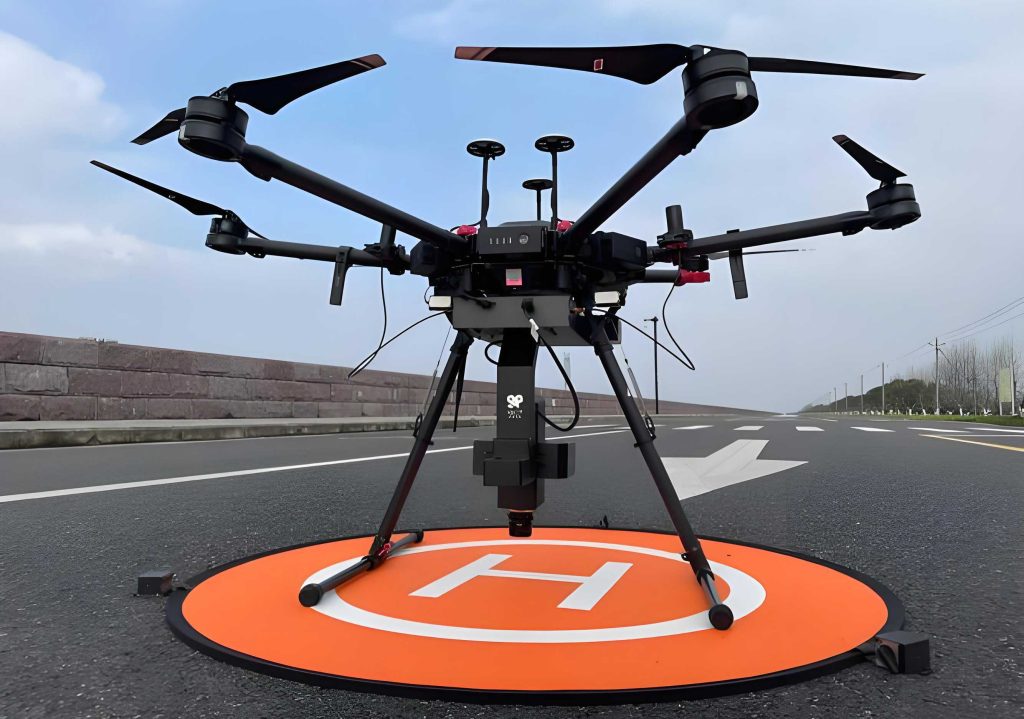
Equipment Selection and Dynamic Modeling
Choosing the right UAV drone platform is the first step. The DJI M30T we selected is a quadrotor UAV drone with a robust camera payload. To maximize inspection coverage and accuracy, we constructed a dynamic model for the quadrotor UAV drone. The relationship between linear motion and velocity is given by:
$$ \dot{\mathbf{p}} = \mathbf{R} \mathbf{v}_b $$
where \(\dot{\mathbf{p}}\) is the time derivative of the position vector in the world coordinate system, \(\mathbf{R}\) is the rotation matrix from the body coordinate system to the world coordinate system, and \(\mathbf{v}_b\) is the velocity vector expressed in the body frame. This model allows us to determine optimal flight parameters such as altitude, speed, and camera gimbal angle to ensure full coverage without blind spots.
We also consider the energy constraints of the UAV drone. Each battery set supports approximately 30 minutes of flight. To inspect the entire 80 MWp station, we prepared at least eight battery sets per mission. Environmental temperature affects battery performance, so we schedule flights during moderate weather conditions and plan efficient routes to minimize energy consumption.
Algorithm Selection for Defect Recognition
Photovoltaic modules are made of semiconductor materials (P-type and N-type silicon) that generate electricity through the photovoltaic effect. Under normal operation, the equivalent circuit of a photovoltaic cell is represented by:
$$ I = I_{sc} – I_d \left( \exp\left(\frac{q(V + I R_s)}{n k T}\right) – 1 \right) – \frac{V + I R_s}{R_p} $$
where \(I\) is the load current, \(I_{sc}\) is the photocurrent, \(I_d\) is the reverse saturation current, \(q\) is the electron charge, \(n\) is the diode ideality factor, \(k\) is the Boltzmann constant, \(T\) is the cell temperature, \(V\) is the load voltage, \(R_s\) is the series resistance, and \(R_p\) is the parallel resistance. When defects occur (e.g., shading, cracks, or PID), the cell may become reverse-biased, causing localized heating and hot spots. Thermal infrared imaging captures these temperature anomalies, making it an effective diagnostic tool.
For recognizing defects from thermal images acquired by the UAV drone, we employ a convolutional neural network (CNN) architecture based on YOLOv5. The network consists of convolutional layers, pooling layers, and activation functions. This architecture is well-suited for end-to-end feature extraction, particularly for thermal images where temperature gradients are subtle and edges are blurry. The YOLOv5 structure includes a backbone, neck, and head for object detection. The model is trained on a dataset of annotated thermal images containing common defects such as hot spots, micro-cracks, and PID. The use of this algorithm significantly improves detection accuracy compared to traditional thresholding methods.
Application Strategy of UAV Drone Intelligent Inspection
Our inspection procedure follows three stages: image acquisition, defect identification, and problem resolution.
Image Acquisition
During image acquisition, the UAV drone flies over the photovoltaic array at a predetermined altitude and speed. We calibrate the pixel resolution to convert image distances to real-world measurements. The pixel calibration factor \(k\) is defined as:
$$ k = \frac{l}{p} $$
where \(l\) is the pixel size (in pixels) and \(p\) is the corresponding real-world dimension (in mm). For a typical photovoltaic module measuring 1680×1002×35 mm and a flight altitude of 20 m, the calibration factor varies slightly across the image: 16.03 at the top-left corner, 16.01 at bottom-left, 16.01 at top-right, 16.01 at bottom-right, and 15.51 at the center. These values are used to quantify defect sizes accurately.
Defect Identification
Raw thermal images contain environmental elements and noise. We first manually define the region of interest to exclude background. Then we apply a bilateral filter to reduce noise while preserving edges. The bilateral filter weight is expressed as:
$$ w(x,y) = \exp\left( -\frac{(x-x_0)^2 + (y-y_0)^2}{2\sigma_d^2} \right) \cdot \exp\left( -\frac{(I(x,y)-I(x_0,y_0))^2}{2\sigma_r^2} \right) $$
where \((x_0,y_0)\) is the center pixel, \((x,y)\) is a neighboring pixel, \(I\) is the gray value, \(\sigma_d\) is the spatial standard deviation, and \(\sigma_r\) is the gray standard deviation. After preprocessing, the YOLOv5 model analyzes the thermal image to detect anomalies. In our case, the model identified an abnormal temperature rise caused by a failed bypass diode or an open circuit in the string. This indicates that the module is non-functional and requires replacement.
Problem Resolution
Once a defect is identified, we dispatch maintenance personnel to the exact location. For hot spots due to internal faults, we replace the defective module. For shading or debris, we clean the surface. For micro-cracks, we replace the module to prevent future propagation. This targeted approach minimizes downtime and ensures system reliability.
Performance Evaluation
We compared the traditional manual inspection method with our UAV drone intelligent inspection system. The results are summarized in the following table. The UAV drone system achieved at least 67% improvement in inspection quality and over 80% reduction in inspection time. Detailed accuracy for each defect type is presented below.
| Defect Type | Traditional Inspection Accuracy (%) | UAV Drone Inspection Accuracy (%) |
|---|---|---|
| Hot spot | 87.1 | 93.2 |
| Micro-crack | 81.2 | 90.4 |
| Encapsulation aging | 78.2 | 88.7 |
| PID effect | 87.0 | 92.4 |
| Burnout | 88.3 | 94.5 |
The data clearly demonstrates that the UAV drone intelligent inspection outperforms manual inspection across all defect categories. The improvement is particularly significant for micro-cracks and encapsulation aging, which are difficult to detect visually. However, we also note limitations: the UAV drone’s battery life limits continuous flight to about 30 minutes, requiring multiple battery swaps and careful mission planning. Future work will focus on optimizing flight paths and exploring longer-endurance UAV drone platforms.
Conclusion
We have successfully implemented a UAV drone-based intelligent inspection system for photovoltaic module health diagnosis. By selecting a suitable quadrotor UAV drone, developing a dynamic model, and employing a convolutional neural network (YOLOv5) for thermal image analysis, we achieved high detection accuracy and operational efficiency. Comparative results show that our approach improves inspection quality by at least 67% and reduces inspection time by more than 80%. The system effectively identifies hot spots, micro-cracks, PID, and other defects, enabling timely maintenance and reducing downtime. Despite the battery endurance challenge, the overall benefits justify widespread adoption of UAV drone intelligent inspection in large-scale photovoltaic plants. We recommend that other operators consider integrating UAV drone technology into their maintenance workflows to enhance reliability and profitability.