
As a dedicated observer of defense technology trends, I have witnessed the transformative role of military drones in modern warfare. The events of September 11 and subsequent operations in Afghanistan and Iraq have accelerated the adoption and innovation of unmanned aerial vehicles (UAVs), making them cornerstone assets for the United States military. In this article, I will explore the latest dynamics in U.S. military drone development, focusing on new strategic plans, payload upgrades, technological breakthroughs, and enhanced models. My analysis is based on recent budgetary shifts, research initiatives, and operational feedback, all pointing toward an era where military drones will dominate aerial operations. Throughout this discussion, I will emphasize the term “military drone” to underscore its critical importance in contemporary defense strategies.
The evolution of military drones is not merely about incremental improvements; it represents a paradigm shift in how surveillance, reconnaissance, and combat missions are conducted. From my perspective, the U.S. Department of Defense’s increased investment in drone systems reflects a commitment to maintaining technological superiority. In the following sections, I will delve into specific areas, utilizing tables and formulas to summarize key data and principles. This approach will help elucidate complex concepts, such as endurance calculations and sensor performance metrics, which are vital for understanding the capabilities of modern military drones.
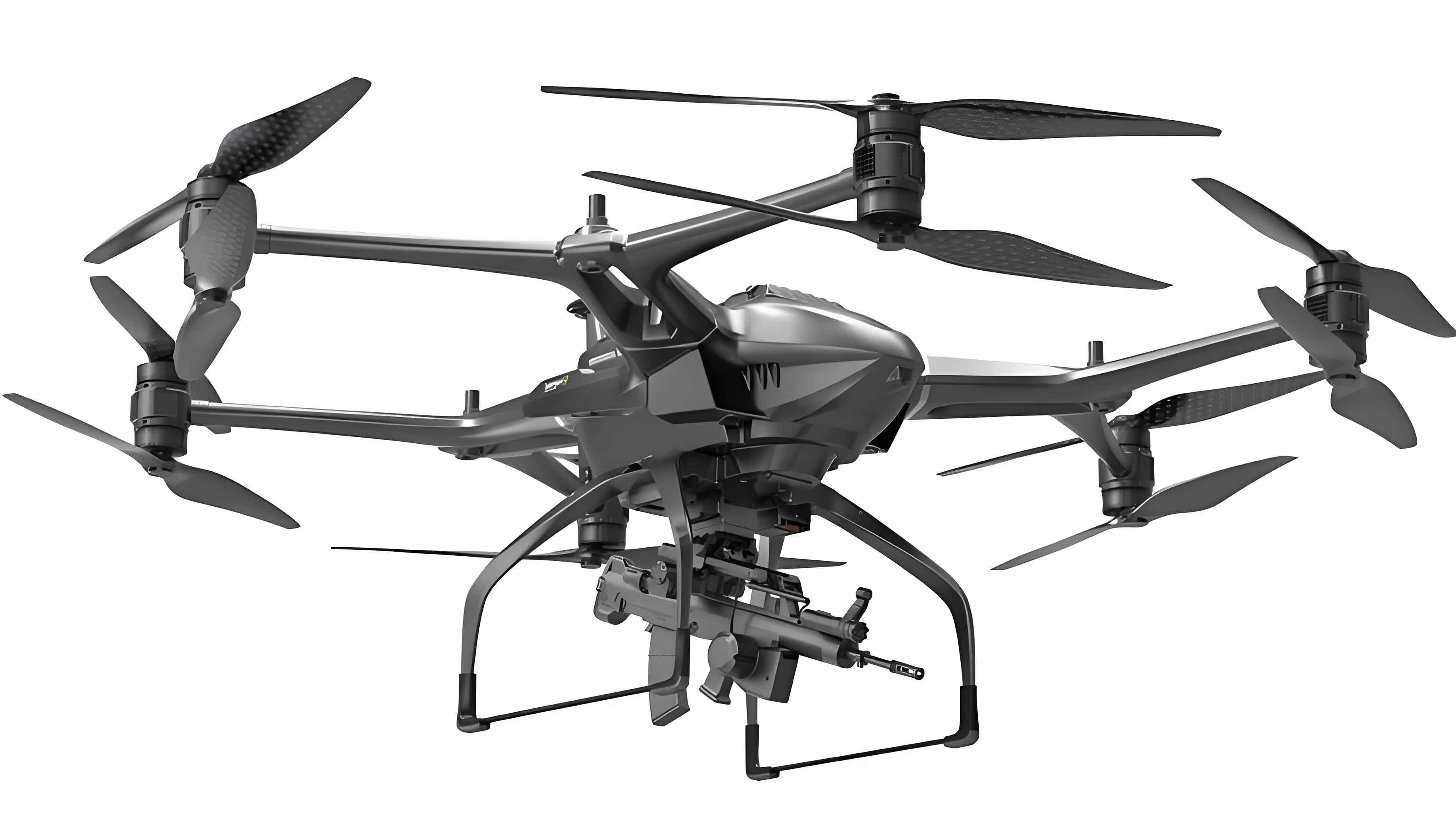
In recent years, I have noted a significant revision in the long-term plans for military drones across U.S. armed forces. The fiscal year 2007 defense budget allocated approximately $1.7 billion for unmanned aerial systems (UAS), signaling a robust commitment to expansion. Each branch—Army, Navy, and Air Force—has embarked on distinct development pathways, though with growing collaboration to avoid redundancy. For instance, the U.S. Navy, previously slower in drone adoption, has initiated three key acquisition programs: a small ship-based military drone, a long-endurance surveillance military drone, and a carrier-based stealth unmanned combat aerial vehicle (UCAV) demonstrator. This shift indicates a strategic pivot toward maritime drone integration, which I believe will enhance naval reach and responsiveness.
The U.S. Army, on the other hand, has adjusted its Future Combat Systems (FCS) drone categories, deferring two of the originally planned four types to better align with operational needs and funding efficiency. Based on my assessment, the Army now focuses on several military drone classes: continued enhancements to the Raven small military drone and Shadow tactical military drone for brigade-level units, deployment of the Extended Range/Multi-Purpose (ER/MP) military drone for division-level forces, and development of Class I (platoon-level) and Class IV (brigade-level) drones within the FCS framework. This tailored approach ensures that military drones are optimized for specific echelons, improving battlefield coherence.
Inter-service cooperation is another trend I have observed. The U.S. Air Force and Army are actively working on standardizing military drone components, particularly in common data links, remote video transceivers, and portable ground data terminals. Additionally, the Joint Chiefs of Staff have established two cross-service UAS organizations to foster integration. From my viewpoint, such collaboration reduces costs and enhances interoperability, making military drones more effective in joint operations. To summarize these plans, I present a table outlining key U.S. military drone initiatives by branch:
| Military Branch | Drone Program | Primary Role | Key Features |
|---|---|---|---|
| U.S. Navy | Small Ship-Based Drone | Reconnaissance | Compact design, launch from vessels |
| U.S. Navy | Long-Endurance Surveillance Drone | Persistent monitoring | High altitude, long loiter time |
| U.S. Navy | Carrier-Based UCAV Demonstrator | Stealth combat | Low observability, strike capabilities |
| U.S. Army | Raven Small Drone | Brigade-level ISR | Hand-launched, real-time video |
| U.S. Army | Shadow Tactical Drone | Tactical surveillance | Medium endurance, modular payloads |
| U.S. Army | ER/MP Drone | Division-level operations | Extended range, multi-role |
| U.S. Air Force | Global Hawk B | High-altitude ISR | Long endurance, advanced sensors |
Moving to payload advancements, I have been impressed by the rapid miniaturization and sophistication of sensors equipped on military drones. The demand for higher performance has driven innovations in electro-optical (EO), infrared (IR), and synthetic aperture radar with ground moving target indication (SAR/GMTI) systems. For example, the Warrior military drone features an EO/IR/laser designator sensor that includes a third-generation mid-wave IR sensor with six fields of view, a targeting color TV camera, and a laser rangefinder. This integration allows for fused high-resolution imagery and automatic video tracking of moving targets, enhancing the military drone’s surveillance accuracy.
In signal intelligence, the U.S. Air Force has deployed a new sensor on the Global Hawk military drone called the Highband System Production Configuration Unit (HBSPCU), part of the Airborne Signals Intelligence Payload (ASIP) system. From my analysis, this sensor can detect, intercept, and identify enemy radar signals at altitudes around 18 kilometers, significantly boosting signal intelligence gathering. The data is transmitted to distributed common ground stations for analysis, providing near-real-time insights. Such capabilities underscore the military drone’s role as a multi-domain intelligence platform.
Miniaturization is equally critical, especially for small and micro military drones. I have tracked developments like the small Ka-band millimeter-wave radar, which measures under 28 cm in diameter and weighs less than 8 kg, designed to prevent mid-air collisions. Another example is the MiniSAR by Lockheed Martin, tested on the SkySpirit military drone, which delivers ground imagery through smoke, dust, and adverse weather. Additionally, the U.S. Air Force Research Laboratory is developing a small common data link for military drones weighing 4 kg to 90 kg, ensuring interoperability with existing systems. Short-wave infrared (SWIR) sensors are also emerging, capable of generating high-resolution images under any conditions by detecting reflected infrared waves. These advancements make military drones more versatile and deployable in diverse scenarios.
To quantify sensor performance, I often refer to the radar range equation, which is essential for understanding the detection capabilities of military drones. The formula for maximum detection range \( R \) is given by:
$$ R = \sqrt[4]{\frac{P_t G^2 \lambda^2 \sigma}{(4\pi)^3 P_{min}}} $$
where \( P_t \) is the transmitted power, \( G \) is the antenna gain, \( \lambda \) is the wavelength, \( \sigma \) is the target’s radar cross-section, and \( P_{min} \) is the minimum detectable signal. This equation highlights how advancements in radar technology, such as increased power or reduced wavelength, can extend the operational range of a military drone’s sensors, making it more effective in surveillance missions.
Specialized missions have also driven payload innovation. For instance, under NASA funding, Lockheed Martin has tested chemical warfare agent detectors on expendable military drones like the Silver Fox. The Sniffer STAR sensor, weighing less than 50 grams, can identify nerve and mustard gases within 20 seconds, with data relayed via satellite. Similarly, Boeing is integrating biological warfare agent detectors on the Scan Eagle military drone, using a dual-drone approach—one for surveillance and one for sampling. In my opinion, these applications demonstrate the military drone’s potential in hazardous environments, reducing risk to human personnel.
Technological progress in military drones extends beyond payloads to core systems like propulsion and aerodynamics. One key area I have followed is the development of heavy fuel engine (HFE) technology. The U.S. military prioritizes HFE to streamline logistics, as it allows military drones to use JP-8 fuel common to aircraft, rather than aviation gasoline. This shift reduces fire hazards, lowers fuel costs, and improves reliability. For example, the Hunter military drone was upgraded with diesel-based HFE, doubling its endurance to over 21 hours. Similarly, the Scan Eagle military drone achieved a record endurance of 28 hours and 44 minutes using HFE. The endurance \( E \) of a military drone can be modeled by the formula:
$$ E = \frac{F}{C} $$
where \( F \) is the fuel capacity and \( C \) is the fuel consumption rate. HFE technology optimizes \( C \), enabling longer missions for military drones without increasing fuel load, which is crucial for persistent operations.
Another groundbreaking technology is morphing wing design, funded by the Defense Advanced Research Projects Agency (DARPA) under the Morphing Aircraft Structures (MAS) program. From my research, this allows military drones to alter wing shape in flight—increasing wingspan for efficient loitering and reducing it for high-speed dashes. NextGen Aeronautics successfully demonstrated this on the MFX-1 jet-powered scale prototype, changing wingspan by 30% and sweep angle from 15° to 35° at speeds of 185–220 km/h. The aerodynamic benefits can be expressed using the lift equation:
$$ L = \frac{1}{2} \rho v^2 S C_L $$
where \( L \) is lift, \( \rho \) is air density, \( v \) is velocity, \( S \) is wing area, and \( C_L \) is the lift coefficient. By modulating \( S \) and \( C_L \), morphing wings enhance the military drone’s adaptability across flight regimes, though challenges remain in structural integrity.
Autonomous aerial refueling is a third critical technology I have monitored. It extends the range and endurance of military drones, reducing reliance on forward basing. The U.S. Air Force Research Laboratory and Boeing have tested this using a Learjet simulating a military drone and a KC-135R tanker. The system autonomously maintains the drone in refueling positions—pre-contact, contact, and observation—via advanced flight controls. This capability can be analyzed through relative motion equations, such as:
$$ \Delta \mathbf{r} = \mathbf{r}_{\text{drone}} – \mathbf{r}_{\text{tanker}} $$
where \( \Delta \mathbf{r} \) represents the position vector between the military drone and tanker. Precise control of \( \Delta \mathbf{r} \) ensures safe refueling, enabling military drones to undertake longer missions and respond swiftly to time-sensitive targets.
In terms of new and improved military drone models, I have observed several notable upgrades. The Global Hawk B, developed by Northrop Grumman, features a wingspan of 39.9 meters, length of 14.5 meters, and endurance of 36 hours. It can carry heavier payloads, including integrated sensors for electro-optical, infrared, and SAR/GMTI capabilities, along with open architecture for signals intelligence systems. From my perspective, this makes the Global Hawk B a premier high-altitude, long-endurance (HALE) military drone for broad-area surveillance.
The Predator C, General Atomics’ latest variant, incorporates design changes for higher altitude flight and stealth, such as reshaped fuselage and turboprop engines. This addresses lessons from earlier models, enhancing the military drone’s survivability in contested airspace. Similarly, the Scan Eagle Block D by Insitu includes upgrades like a higher-resolution IR camera, improved stabilized gimbals, and in-flight fuel measurement, boosting its reconnaissance utility. I have compiled a table comparing these improved military drone models:
| Drone Model | Developer | Key Improvements | Endurance | Primary Mission |
|---|---|---|---|---|
| Global Hawk B | Northrop Grumman | Larger payload capacity, open architecture | 36 hours | High-altitude ISR |
| Predator C | General Atomics | Stealth enhancements, turboprop engine | Classified (estimated 24+ hours) | Multi-role surveillance/strike |
| Scan Eagle Block D | Insitu | Upgraded IR sensor, stabilized gimbal | 28+ hours | Tactical reconnaissance |
| MQ-8B Fire Scout | Northrop Grumman | Four-blade rotor, doubled range | 8+ hours | Naval reconnaissance |
The MQ-8B Fire Scout rotary-wing military drone recently completed its first flight for the U.S. Navy, featuring a four-blade rotor for greater power and fuel capacity compared to the earlier RQ-8A. It is slated for deployment on Littoral Combat Ships (LCS), highlighting the expanding role of military drones in maritime domains. Other rotary-wing models like Boeing’s A160 Hummingbird and Bell’s TR918 Eagle Eye tiltrotor drone are also under development, indicating a trend toward versatile vertical takeoff and landing (VTOL) military drones for complex environments.
Looking ahead, I believe military drones will evolve from support assets to central combat platforms. The U.S. Department of Defense’s “Great Leap” initiative envisions replacing hand-launched reconnaissance drones with long-range unmanned bombers, signaling a shift toward offensive capabilities. Additionally, military drones are being developed for electromagnetic spectrum warfare, cyber attacks, and electronic jamming, expanding their utility across domains. In my assessment, the integration of artificial intelligence and machine learning will further enhance autonomy, enabling military drones to perform complex missions with minimal human intervention.
To summarize the technological trajectory, I often use a performance index formula for military drones, combining factors like endurance, payload capacity, and stealth. If \( I \) represents the overall performance index, it can be approximated as:
$$ I = \alpha E + \beta P + \gamma S $$
where \( E \) is endurance, \( P \) is payload score, \( S \) is stealth coefficient, and \( \alpha, \beta, \gamma \) are weighting factors based on mission requirements. As advancements in HFE, morphing wings, and autonomous systems progress, \( I \) increases, making military drones more dominant in future conflicts.
In conclusion, my analysis of U.S. military drone developments reveals a dynamic landscape driven by strategic planning, technological innovation, and operational feedback. The emphasis on payload sophistication, key technologies like HFE and morphing wings, and improved models such as the Global Hawk B and Predator C underscores the military drone’s growing prominence. As these systems become more pervasive, they will redefine aerial warfare, offering unprecedented persistence, versatility, and lethality. I anticipate that military drones will eventually become ubiquitous equipment across all U.S. military branches, fundamentally altering defense postures and tactics worldwide.