
In my extensive analysis of modern battlefield dynamics, I have come to recognize the profound shift brought about by unmanned aerial vehicles (UAVs). The proliferation of low-cost, modified drones has ushered in a new era of warfare, where anti-UAV capabilities are not just an addition but a necessity for survival. From my perspective, the U.S. military’s relentless pursuit of effective anti-UAV systems reflects a strategic imperative to counter emerging threats in conflicts ranging from Ukraine to the Red Sea. As I delve into the technologies and architectures, I aim to provide a comprehensive overview that underscores the complexity and urgency of anti-UAV defense.
The evolution of anti-UAV systems, often termed C-UAV, is driven by the need to address drones that are slow, low-flying, and often obscured by ground clutter. In my observation, these systems overlap with integrated air and missile defense (IAMD) and indirect fire protection capabilities, but anti-UAV focuses specifically on neutralizing smaller, cheaper threats. A critical insight I have gained is that no single solution exists; instead, an effective anti-UAV architecture must integrate diverse systems across services and nations. The cost factor is paramount—if an anti-UAV interceptor costs significantly more than the drone it targets, the adversary gains an economic advantage. This principle has shaped U.S. efforts, as emphasized by defense officials who stress the need for affordable, high-volume production.
From my first-hand review of U.S. initiatives, I note that the Joint Counter-Small Unmanned Aircraft Systems Office (JCO) plays a pivotal role in coordinating anti-UAV efforts for drones under 600 kg. The U.S. Army, as the lead service, has prioritized defending against Group 3 UAVs, which include many attack drones, while training all forces to handle widely proliferated Group 1 and 2 threats. Internationally, similar projects like the UK’s Synergia and NATO’s interoperability exercises highlight the global emphasis on anti-UAV cooperation. In my assessment, the adoption of open standards, such as the SAPIENT protocol, facilitates seamless integration of sensor data, which is crucial for effective anti-UAV networks.
In exploring anti-UAV sensor technologies, I have identified several key components. Radars with active electronically scanned arrays (AESA) and pulse-Doppler techniques are foundational, though they can struggle with ground clutter. For example, the detection range for a radar in an anti-UAV context can be modeled using the radar equation: $$R_{max} = \sqrt[4]{\frac{P_t G_t G_r \lambda^2 \sigma}{(4\pi)^3 k T_0 B F S/N}}$$ where \(R_{max}\) is the maximum range, \(P_t\) is transmitted power, \(G_t\) and \(G_r\) are antenna gains, \(\lambda\) is wavelength, \(\sigma\) is radar cross-section, \(k\) is Boltzmann’s constant, \(T_0\) is temperature, \(B\) is bandwidth, \(F\) is noise figure, and \(S/N\) is signal-to-noise ratio. This formula illustrates the challenges in detecting small UAVs with low \(\sigma\). Additionally, electro-optical/infrared (EO/IR), acoustic, and radio frequency (RF) sensors have proven vital in conflicts like Ukraine. Artificial intelligence (AI) and machine learning (ML) are increasingly applied to enhance anti-UAV detection and classification, but issues like identification friend or foe (IFF) persist, as seen in incidents where friendly assets were mistaken for threats.
To summarize key anti-UAV sensor types, I present the following table:
| Sensor Type | Primary Function in Anti-UAV | Advantages | Limitations |
|---|---|---|---|
| Radar (AESA) | Detection and tracking of UAVs | Long range, all-weather capability | Susceptible to clutter, high cost |
| EO/IR | Visual identification and targeting | High resolution, passive operation | Limited by weather and visibility |
| RF Sensor | Detection of drone communications | Can locate operators, non-kinetic | May be jammed or encrypted |
| Acoustic | Detection via sound signatures | Low cost, passive | Short range, background noise issues |
Moving to integrated anti-UAV systems, I have examined the U.S. Army’s Fixed and Mobile Low, Slow, Small Unmanned Aircraft System Integrated Defeat Systems (FS-LIDS and M-LIDS). These systems combine sensors, command and control (like the Forward Area Air Defense C2 system), and effectors into deployable packages. In my analysis, M-LIDS exemplifies a mobile anti-UAV platform, with kinetic and electronic warfare variants mounted on M-ATV vehicles. The kinetic version uses a 30mm cannon and the Coyote Block 2 interceptor, while the EW variant employs jammers. The Coyote, a turbojet-powered loitering munition, represents a cost-effective anti-UAV effector with a range of 10-15 km. I estimate that the unit cost of such interceptors is critical for sustainable anti-UAV operations, as highlighted by the need for “magazine depth” in engagements.
Similarly, the U.S. Marine Corps’ Marine Air Defense Integrated System (MADIS) showcases another approach to anti-UAV defense. Based on the Joint Light Tactical Vehicle (JLTV), MADIS Mk1 and Mk2 vehicles combine sensors, radars like the RPS-62, and effectors such as 30mm guns and Stinger missiles. In my view, the synergy between Mk1 (kinetic) and Mk2 (EW) versions enhances anti-UAV flexibility. The Light MADIS (LMADIS) on MRZR all-terrain vehicles offers a lighter option, reportedly used in operations like the downing of an Iranian drone. These systems underscore the trend toward modular, vehicle-based anti-UAV solutions.
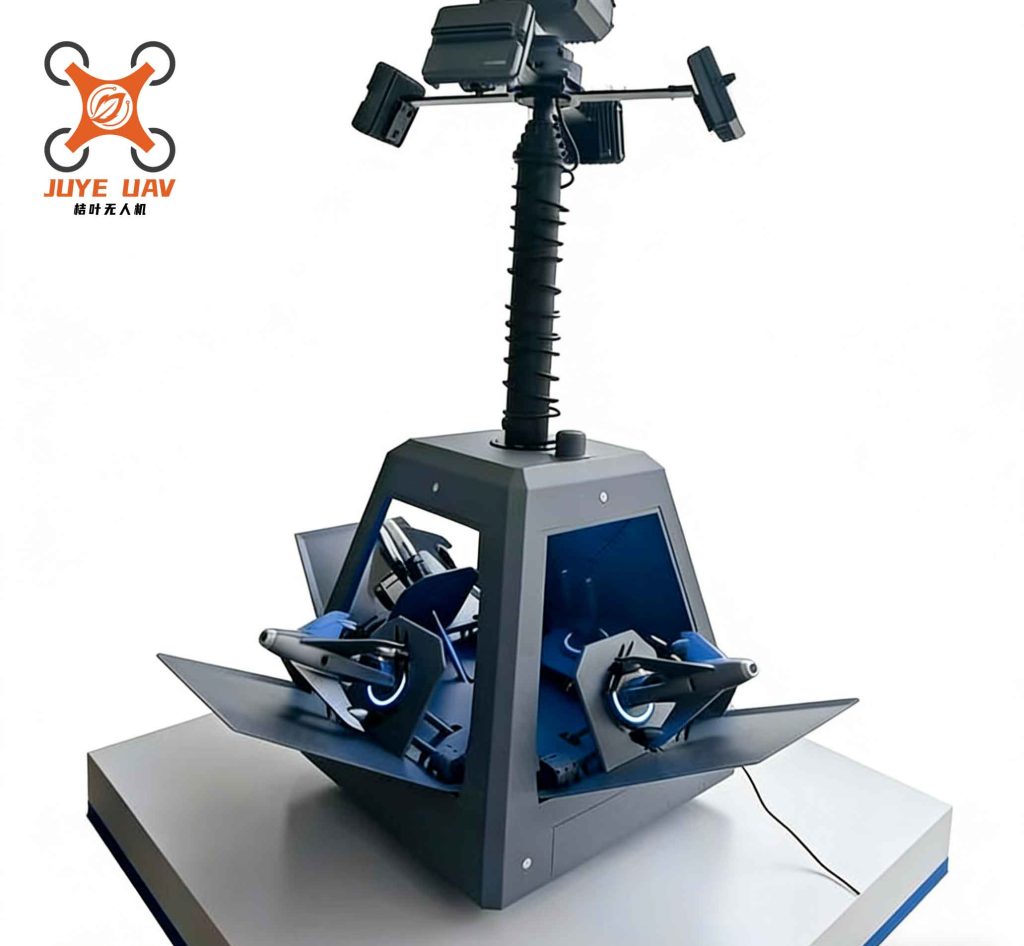
In my research on cost-effective anti-UAV interceptors, I have focused on systems like the Vehicle-Agnostic Modular Palletized ISR Rocket Equipment (VAMPIRE). This palletized kit includes electro-optical sensors and a quad launcher for APKWS laser-guided rockets, providing a low-cost anti-UAV capability. The U.S. has deployed such systems to Ukraine, demonstrating their utility in countering Group 2 and 3 drones. The cost-effectiveness can be expressed as a ratio: $$C_{eff} = \frac{C_{drone}}{C_{interceptor}}$$ where \(C_{eff} > 1\) indicates an economic advantage for the anti-UAV side. For VAMPIRE, \(C_{eff}\) is favorable due to the relatively low cost of rockets compared to traditional missiles.
Another notable anti-UAV effector is the Coyote series, which blurs the line between missiles and loitering munitions. From my perspective, its evolution to Block 2 and beyond reflects innovation in anti-UAV technology. The Coyote Block 2’s specs include a speed of 370 km/h and a fragmentation warhead, optimized for drone engagements. The planned procurement of thousands of Coyotes underscores the scale of anti-UAV demand. Similarly, the Roadrunner-M system offers a recoverable interceptor, adding sustainability to anti-UAV operations. I have compiled a comparison of key anti-UAV effectors in the table below:
| Effector System | Type | Primary Anti-UAV Role | Approx. Cost per Unit | Range |
|---|---|---|---|---|
| Coyote Block 2 | Loitering Munition | Interception of Group 1-3 UAVs | Moderate (est. $100k) | 10-15 km |
| APKWS (VAMPIRE) | Guided Rocket | Kinetic engagement | Low (est. $30k) | 5-7 km |
| Stinger Missile | Surface-to-Air | Point defense | High (est. $200k) | 4-8 km |
| Roadrunner-M | Recoverable UAV | Counter-Group 3 UAVs | Moderate-High | Classified |
Directed energy weapons represent a transformative frontier in anti-UAV defense, as I have studied extensively. High-energy lasers (HELs) offer a low cost-per-shot solution, ideal for engaging numerous drones. The energy required to disable a UAV can be approximated by: $$E_{disable} = P_{laser} \cdot t_{engage} \cdot \eta$$ where \(P_{laser}\) is laser power, \(t_{engage}\) is engagement time, and \(\eta\) is atmospheric transmission efficiency. For instance, a 50 kW laser might need 1-2 seconds to burn through a small drone’s hull, depending on range and conditions. The U.S. has deployed various HEL systems, such as the HELIOS on naval vessels and the Guardian Multi-Mission HEL (MMHEL) on Stryker vehicles. In my analysis, these systems excel in clear environments but face challenges in adverse weather, limiting their anti-UAV effectiveness in all scenarios.
High-power microwave (HPM) weapons complement lasers by enabling simultaneous engagement of drone swarms, a critical anti-UAV capability. The power density at range for an HPM system is given by: $$S = \frac{P_{tx} G_{tx}}{4\pi R^2}$$ where \(S\) is power density, \(P_{tx}\) is transmitted power, \(G_{tx}\) is antenna gain, and \(R\) is distance. This shows how HPM can disrupt multiple UAV electronics at once. Systems like the Tactical High-power Operational Responder (THOR) and Leonidas have been tested for anti-UAV roles, with the latter integrated onto vehicles for mobile defense. I believe HPM’s non-kinetic nature reduces collateral damage, making it attractive for anti-UAV operations in populated areas.
To illustrate the trade-offs between kinetic and directed energy anti-UAV systems, I propose the following formula for overall effectiveness: $$E_{total} = \alpha \cdot E_{kinetic} + \beta \cdot E_{DE} + \gamma \cdot E_{EW}$$ where \(\alpha, \beta, \gamma\) are weighting factors based on scenario, and each component represents effectiveness scores. This holistic view aligns with the U.S. military’s approach of layered anti-UAV defense.
Non-kinetic anti-UAV measures, such as electronic warfare (EW), are equally vital. From my observations, EW systems like jammers and spoofers target drone command links or GPS, offering a soft-kill option. However, advancements in drone autonomy, as seen in Ukraine, reduce EW efficacy over time. The balance between innovation and counter-innovation defines the anti-UAV landscape. I have seen how passive defenses—like armor upgrades on vehicles—complement active anti-UAV systems, emphasizing a multi-faceted approach.
Looking ahead, the future of anti-UAV systems hinges on integration and interoperability. In my opinion, the U.S. Joint All-Domain Command and Control (JADC2) concept aims to seamless connect sensors and shooters, but current anti-UAV networks still face gaps. International collaboration, as seen in NATO exercises, will be key to developing robust anti-UAV architectures. The table below summarizes future trends in anti-UAV technology:
| Trend | Impact on Anti-UAV | Challenges |
|---|---|---|
| AI/ML Integration | Enhanced detection and decision-making | Data quality, adversarial AI |
| Swarm Countermeasures | Need for HPM and network targeting | Cost, scalability |
| Modular Systems | Flexible deployment across platforms | Standardization issues |
| International Standards | Improved interoperability | Political and technical barriers |
In conclusion, my deep dive into U.S. military anti-UAV systems reveals a dynamic and evolving field. The emphasis on cost, production scale, and integration reflects the pragmatic realities of modern warfare. As drones continue to proliferate, anti-UAV capabilities will remain at the forefront of defense planning. From directed energy to kinetic interceptors, each technology plays a role in a comprehensive anti-UAV strategy. I am convinced that ongoing innovation, coupled with lessons from conflicts, will shape the next generation of anti-UAV systems, ensuring they are both effective and affordable. The journey toward dominance in the anti-UAV domain is far from over, but the progress so far underscores a commitment to safeguarding forces against an ever-present threat.