
In recent years, the rapid commercialization and proliferation of unmanned aerial vehicles (UAVs) have escalated threats to military assets and civilian infrastructure globally. As a researcher focused on defense technologies, I have observed that the increasing accessibility of low-cost, easy-to-operate drones has led to a surge in malicious incidents, such as the widely reported strike in January 2020 that heightened international attention. With over 100 drone intrusion events documented in 2019 alone, the urgency for robust anti-UAV measures has become paramount. The U.S. Department of Defense (DoD) has responded with multifaceted initiatives to enhance its anti-UAV capabilities, positioning this domain as a critical component of national security. This article delves into the strategic advancements, technological developments, and insights gleaned from the U.S. approach, emphasizing the imperative for global stakeholders to address UAV threats through innovation and integration.
The evolution of UAV technology over the past decade has enabled state and non-state actors to deploy reconnaissance and strike capabilities, posing significant risks to U.S. forces and interests. According to assessments, more than 600 commercial drone models have been militarized by over 80 entities, including terrorist organizations. In response, the DoD has elevated the strategic importance of anti-UAV efforts, implementing policies and frameworks to mitigate these emerging threats. For instance, the release of the “Counter-Small Unmanned Aircraft Systems Strategy” in January 2021 marks a shift from tactical to strategic-level planning, underscoring the DoD’s commitment to addressing UAV risks holistically. This strategic focus is further reinforced through budget allocations, organizational reforms, and extensive exercises, with expenditures on anti-UAV solutions reaching approximately $9 billion in 2019 and at least $573 million in 2020 for research and procurement. To summarize key milestones, I present a timeline of U.S. anti-UAV strategic initiatives in Table 1, highlighting the progression from doctrine to execution.
| Year | Initiative | Description | Impact on Anti-UAV Capabilities |
|---|---|---|---|
| 2017 | ATP 3-01.81 Manual | Provided tactical guidance for Army units to counter UAVs using standardized procedures. | Enhanced training and operational readiness for ground forces. |
| 2018 | Cyberspace and Electronic Warfare Concept | Emphasized electronic warfare integration to improve anti-UAV effectiveness for ground forces. | Promoted synergy between cyber and kinetic domains. |
| 2019 | Appointment of Senior Integration Group | Established high-level oversight to coordinate anti-UAV activities across DoD components. | Streamlined policy, procurement, and technological standards. |
| 2021 | Counter-Small UAV Strategy | Outlined a comprehensive approach to address small UAV threats at a strategic level. | Elevated anti-UAV efforts to a national security priority. |
From my analysis, the DoD’s strategic emphasis is driven by the recognition that no single solution can counter diverse UAV threats. Consequently, the development of anti-UAV systems spans near-term, mid-term, and long-term horizons, each targeting specific operational needs. In the near term, deception and jamming systems dominate investments, leveraging electro-optical countermeasures, control signal interference, and data-link disruptions to neutralize UAVs. These systems, such as the Expeditionary Mobile Air Defense Integrated System (X-MADIS) and the Silent Archer, employ radar,射频探测, and electronic warfare to detect, track, and disable drones. For example, the drone defender radio-frequency gun uses targeted interference to disrupt communications, rendering UAVs inoperable. The effectiveness of such jamming can be modeled using the jamming-to-signal ratio (JSR), expressed as: $$ JSR = \frac{P_j G_j}{P_s G_s} $$ where \( P_j \) is the jamming power, \( G_j \) is the jamming antenna gain, \( P_s \) is the signal power, and \( G_s \) is the signal antenna gain. A higher JSR indicates greater interference efficacy, a principle central to many anti-UAV designs.
Mid-term developments focus on emerging technologies like high-energy lasers, directed-energy weapons, and swarm-based systems. The DoD is investing heavily in platforms such as the Mobile High-Energy Laser Weapon System and the Tactical High-power Operational Responder (THOR), which use lasers and microwaves to incapacitate UAVs. The energy required for laser-based anti-UAV systems can be calculated using the equation: $$ E_{required} = \frac{P_{laser} \cdot t_{exposure}}{\eta_{system}} $$ where \( P_{laser} \) is the laser power, \( t_{exposure} \) is the exposure time, and \( \eta_{system} \) is the system efficiency. These systems offer precision and scalability, particularly against drone swarms. Additionally, programs like the Blade system and Coyote interceptor drones exemplify the shift toward networked, multi-domain anti-UAV solutions. To illustrate the diversity of these systems, Table 2 categorizes key anti-UAV technologies by their operational characteristics and development stage.
| System Type | Examples | Key Technologies | Development Stage | Anti-UAV Effectiveness Metrics |
|---|---|---|---|---|
| Deception/Jamming | X-MADIS, Silent Archer, Drone Defender | RF interference, electro-optical countermeasures | Near-term (Deployed) | JSR > 10 dB, response time < 5s |
| Directed Energy | High-Energy Lasers, THOR | Laser beams, microwave pulses | Mid-term (Testing) | Power output 30-100 kW, range up to 5 km |
| Swarm-based | Coyote, Interceptor Drones | Autonomous drones, AI-driven coordination | Mid-term (Prototype) | Swarm size 10-50 units, engagement speed > 50 m/s |
| Smart Munitions | Guided Bullets, Intelligent Projectiles | Real-time tracking, adaptive guidance | Long-term (Research) | Accuracy < 0.1 mrad, multi-target capability |
Looking ahead, long-term anti-UAV innovations will likely revolve around fully autonomous systems and smart munitions, driven by artificial intelligence (AI) and machine learning. The Titan system, for instance, uses AI algorithms to classify and neutralize approaching drone swarms, representing a leap toward cognitive anti-UAV warfare. Similarly, smart bullets with real-time trajectory adjustment capabilities are under development, promising enhanced precision against fast-moving UAVs. The trajectory optimization for such munitions can be described by differential equations: $$ \frac{d\mathbf{v}}{dt} = \mathbf{a}_{control} + \mathbf{g} $$ where \( \mathbf{v} \) is the velocity vector, \( \mathbf{a}_{control} \) is the controlled acceleration, and \( \mathbf{g} \) is gravity. These advancements underscore the DoD’s commitment to maintaining technological superiority in the anti-UAV domain.
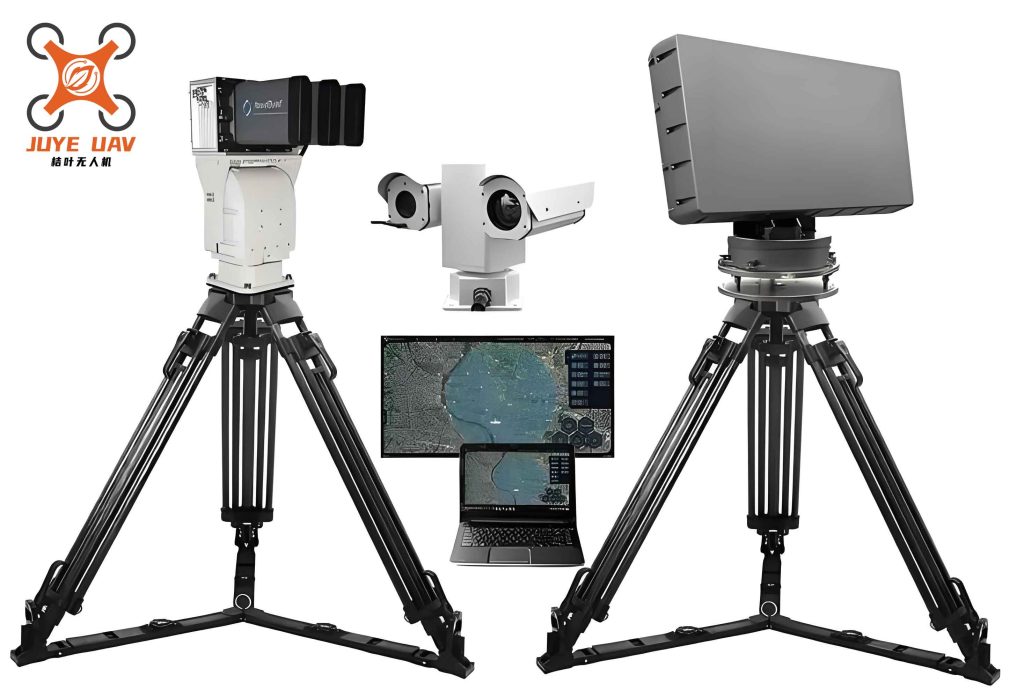
The integration of these anti-UAV systems into military operations requires robust testing and validation. In my assessment, the DoD’s approach combines live exercises, simulations, and partnerships with industry to refine capabilities. For example, the use of electronic warfare in anti-UAV scenarios has been demonstrated in conflicts, highlighting the practicality of jamming-based solutions. Moreover, the proliferation of drone swarms necessitates scalable anti-UAV strategies, prompting research into network-centric defenses that can handle hundreds of simultaneous threats. The effectiveness of such defenses can be quantified using probability models, such as the likelihood of neutralizing a drone swarm: $$ P_{neutralize} = 1 – \prod_{i=1}^{n} (1 – p_i) $$ where \( n \) is the number of drones in the swarm, and \( p_i \) is the probability of defeating the i-th drone. This formula emphasizes the need for high-confidence interceptors in anti-UAV systems.
From these observations, I derive several insights for enhancing global anti-UAV capabilities, particularly from a national defense perspective. First, strategic top-level design is crucial to foster a conducive policy environment for anti-UAV development. Establishing centralized coordination bodies can streamline efforts across military and civilian sectors, ensuring alignment with security objectives. Second, system-of-systems integration, leveraging军民融合, can accelerate innovation by pooling resources and expertise. This involves joint R&D initiatives, compatible standards, and technology transfer mechanisms to build a resilient anti-UAV industrial base. Third, indigenous innovation must be prioritized to secure technological edges, focusing on core components like processors, sensors, and AI algorithms. By combining self-reliance with international collaboration, nations can develop layered anti-UAV architectures that address both conventional and asymmetric threats.
To elaborate on these recommendations, I propose a framework for anti-UAV development that balances immediate needs with future trends. Table 3 outlines key action areas, aligned with the insights from the U.S. experience, to guide stakeholders in strengthening their anti-UAV postures.
| Action Area | Specific Measures | Expected Outcomes | Alignment with Anti-UAV Goals |
|---|---|---|---|
| Top-Level Design | Establish national anti-UAV task forces; enact supportive regulations and funding policies. | Coherent strategy, reduced duplication, faster deployment. | Enhances strategic prioritization of anti-UAV efforts. |
| System Integration | Foster军民融合 for R&D create joint testing environments; develop interoperable standards. | Accelerated technology adoption, cost-sharing, improved readiness. | Builds scalable and adaptable anti-UAV ecosystems. |
| Autonomous Innovation | Invest in AI-driven anti-UAV systems; advance directed-energy and smart munition research. | Technological leadership, higher interception rates, deterrence against swarms. | Ensures long-term competitiveness in anti-UAV domain. |
In conclusion, the U.S. DoD’s multifaceted approach to anti-UAV capabilities offers valuable lessons for addressing the growing drone threat. By elevating anti-UAV strategies to a national security level, investing in diverse technological solutions, and fostering innovation, the DoD has built a resilient defense architecture. However, the dynamic nature of UAV threats requires continuous adaptation, particularly as AI and autonomy redefine warfare. From my perspective, the future of anti-UAV defense lies in integrated, intelligent systems that can operate across domains with minimal human intervention. As nations worldwide grapple with similar challenges, the principles of strategic planning, resource integration, and technological autonomy will remain pivotal. Ultimately, the success of anti-UAV initiatives hinges on a proactive stance—anticipating threats rather than merely reacting to them—and this demands sustained commitment from policymakers, industry, and the research community.
The journey toward robust anti-UAV capabilities is ongoing, with advancements in sensors, directed energy, and AI paving the way for more effective counters. As I reflect on the U.S. experience, it is clear that collaboration and innovation are key to staying ahead in this critical field. By embracing these principles, stakeholders can mitigate risks and safeguard security in an era of proliferating UAVs.