
The rapid evolution of unmanned aerial systems has fundamentally reshaped modern air and space operations, creating an urgent demand for highly skilled drone specialists within military forces. The traditional model of education, heavily reliant on first classroom theoretical instruction, often struggles to bridge the gap between foundational knowledge and the complex, adaptive problem-solving required on the modern battlefield. To cultivate drone professionals who are not only technically proficient but also innovative, collaborative, and tactically minded, a paradigm shift in pedagogical approach is necessary. This article details our implementation and exploration of a reformed second classroom instructional model for drone training, grounded firmly in the principles of Outcomes-Based Education (OBE). We analyze the inherent limitations of previous extracurricular activities, present a structured framework for OBE-driven design and execution, and provide empirical evidence of its positive impact on cadet development. The core of our methodology involves a deliberate reversal of the instructional design process, starting from clearly defined, measurable terminal capabilities and working backward to create cadet-centered, practice-intensive learning experiences that rigorously support the overarching goals of military drone training.
Challenges in Conventional Extracurricular Drone Training
Historically, the second classroom for our drone specialty primarily functioned as an extension of basic flight practice, organized through instructor-led clubs. While this provided initial hands-on exposure, a systematic analysis revealed several critical shortcomings that hampered the development of high-order competencies essential for future drone officers. These challenges are summarized in the table below:
| Deficiency Area | Manifestation | Impact on Cadet Development |
|---|---|---|
| Insufficient Instructional Depth & Personalization | Drone technology is interdisciplinary, requiring knowledge in aerodynamics, control systems, electronics, and sensors. Instructor expertise was often narrow, limiting the depth of guidance. Cadets faced challenges without timely, expert intervention. | Stifled innovation and advanced problem-solving. Led to cadet frustration and potential attrition from activities. |
| Lack of Targeted Alignment | Activities were generic (e.g., basic flight practice) and not systematically linked to specific course objectives or operational tasks (e.g., mission planning, payload integration, system troubleshooting). | Failed to translate theoretical knowledge from core courses into applied, context-rich skills. Limited the tactical relevance of the training. |
| Outdated Pedagogical Mode | An instructor-centric, knowledge-transmission model prevailed. Activities were often designed ad-hoc without a clear learning sequence, failing to simulate real-world knowledge application environments. | Cadets remained passive learners, leading to low engagement and a lack of intrinsic motivation for deep learning in drone training. |
| Weak Incentive and Constraint Mechanisms | With less external career pressure, cadets’ intrinsic drive varied widely. The lack of a formalized reward/recognition system linked to skill mastery led to inconsistent participation and effort. | Undermined the value and effectiveness of the second classroom. Failed to cultivate a culture of excellence and persistent skill refinement in drone training. |
These deficiencies highlighted that our extracurricular drone training was not operating as a true amplifier of first classroom learning or a reliable builder of operational capability. A structured, goal-oriented framework was needed to transform these activities into a powerful engine for talent development.
The OBE Framework for Second Classroom Drone Training
Outcomes-Based Education provided the necessary philosophical and methodological foundation for this transformation. OBE inverts the traditional educational process by first defining the essential knowledge, skills, and attributes (the “outcomes”) cadets must demonstrably possess upon completion of a learning segment, and then designing all instruction and assessment backward from that point. For military drone training, this translates to a relentless focus on battlefield-relevant competencies.
Our implementation model, visualized in Figure 1, is a continuous cycle with four key phases:
1. Defining Clear, Measurable Outcomes: We derived specific second classroom outcomes directly from the broader program educational objectives for drone specialists. These outcomes are concrete, observable, and assessable. They move beyond “understanding” to “doing” and “creating.”
2. Designing Backward from Outcomes: Every activity, club session, and competition preparation is planned with the explicit purpose of enabling cadets to achieve one or more of the defined outcomes. The question shifts from “What should we teach today?” to “What must the cadets be able to do, and what experiences will best enable that?”
3. Implementing Cadet-Centered Processes: The instructional model flips. Cadets become active agents in their learning. Instructors transition from lecturers to facilitators, mentors, and designers of complex learning environments. The primary venues for this are specialized clubs, national-level competitions, and targeted workshop series.
4. Assessing and Continuously Improving: Rigorous, multi-faceted assessment is used not just for grading, but for diagnosing learning gaps and improving the instructional design itself. Feedback from cadets, competition results, and internal reviews directly inform refinements to the drone training process.
The cornerstone of this model is the set of defined learning outcomes. Our second classroom outcomes for advanced drone training are:
- Cadets will demonstrate proficiency in piloting unmanned aerial vehicles to reliably execute specified mission profiles under varying conditions.
- Cadets will function effectively within a team, demonstrating clear communication, role adaptability, and collaborative problem-solving to accomplish complex drone-related tasks.
- Cadets will design, implement, and test subsystems for unmanned platforms, including writing and debugging flight control code and integrating sensors, to meet defined operational requirements.
- Cadets will apply engineering principles to the complete process of designing, fabricating, assembling, and tuning competitive aerial vehicles from raw materials.
These outcomes can be linked to a conceptual performance metric for drone training effectiveness. While real-world performance is multi-dimensional, we can model a simplified aggregate competency score \( C \) for a cadet team as a function of demonstrated skills across these domains:
$$ C = \alpha \cdot S_p + \beta \cdot S_t + \gamma \cdot S_d + \delta \cdot S_e $$
Where:
\( S_p \) represents the Piloting Skill score (Outcome 1),
\( S_t \) represents the Teamwork & Communication score (Outcome 2),
\( S_d \) represents the Design & Implementation score (Outcome 3),
\( S_e \) represents the Engineering & Fabrication score (Outcome 4).
The coefficients \( \alpha, \beta, \gamma, \delta \) are weighting factors that reflect the relative importance of each outcome for a specific mission or evaluation context, with \( \alpha + \beta + \gamma + \delta = 1 \). The OBE process aims to maximize \( C \) for all cadets through targeted interventions.
Cadet-Centered Implementation: Clubs, Competitions, and Coaching
The implementation of OBE principles radically restructured our second classroom ecosystem for drone training. The process is a reverse-engineering of the path to the final outcomes, creating a scaffolded journey for cadets.
| Implementation Pillar | Primary OBE Outcomes Addressed | Key Activities & Pedagogy | Instructor Role |
|---|---|---|---|
| Drone Specialty Club | 1, 2 | Regular flight training sessions; internal “mini-challenges” (races, interception simulations); structured team projects; peer mentoring systems. | Facilitator, Safety Officer, Resource Provider. Identifies and nurtures talent. |
| National Competition Pipeline (e.g., Electronics Design Contest, CADC) |
2, 3, 4 | Year-long project cycles; requirement analysis; iterative design, build, and test loops; technical report writing; competition simulation. | Project Mentor, Design Reviewer, Technical Consultant. Guides the engineering process. |
| Thematic Workshop Series | 1, 2, 3, 4 (Support) | Advanced topics (e.g., PID tuning, composite materials, mission planning software); soft skills (project management, technical briefing); personalized skill clinics. | Subject Matter Expert, Coach. Provides just-in-time, personalized knowledge. |
The club serves as the foundational talent pool and continuous practice environment. It is here that basic piloting skills (Outcome 1) are honed to a high level of reliability, and where the foundations of teamwork (Outcome 2) are built through regular collaborative exercises. The club operates with a military-lite structure, having distinct sections for operations, technical development, logistics, and communications, giving cadets early leadership and management experience.
The true crucible for applied learning, however, is the preparation for and participation in high-stakes national competitions. Pursuing events like the Electronics Design Contest (which frequently features drone challenges) and the China Aeromodelling Design Challenge (CADC) provides an authentic, demanding context for Outcomes 2, 3, and 4. Cadets must form teams, manage multi-month projects, conceive original designs, write sophisticated code, manufacture airframes, and solve unforeseen technical problems—all under time pressure. This is the essence of OBE in action: learning is driven by the need to produce a winning outcome. Instructors guide this process through structured mentorship, asking probing questions rather than providing direct answers, and encouraging evidence-based decision-making.
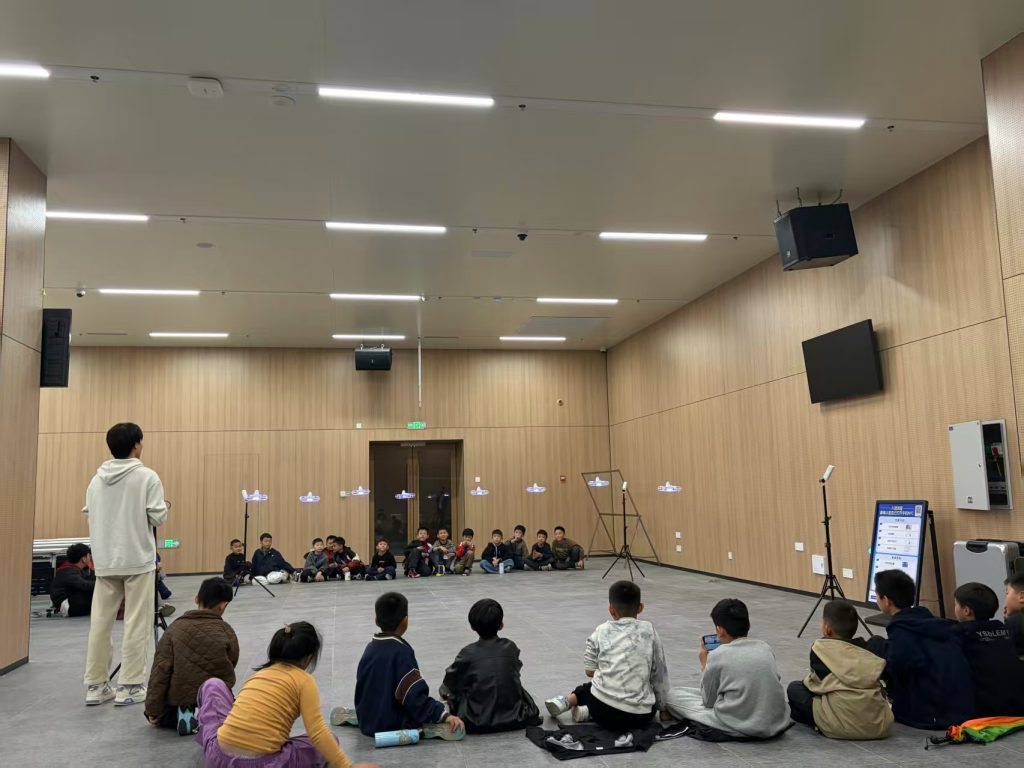
The image above captures the immersive, hands-on nature of this transformed drone training environment. Cadets are not passive listeners; they are actively assembling, configuring, and troubleshooting systems, embodying the “learning by doing” philosophy central to our OBE approach. This practical engagement is critical for internalizing complex interdisciplinary concepts from their core academic courses.
To support both club operations and competition readiness, a series of thematic workshops are delivered. These are not generic lectures but targeted interventions based on continuous needs assessment. If a team struggles with aerodynamic stability, a workshop on vehicle dynamics and simulation is organized. If another team has communication breakdowns, a session on agile project management for engineering teams is conducted. This responsive, just-in-time coaching model ensures that instruction is directly relevant and immediately applicable, closing the loop on the backward design principle.
Assessment, Feedback, and Observed Outcomes
A robust OBE system requires congruent assessment. We employ a multi-modal evaluation strategy aligned with our defined outcomes, moving beyond written exams to authentic performance measures.
- Performance Rubrics: Cadets are assessed during club challenges and competition preparations using detailed rubrics for piloting precision, system functionality, design innovation, and teamwork.
- Artifact Evaluation: The quality of tangible outputs—flight control code, engineering reports, CAD models, and the physical aircraft themselves—serves as direct evidence of learning.
- Competition Results: Success in external competitions provides a powerful, objective benchmark against national standards, validating the effectiveness of our drone training program.
- 360-Degree Feedback: Cadets receive feedback from instructors, peer team members, and through self-reflection, fostering metacognitive awareness of their own skill development.
This data is used not only to grade but, more importantly, to drive continuous improvement of the second classroom program itself. Lessons learned from competition failures directly inform changes to workshop topics, club training regimens, and mentorship strategies for the following cycle.
The impact of this OBE-driven reform has been quantitatively and qualitatively significant over a multi-year implementation period. The expansion of the program and its achievements are summarized below:
| Metric | Pre-Reform Baseline (2020) | Post-Reform Period (2021-2023) |
|---|---|---|
| Active Club Membership | 14 Cadets | 77 Cadets (450% growth) |
| Instructor Team Size | ~3-5 Instructors | 15+ Instructors |
| National Electronics Design Contest | No Awards | Provincial Top Prize (2022), National 2nd Prize (2023) |
| CADC National Competition | No Participation/Awards | National 3rd Prize (2021), Multiple Top-10 Finishes (2023) |
| Cadets in Competition Pipeline | ~10-15 | 40+ |
Beyond these metrics, anonymous surveys of senior cadets who participated in the reformed drone training program reveal a strong positive perception of its educational value. When asked to rate their agreement with statements regarding the second classroom’s impact, the responses were overwhelmingly positive, indicating success in achieving the holistic goals of the OBE model.
| Statement | Agree | Mostly Agree | Disagree |
|---|---|---|---|
| Instructors provided effective personalized coaching and guidance. | 93.5% | 6.5% | 0.0% |
| The activities broadened my technical knowledge and increased my interest in the drone field. | 90.3% | 9.7% | 0.0% |
| My leadership, communication, and teamwork skills were enhanced. | 87.1% | 9.7% | 3.2% |
| I improved my ability to identify, analyze, and solve complex technical problems. | 83.9% | 12.9% | 3.2% |
Conclusion
The integration of Outcomes-Based Education principles into the second classroom for military drone training has proven to be a transformative strategy. By starting with a clear vision of the operational-capable graduate and meticulously designing backward from those goals, we have created a dynamic, cadet-centered learning ecosystem. This ecosystem, built upon the pillars of a structured specialty club, authentic national competitions, and responsive coaching, effectively bridges the theory-practice gap. It transforms extracurricular time from casual practice into a rigorous proving ground for technical skill, innovative thinking, systems engineering, and military teamwork. The results—seen in dramatic growth in participation, prestigious awards, and strong cadet feedback—confirm that this model significantly elevates the quality and relevance of professional drone training. It cultivates not just drone operators, but the adaptive problem-solvers and future technical leaders required for supremacy in the modern aerial domain. This approach offers a replicable framework for enhancing professional military education across technical specialties, ensuring that training keeps pace with the relentless evolution of technology and tactics.