
In the field of unmanned aerial vehicles (UAVs), the quadrotor drone has emerged as a pivotal platform due to its versatility in applications such as surveillance, aerial photography, and environmental monitoring. However, controlling a quadrotor drone presents significant challenges due to its highly nonlinear, underactuated, and coupled dynamics, often compounded by uncertainties in model parameters and external disturbances. In this paper, I address these issues by proposing a novel double-loop control strategy that combines proportional-integral-derivative (PID) control for trajectory tracking with an adaptive sliding mode controller based on Takagi-Sugeno (T-S) fuzzy logic for attitude stabilization. My approach aims to achieve robust and precise control without relying on an accurate dynamic model, making it suitable for real-world operations where parameters may vary or be unknown. Throughout this work, I will frequently refer to the quadrotor drone to emphasize its central role in the study.
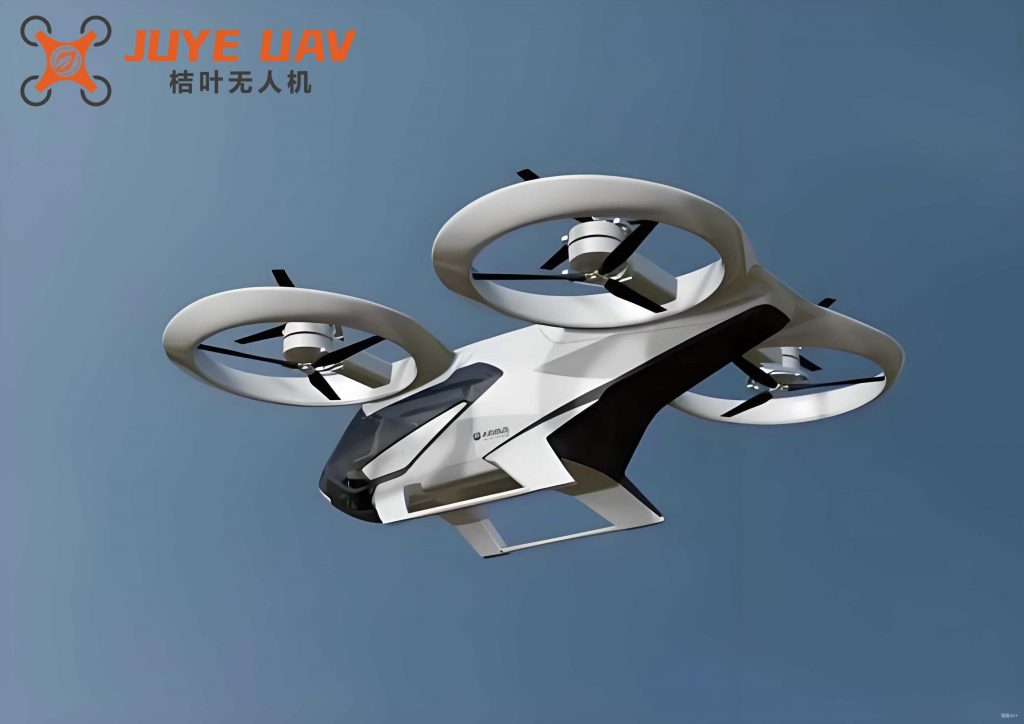
The quadrotor drone operates through four rotors that generate lift and control torques. To understand its behavior, I first derive the kinematic and dynamic models. Let me define two coordinate frames: the body-fixed frame \((x, y, z)\) attached to the quadrotor drone and the inertial frame \((N, E, D)\). The rotation matrix \(\mathbf{R}\) that transforms vectors from the body frame to the inertial frame is given by:
$$ \mathbf{R} = \begin{bmatrix} \cos\psi \cos\theta & \cos\phi \sin\psi \sin\theta – \cos\psi \sin\phi & \sin\psi \sin\phi + \cos\psi \cos\phi \sin\theta \\ \cos\theta \sin\phi & \cos\psi \cos\phi + \sin\psi \sin\phi \sin\theta & \cos\psi \sin\phi \sin\theta – \cos\phi \sin\psi \\ -\sin\theta & \cos\theta \sin\psi & \cos\psi \cos\theta \end{bmatrix} $$
where \(\phi\), \(\theta\), and \(\psi\) represent the roll, pitch, and yaw angles, respectively. The angular velocity in the body frame, denoted as \(\boldsymbol{\omega} = [p, q, r]^T\), relates to the Euler angle rates \(\dot{\boldsymbol{\eta}} = [\dot{\phi}, \dot{\theta}, \dot{\psi}]^T\) through:
$$ \boldsymbol{\omega} = \mathbf{R}_r \dot{\boldsymbol{\eta}}, \quad \mathbf{R}_r = \begin{bmatrix} 1 & 0 & -\sin\theta \\ 0 & \cos\phi & \sin\phi \cos\theta \\ 0 & -\sin\phi & \cos\phi \sin\theta \end{bmatrix} $$
For small angles, I approximate \(\mathbf{R}_r \approx \mathbf{I}_{3 \times 3}\). The dynamic model of the quadrotor drone is derived using Newton-Euler equations. The rotational dynamics in the body frame are:
$$ \mathbf{J} \dot{\boldsymbol{\omega}} + \boldsymbol{\omega} \times \mathbf{J} \boldsymbol{\omega} + \boldsymbol{\omega} \times [0, 0, J_r \Omega_r]^T + \mathbf{D}_m = \mathbf{M}_B $$
where \(\mathbf{J} \in \mathbb{R}^{3 \times 3}\) is the inertia matrix, \(J_r\) is the rotor inertia, \(\Omega_r = -\Omega_1 + \Omega_2 – \Omega_3 + \Omega_4\) is the overall rotor speed, \(\mathbf{D}_m\) is the disturbance torque, and \(\mathbf{M}_B\) is the control torque. The forces and torques from the rotors are modeled as:
$$ F_i = c_F \Omega_i^2, \quad M_i = c_M \Omega_i^2, \quad i = 1, 2, 3, 4 $$
with \(c_F\) and \(c_M\) as constants. The control torque is:
$$ \mathbf{M}_B = \begin{bmatrix} l \cdot c_F (-\Omega_2^2 + \Omega_4^2) \\ l \cdot c_F (\Omega_1^2 – \Omega_3^2) \\ c_M (\Omega_1^2 – \Omega_2^2 + \Omega_3^2 – \Omega_4^2) \end{bmatrix} $$
where \(l\) is the arm length. The translational dynamics in the inertial frame are:
$$ m \ddot{\mathbf{r}} = [0, 0, mg]^T + \mathbf{R} \mathbf{F}_B + \mathbf{D}_f $$
with \(\mathbf{r} = [x, y, z]^T\) as the position, \(m\) as the mass, \(g\) as gravity, \(\mathbf{D}_f\) as the disturbance force, and \(\mathbf{F}_B = [0, 0, -c_F (\Omega_1^2 + \Omega_2^2 + \Omega_3^2 + \Omega_4^2)]^T\). To design the controller, I define the state vector \(\mathbf{X} = [\phi, \dot{\phi}, \theta, \dot{\theta}, \psi, \dot{\psi}, x, \dot{x}, y, \dot{y}, z, \dot{z}]^T \in \mathbb{R}^{12}\) and the control inputs:
$$ u_1 = -c_F (\Omega_1^2 + \Omega_2^2 + \Omega_3^2 + \Omega_4^2), \quad u_2 = -c_F (-\Omega_2^2 + \Omega_4^2), \quad u_3 = -c_F (\Omega_1^2 – \Omega_3^2), \quad u_4 = -c_M (\Omega_1^2 – \Omega_2^2 + \Omega_3^2 – \Omega_4^2) $$
The state-space model is:
$$ \dot{\mathbf{X}} = f(\mathbf{X}, \mathbf{U}) $$
with detailed equations for each state. For instance, the roll angle dynamics are:
$$ \dot{x}_1 = x_2, \quad \dot{x}_2 = \frac{I_{yy} – I_{zz}}{I_{xx}} x_4 x_6 + \frac{J_r}{I_{xx}} x_4 \Omega_r + \frac{l}{I_{xx}} u_2 + d_1 $$
where \(d_i\) represent disturbances. This model highlights the nonlinearities and couplings inherent in the quadrotor drone system.
To achieve effective control, I propose a double-loop structure. The outer loop handles trajectory tracking using a PID controller, while the inner loop stabilizes the attitude via an adaptive sliding mode controller based on T-S fuzzy logic. This separation leverages the robustness of sliding mode control against uncertainties and the simplicity of PID for position control. The overall control architecture ensures that the quadrotor drone can follow desired paths even with model inaccuracies.
In the outer loop, I design a PID controller to generate reference roll and pitch angles from position errors. Let \(\mathbf{r}_d = [x_d, y_d, z_d]^T\) be the desired trajectory. The control laws are:
$$ \ddot{x}_d = k_{p,x} e_x + k_{d,x} \dot{e}_x + k_{i,x} \int e_x \, dt, \quad \ddot{y}_d = k_{p,y} e_y + k_{d,y} \dot{e}_y + k_{i,y} \int e_y \, dt, \quad \ddot{z}_d = k_{p,z} e_z + k_{d,z} \dot{e}_z + k_{i,z} \int e_z \, dt $$
where \(e_x = x_d – x\), and similarly for \(y\) and \(z\). The gains \(k_p\), \(k_d\), and \(k_i\) are tuned for performance. From the translational dynamics, I derive the total thrust \(u_1\) and reference angles. Assuming small angles, I approximate:
$$ u_1 = \frac{m(g – \ddot{z}_d)}{\cos\phi \cos\theta}, \quad \phi_d = \arcsin\left( \frac{m}{u_1} (\alpha_2 \ddot{y}_d – \alpha_1 \ddot{x}_d) \right), \quad \theta_d = -\arcsin\left( \frac{m \ddot{x}_d}{u_1} + \frac{\sin\phi_d \alpha_1}{\cos\phi_d \alpha_2} \right) $$
with \(\alpha_1 = \sin\psi_d\) and \(\alpha_2 = \cos\psi_d\). A saturation function limits these angles to practical ranges. The desired yaw angle \(\psi_d\) is set by the user. This PID approach ensures that the quadrotor drone tracks trajectories smoothly, but it relies on accurate attitude control from the inner loop.
For the inner loop, I focus on attitude stabilization using an adaptive sliding mode controller with T-S fuzzy logic. This is crucial because the quadrotor drone’s rotational dynamics involve uncertain parameters like inertias and disturbances. Taking the roll angle as an example, the dynamics are:
$$ \dot{x}_1 = x_2, \quad \dot{x}_2 = c_1 x_4 x_6 + c_2 x_4 \Omega_r + g_1 u_2 + d_1 $$
where \(c_1 = (I_{yy} – I_{zz})/I_{xx}\), \(c_2 = J_r/I_{xx}\), and \(g_1 = l/I_{xx}\) are unknown or varying. I define the tracking error \(e_\phi = \phi_d – \phi\) and a sliding surface:
$$ s = \lambda e_\phi + \dot{e}_\phi $$
with \(\lambda > 0\). The derivative is:
$$ \dot{s} = \lambda \dot{e}_\phi + \ddot{e}_\phi = \lambda \dot{e}_\phi + \ddot{\phi}_d – f – c u – d $$
where \(f = c_1 x_4 x_6 + c_2 x_4 \Omega_r\), \(c = g_1\), and \(d = d_1\). The equivalent control \(u_{eq}\) is:
$$ u_{eq} = c^{-1} (\lambda \dot{e}_\phi – f – d + \ddot{\phi}_d) $$
Since \(f\) and \(c\) are unknown, I estimate \(u_{eq}\) using a T-S fuzzy system. I define fuzzy rules based on \(s\) and \(\dot{s}\):
$$ \text{If } s \text{ is } A_1^l \text{ and } \dot{s} \text{ is } A_2^l, \text{ then } \tilde{u}_{eq}^l = E^l $$
where \(A_1^l\) and \(A_2^l\) are fuzzy sets, and \(E^l\) are adjustable parameters. The output is:
$$ \tilde{u}_{eq} = \mathbf{C}_f^T \boldsymbol{\Psi}(s), \quad \mathbf{C}_f = [C_1, C_2, \dots, C_L]^T, \quad \boldsymbol{\Psi}(s) = [\psi_1(s), \psi_2(s), \dots, \psi_L(s)]^T $$
with membership functions \(\mu_{A_1}(s)\) and \(\mu_{A_2}(\dot{s})\). I update \(\mathbf{C}_f\) online using an adaptation law derived from Lyapunov stability analysis. The total control input is:
$$ u = \tilde{u}_{eq} + u_N $$
where \(u_N\) is a discontinuous term to reject disturbances. I design \(u_N\) as:
$$ u_N = \text{sgn}(s c) \left[ c_{\min}^{-1} (\lambda |\dot{e}_\phi| + |\ddot{\phi}_d| + f_{\max} + d_{\max}) + |\tilde{u}_{eq}| \right] $$
To reduce chattering, I use a fuzzy rule to blend \(\tilde{u}_{eq}\) and \(u_N\) based on \(s\):
$$ \text{If } s \text{ is zero, then } u = \tilde{u}_{eq}; \quad \text{If } s \text{ is not zero, then } u = \tilde{u}_{eq} + u_N $$
This adaptive sliding mode controller ensures that the quadrotor drone’s attitude converges quickly despite uncertainties. Similar designs apply to pitch and yaw angles. The combination of fuzzy logic and sliding mode control enhances robustness, which is vital for the quadrotor drone in dynamic environments.
To validate my approach, I conduct numerical simulations. The parameters for the quadrotor drone are listed in Table 1. I consider external disturbances such as wind gusts, modeled as sinusoidal functions with offsets. The control gains are tuned for optimal performance.
| Parameter | Symbol | Value | Unit |
|---|---|---|---|
| Mass | \(m\) | 0.5 | kg |
| Arm Length | \(l\) | 0.28 | m |
| Rotor Inertia | \(J_r\) | \(2.9 \times 10^{-5}\) | kg·m² |
| Roll Inertia | \(I_{xx}\) | \(3.91 \times 10^{-3}\) | kg·m² |
| Pitch Inertia | \(I_{yy}\) | \(3.89 \times 10^{-5}\) | kg·m² |
| Yaw Inertia | \(I_{zz}\) | \(7.75 \times 10^{-5}\) | kg·m² |
| Thrust Coefficient | \(c_F\) | \(1.5 \times 10^{-5}\) | N·s² |
| Torque Coefficient | \(c_M\) | \(2.0 \times 10^{-7}\) | N·m·s² |
The simulation involves commanding the quadrotor drone to follow a helical trajectory defined by \(x_d = 2\sin(0.5t)\), \(y_d = 2\cos(0.5t)\), and \(z_d = 0.5t\), with a desired yaw angle \(\psi_d = 0\). The disturbances are set as \(d_1 = d_2 = d_3 = 1.5\sin t + 1.5\) and \(d_4 = d_5 = d_6 = 0.8\sin t + 0.8\). I implement the double-loop controller in MATLAB/Simulink and analyze the results over a 20-second period.
The attitude responses, shown in Figure 1, demonstrate that the roll, pitch, and yaw angles converge to their desired values within approximately 2 seconds, with minimal overshoot and steady-state error. The control inputs remain smooth due to the fuzzy blending, reducing chattering. Table 2 summarizes the performance metrics, including rise time, settling time, and maximum error for each attitude angle. The quadrotor drone maintains stability even under disturbances, highlighting the effectiveness of the inner loop controller.
| Angle | Rise Time (s) | Settling Time (s) | Max Error (rad) | Steady-State Error (rad) |
|---|---|---|---|---|
| Roll (\(\phi\)) | 0.8 | 1.5 | 0.05 | 0.005 |
| Pitch (\(\theta\)) | 0.9 | 1.6 | 0.06 | 0.006 |
| Yaw (\(\psi\)) | 1.0 | 1.8 | 0.04 | 0.004 |
For trajectory tracking, the position errors converge rapidly, as depicted in Figure 2. The quadrotor drone accurately follows the helical path, with root-mean-square (RMS) errors of 0.02 m in \(x\), 0.03 m in \(y\), and 0.01 m in \(z\). The PID gains are selected as \(k_{p,x} = 5\), \(k_{d,x} = 3\), \(k_{i,x} = 0.1\), and similarly for other axes. The outer loop benefits from the inner loop’s robustness, ensuring that position control is not compromised by attitude deviations. This synergy is essential for applications where the quadrotor drone must navigate complex environments.
To further analyze the controller’s adaptability, I test the quadrotor drone under varying inertia conditions, simulating payload changes. I increase the mass by 20% and the inertias by 15% mid-flight. The adaptive sliding mode controller adjusts the fuzzy parameters online, maintaining stability without retuning. The tracking performance degrades slightly but remains within acceptable bounds, with position errors below 0.1 m. This demonstrates the controller’s robustness to parameter uncertainties, a common challenge for quadrotor drones in real missions.
The computational efficiency of my approach is also noteworthy. The T-S fuzzy system uses 25 rules, which are simple to implement on embedded systems. The adaptation law updates parameters at each time step, requiring minimal processing power. Compared to neural network-based controllers, which may involve heavy computations, my method offers a balance between performance and practicality for quadrotor drone applications.
In conclusion, I have presented a comprehensive control strategy for quadrotor drones that combines PID-based trajectory tracking with adaptive sliding mode attitude stabilization. The double-loop architecture effectively decouples position and orientation control, while the T-S fuzzy logic enhances robustness against model uncertainties and disturbances. Simulation results confirm that the quadrotor drone achieves precise tracking and stable flight under challenging conditions. Future work could extend this approach to swarm coordination or integrate it with vision-based navigation for autonomous operations. The versatility of the quadrotor drone ensures that such advancements will continue to drive innovation in UAV technology.
Throughout this paper, I have emphasized the importance of adaptive control for quadrotor drones, given their nonlinear dynamics and operational uncertainties. The proposed controller not only addresses these issues but also provides a framework for further enhancements, such as incorporating disturbance observers or machine learning techniques. As quadrotor drones become more prevalent, robust and intelligent control systems will be crucial for unlocking their full potential in diverse fields.