
The integration of Unmanned Aerial Vehicle (UAV) technology into the field of firefighting and emergency response represents a paradigm shift in how we approach disaster management and life-saving interventions. As a first-person observer and analyst of this technological evolution, I have witnessed the rapid transition of fire UAV systems from novel gadgets to indispensable tools on the frontline. This article delves into a comprehensive examination of UAV technology, its quantifiable efficacy in rescue scenarios, its multifaceted applications—with a particular focus on wildland firefighting—and the challenges that must be surmounted to unlock its full potential. The core of this discussion hinges on the specialized fire UAV, a platform engineered or adapted to meet the extreme demands of firegrounds and complex rescue environments.
Technological Foundation of Firefighting UAVs
The effectiveness of a fire UAV in hostile environments is fundamentally determined by the integration and robustness of its core subsystems. Unlike commercial or recreational drones, a fire UAV must be designed with resilience, precision, and mission-specific functionality at its core.
Core Subsystems and Their Functions
A mission-ready fire UAV is an assembly of critical systems working in concert. The following table summarizes these key components and their vital roles in rescue operations:
| Subsystem | Primary Components | Function in Fire/Rescue Context |
|---|---|---|
| Flight Control System (FCS) | Microprocessor, IMU (Gyroscope, Accelerometer), Barometer, GPS/GNSS Module, Control Software | The “brain” of the UAV. It processes sensor data to maintain stable flight, execute autonomous navigation, and follow predefined or real-time commanded paths, even in turbulent, smoky conditions. |
| Propulsion & Power System | Brushless DC Motors, Electronic Speed Controllers (ESCs), Propellers, High-Capacity Lithium Polymer/Smart Batteries | Provides lift, thrust, and maneuverability. The energy density of the battery is the primary constraint on flight endurance (Endurance) and payload capacity. |
| Sensor & Perception Suite | Visual (RGB) Camera, Thermal Imaging Camera (TIC), LiDAR, Multispectral Sensors, Gas Detectors (e.g., CO, VOCs) | Forms the “senses” of the UAV. Enables key tasks: TIC for seeing through smoke and locating heat signatures; RGB for mapping and damage assessment; gas sensors for hazard identification. |
| Communication System | Radio Transceivers (e.g., 2.4 GHz, 5.8 GHz), Antennas, Potential Satellite Links, 4G/5G Modems | Maintains the critical link between the UAV and the Ground Control Station (GCS). Must be resistant to interference and provide low-latency, high-bandwidth data for live video and telemetry. |
| Payload & Deployment System | Gimbal-stabilized Camera Mounts, Payload Release Mechanisms, Loudspeakers, Droppable Medical Kits, Specialist Modules (e.g., water/retardant tanks) | Carries the mission-specific equipment. For a true fire UAV, this may include systems for aerial ignition (backfiring) or direct suppression agent delivery. |
Dynamics and Control: The Mathematical Backbone
The precise control of a multirotor fire UAV, such as a quadcopter, is governed by nonlinear dynamics. Its movement in three-dimensional space is described by translational and rotational equations derived from Newton-Euler mechanics. We can define a body-fixed frame \( B \) and an inertial earth frame \( E \).
The key forces and torques are generated by varying the angular speeds (\( \omega_i \)) of its rotors. The total thrust \( T \) along the body’s z-axis and the torques \( (\tau_\phi, \tau_\theta, \tau_\psi) \) around the roll (\( \phi \)), pitch (\( \theta \)), and yaw (\( \psi \)) axes are given by:
$$
\begin{aligned}
T &= k \sum_{i=1}^{4} \omega_i^2 \\
\tau_\phi &= l k (\omega_4^2 – \omega_2^2) \\
\tau_\theta &= l k (\omega_3^2 – \omega_1^2) \\
\tau_\psi &= b (\omega_1^2 – \omega_2^2 + \omega_3^2 – \omega_4^2)
\end{aligned}
$$
where \( k \) and \( b \) are thrust and drag coefficients, and \( l \) is the arm length from the center to a motor. The full state-space model, relating control inputs to attitude and position, is highly nonlinear. For effective stabilization and trajectory tracking in dynamic fire environments, advanced control laws are essential. One effective approach is Feedback Linearization (FBL) combined with a PD controller. The FBL technique transforms the nonlinear system into an equivalent linear one, allowing the use of robust linear control methods to achieve precise command following, a critical requirement for a fire UAV performing tasks like hovering over a hotspot or flying a precise search pattern.
Quantitative Efficacy Assessment Framework
Evaluating a fire UAV‘s performance requires moving beyond qualitative description to measurable, mission-critical metrics. Based on operational analysis, I propose the following key performance indicators (KPIs) as a framework for assessment.
| Performance Indicator | Description & Measurement | Impact on Rescue Mission |
|---|---|---|
| Coverage & Speed (Cs) | Area surveyed per unit time (e.g., km²/h). Combines operational speed \(v\) and endurance \(t_{end}\). \( C_s \propto v \times t_{end} \). | Determines how quickly a large fire perimeter or search area can be assessed. Fixed-wing fire UAV platforms typically excel here. |
| Image & Data Fidelity (If) | Resolution (spatial/thermal), signal-to-noise ratio, geotagging accuracy, and real-time data link latency. | High \(I_f\) enables accurate hotspot detection, structural assessment, and safe operational planning for ground crews. |
| Communication Stability (Cσ) | Link availability (%) and mean time between dropouts over a standard mission profile in a simulated noisy environment. | Directly correlates with situational awareness and safe UAV control. Loss of link can lead to mission failure or vehicle loss. |
| Obstacle Avoidance Capability (Oa) | Success rate in dynamic obstacle fields, reaction time, and minimum operational clearance maintained. | Essential for autonomous navigation in complex terrains like forests or urban collapse zones. Algorithms using SLAM (Simultaneous Localization and Mapping) or reactive methods like Artificial Potential Fields are common. A simplified potential function \( U_{total}(q) = U_{goal}(q) + U_{obs}(q) \) guides the UAV, where \(q\) is its position, attracting it to the goal and repelling it from obstacles. |
| Endurance & Payload (Ep) | Maximum flight time under a given payload mass. The fundamental trade-off: \( t_{end} \approx \frac{C_{bat} \cdot \eta}{P_{avg}(m_{payload})} \), where \(C_{bat}\) is battery capacity, \(\eta\) is efficiency, and \(P_{avg}\) is average power draw. | Limits mission duration and the type of equipment (e.g., heavier thermal sensors, larger suppression tanks) a fire UAV can carry. |
This framework allows agencies to objectively compare different fire UAV systems and select the optimal platform for specific mission profiles, balancing these often-competing KPIs.
Strategic Applications in Wildland Firefighting
The application of UAV technology has revolutionized wildland fire response, offering capabilities that were previously impossible, highly risky, or prohibitively expensive with manned aircraft. The fire UAV acts as a force multiplier across the entire incident lifecycle.
Fire Monitoring, Reconnaissance, and Intelligence
This is the most prevalent and impactful application. A fire UAV equipped with visual and thermal cameras provides real-time intelligence on fire behavior, perimeter mapping, and spot fire detection. The thermal camera is particularly crucial, as it can penetrate smoke to identify active fire fronts and residual hotspots. By processing successive geotagged images, fire spread vectors and rate of spread (ROS) can be calculated, feeding predictive models. This aerial perspective allows incident commanders to deploy ground and aerial assets more efficiently and safely.
Aerial Delivery of Suppressants and Igniters
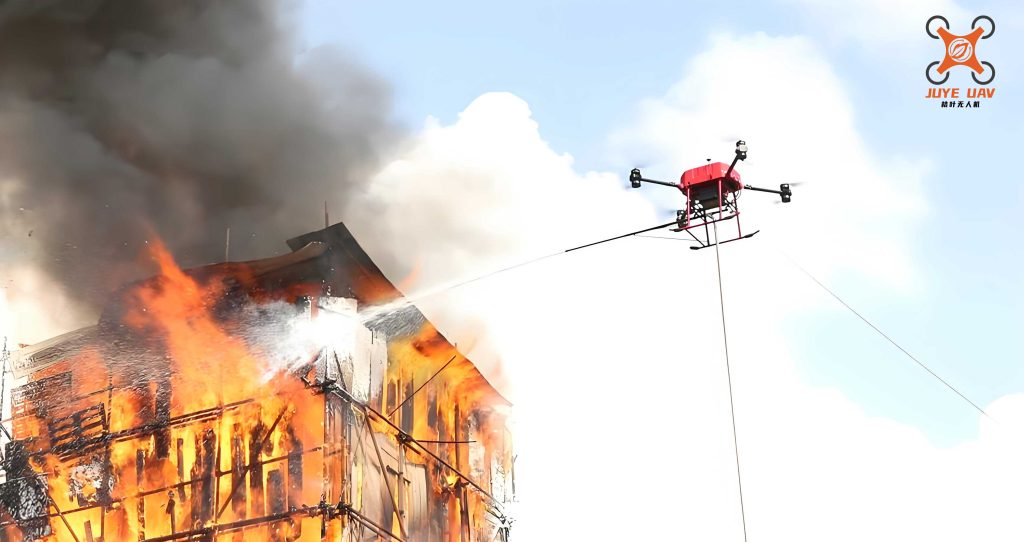
Beyond observation, specialized fire UAV platforms are being developed for direct intervention. While large tankers handle bulk drops, UAVs offer precision. They can deliver water, foam, or fire retardant to protect specific high-value assets or to cool hotspots threatening fireline containment. Perhaps more innovatively, UAVs can be used for aerial ignition, executing precise backburns or burnout operations by dropping plastic sphere dispensers (PSDs) or other incendiary devices. This creates controlled firelines to starve the main fire of fuel, a tactic where the precision and lower cost of a fire UAV are distinct advantages over manned helicopters.
Communication Relay and Network Extension
Mountainous terrain and vast fire perimeters often disrupt traditional radio communication, creating dangerous gaps for ground crews. A fire UAV can be deployed as an airborne cellular or radio repeater, creating a temporary, mobile communications network. By hovering at altitude, it establishes line-of-sight links between isolated crews and the command post, ensuring continuous voice and data exchange. This application of the fire UAV directly enhances personnel safety and operational coordination.
Logistical Support and Search & Rescue (SAR)
UAVs can transport critical supplies to firefighters in remote or inaccessible areas, delivering items like batteries, medical kits, water, or food without risking personnel on hazardous ground routes. In SAR scenarios following a wildfire or during a prescribed fire, a fire UAV with thermal imaging becomes an invaluable tool for locating missing individuals. The thermal sensor can detect a human heat signature amidst cool ash or dense undergrowth day or night, drastically reducing search times and increasing the probability of a successful rescue.
| Application Phase | Primary UAV Function | Key Enabling Technology | Operational Benefit |
|---|---|---|---|
| Pre-Ignition & Initial Attack | Patrol, lightning-strike detection, rapid initial assessment. | Long-endurance airframes, autonomous patrol software, sensitive thermal sensors. | Enables earlier detection and faster, more informed initial response. |
| Active Firefighting | Perimeter mapping, hotspot detection, spread prediction, communication relay. | Real-time Kinematic (RTK) GPS, high-definition thermal imaging, live video downlink, mesh radio payloads. | Enhances situational awareness, improves ground crew safety, optimizes resource deployment. |
| Direct Suppression Support | Precision delivery of water/retardant, aerial ignition for backfiring. | Heavy-lift platforms, precision release mechanisms, GPS-guided flight paths. | Provides targeted intervention, supports containment strategies, protects specific assets. |
| Post-Fire & SAR | Hotspot mop-up verification, damage assessment, search for missing persons. | High-resolution visual/thermal cameras, data analytics software for change detection. | Ensures fire is fully extinguished, accelerates damage surveys, enhances SAR efficacy. |
Current Limitations and Trajectory for Future Development
Despite the clear advantages, the operationalization of fire UAV technology faces significant hurdles. From my analysis, these limitations can be categorized and addressed through focused research and development.
Persistent Technological and Operational Constraints
The most acute limitation remains Endurance & Payload (Ep). The energy density of current battery technology restricts most multirotor fire UAV systems to flight times of 30-60 minutes under load, necessitating frequent rotations and complicating sustained operations. Payload capacity limits the size and weight of suppressant tanks or sensor suites. Furthermore, Communication Stability (Cσ) in the electromagnetically noisy, terrain-obstructed fire environment is not guaranteed. Regulatory airspace integration, especially during large incidents with numerous manned aircraft, poses a persistent operational challenge. Finally, the cognitive load on pilots managing complex sensor data while safely flying the UAV requires significant training and can lead to human error.
Pathways for Advancement and Integration
The future of the fire UAV lies in overcoming these constraints through technological innovation and smarter systems integration. I envision progress in several key areas:
1. Propulsion and Energy Systems: Research into hybrid gas-electric powertrains, hydrogen fuel cells, and advanced battery chemistries (e.g., solid-state) is critical to break the endurance ceiling. The goal is to develop a fire UAV that can operate for multiple hours, not just minutes.
2. Autonomous Swarm Intelligence: The future lies not in single, complex UAVs, but in coordinated swarms of simpler, cheaper units. A swarm of fire UAV agents could collaboratively map a fire perimeter, establish a distributed communication mesh, or perform distributed sensing. Control algorithms for such swarms, ensuring collision avoidance and collective goal achievement, are an active area of research. The collective behavior can be inspired by nature, using modified Boid-like rules for cohesion, separation, and alignment towards a mission objective.
3. Advanced Sensor Fusion and AI-Driven Analytics: Onboard processing power will increase, enabling real-time sensor fusion (e.g., LiDAR for 3D structure + thermal for heat). Machine learning algorithms will automatically identify threats (e.g., spotting a new fire ignition, recognizing a compromised structure, locating a person in distress) from the sensor data stream, alerting operators to critical information rather than forcing them to find it in a flood of video.
4. Robust Communication Networks: Leveraging 5G networks where available and developing advanced, frequency-agile mesh radio protocols will ensure resilient command and data links. Satellite communication modules will provide backup connectivity in the most remote areas.
5. Standardization and Interoperability: For widespread adoption, fire UAV systems must adhere to common data standards and communication protocols, allowing different agencies and different UAV models to share information seamlessly on the fireground.
Conclusion
The ascent of the fire UAV from a niche tool to a cornerstone of modern emergency response is undeniable. Its ability to provide unparalleled situational awareness, extend communication networks, deliver targeted resources, and perform dangerous reconnaissance has already saved lives and property. The quantitative framework for assessing its efficacy—spanning coverage, data fidelity, communication stability, autonomy, and endurance—provides a roadmap for both procurement and continued technological refinement. While challenges related to flight time, payload, and seamless airspace integration persist, the trajectory of innovation points toward a future where autonomous swarms of fire UAV systems work in concert with manned assets and ground crews, creating a smarter, safer, and more effective firefighting force. The ongoing development in energy systems, artificial intelligence, and robust communications will not merely incrementally improve existing capabilities but will undoubtedly unlock novel applications, further cementing the role of the unmanned aerial vehicle as an indispensable guardian in the face of fire and disaster.