
With the maturation of UAV (Unmanned Aerial Vehicle) drone technology, its application has gradually expanded into numerous fields. Within the freight and logistics industry, UAV drones demonstrate significant application potential due to their advantages of high flexibility and rapid response times. Chengdu, a pivotal logistics hub in southwestern China, characterized by complex terrain and continuously growing logistical demands, presents a vast and promising space for the deployment of UAV drones. This article delves into the application of UAV drones within Chengdu’s freight logistics ecosystem, analyzing current logistics practices, showcasing practical implementations, and exploring the technological, managerial, and policy dimensions that shape its future.
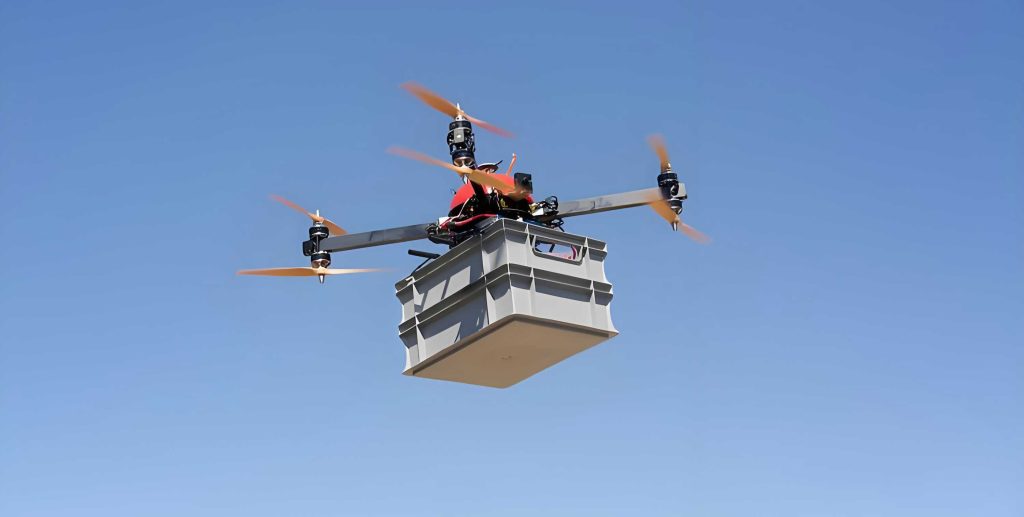
Current Logistics Landscape and the Demand for UAV Drone Applications
1.1 The Status Quo of Chengdu’s Freight Logistics
Chengdu stands as a critical transportation and logistics nexus in southwestern China. The sector has shown marked development in recent years. Statistical data indicates a stable growth trend in total freight volume over the past five years, with an average annual growth rate of approximately 8%. The modal split of transportation is dominated by road transport, which handles over 70% of the cargo volume, followed by rail (around 20%) and air transport (about 10%). In terms of infrastructure, Chengdu hosts several large-scale logistics parks and distribution centers equipped with advanced warehousing facilities, catering to diverse storage and transshipment needs.
The dominance of road transport, while reliable, introduces challenges such as traffic congestion, variable transit times, and limitations in reaching areas with underdeveloped road networks. This creates specific gaps in service that emerging technologies like UAV drones are poised to address.
| Transport Mode | Approx. Market Share | Key Advantages | Primary Limitations |
|---|---|---|---|
| Road Transport | >70% | Extensive network, door-to-door flexibility, low cost for short hauls. | Susceptible to congestion, variable speed, carbon emissions. |
| Rail Transport | ~20% | High capacity, cost-effective for bulk goods over long distances. | Fixed infrastructure, less flexible for last-mile delivery. |
| Air Transport | ~10% | Extremely fast for long-distance, high-value cargo. | High cost, limited by airport infrastructure and capacity. |
| UAV Drones (Emerging) | <1% (Growing) | Direct point-to-point, avoids ground congestion, fast for short/medium hauls. | Regulatory restrictions, payload/range limits, weather sensitivity. |
1.2 Potential Demand for UAV Drone Deployment
The evolution of Chengdu’s logistics sector has increasingly turned attention towards UAV drones. Their inherent ability to bypass terrestrial traffic, coupled with rapid deployment, offers solutions to persistent issues in traditional logistics, particularly in specialized scenarios.
A. Fresh Agricultural Product Delivery: The rural peripheries of Chengdu are vital agricultural production bases. However, their transportation infrastructure is often less developed. Traditional delivery of perishable goods from these areas to urban centers can be time-consuming, compromising freshness. Surveys suggest that average delivery time using conventional methods can be around 3 hours. UAV drone delivery can potentially reduce this to approximately 1 hour. The impact on quality and economics is significant. It is estimated that using UAV drones for such deliveries can reduce the spoilage rate of fresh produce to as low as 5%, substantially boosting economic returns. The time-saving benefit can be modeled simply:
$$t_{savings} = t_{traditional} – t_{UAV}$$
Where typically, \( t_{traditional} \approx 3 \) hours and \( t_{UAV} \approx 1 \) hour, resulting in \( t_{savings} \approx 2 \) hours.
Furthermore, the value preservation can be expressed as a reduction in loss rate \( \Delta L \):
$$\Delta L = L_{traditional} – L_{UAV}$$
If \( L_{traditional} \) is, for instance, 15% and \( L_{UAV} = 5\% \), then \( \Delta L = 10\% \), representing a major improvement in supply chain efficiency.
B. Emergency and Disaster Relief Logistics: UAV drones hold immense value in delivering critical supplies during emergencies such as earthquakes or floods, where ground infrastructure is damaged or inaccessible. Unconstrained by ground conditions, UAV drones can swiftly transport medicine, food, and other essentials to affected populations. For example, during a flooding event in the Chengdu region, UAV drones were instrumental in delivering aid, showcasing their role as a resilient logistics backbone when traditional systems fail. The utility function \( U_{emergency} \) for UAV drones in such contexts is exceptionally high due to the criticality of time \( t \) and access \( A \):
$$U_{emergency} = f(\frac{1}{t}, A)$$
Where UAV drones maximize \( U \) by minimizing \( t \) and maximizing access \( A \) where \( A_{traditional} \to 0 \).
Application Practices of UAV Drones in Chengdu’s Freight Logistics
2.1 Case Analysis of UAV Drone Logistics
Recent years have seen tangible applications of UAV drones in Chengdu’s logistics landscape, transitioning from theory to practice.
Case 1: Inter-Provincial Trunk-and-Branch Route Verification: A significant test flight involved a large, four-engine civil UAV drone. This UAV drone completed a cargo flight from a Chengdu airport to an airport in a mountainous region, carrying a payload of high-value, time-sensitive goods (e.g., live seafood). The flight duration was about 1.5 hours, cutting the traditional land transport time by over 50%. This operation validated a “province-to-province” air-to-air relay model, where goods were flown into Chengdu via conventional aviation and then transferred to the UAV drone for the final leg into challenging terrain. The UAV drone used had a maximum take-off weight of 4.35 tons and a payload capacity of 1.8 tons, with a range exceeding 1,500 km under specific loads. This established a reliable “aerial supply chain channel” for fresh and emergency goods.
Case 2: Urban Logistics during Major Events: During a large international horticultural exposition held in Chengdu, a new urban district deployed UAV drones for food and beverage delivery within the main venue. Multiple UAV drone delivery routes were established to serve visitors, demonstrating the potential for UAV drones in dense urban environments and for on-demand urban logistics, providing valuable operational experience.
| Case Type | UAV Drone Type | Max Payload | Effective Range | Primary Cargo | Time Efficiency Gain |
|---|---|---|---|---|---|
| Trunk/Branch Logistics | Large Fixed-Wing Multi-engine | 1.5 – 1.8 tons | >1500 km | Fresh produce, Emergency supplies | >50% reduction vs. road |
| Urban Last-Mile | Medium Multi-rotor | 5 – 10 kg | 10 – 20 km | Retail goods, Food | 60-70% reduction in dense traffic |
2.2 Technological and Managerial Enablers for UAV Drone Cargo Operations
The effective application of UAV drones rests on twin pillars: technological advancement and robust management frameworks.
Technological Support: Key technological bottlenecks in payload, endurance, and intelligence are being continuously overcome. The large UAV drones mentioned represent progress in capacity. Simultaneously, advancements in autonomous flight, sense-and-avoid systems, and AI-driven route optimization enhance safety and reliability. Communications technology, particularly integration with 5G and IoT networks, ensures real-time data transmission and control, allowing for dynamic monitoring and adjustment of UAV drone fleets. The overall system efficiency \( \eta_{system} \) can be considered a function of individual technological factors:
$$\eta_{system} = \eta_{payload} \cdot \eta_{navigation} \cdot \eta_{communication} \cdot \eta_{energy}$$
Where each \( \eta \) factor represents the efficiency contribution from payload design, autonomous navigation, communications reliability, and energy/power systems, respectively.
Managerial and Regulatory Support: Safe and efficient operation requires clear regulatory guidelines for airspace access, flight altitudes, routes, and operator licensing. The establishment of dedicated low-altitude logistics corridors or specific operational zones is a critical management innovation. Furthermore, operational management systems for fleet coordination, maintenance, and ground infrastructure (e.g., vertiports, charging stations) are essential. A simplified model for airspace capacity \( C \) for UAV drone logistics corridors can be conceptualized as:
$$C = N \cdot \frac{v}{d} \cdot T_{op}$$
Where \( N \) is the number of parallel lanes, \( v \) is the average UAV drone speed, \( d \) is the minimum safe separation distance, and \( T_{op} \) is the daily operational time window. Optimizing \( C \) is a key managerial challenge.
| Application Scenario | Key Advantage of UAV Drones | Primary KPI Metric | Typical Performance Target |
|---|---|---|---|
| Perishable Goods Delivery | Speed & Freshness Preservation | Reduction in Average Delivery Time; Reduction in Spoilage Rate | Time cut by >50%; Spoilage <5% |
| Emergency Relief | Access & Speed | Time to First Delivery (TTFD) in inaccessible zones | TTFD < 2 hours post-alert |
| Urban Last-Mile E-commerce | Congestion Avoidance | On-Time Delivery Rate; Cost per Delivery | On-Time >99%; Cost competitive with ground |
| Inter-facility Trunking | Bypassing Terrain | Payload-Range Product; Operational Availability | Maximize ton-km; Availability >95% |
Development Prospects for UAV Drones in Chengdu’s Logistics
The future trajectory for UAV drones in this domain is shaped by trends in technology, application diversification, and market forces.
1. Technological Trajectory: Continuous improvements in battery energy density, aerodynamic design, and composite materials will extend the range and payload of UAV drones. We can expect a family of UAV drones catering to different segments, from micro-delivery UAV drones to heavy-lift cargo UAV drones. The relationship between payload \( W \) and range \( R \) is often a fundamental design trade-off, approximated for electric UAV drones by the Breguet-type equation modified for batteries:
$$R = \frac{\eta_{total} \cdot E_{batt}}{g \cdot (W/SFC)} \cdot \ln\left(\frac{m_{start}}{m_{end}}\right)$$
Where \( \eta_{total} \) is total powertrain efficiency, \( E_{batt} \) is battery energy, \( g \) is gravity, \( W/SFC \) is related to specific energy consumption, and the logarithmic term involves the mass ratio. Advances directly increase \( E_{batt} \) and \( \eta_{total} \), pushing the frontier of \( R \) for a given \( W \).
2. Expansion of Application Scenarios: Beyond current uses, UAV drones will find roles in intra-campus logistics, industrial part delivery between manufacturing sites, and regular scheduled cargo routes to remote townships. Integration with smart city infrastructure and AI-driven logistics platforms will enable highly responsive and adaptive UAV drone logistics networks.
3. Market Potential: Chengdu’s position as a growing mega-city and regional hub ensures sustained and diversified logistics demand. The consumer and business push for faster, more reliable delivery will make UAV drone-based solutions increasingly attractive from a total cost and service quality perspective. The addressable market volume \( V_{market} \) for UAV drone logistics can be modeled as a fraction of the total logistics market \( V_{total} \) that is sensitive to time \( S_t \) and located in areas suitable for UAV drone operation \( G_{UAV} \):
$$V_{market} = V_{total} \cdot S_t \cdot G_{UAV}$$
All three factors are expected to grow in Chengdu’s context.
Challenges and Strategic Countermeasures
Despite the promising outlook, the widespread adoption of UAV drones for freight in Chengdu faces several hurdles.
| Challenge Category | Specific Issues | Proposed Strategies & Solutions |
|---|---|---|
| Safety & Regulation | Operational safety in complex environments (weather, interference). | Enhance UAV drone sense-and-avoid tech; Implement robust UTM (Unmanned Traffic Management) for real-time monitoring and deconfliction. |
| Restrictive airspace management and complex approval processes. | Advocate for progressive regulation; Establish permanent low-altitude logistics corridors; Streamline flight approval via digital platforms. | |
| Technical & Operational | Payload and range limitations for economic viability. | Invest in R&D for next-gen batteries (e.g., solid-state), hydrogen fuel cells, and aerodynamic efficiency. |
| Economic & Infrastructural | High initial investment and operational costs; Lack of ground infrastructure. | Develop scalable, shared logistics UAV drone networks to amortize costs. Plan and invest in vertiport/charging grid infrastructure. |
| Public & Social | Noise concerns, privacy issues, and public acceptance. | Engage in community outreach; Design quieter UAV drone propulsion; Enforce strict data privacy and flight path regulations. |
From a strategic planning perspective, optimizing the UAV drone logistics network involves solving a routing and scheduling problem that minimizes total cost \( C_{total} \) subject to constraints like payload \( P_{max} \), range \( R_{max} \), and time windows \( T_{window} \). A simplified objective function for a fleet of UAV drones \( k \) serving demand points \( i,j \) could be:
$$\text{Minimize } C_{total} = \sum_{k} \sum_{i} \sum_{j} (c_{ij}^k \cdot x_{ij}^k) + \text{(Fixed Fleet Costs)}$$
Subject to:
$$\sum_{i} q_i \cdot y_i^k \leq P_{max}^k \quad \forall k$$
$$\sum_{(i,j) \in \text{route } k} d_{ij} \leq R_{max}^k \quad \forall k$$
$$t_i^k \in T_{window}^i \quad \forall i,k$$
Where \( x_{ij}^k \) is a binary decision variable for UAV drone \( k \) traveling from \( i \) to \( j \), \( c_{ij}^k \) is the associated cost, \( q_i \) is demand at point \( i \), \( y_i^k \) is an assignment variable, \( d_{ij} \) is distance, and \( t_i^k \) is arrival time.
Conclusion
UAV drones are emerging as a disruptive force in Chengdu’s freight logistics sector. Driven by dual engines of technological innovation and managerial adaptation, UAV drones offer compelling advantages in enhancing efficiency, reducing costs for specific segments, and providing resilient solutions for special scenarios like emergency response and perishable goods delivery. The practical cases in trunk routing and urban delivery underscore this transition from concept to operational reality. While challenges related to safety regulation, technical limits, and public acceptance remain significant, they are addressable through focused R&D, progressive policy-making, and strategic infrastructure investment. As technology continues to advance and the regulatory environment matures, UAV drones are poised to play an increasingly substantial role. Their integration promises to propel Chengdu’s logistics industry toward a more intelligent, efficient, and sustainable future, solidifying the city’s competitive edge as a modern logistics hub. The journey of UAV drones in this landscape is just beginning, and its full potential will unfold through continued collaboration between industry, academia, and government.