
As a seasoned professional in firefighting and rescue operations, I have observed firsthand the escalating risks in the chemical industry, where hazardous materials pose constant threats of fires, explosions, and toxic leaks. Traditional rescue methods often fall short in such volatile environments due to limited access, delayed information, and high personnel risk. In recent years, the advent of drone technology, particularly fire UAVs, has revolutionized our approach, offering agility, rapid response, and adaptability. This article delves into my perspective on the critical importance, diverse applications, inherent challenges, and optimization strategies for fire UAVs in chemical firefighting and rescue, aiming to provide a comprehensive analysis with empirical insights, supplemented by tables and formulas to encapsulate key concepts.
The significance of fire UAV technology in chemical firefighting cannot be overstated. Chemical plants handle flammable, explosive, and toxic substances, making accidents potentially catastrophic. Conventional救援 struggles with slow situational awareness, as ground teams face obstacles like collapsed structures,火势蔓延, and gas扩散. Fire UAVs, however, excel by penetrating危险 zones that are inaccessible to humans or vehicles. Equipped with multi-sensor payloads, they capture real-time data on火情, structural integrity, and gas concentrations, transmitting it instantly to command centers. This enhances the timeliness, comprehensiveness, and safety of information acquisition compared to manual methods. Mathematically, we can express the efficiency gain using a simple formula for reconnaissance time reduction: $$ \Delta t = t_{\text{manual}} – t_{\text{UAV}} $$ where \( t_{\text{manual}} \) is the time for human scouts to assess a scene, and \( t_{\text{UAV}} \) is the drone’s time, typically much lower due to aerial mobility. For instance, if \( t_{\text{manual}} = 60 \text{ minutes} \) and \( t_{\text{UAV}} = 10 \text{ minutes} \), the efficiency improvement is \( \Delta t = 50 \text{ minutes} \), drastically accelerating decision-making. This underscores why fire UAVs are indispensable in modern chemical rescue workflows.
In terms of specific applications, fire UAVs serve multiple roles that enhance operational efficacy. I will categorize these into surveillance and reconnaissance, material transportation, fire suppression, and personnel search and rescue, each illustrated with tables and formulas.
Surveillance and Reconnaissance
Fire UAVs revolutionize monitoring by deploying advanced sensors. During routine inspections, they identify equipment faults, preventing accidents. In emergencies, they provide aerial panoramas, tracking火势蔓延, damage assessment, and weather changes. Small fire UAVs can navigate tight spaces like pipelines and tanks, overcoming human盲区. Specialized化学检测 drones with gas sensors enable real-time leak detection, pinpointing locations and measuring concentrations. To quantify the risk reduction, consider a formula for hazard detection probability: $$ P_{\text{detect}} = 1 – e^{-\lambda \cdot A \cdot t} $$ where \( \lambda \) is the sensor sensitivity, \( A \) is the area covered, and \( t \) is the operation time. Fire UAVs increase \( A \) and \( \lambda \), boosting \( P_{\text{detect}} \). Table 1 summarizes common sensor configurations for fire UAVs in surveillance.
| Sensor Type | Function | Typical Fire UAV Applications |
|---|---|---|
| High-definition visible light camera | Captures detailed imagery for daytime assessment | Monitoring火势 spread, structural damage |
| Infrared thermal imaging camera | Detects heat signatures through smoke and darkness | Identifying hot spots, locating hidden fires |
| Gas detection sensors (e.g., for VOCs,有毒 gases) | Measures concentrations of hazardous chemicals | Leak localization, air quality monitoring |
| Multi-spectral imaging systems | Combines spectra for enhanced analysis | Assessing chemical spills, vegetation火risk |
The integration of these sensors allows fire UAVs to deliver a comprehensive situational picture. For example, the coverage area \( A \) can be modeled as \( A = v \cdot t \cdot w \), where \( v \) is the fire UAV’s velocity, \( t \) is time, and \( w \) is the sensor swath width. Optimizing these parameters maximizes reconnaissance efficiency.
Material Transportation
Fire UAVs provide agile aerial logistics in disrupted environments. When ground routes are blocked by火势 or debris, large cargo drones transport essential supplies like fire extinguishing agents, protective gear, and medical kits. They serve as an “airborne lifeline,” especially in isolated scenarios. Small fire UAVs can relay communication or deliver lightweight items. The payload capacity is critical; we can express the transport efficiency as: $$ E_{\text{transport}} = \frac{m_{\text{payload}}}{t_{\text{round-trip}}} $$ where \( m_{\text{payload}} \) is the mass carried, and \( t_{\text{round-trip}} \) is the time for a delivery cycle. By using fire UAVs with higher \( m_{\text{payload}} \) and lower \( t_{\text{round-trip}} \), we enhance救援 support. Table 2 outlines typical transport roles for fire UAVs.
| Fire UAV Type | Payload Capacity | Common Missions |
|---|---|---|
| Large multi-rotor cargo drone | Up to 50 kg | Delivering foam concentrates, tools, emergency supplies |
| Medium hybrid VTOL drone | 10-20 kg | Transporting sensors, communication relays |
| Small quadcopter | 1-5 kg | Carrying medical items,信息传递 in confined areas |
In practice, the use of fire UAVs for transportation reduces exposure risks for rescue personnel. For instance, if a toxic leak requires sealants, a fire UAV can deliver them directly, minimizing human entry into danger zones.
Fire Suppression Operations
Fire UAVs actively combat flames through various means. Large models equipped with water cannons or extinguishing agents can target火点 precisely. Swarms of fire UAVs can coordinate to form a layered attack strategy. The effectiveness of灭火 can be modeled using a formula for fire suppression rate: $$ R_{\text{suppress}} = \frac{Q_{\text{agent}} \cdot \eta}{A_{\text{fire}}} $$ where \( Q_{\text{agent}} \) is the flow rate of extinguishing agent, \( \eta \) is the efficiency factor (dependent on accuracy), and \( A_{\text{fire}} \) is the fire area. Fire UAVs improve \( \eta \) by精准投放. Table 3 details灭火 capabilities of fire UAVs.
| Fire UAV Class | Suppression Method | Typical Range/Capacity |
|---|---|---|
| Heavy-lift灭火 drone | High-pressure water mist, foam投射 | Range up to 100 m, payload of 20-30 L |
| Medium multi-rotor | Fire-retardant blankets,干粉投放 | Coverage of small areas, e.g., 10 m² |
| Lightweight tactical drone | Guided灭火弹 deployment | Precision strikes on isolated火点 |
Moreover, fire UAVs can operate in coordination, such as using a leader-follower model where one fire UAV scouts and others suppress. This synergy enhances overall灭火效能.
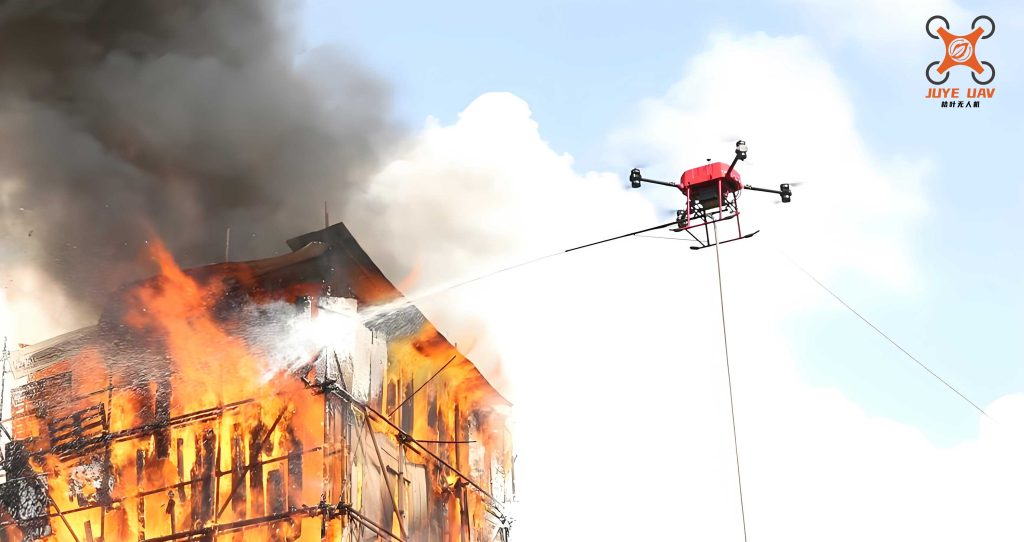
The image above illustrates a fire UAV in action, showcasing its compact design and potential for deployment in harsh environments. This visual underscores the practical implementation of these technologies in real-world scenarios.
Personnel Search and Rescue
In chemical accidents, locating trapped individuals is paramount. Fire UAVs equipped with thermal cameras and audio sensors can scan vast areas quickly, even through smoke or darkness. The search efficiency can be quantified as: $$ S_{\text{efficiency}} = \frac{N_{\text{found}}}{t_{\text{search}} \cdot A_{\text{zone}}} $$ where \( N_{\text{found}} \) is the number of survivors located, \( t_{\text{search}} \) is the time taken, and \( A_{\text{zone}} \) is the search area. Fire UAVs increase \( N_{\text{found}} \) and reduce \( t_{\text{search}} \). Advanced algorithms for autonomous navigation further boost this. Table 4 summarizes search and rescue features of fire UAVs.
| Technology on Fire UAV | Function | Benefit in Chemical Incidents |
|---|---|---|
| Infrared thermal imaging | Detects body heat signatures | Locates survivors in low-visibility conditions |
| High-sensitivity microphones | Captures faint呼救 sounds | Identifies trapped persons in rubble |
| AI-based视觉识别 | Automates target detection | Speeds up搜索 in complex layouts |
| Payload droppers | Delivers emergency supplies | Provides aid to survivors before extraction |
From my experience, fire UAVs have proven invaluable in time-critical搜救 missions, often achieving outcomes unattainable by ground teams alone.
Despite these advantages, fire UAV technology faces significant challenges in chemical firefighting environments. I categorize these into complex flight conditions, limited battery endurance, and communication interference, each analyzed with formulas and tables.
Complex Flight Environments
Chemical accident sites present extreme conditions that hinder fire UAV operations. High temperatures can degrade materials and electronics, while turbulent热气流 affects stability. Smoke and dust obscure sensors, reducing navigation accuracy. Toxic gases may corrode components or cause electromagnetic interference. We can model the environmental impact on flight performance using a risk factor: $$ R_{\text{env}} = \alpha \cdot T + \beta \cdot S + \gamma \cdot G $$ where \( T \) is temperature deviation from nominal, \( S \) is smoke density, \( G \) is gas concentration, and \( \alpha, \beta, \gamma \) are weighting coefficients. High \( R_{\text{env}} \) values indicate greater operational risk for fire UAVs. Additionally, structural obstacles like pipes and buildings create signal shadows, complicating control. Table 5 outlines environmental challenges for fire UAVs.
| Environmental Factor | Impact on Fire UAV | Mitigation Strategies |
|---|---|---|
| High heat and radiation | Material fatigue, sensor malfunction | Use heat-resistant alloys, active cooling |
| Dense smoke and particulates | Reduced visibility, impaired optics | Employ infrared/Lidar sensors, filter systems |
| Toxic chemical leaks | Corrosion, electrostatic discharges | Apply protective coatings, shielding |
| Complex electromagnetic fields | Communication dropout,导航 errors | Implement抗干扰 protocols, redundant links |
These factors necessitate robust design and adaptive algorithms for fire UAVs to maintain reliability.
Limited Battery Endurance
Battery life remains a critical bottleneck for fire UAVs. Most commercial drones offer only 20-40 minutes of flight per charge, insufficient for prolonged救援 operations. Frequent recharging or battery swaps disrupt mission continuity. The operational time can be expressed as: $$ T_{\text{op}} = \frac{E_{\text{battery}}}{P_{\text{load}} + P_{\text{flight}}} $$ where \( E_{\text{battery}} \) is the battery energy, \( P_{\text{load}} \) is the power for payloads, and \( P_{\text{flight}} \) is the power for propulsion. To extend \( T_{\text{op}} \), we need higher \( E_{\text{battery}} \) or lower power consumption. Moreover, lithium batteries pose fire risks if damaged, adding safety concerns. Research into alternative energy sources, like fuel cells, is crucial. Table 6 compares battery technologies for fire UAVs.
| Battery Type | Energy Density (Wh/kg) | Typical Endurance for Fire UAV | Safety Considerations |
|---|---|---|---|
| Lithium-polymer (LiPo) | 150-200 | 20-40 minutes | Risk of thermal runaway, requires careful management |
| Lithium-sulfur (Li-S) | 300-500 | Potential for 60+ minutes | Improved safety, but still in development |
| Fuel cell systems | 500-1000 | Hours of operation | Lower fire hazard, but higher complexity and cost |
Enhancing endurance is vital for fire UAVs to sustain missions in large-scale chemical incidents.
Communication Interference and Control Risks
Reliable communication is essential for fire UAV control, but chemical plants often have electromagnetic interference from metal structures and equipment. This can cause signal loss, leading to失控. The signal-to-noise ratio (SNR) can be modeled as: $$ \text{SNR} = \frac{P_{\text{signal}}}{P_{\text{noise}} + P_{\text{interference}}} $$ where \( P_{\text{signal}} \) is the transmitted power, \( P_{\text{noise}} \) is ambient noise, and \( P_{\text{interference}} \) is from external sources. Low SNR degrades control reliability. Additionally, cybersecurity threats pose risks of hijacking or data breaches. To address this, fire UAVs require robust encryption and backup systems like inertial navigation. Table 7 summarizes communication challenges and solutions for fire UAVs.
| Challenge | Effect on Fire UAV | Potential Solutions |
|---|---|---|
| Multipath fading in metal-rich areas | Signal attenuation, control delays | Use diversity antennas,频跳 spread spectrum |
| Electromagnetic noise from machinery | Data corruption, link dropout | Implement shielding, error-correcting codes |
| Jamming or spoofing attacks | Loss of control, mission compromise | Adopt military-grade encryption, AI-based anomaly detection |
| Limited line-of-sight in complex terrain | Reduced range, communication gaps | Deploy relay drones, satellite links (e.g.,北斗) |
Strengthening communication security is imperative for the safe deployment of fire UAVs in high-stakes environments.
To enhance the efficacy of fire UAV technology in chemical firefighting, I propose strategies centered on optimizing design, improving training, and bolstering communication security, supported by tables and formulas.
Optimizing Fire UAV Design and Performance
Advancements in materials, aerodynamics, and systems integration can boost fire UAV resilience. For instance, using composite materials reduces weight while maintaining strength. The structural efficiency can be quantified as: $$ \text{SE} = \frac{\sigma}{\rho} $$ where \( \sigma \) is the material strength and \( \rho \) is density. Higher SE values allow for longer flight times or larger payloads. Additionally, modular designs enable quick reconfiguration for different tasks. In terms of flight control, implementing redundant sensors and AI-driven避障 algorithms enhances autonomy. The control system reliability can be expressed as: $$ R_{\text{system}} = 1 – \prod_{i=1}^{n} (1 – R_i) $$ where \( R_i \) is the reliability of each subsystem. By increasing \( R_i \) through robust engineering, we improve overall fire UAV dependability. Table 8 outlines key design optimizations for fire UAVs.
| Aspect | Improvement Approach | Expected Benefit for Fire UAV |
|---|---|---|
| Airframe materials | Carbon fiber, magnesium alloys | Lightweight, corrosion-resistant, high strength-to-weight ratio |
| Propulsion system | Brushless motors, efficient propellers | Increased thrust, lower power consumption |
| Sensor integration | Miniaturized multi-spectral packages | Enhanced data acquisition in compact form |
| Power management | Hybrid能源 systems, smart battery management | Extended endurance, reduced fire risk |
These innovations will enable fire UAVs to operate more effectively in extreme conditions.
完善 Fire UAV Operator Training
Effective training is crucial for maximizing fire UAV potential. A structured curriculum should cover theory, simulation, and实战 drills. The competency level can be modeled as: $$ C = w_1 \cdot K + w_2 \cdot S + w_3 \cdot E $$ where \( K \) is knowledge score, \( S \) is simulation performance, \( E \) is field experience, and \( w_1, w_2, w_3 \) are weights. Regular assessments ensure skill retention. Table 9 presents a sample training framework for fire UAV operators.
| Training Phase | Content Focus | Duration (Hours) | Assessment Metrics |
|---|---|---|---|
| Theoretical instruction | Aerodynamics,气象学, emergency protocols | 40 | Written exams on regulations and scenarios |
| Simulator-based practice | Virtual火场 navigation, sensor operation | 30 | Success rate in simulated missions |
| Hands-on field exercises | Live flight in controlled hazardous environments | 50 | Precision in tasks like物资投送 or搜索 |
| Continual professional development | Updates on new fire UAV technologies | Annual 20-hour refreshers | Performance in surprise drills |
Such training ensures that operators can adeptly manage fire UAVs under pressure, reducing human error.
Strengthening Fire UAV Communication and Control Security
To mitigate interference and cyber threats, fire UAVs should employ advanced communication technologies. For example, using cognitive radio can dynamically select clean frequencies. The communication robustness can be quantified by the link availability: $$ A_{\text{link}} = \frac{T_{\text{uptime}}}{T_{\text{total}}} $$ where \( T_{\text{uptime}} \) is the time with stable connection, and \( T_{\text{total}} \) is the total mission time. Implementing redundancy, such as dual-band radios or laser links, increases \( A_{\text{link}} \). Additionally, encryption standards like AES-256 protect data integrity. Table 10 summarizes security enhancements for fire UAVs.
| Measure | Implementation | Impact on Fire UAV Operations |
|---|---|---|
| Anti-jamming techniques | 频跳, direct-sequence spread spectrum | Maintains control in electromagnetically noisy zones |
| Encryption protocols | End-to-end encryption for command and video feeds | Prevents unauthorized access or data interception |
| Redundant navigation | GPS/北斗 with inertial navigation systems (INS) | Ensures position accuracy even if signals are lost |
| AI-based threat detection | Real-time monitoring for anomalies in control signals | Early warning of potential hijacking or failures |
By adopting these strategies, fire UAVs can achieve higher reliability and safety in complex chemical fire scenarios.
In conclusion, fire UAV technology has profoundly transformed chemical firefighting and rescue, offering unparalleled capabilities in surveillance, logistics, suppression, and搜救. However, challenges like environmental extremes, battery limitations, and communication vulnerabilities persist. Moving forward, I believe that focused innovation in fire UAV design—such as developing more durable materials and longer-lasting power sources—coupled with comprehensive training and robust security frameworks, will unlock even greater potential. The integration of AI for autonomous swarming and real-time data analysis will further elevate fire UAV efficacy. As we continue to refine these systems, fire UAVs are poised to become cornerstone tools in industrial safety, driving智慧化升级 in emergency response. The journey ahead involves collaboration across industries and continuous learning from实战 experiences, ensuring that fire UAVs remain at the forefront of saving lives and protecting property in the hazardous chemical sector.