
As a professional deeply involved in the integration of advanced technology into emergency response, I have witnessed firsthand the paradigm shift brought about by Unmanned Aerial Vehicles (UAVs). In the critical domain of firefighting and rescue, the application of specialized fire drone systems has evolved from a novel concept into an indispensable operational tool. The complexity and inherent danger of firegrounds, especially in urban environments with high-rise structures and industrial complexes, necessitate tools that can extend sensory and operational capabilities without jeopardizing human lives. This analysis delves into the comprehensive application, technical design, and stringent requirements for fire drone technology, presenting a detailed perspective on its current and future impact.
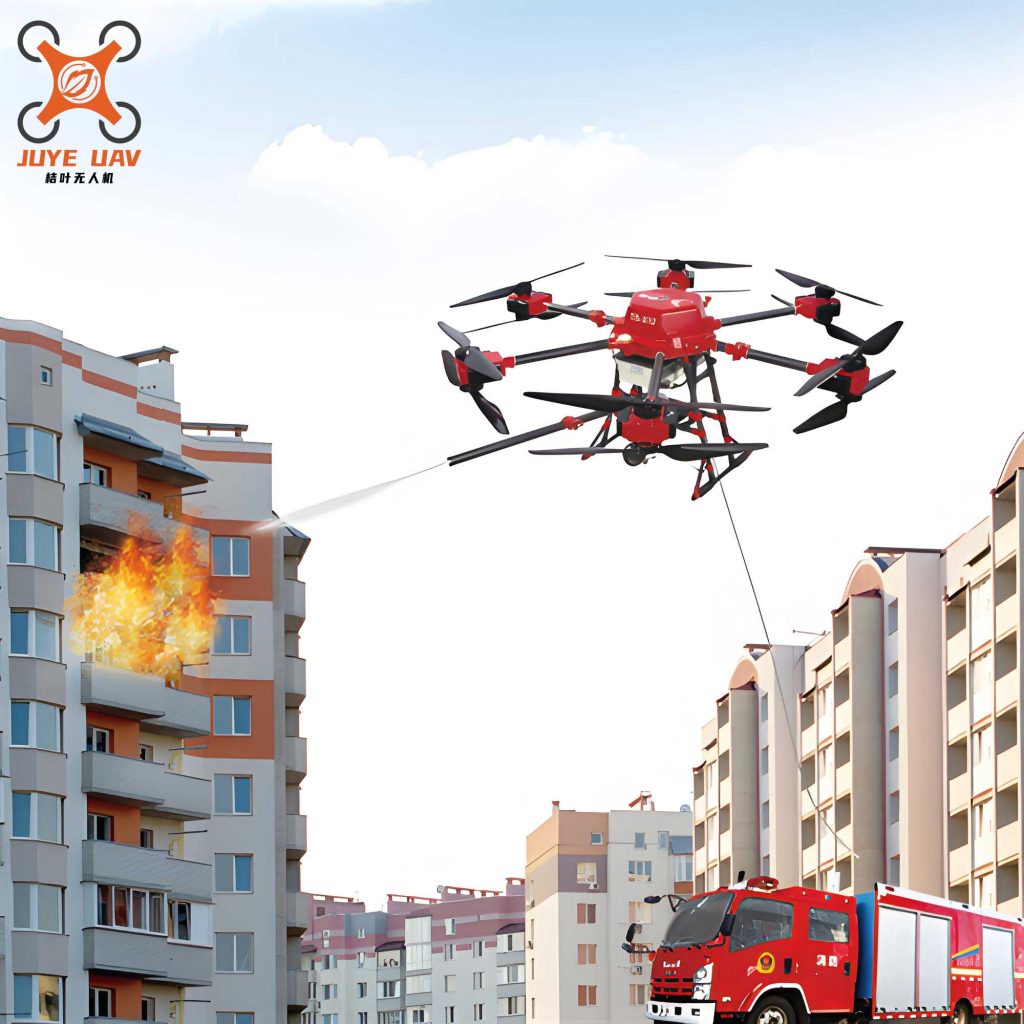
1. Conceptual Foundation and Core Advantages of Fire Drones
A fire drone is a remotely piloted or autonomously operated aerial system specifically engineered for fire service applications. Unlike generic UAVs, a true fire drone integrates robust airframes, specialized payloads, and reliable communication systems designed to withstand the extreme conditions of fire and rescue scenarios. The core subsystems include a multi-rotor or fixed-wing platform, a flight controller, a suite of sensors (visual, thermal, environmental), a secure digital data-link for real-time transmission, and a ground control station (GCS). The operational superiority of a fire drone in firefighting is anchored in two fundamental advantages:
1.1 Unmatched Operational Flexibility and Accessibility
The compact size and vertical take-off and landing (VTOL) capability of multi-rotor fire drone platforms grant them exceptional maneuverability. They can navigate through dense smoke, around structural obstructions, and into confined spaces that are completely inaccessible or prohibitively risky for ground crews and traditional aerial assets. This flexibility is quantified by performance parameters such as hover accuracy, obstacle avoidance capability, and wind resistance. The control dynamics can be expressed in terms of thrust ($T$) and torque ($\tau$) required for stable flight in turbulent, heat-induced updrafts common at fire scenes:
$$ \begin{aligned} T &= \sum_{i=1}^{n} k \cdot \omega_i^2 \\ \tau &= \sum_{i=1}^{n} (-1)^{i} \cdot d \cdot k \cdot \omega_i^2 \end{aligned} $$
where $k$ is the thrust coefficient, $\omega_i$ is the angular velocity of motor $i$, $n$ is the number of rotors, and $d$ is the distance from the center of mass. A well-designed fire drone must dynamically adjust $\omega_i$ to maintain stability despite environmental disturbances.
1.2 Expansive Aerial Intelligence, Surveillance, and Reconnaissance (ISR)
The primary value of a fire drone lies in its ability to become a “eye in the sky,” providing a comprehensive, real-time visual and data-driven picture of the incident. Equipped with high-resolution zoom cameras, wide-angle lenses, and most critically, thermal imaging cameras (TICs), the fire drone can detect hotspots, identify victims through smoke, and map fire spread. The ground control station receives this stream of data, enabling command staff to make informed, strategic decisions. The field of view (FOV) and ground sample distance (GSD) are key metrics for sensor performance:
$$ \text{GSD} = \frac{H \cdot s}{f} $$
where $H$ is the flight altitude, $s$ is the sensor pixel size, and $f$ is the focal length of the lens. A lower GSD indicates higher image detail, crucial for identifying small ignition sources or trapped individuals.
2. Systematic Design of a Fire Drone Operational System
Deploying a fire drone is not merely about launching a single aircraft; it involves deploying an integrated system. The design of this system must be driven by stringent operational requirements to ensure reliability and effectiveness in life-threatening situations.
2.1 Operational Design Requirements (ODR)
The following table outlines the minimum technical specifications for an effective tactical-level fire drone system:
| System Parameter | Minimum Requirement | Rationale |
|---|---|---|
| Flight Endurance | > 45 minutes (with standard payload) | Allows for sustained reconnaissance over a typical operational period. |
| Operational Range | > 5 km (Data Link) | Ensures control and video feed integrity over large incident sites or in urban canyons. |
| Video Transmission Latency | < 200 ms | Critical for real-time piloting and decision-making; high latency can cause pilot disorientation. |
| Sensor Suite | EO/IR (Visible & Thermal) Camera, GPS | Core sensing for day/night, all-weather intelligence gathering. |
| Environmental Resilience | IP54 or higher, Operate in up to 40°C ambient | Protection against water, dust, and high ambient temperatures near fires. |
| Data Output | Live streaming to GCS & cloud, metadata tagging | Enables shared situational awareness across multiple command nodes. |
2.2 Architectural System Design
The fire drone system architecture is tripartite:
A. Airborne Segment: This includes the UAV platform itself, housing the avionics (flight controller, GNSS, IMU), the propulsion system, the sensor payloads (gimballed camera systems), and the air-to-ground data transceiver. The platform must be designed for quick deployment, often from the back of an apparatus.
B. Ground Control Station (GCS): This is the command hub, typically a ruggedized laptop or tablet running specialized software. It displays real-time telemetry (altitude, speed, battery status, position), live video feeds, and sensor data. The software allows for mission planning, automated flight paths (waypoint navigation), and sensor control.
C. Communication Data Link: This is the critical lifeline. It uses secure, frequency-agile digital links (e.g., COFDM) to transmit high-definition video and bidirectional control signals. Redundancy and anti-interference capabilities are paramount. The link budget equation determines its reliability:
$$ P_{rx} = P_{tx} + G_{tx} + G_{rx} – L_{path} – L_{losses} $$
where $P_{rx}$ is received power, $P_{tx}$ is transmitted power, $G$ are antenna gains, $L_{path}$ is free-space path loss ($20\log_{10}(d) + 20\log_{10}(f) + 92.45$ for $d$ in km and $f$ in GHz), and $L_{losses}$ accounts for other attenuations.
3. Multifaceted Applications in Fireground and Rescue Operations
The utility of a fire drone permeates every phase of an incident response, from initial dispatch to post-incident analysis.
3.1 Initial Size-Up and Dynamic Reconnaissance
Upon arrival, a fire drone can be airborne in minutes, providing an instantaneous overhead view. This rapid size-up answers critical questions: What is the seat of the fire? Is it extending? Are there exposures? For structural fires, the fire drone can safely assess roof conditions, structural integrity, and window glass failure. In wildland urban interface (WUI) fires, it can map the fire’s head, flank, and spotting activity far ahead of ground teams.
3.2 Search and Rescue (SAR) and Victim Identification
Using thermal imaging, a fire drone can quickly scan large areas—collapsed buildings, dense forests, or flooded zones—to locate missing persons based on their heat signature. The contrast between a human body (approx. 37°C) and the ambient or background temperature is easily discernible. The thermal sensor’s performance is governed by metrics like Noise Equivalent Temperature Difference (NETD), with a lower NETD (< 50 mK) being desirable for detecting subtle temperature differences.
3.3 Hazardous Environment Monitoring and Gas Detection
Specialized payloads can turn a fire drone into a mobile environmental sensor. It can be equipped with gas detectors (for CO, H2S, VOCs, radiation) and flown into chemically contaminated or potentially explosive atmospheres to measure concentration levels without risking a Hazmat team’s entry. Data from multiple waypoints can be used to create a 3D contamination plume model.
3.4 Operational Support and Logistics
Beyond reconnaissance, a fire drone can perform active support roles. With appropriate attachments, it can deliver small critical payloads (e.g., radios, medical supplies, breathing apparatus) to trapped firefighters or civilians. It can also provide persistent lighting over a night-time operation or act as a temporary communication relay to boost radio signals in areas with poor coverage, effectively extending the operational range of ground units.
The effectiveness of a delivery or relay fire drone can be analyzed by its payload capacity versus endurance, often a trade-off described by the following relationship for electric multi-rotors:
$$ E_{total} = C \cdot V \cdot \eta $$
$$ t_{flight} \approx \frac{E_{total}}{P_{hover}} = \frac{C \cdot V \cdot \eta}{k \cdot (m_{total})^{3/2}} $$
where $C$ is battery capacity, $V$ is voltage, $\eta$ is efficiency, $P_{hover}$ is hover power, $k$ is a constant, and $m_{total}$ is the total mass (airframe + payload).
4. Stringent Technical Requirements for Operational Fire Drones
For a fire drone system to be trusted in life-or-death situations, it must meet exceptionally high standards in several key areas.
4.1 Extreme Reliability and Redundancy
System failure is not an option. This demands redundant critical systems: dual GNSS receivers, inertial navigation systems (INS) that can operate during GNSS denial, dual battery links, and fail-safe flight controllers. The probability of system loss must be minimized. Furthermore, the fire drone must be resistant to electromagnetic interference (EMI) from high-power fireground equipment like pumpers and ladder trucks.
4.2 Thermal and Environmental Hardening
A fire drone must operate in proximity to intense radiant heat. This requires materials with high melting points, active or passive cooling systems for electronics and sensors, and heat shields. The thermal protection must ensure that the internal compartment temperature ($T_{int}$) remains within operational limits despite high external radiant heat flux ($\dot{q}_{rad}^{”}$):
$$ \dot{q}_{rad}^{”} = \sigma \epsilon (T_{ext}^4 – T_{int}^4) $$
where $\sigma$ is the Stefan-Boltzmann constant and $\epsilon$ is the emissivity of the protective surface. Design must manage this heat load effectively.
4.3 Data Security and Integration
The video and data streams from a fire drone are sensitive operational intelligence. Secure, encrypted data links are mandatory to prevent interception or jamming. Moreover, the data must seamlessly integrate into existing incident command systems. This means compatibility with standard video formats (RTSP) and GIS platforms, allowing thermal overlays on maps and sharing feeds with other agencies.
4.4 Pilot Training and Standard Operating Procedures (SOPs)
The technology is only as good as its operator. Comprehensive training for fire drone pilots must go beyond basic flight skills to include airspace regulations, mission-specific sensor operation, data interpretation, and integration into tactical fireground operations. Clear SOPs must govern when, where, and how fire drones are deployed to avoid conflicts with manned aircraft (like helicopters) and ground operations.
5. Future Trajectory and Conclusion
The evolution of the fire drone is far from complete. We are moving towards increasingly autonomous systems capable of swarm operations, where multiple fire drones collaborate—one mapping the fire perimeter with LiDAR, another monitoring gas concentrations, and a third keeping visual track of firefighter crews, all coordinated by AI. Advanced sensors like hyperspectral imagers could identify specific burning materials. Integration with Building Information Modeling (BIM) could allow a fire drone to navigate inside a structure with pre-loaded floor plans while identifying structural weaknesses in real-time.
The implementation of a robust fire drone program represents a significant force multiplier for fire and rescue services. It enhances situational awareness, improves operational safety, increases the speed and efficacy of search and rescue, and provides critical data for strategic decision-making. As the technology matures and becomes more integrated into the fabric of incident command, the fire drone will undoubtedly solidify its role as a cornerstone of modern, intelligent, and effective firefighting and emergency response.