
In recent years, the rapid urbanization and proliferation of high-rise buildings and high-risk industrial complexes have significantly escalated the complexity of missions undertaken by fire and rescue services. These services, responsible for fire suppression, emergency rescue, and fire safety oversight, now face environments where the danger to personnel is substantially higher. During incidents involving hazardous chemicals, earthquake relief, flood fighting, mountain rescue, highway emergencies, and fires in large-span structures, the limitations of traditional on-the-ground reconnaissance have become starkly apparent. The safety of firefighters operating in these opaque and volatile conditions is a paramount concern.
The current configuration of firefighting equipment in many regions remains rooted in established paradigms. A lack of widespread adoption of new technological applications and advanced equipment can lead to missed critical intervention windows during emergencies, potentially exacerbating losses. For instance, in scenarios like major chemical explosions, where toxic gases pose severe and immediate threats, conventional methods of damage assessment become ineffective and far too risky for personnel. The deployment of fire drones in such situations has proven to be a game-changer. By serving as an aerial vantage point, these fire drones can safely collect real-time data from the heart of a disaster zone, transmitting crucial visual and sensor-based information back to the command center to inform strategic decision-making.
The core function of a fire drone is to act as an agile, unmanned aerial platform, providing indispensable intelligence and operational support. Its technical advantages directly address the persistent challenges of rapid, safe, and effective situational awareness in firefighting.
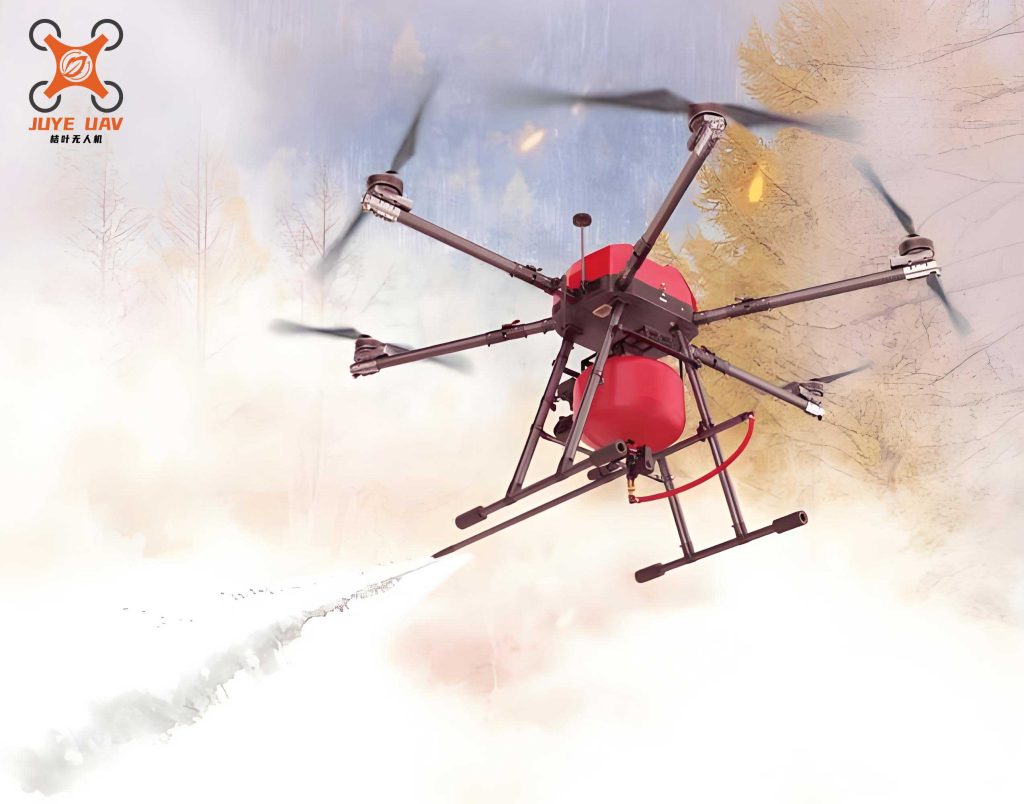
Technical Foundations and Advantages of Fire Drones
A fire drone is an unmanned aerial vehicle (UAV) operated via remote radio control or onboard programmed instructions. Its value lies in a combination of compact size, relatively low cost, operational simplicity, and minimal infrastructure requirements. Modern systems for fire service use integrate several key subsystems: a ground control station (GCS), the aerial platform itself, a gimbaled video/payload system, a microwave or digital wireless real-time transmission link, a GPS-based navigation and autopilot system, high-capacity lithium-polymer battery units, and potential 4G/5G relay links for extended range.
The operational superiority of the fire drone can be quantified and summarized through several key parameters, as outlined in the table below:
| Advantage | Technical & Operational Manifestation | Key Metrics/Formula |
|---|---|---|
| Mobility & Flexibility | Small, lightweight (often <25 kg), portable, quick deployment independent of ground vehicle access. Requires only 1-2 operators. | Deployment Time, $T_d = t_{setup} + t_{takeoff}$; Target: $T_d < 5$ min. |
| Comprehensive Field of View | Beyond-visual-line-of-sight (BVLOS) capability via data links. Provides macro and micro perspectives from various altitudes and angles. | Area Coverage Rate, $A_{rate} = \frac{v \cdot h \cdot \tan(\theta)}{t}$, where $v$ is velocity, $h$ is altitude, $\theta$ is camera FOV. |
| Operational Simplicity | Intuitive ground control software (GCS) interface. Real-time video feed accessible on PCs, tablets, or smartphones for remote monitoring. | Operator Training Threshold; often requires < 40 hours for basic proficiency. |
| Risk Mitigation | Removes personnel from immediately hazardous environments (toxic, explosive, structurally unsound). | Risk Reduction Factor, $R_{rf} = 1 – \frac{P_{drone}}{P_{manual}}$, where $P$ is probability of casualty. |
The effectiveness of a fire drone in providing situational awareness can be modeled by its ability to transmit critical information. The information value $I_v$ gathered over a mission can be conceptualized as:
$$ I_v = \int_{0}^{T} \left( \alpha \cdot R_{video}(t) + \beta \cdot S_{sensor}(t) \right) dt $$
where $T$ is the total flight time, $R_{video}(t)$ is the resolution and clarity of the video feed, $S_{sensor}(t)$ represents data from integrated sensors (thermal, gas), and $\alpha$, $\beta$ are weighting coefficients for different data types based on incident priority.
Practical Applications and Future Prospects in Firefighting
Aligning with the practical needs of fire and rescue operations, fire drones can provide solutions across four critical operational domains.
1. Disaster Reconnaissance and Assessment
The primary application is enhanced reconnaissance. Fire drones overcome terrain and environmental obstacles, providing a rapid aerial assessment where ground teams cannot safely or quickly penetrate. They exponentially increase reconnaissance efficiency, identifying key hazard factors—such as the seat of a fire, structural weaknesses, or casualty locations—to enable informed command decisions. Crucially, they perform this role while keeping personnel out of harm’s way. Beyond visual imaging, fire drones can be integrated with modular detection payloads:
- Gas Detection: Integrating sensors for combustible gases (LEL), oxygen, and toxic gases like CO, H₂S.
- Thermal Imaging: Using infrared cameras to detect heat sources through smoke, identify hotspots, and locate victims via body heat signatures.
- Environmental Sensing: Measuring wind speed/direction at various altitudes, temperature gradients, and radiation levels.
2. Direct Fire Suppression and Rescue Assistance
The next evolutionary step is employing fire drones as active intervention platforms. By carrying specialized payloads, they can tackle incidents in otherwise inaccessible areas.
- Initial Attack: Carrying water, foam, dry chemical, or CO₂ extinguishing agents to suppress incipient fires in high-rise, confined, or hazardous spaces, containing spread before ground forces establish lines. The effective payload $P_{eff}$ for a suppression drone is a key metric: $$ P_{eff} = W_{total} – (W_{frame} + W_{battery} + W_{avionics}) $$ where $W_{total}$ is the maximum takeoff weight.
- Creating Access/Pathfinding: In water, mountain, or urban collapse rescues, fire drones can deliver life-lines, communication devices, or small tools with far greater precision than traditional throw-bags or launchers. They can also safely deliver detonators for controlled breaching in hazardous zones.
- Logistics and Supply: Transporting critical supplies—such as medical kits, bottled water, respirators, or communication relays—across dangerous terrain to isolated victims or forward teams.
3. Auxiliary Support and Communication
Fire drones serve as versatile force multipliers in support roles:
- Aerial Communication Hub: Equipped with loudspeakers and microphones, they can broadcast evacuation instructions or commands more effectively than ground-based units, especially in high-rise or large-area incidents. They can also act as a temporary communication relay (airborne cell site or mesh node) to restore command networks where infrastructure is damaged.
- Illumination: Mounting high-lumen LED arrays turns a fire drone into a mobile, hovering light source for night operations.
- Emergency Mapping and Modeling: Using photogrammetry software with captured imagery, fire drones can quickly generate 2D orthomosaics and 3D models of a disaster site. This provides commanders with scaled maps for planning resource deployment and understanding terrain challenges. The ground sampling distance (GSD), which defines map resolution, is given by: $$ GSD = \frac{h \cdot s}{f} $$ where $h$ is flight altitude, $s$ is sensor pixel size, and $f$ is lens focal length.
4. Persistent Monitoring and Inspection
For both emergency and preventive functions, fire drones offer unparalleled monitoring capabilities.
- Active Incident Monitoring: Providing continuous, real-time video of fire development, structural integrity, and perimeter security over extended periods.
- Pre-Incident Inspection: Conducting routine inspections of high-rise buildings, industrial facilities, and critical infrastructure. Thermal imaging can identify electrical faults or insulation failures before they ignite.
- Post-Incident Investigation: Documenting the scene through high-resolution imagery and video for later analysis and forensic purposes.
Technical Requirements for Fire Service Deployment
To be viable in the harsh and unpredictable fireground environment, a fire drone system must meet stringent technical criteria, often exceeding those for commercial UAVs.
| Requirement | Specification | Rationale |
|---|---|---|
| Robustness & Reliability | Resistance to high temperatures (>70°C for short periods), wind gusts (>15 m/s), water ingress (IP54 minimum), and corrosive/explosive atmospheres (ATEX rating where possible). | Fire environments produce intense heat, unpredictable winds, water from hoses, and potentially explosive vapors. |
| Operational Performance | Endurance > 45 minutes (electric) or > 90 minutes (hybrid/gas); service ceiling up to 500m AGL; operational range > 5-10 km BVLOS. | Must cover large incident areas, operate near tall structures, and maintain position for meaningful observation or task periods. |
| Data Link Stability | Secure, low-latency, high-bandwidth video/data link with strong anti-interference capabilities in urban and industrial settings. | Decision-making depends on real-time, clear, and uninterrupted visual and sensor data. |
| Payload Integration & Compatibility | Standardized mounting interfaces (e.g., ROS, SDK) to support quick swapping of thermal, gas, LiDAR, loudspeaker, or delivery modules. | Mission needs vary dramatically; a single platform must adapt to different roles through modular payloads. |
| Operational Rigor | Strict pilot certification programs (e.g., FAI/NAV), standardized maintenance logs, detailed SOPs for incident deployment, and strict adherence to aviation regulations. | Ensures safety, airspace coordination, and optimal system readiness while minimizing operational risks. |
Strategic Deployment and Configuration Recommendations
A tiered deployment strategy ensures that fire drone capabilities are matched to operational echelons and response needs.
| Organizational Level | Recommended Platform Type | Primary Role & Capabilities | Deployment Protocol |
|---|---|---|---|
| Company/Station Level (e.g., Heavy Rescue Companies) | Compact, man-portable electric multirotor. | Tactical Reconnaissance: Rapid deployment with first-alarm units. Short-range, high-agility visual and thermal assessment. | Deployed with the first-due engine or rescue company. Focus on immediate scene size-up. |
| District/Department Level (e.g., City Fire Department) | Medium-duty electric or hybrid VTOL fire drone with extended endurance and modular payload bays. | Extended Operations & Support: Longer-duration monitoring, mapping, communication relay, and light payload delivery (e.g., medical supplies). | Deployed with the incident command post or as a dedicated resource for major incidents. Used for area surveillance and support tasks. |
| Regional/State Level (e.g., State Fire Marshal, USAR Task Force) | Large, long-endurance gas-powered or heavy-lift electric fire drone. | Strategic Asset for Major Disasters: Long-range BVLOS missions, heavy payload transport (e.g., breathing apparatus, tools), large-area mapping, and persistent wide-area surveillance. | Deployed for major, complex incidents requiring sustained air support, inter-agency coordination, and coverage of vast geographical areas. |
The optimal number of units $N_{units}$ for a department can be estimated based on risk and coverage:
$$ N_{units} \approx \left\lceil \frac{A_{coverage} \cdot \rho_{risk}}{C_{drone} \cdot T_{endurance}} \right\rceil $$
where $A_{coverage}$ is the jurisdictional area, $\rho_{risk}$ is a risk density factor (based on building height, hazard occupancy), $C_{drone}$ is the effective area coverage rate of the drone, and $T_{endurance}$ is its operational availability per day.
Conclusion
The integration of fire drones into modern firefighting represents a fundamental shift in operational capability. By providing an eye in the sky that is fast, versatile, and risk-free to personnel, the fire drone has transitioned from a novel gadget to an essential tool for situational awareness, risk assessment, and direct intervention. As technology continues to advance—with improvements in battery life, autonomous swarming, artificial intelligence for data analysis, and more robust payload capacities—the role of the fire drone will only expand. For fire services worldwide, proactively adopting, standardizing, and integrating fire drone operations into their tactical doctrine is no longer a question of innovation, but one of operational necessity and commitment to firefighter safety and mission efficacy. The future of firefighting is intelligent, data-driven, and elevated, with the fire drone serving as a critical pillar in this new paradigm.