
The landscape of emergency response, particularly within the high-stakes domain of chemical firefighting, is undergoing a profound transformation driven by technological innovation. Among the most impactful advancements is the integration of Unmanned Aerial Vehicles (UAVs), or as they are increasingly termed in this context, fire drones. These sophisticated aerial platforms are moving beyond a supplementary role to become central components in firefighting strategy, fundamentally altering how responders assess risk, deploy resources, and ultimately save lives and property. This article delves deep into the application, advantages, and future trajectory of fire drone technology in mitigating the unique and severe challenges posed by chemical fires.
The core advantage of a modern fire drone lies in its system integration. A typical platform for industrial firefighting comprises several critical subsystems, whose interplay defines its operational capability.
| Subsystem | Key Components | Primary Function in Chemical Fire Response |
|---|---|---|
| Flight Control System (FCS) | IMU (Inertial Measurement Unit), GPS/GNSS, Flight Controller, Autopilot Software | Provides stable flight, autonomous navigation, waypoint following, and holds position in turbulent, thermally active environments near fires. |
| Data Link & Communication System | Radio Transceivers, 4G/5G modules, Satellite Comms (optional), Video Encoders | Enables real-time, beyond-visual-line-of-sight (BVLOS) telemetry, HD video streaming, and two-way command/control between the fire drone and the incident command. |
| Payload & Sensor Suite | Gimbal-stabilized EO/IR (Electro-Optical/Infrared) camera, Multispectral/Gas Detection Sensors, Thermal Imaging, Loudspeaker, Payload Release Mechanism | The “eyes and tools” of the operation. Conducts reconnaissance, identifies hotspots and chemical plumes, locates victims, measures gas concentrations, and delivers extinguishing agents. |
| Airframe & Propulsion | Lightweight Composite Frame, Brushless Motors, High-Capacity Batteries or Hybrid Generators | Provides the physical platform. Design focuses on durability, wind resistance (often > Level 6), and maximizing flight time for extended mission profiles. |
| Launch & Recovery System | Portable Landing Pads, Automated Landing Systems, Catapults (for fixed-wing) | Facilitates rapid deployment and retrieval in confined or hazardous areas adjacent to the incident zone. |
The mathematical foundation for a fire drone’s operation often involves understanding its kinematics and sensor coverage. For instance, the area coverage rate \( A_{cov} \) for a drone conducting a systematic search pattern can be modeled as:
$$ A_{cov} = v \cdot w \cdot \eta $$
where \( v \) is the ground speed, \( w \) is the effective sensor swath width (a function of altitude and sensor field-of-view), and \( \eta \) is the efficiency factor accounting for turn-around time and overlap. For a hovering fire drone monitoring a gas leak, the dispersion of a contaminant can be related to sensor readings to estimate source strength, using simplified plume models.
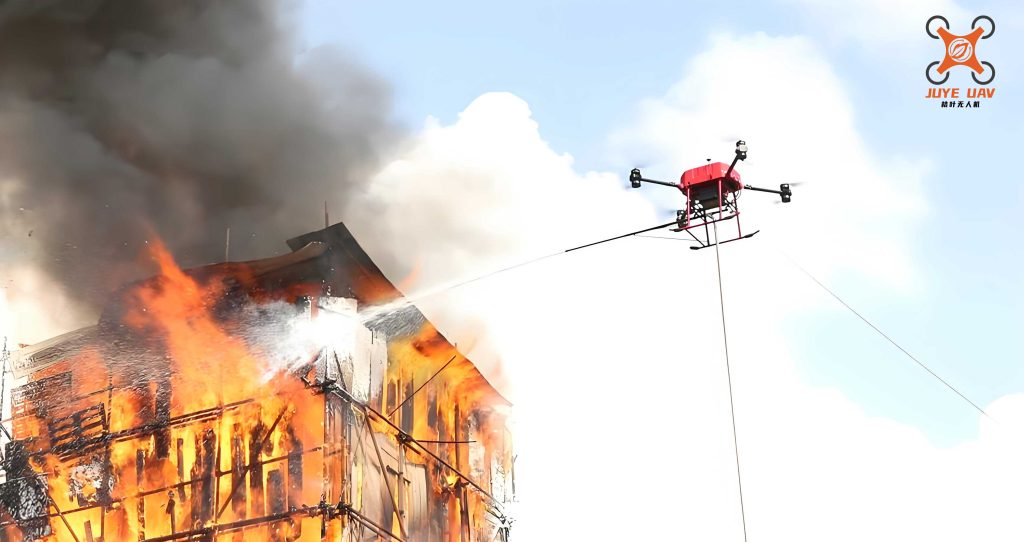
Chemical fires represent a category of industrial disaster characterized by extreme complexity and lethality. The traditional approach to such incidents is fraught with limitations that fire drone technology directly addresses. The inherent dangers can be summarized by several critical properties:
- High Hazard Potential and Explosive Risk: Combustible materials are often stored under pressure or in large quantities. The fire energy release rate \( \dot{Q} \) can be immense, leading to rapid escalation. The risk of Boiling Liquid Expanding Vapor Explosions (BLEVEs) or cascading secondary explosions creates a dynamically unstable environment unsafe for initial human entry.
- Rapid and Unpredictable Fire Spread: Flammable liquids and gases facilitate swift flame propagation. The fire spread velocity can be a function of fuel type, confinement, and pre-existing thermal radiation, often following power-law growth in early stages before adequate intervention.
- Toxic and Corrosive Atmosphere: Combustion and thermal decomposition of chemicals generate toxic smoke (e.g., hydrogen cyanide, phosgene, HCl) and corrosive gases. This creates an Immediate Danger to Life and Health (IDLH) zone, complicating rescue and requiring advanced, time-consuming personnel protection before entry.
- Extreme Difficulty in Suppression and Control: Effective extinguishment requires precise application of specific agents (foam, dry powder, etc.). Incorrect agent selection can exacerbate the situation. Furthermore, prolonged cooling operations are necessary to prevent re-ignition or structural collapse, demanding sustained resource deployment in a hazardous area.
The operational deployment of fire drones in a chemical incident follows a phased methodology, integrating seamlessly into the Incident Command System (ICS).
Phase 1: Initial Assessment and Reconnaissance (The “Eye in the Sky”)
Upon arrival, the primary goal is situational awareness. A fire drone is launched within minutes to perform an initial overflight. Equipped with high-zoom EO and thermal imaging cameras, it provides a comprehensive overhead view, identifying the fire’s epicenter, involved vessels, spreading direction, and potential victim locations. This initial data is crucial for formulating the Incident Action Plan (IAP).
Advanced drones employ real-time photogrammetry and SLAM (Simultaneous Localization and Mapping) techniques. By capturing overlapping images, they can construct a 3D point cloud or mesh model of the incident site. This model allows command staff to perform virtual reconnaissance, measure distances to hazards, plan access routes, and identify water sources. The process can be represented as a function of image overlap and processing power. The positional data from each image, tied to GPS coordinates, allows for the reconstruction of a geo-referenced 3D environment.
Phase 2: Persistent Monitoring and Hazard Detection
Following the initial recon, a fire drone can be tasked with persistent station-keeping to monitor fire development and detect evolving hazards. This is where specialized payloads become critical.
| Payload Type | Detection Principle | Data Output & Use Case |
|---|---|---|
| Multi-gas Detector | Electrochemical, PID (Photoionization), or NDIR (Non-Dispersive Infrared) sensors. | Provides real-time concentration readings (ppm/ppb) for gases like VOCs, H2S, CO, O2 depletion. Used to map gas plume dispersion and define hot, warm, and cold zones. |
| FTIR or Raman Spectrometer | Absorption of infrared light by molecular bonds. | Identifies unknown chemical compounds in a plume by their spectral signature, crucial for deciding on suppression agents and public safety warnings. |
| Radiometric Thermal Camera | Detects infrared radiation and assigns accurate temperature values. | Identifies overheating equipment, pinpoints hidden fire pockets behind walls (compartment fires), and monitors the cooling effectiveness of applied water/foam on storage tanks. The heat flux \( q” \) from a surface can be estimated using Stefan-Boltzmann law: $$ q” = \epsilon \sigma (T_{surface}^4 – T_{ambient}^4) $$ where \( \epsilon \) is emissivity and \( \sigma \) is the Stefan-Boltzmann constant. |
Phase 3: Active Intervention and Support
Beyond observation, modern fire drone platforms are evolving into active intervention tools.
- Aerial Delivery of Extinguishing Agents: Heavy-lift drones can carry and accurately deploy fire-suppression payloads. These can be simple dry-chemical fire extinguisher balls or specialized modules for releasing liquid suppressants like wet chemicals or Class A foam on targeted areas. The release mechanism is often electronically triggered via the data link. The required mass \( m_{agent} \) of extinguishing agent can be approximated based on the fire’s heat release rate and the agent’s specific extinguishing concentration.
- Communication and Command Relay: In large-scale incidents where terrestrial communication infrastructure is damaged or overloaded, a fire drone can act as a temporary aerial communication node (cell-on-wing/light). It can also be equipped with a powerful loudspeaker to broadcast evacuation instructions or safety commands to personnel on the ground over high noise levels.
- Pre-fire Inspection and Prevention: Proactively, fire drones are used for routine inspection of complex industrial facilities. Using thermal imaging, they can identify overheating electrical components, insulation faults, or leaks from pressurized lines before they escalate into fires, enabling predictive maintenance.
The future evolution of fire drone technology for chemical emergency response is geared towards greater autonomy, integration, and resilience. The key developmental vectors include:
1. Advanced Energy and Propulsion Systems
The current limitation of battery-powered drones (typically 20-40 minutes under load) is a significant constraint for prolonged incidents. Research is focused on hybrid-electric systems, hydrogen fuel cells, and automated wireless charging pads deployed near the incident perimeter. The endurance \( E \) is a critical parameter:
$$ E = \frac{C_{batt} \cdot V_{batt} \cdot \eta_{sys}}{P_{load}} $$
where \( C_{batt} \) is battery capacity, \( V_{batt} \) is voltage, \( \eta_{sys} \) is system efficiency, and \( P_{load} \) is the total power draw from propulsion and payloads. Increasing \( E \) is paramount.
2. Artificial Intelligence and Swarm Intelligence
The next generation of fire drones will leverage AI for real-time data analysis. Machine learning algorithms can be trained to automatically identify specific hazards (e.g., a leaking valve, a person in distress, a specific flame pattern) from video feeds, alerting commanders instantly. Furthermore, the concept of drone swarms—multiple, coordinated fire drones operating as a single system—holds immense potential. One swarm could map a gas plume in 3D, another could monitor structural integrity, while a third maintains communication links. Swarm behavior can be modeled using distributed algorithms that optimize coverage and task allocation.
3. Deep Integration with Big Data and Digital Twins
Fire drone data will feed into centralized big data platforms for the fire service. Live sensor data, combined with pre-loaded plant schematics, chemical databases, and weather models, will create a dynamic “Digital Twin” of the incident. This twin can run predictive simulations, such as forecasting plume dispersion using Gaussian or CFD models:
$$ C(x,y,z) = \frac{Q}{2\pi u \sigma_y \sigma_z} \exp\left(-\frac{y^2}{2\sigma_y^2}\right)\left[\exp\left(-\frac{(z-H)^2}{2\sigma_z^2}\right) + \exp\left(-\frac{(z+H)^2}{2\sigma_z^2}\right)\right] $$
where \( C \) is concentration, \( Q \) is source strength, \( u \) is wind speed, \( \sigma_y, \sigma_z \) are dispersion parameters, and \( H \) is effective release height. This allows commanders to test “what-if” scenarios for different mitigation strategies virtually before committing resources.
| Technology Area | Specific Innovation | Impact on Chemical Firefighting |
|---|---|---|
| Advanced Materials | Heat-reflective/ablative coatings, lightweight composites. | Enables closer proximity to extreme heat for longer durations, improving data quality from hotspots. |
| Sensor Fusion & AI | Onboard processing combining LiDAR, thermal, visual, and spectral data. | Automatic, real-time creation of annotated hazard maps, identifying chemical types, fire intensity, and structural weaknesses without human interpretation delay. |
| Resilient Comms | Mesh networking between drones and ground units, satellite backhaul. | Creates a robust, ad-hoc communication network immune to single-point failure, ensuring continuous C2 in chaotic environments. |
| Autonomous Logistics | Drones for ferrying equipment (hoses, tools, batteries) to frontline crews. | Reduces physical burden on firefighters, accelerates resupply, and keeps personnel out of high-risk transport corridors. |
In conclusion, the integration of fire drone technology is not merely an additive improvement but a fundamental paradigm shift in chemical firefighting and rescue. By serving as persistent, intelligent, and adaptable aerial platforms, these systems provide unprecedented levels of situational awareness, directly enhance operational safety by limiting initial human exposure to extreme hazards, and enable more precise, effective, and faster intervention. The ongoing convergence of advancements in aeronautics, sensor technology, artificial intelligence, and data analytics promises to further elevate the capabilities of the fire drone. The future of industrial emergency response lies in a seamless human-machine teaming, where the courage and expertise of firefighters are powerfully augmented by the tireless, penetrating, and analytical capabilities of advanced aerial robots. The strategic deployment and continuous evolution of fire drone fleets will undoubtedly be a cornerstone in building more resilient communities and safeguarding both responders and the public from the devastating consequences of chemical incidents.