
In the current era of rapid technological advancement, drones, or Unmanned Aerial Vehicles (UAVs), are fundamentally reshaping traditional paradigms of disaster management and rescue operations. Among these, the specialized category of fire drone systems has emerged as a pivotal technological tool within modern emergency response frameworks. This analysis, from my perspective as a practitioner in the field, aims to comprehensively explore the application of fire drone technology in disaster prevention, mitigation, and response. I will delve into its critical functions in early warning, situational assessment, and lifesaving support, while also examining future developmental trajectories.
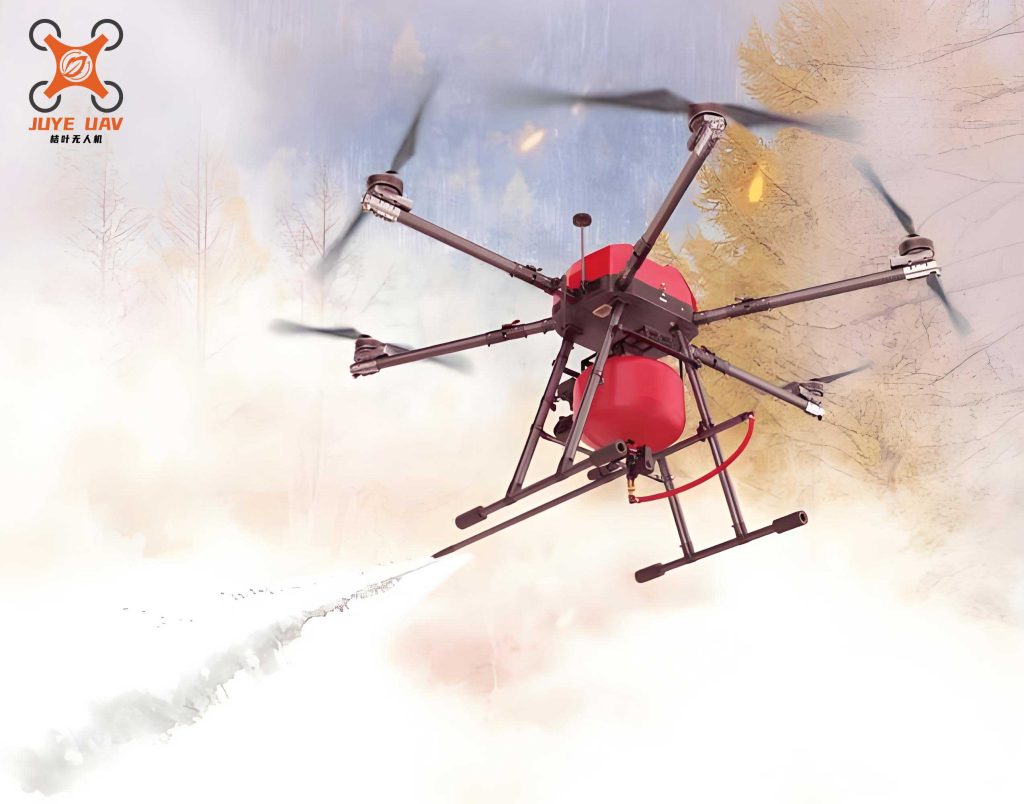
I. Technical Overview of Fire Drones
The evolution of UAVs, culminating in today’s sophisticated fire drone, began in the early 20th century. Breakthroughs in recent decades, driven by advancements in micro-sensors, flight control systems, and high-energy-density batteries, have transformed them from primarily military tools into versatile assets for civilian applications. A modern fire drone platform is characterized by its mobility, adaptability to carry diverse payloads, and capability for remote or autonomous operation. The core value proposition of a fire drone lies in its ability to access hazardous areas, providing critical intelligence and intervention while keeping human responders out of immediate danger.
Classification and Operational Parameters
Fire drone systems can be categorized primarily by airframe configuration, each with distinct performance characteristics suited for specific mission profiles. The choice of platform is a fundamental decision in mission planning.
| Platform Type | Key Advantages | Typical Fire & Rescue Mission Profile | Performance Metrics (Typical) |
|---|---|---|---|
| Multi-Rotor | Vertical Takeoff and Landing (VTOL), Precision Hovering | Close-range inspection, structural fire assessment, targeted extinguishing. | Flight Time: 20-45 min; Payload: 1-10 kg. |
| Fixed-Wing | Long Endurance, Large Coverage Area | Wildfire perimeter mapping, large-scale damage assessment. | Endurance: 1-6+ hours; Range: 50-200+ km. |
| VTOL Composite | VTOL + Fixed-Wing Efficiency | Long-range reconnaissance in areas without runways. | Endurance: 1-3 hours; Hover Capability: Yes. |
| Unmanned Helicopter | High Payload Capacity, Stable Hover | Heavy equipment delivery (e.g., supplies, fire retardant), water/foam discharge. | Payload: 20-100+ kg; Endurance: 1-2 hours. |
| Tethered Drone | Unlimited Flight Time (via tether) | Persistent aerial observation, communication relay as an “aerial base station.” | Endurance: Continuous; Operational Altitude: Tether length (e.g., 50-100m). |
The operational effectiveness of a fire drone is governed by several interrelated physical and technical factors. For instance, the power required for a multi-rotor fire drone to hover is given by:
$$ P_{hover} = \frac{(m_{drone} + m_{payload})^{3/2} \cdot \sqrt{g^{3}}}{\sqrt{2 \rho \cdot A \cdot n \cdot \eta}} $$
where \(m_{drone}\) is the drone mass, \(m_{payload}\) is the sensor/equipment mass, \(g\) is gravity, \(\rho\) is air density, \(A\) is rotor disk area, \(n\) is number of rotors, and \(\eta\) is propulsive efficiency. This highlights the direct trade-off between payload capacity and flight time—a critical consideration for mission planners. The effective payload ratio \(R_{eff}\) for a mission can be expressed as:
$$ R_{eff} = \frac{t_{flight} \cdot f(m_{payload})}{m_{drone}} $$
where \(t_{flight}\) is the achievable flight time with the given payload, and \(f(m_{payload})\) is a function representing the utility value of the specific payload.
Sensor Payloads: The “Eyes and Ears” of the Fire Drone
The versatility of a fire drone is unlocked through its modular payloads. A single platform can be rapidly reconfigured for different phases of a disaster response by swapping sensor suites.
| Payload Type | Primary Function | Key Metric / Output |
|---|---|---|
| Visible Light (RGB) Camera | High-resolution imagery, daytime reconnaissance, damage documentation. | Pixel Resolution (e.g., 20 MP), Video Feed. |
| Thermal Imaging Camera | Detect heat signatures through smoke, locate hotspots, find victims (night/day). | Thermal Sensitivity (< 50 mK), Resolution (e.g., 640×512). |
| Multispectral/Hyperspectral Sensors | Assess vegetation moisture (fire risk), identify chemical leaks, map burn severity. | Spectral Bands, Ground Sampling Distance (GSD). |
| LiDAR (Light Detection and Ranging) | Create high-precision 3D terrain models, map structural integrity. | Points per second, Accuracy (cm-level). |
| Gas / Environmental Sensors | Detect and quantify hazardous gases (CO, VOCs, radiation). | Gas Types, Concentration (ppm), Sampling Rate. |
| Communication Relay Module | Extend radio/network coverage for ground teams. | Supported Bands (e.g., LTE, UHF/VHF), Coverage Radius. |
| Pay-and-Deploy Module | Deliver emergency supplies (life vests, medicines, radios). | Payload Capacity, Release Accuracy. |
II. Typical Application Scenarios in Emergency Response
1. Preventive Measures and Resource Allocation
A proactive fire drone equipped with multispectral sensors can conduct periodic low-altitude patrols over forests, industrial sites, and urban interfaces. By analyzing spectral reflectance, it can calculate indices like the Normalized Difference Moisture Index (NDMI) to identify tinder-dry vegetation:
$$ NDMI = \frac{(NIR – SWIR)}{(NIR + SWIR)} $$
where lower values indicate drier, more flammable biomass. This data allows for predictive modeling of fire risk zones. In the active response phase, the fire drone provides real-time data fusion from visible, thermal, and multi-spectral sensors. This creates a comprehensive “fire situation portrait,” enabling command centers to perform quantitative resource forecasting. The required number of fire engines, personnel, and specific equipment types can be calculated based on objective metrics like fireline intensity \(I_B\) (kW/m) and rate of spread \(R\) (m/s), leading to optimized, timely deployment and significantly reducing potential losses.
2. Dynamic Risk Assessment and Coordinated Response
Upon arrival at an incident, the primary role of a fire drone is rapid situational awareness. It flies over the hazard zone, fusing data streams to assess risks. For a wildfire, this involves mapping the fire perimeter \(P(t)\) and calculating the rate of spread vector \(\vec{R}(x,y,t)\), which is a function of fuel, weather, and topography. For a structural fire, thermal imaging creates a 3D temperature field model \(T(x,y,z,t)\), identifying thermal bridges and potential collapse zones. This dynamic risk assessment \(RA(t)\) can be formalized as:
$$ RA(t) = \int_{\Omega} \left[ w_1 \cdot H(\vec{F}) + w_2 \cdot G(\vec{E}) + w_3 \cdot S(\vec{T}) \right] d\Omega $$
where \(\Omega\) is the area of interest, \(H\) represents hazard intensity (flame, heat), \(G\) represents geographic/structural risk, \(S\) represents identified survivor locations, and \(w_n\) are weighting coefficients based on mission priorities. This quantitative output directly informs life-saving decisions on evacuation routes, firefighter positioning, and attack strategies.
In earthquake scenarios, a swarm of fire drone units (now acting as “search drones”) can create a digital twin of the rubble field using photogrammetry. AI-driven analysis of this 3D model and thermal feeds can automatically flag potential survivor locations \((X_{vic}, Y_{vic}, Z_{vic})\) for rescue teams. In floods, drones perform wide-area surveillance to quantify inundated area \(A_{flood}\) and identify isolated persons, enabling precise aerial delivery of life-saving equipment.
3. Community Engagement and Post-Disaster Reconstruction
In the recovery phase, the fire drone shifts to a monitoring and planning role. Periodic aerial surveys using RGB and LiDAR generate time-series orthomosaics and 3D models. The change in a key metric like the Normalized Burn Ratio (NBR) pre- and post-fire indicates burn severity, guiding ecological restoration:
$$ \Delta NBR = NBR_{prefire} – NBR_{postfire} $$
High \(\Delta NBR\) values correspond to high-severity burn areas. These visual and quantitative datasets are invaluable for public communication, showing the community the extent of damage and progress in rebuilding. For planners, drone data provides the high-fidelity base map for optimizing infrastructure placement and tracking reconstruction progress against plans, accelerating the return to normalcy.
III. Application Challenges and Strategic Solutions
Despite their utility, fire drone operations face significant environmental and technical hurdles that can limit their effectiveness.
| Scenario | Primary Challenges for Fire Drone | Impact on Mission |
|---|---|---|
| Wildfire | High winds, intense thermal updrafts, heavy smoke. | Loss of stability, degraded sensor imagery (thermal/visual), inaccurate positioning. |
| Urban Fire | GPS signal multipath/denial, radio frequency (RF) interference, physical obstacles. | Unreliable navigation, communication dropouts, high collision risk, limited sensor Field of View (FOV). |
| Earthquake | Cluttered, unstructured rubble fields; damaged communication infrastructure. | Severe collision risk, loss of GPS/communication links, difficult path planning. |
| Flood/Storm | Heavy rain, strong winds, electromagnetic interference from weather. | Reduced flight stability, sensor occlusion, water damage risk, limited operational altitude. |
Integrated Solution Framework
Overcoming these challenges requires a multi-faceted approach focusing on robustness, autonomy, and connectivity.
1. Enhanced Sensor Fusion & Robustness: Developing sensors resistant to environmental noise is crucial. For instance, a long-wave infrared (LWIR) thermal camera’s ability to penetrate smoke can be characterized by an attenuation coefficient \(\mu_{smoke}\). Combining it with a millimeter-wave radar, which is largely unaffected by smoke, provides redundancy. The fused detection probability \(P_D\) for a target becomes:
$$ P_D = 1 – \prod_{i=1}^{n} (1 – P_{D,i}) $$
where \(P_{D,i}\) is the detection probability of sensor \(i\). This ensures the fire drone maintains situational awareness even in dense smoke.
2. Advanced Autonomous Navigation: To operate in GPS-denied, cluttered environments, the fire drone must rely on SLAM (Simultaneous Localization and Mapping) and AI-based obstacle avoidance. The navigation system uses data from visual odometry, inertial measurement units (IMUs), and depth sensors to maintain an estimated state \(\hat{x}_k\):
$$ \hat{x}_k = f(\hat{x}_{k-1}, u_k) + K_k [z_k – h(\hat{x}_{k-1})] $$
where \(f\) is the state prediction model, \(u_k\) is control input, \(h\) is the observation model, \(z_k\) is the actual sensor measurement, and \(K_k\) is the Kalman gain. This allows for real-time, reliable path planning \(\mathcal{P}\) in complex spaces.
3. Resilient Data Processing & Communication: Implementing edge computing on the fire drone allows for onboard data processing (e.g., hotspot detection, victim identification), reducing the bandwidth \(B\) required for transmission and latency \(\tau\). The required channel capacity \(C\) must satisfy:
$$ C = B \cdot \log_2\left(1 + \frac{S}{N}\right) > R_{data} $$
where \(S/N\) is the signal-to-noise ratio and \(R_{data}\) is the data rate. Using mesh networks or tethered drones as aerial relays can boost \(S/N\) and extend range, ensuring a stable command and data link.
4. Collaborative Swarm Operations: A swarm of heterogeneous drones (a mix of multi-rotor, fixed-wing, and tethered fire drone units) can overcome individual limitations. A task allocation algorithm optimizes the assignment of \(m\) tasks to \(n\) drones to minimize total mission time or maximize area coverage. The coverage efficiency \(E_{cov}\) of a swarm over area \(A\) in time \(T\) can be modeled as:
$$ E_{cov}(T) = \frac{1}{A} \int_0^T \sum_{i=1}^{n} v_i(t) \cdot s_i(t) \cdot \mathbb{1}_{A}(p_i(t)) \, dt $$
where for drone \(i\), \(v_i\) is velocity, \(s_i\) is sensor swath width, \(p_i\) is position, and \(\mathbb{1}_{A}\) is the indicator function for being within the operational area. Swarm intelligence enables persistent, multi-perspective monitoring that a single drone cannot achieve.
IV. Future Trajectory and Concluding Perspective
The future of fire drone technology is directed toward greater intelligence, integration, and autonomy. Technologically, we will see the convergence of more robust AI for real-time predictive analytics (e.g., forecasting flashover in a building or a wildfire’s path using real-time data assimilation into physical models). Airframe design will trend toward greater modularity and endurance. The ultimate goal is a fully integrated fire drone ecosystem that functions as a seamless component of the Incident Command System.
The core evolution can be summarized by the increasing level of autonomous decision-making \(L_A\):
$$ L_A(t) = \alpha \cdot C_{sensor}(t) + \beta \cdot P_{compute}(t) + \gamma \cdot K_{model}(t) $$
where \(C_{sensor}\) is sensor fusion capability, \(P_{compute}\) is processing power, \(K_{model}\) is the fidelity of the embedded world model (digital twin), and \(\alpha, \beta, \gamma\) are scaling factors. As \(L_A\) increases, the role of the human shifts from direct piloting to strategic oversight and exception management.
Concurrently, the establishment of comprehensive standards for airspace integration, data security, privacy, and operational procedures is imperative for the safe and ethical scaling of fire drone deployments. I am convinced that through sustained technological innovation coupled with thoughtful regulatory and operational frameworks, fire drone technology will continue to dramatically enhance our capacity to protect lives, property, and the environment in the face of disasters.