
In my years of experience working in firefighting and emergency response, I have witnessed a dramatic shift in the complexity of rescue scenarios. Today, firefighting units globally face increasingly challenging situations, from towering infernos in high-rise buildings and sprawling industrial complexes to hazardous chemical fires, as well as intricate rescue operations during earthquakes, floods, and mountain accidents. Traditional methods and equipment often fall short in these modern, high-stakes environments. The integration of advanced technological tools has become not just beneficial but essential. Among these, the emergence and adoption of unmanned aerial vehicles, specifically fire drone systems, have proven to be a game-changer. As a new “weapon” in the firefighter’s arsenal, the fire drone plays a crucial auxiliary role, offering capabilities that were previously unimaginable or too risky to attempt. This article delves into the fundamental concepts, technical advantages, and practical applications of fire drone technology, exploring how it is reshaping the landscape of灭火救援 (fire suppression and rescue).
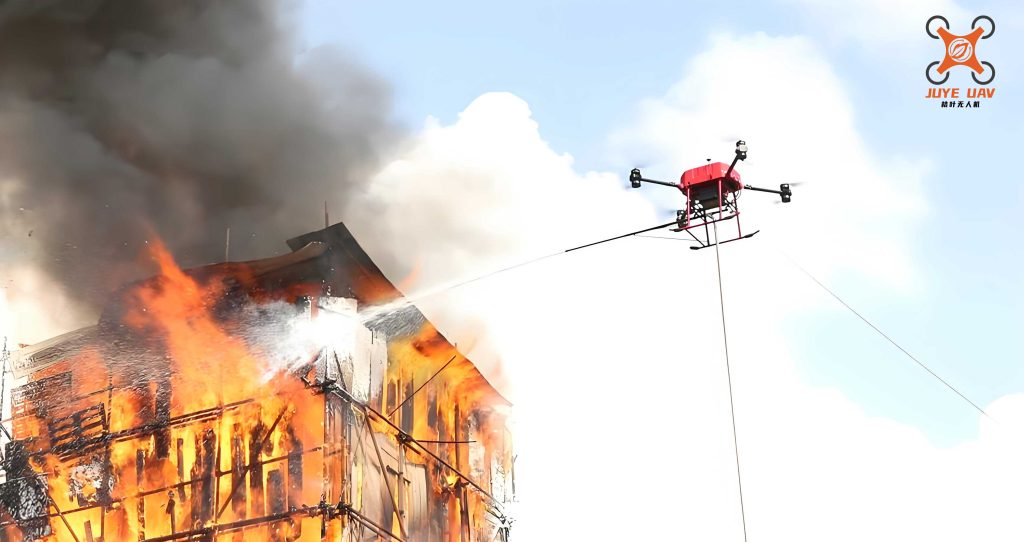
The core value of a fire drone lies in its ability to act as an airborne sensor and intervention platform. Fundamentally, an unmanned aerial vehicle (UAV), or drone, is a pilotless aircraft controlled via radio signals or pre-programmed software. A complete system, often termed an Unmanned Aerial System (UAS), comprises the airframe, the flight control system, mission-specific payloads, and the command/communication link. For firefighting purposes, these platforms are engineered to perform critical functions such as reconnaissance, tactical strikes (like targeted extinguishing agent delivery), acquisition and transmission of visual/audio data, transportation and aerial delivery of supplies, and direct scene intervention. They represent a convergence of multiple disciplines—aerospace, control theory, informatics, surveying, laser technology, sensor networks, and advanced materials—earning the moniker “aerial robots.”
The variety of fire drone platforms is vast, tailored to different mission profiles. They can be categorized in several ways, as summarized in the table below:
| Classification Basis | Categories | Typical Characteristics/Examples |
|---|---|---|
| Size/Dimensions | Regular UAV (≥ 30 cm), Small UAV (100-300 cm), Ultra-small UAV (15-100 cm), Micro UAV (≤ 15 cm) | Micro drones for indoor reconnaissance; larger models for heavy payloads. |
| Flight Mechanism | Fixed-wing, Rotary-wing (Helicopter), Multi-rotor, Flexible-wing, Glider | Multi-rotor fire drones are prevalent for their VTOL and hovering capability. |
| Primary Use Case | Military, Civilian (Industrial-grade, Professional Custom, Consumer-grade) | Firefighting employs robust, customized industrial-grade fire drones. |
The technical superiority of modern fire drones stems from advanced microelectronics, real-time video transmission systems, and sophisticated ground support infrastructure. This allows for aerial monitoring of ground situations at a relatively low comprehensive cost, accessing areas unreachable by conventional means. The primary attributes of a fire drone are agility, portability, and modularity—capable of carrying different sensor suites for diverse scenarios. Larger models can even perform cargo drop missions. The key technical advantages are manifold and can be quantified in certain aspects.
First is portability and ease of operation. A typical fire drone system is lightweight and compact, often operable by just one or two personnel. This logistical simplicity is crucial for rapid deployment. Second is the comprehensive, multi-modal surveillance capability. By mounting various cameras and sensors, a fire drone can provide all-encompassing reconnaissance from any angle, day or night. It can monitor environmental parameters like temperature, humidity, and wind direction, significantly compensating for the blind spots and inherent dangers of manual scouting. The area coverage advantage can be conceptualized. For a drone hovering at altitude h, the theoretical line-of-sight ground coverage radius R is given by the geometric relation, ignoring terrain:
$$ R \approx \sqrt{(h + r_e)^2 – r_e^2} $$
where \( r_e \) is the Earth’s radius. For practical operational altitudes, the visible area \( A \) is:
$$ A = \pi R^2 $$
This demonstrates how a single fire drone can survey a vast area compared to ground teams.
Third is the capacity for remote command and long-distance image transmission. The video feed from the fire drone‘s camera is transmitted to a ground control station (GCS) and can be relayed to a rear command post in real-time. The user manipulates the drone’s gimbal via a controller, and the live video is streamed back through a video transmission system. The signal strength and quality are paramount. A simplified model for received signal power \( P_r \) at the GCS from the fire drone is:
$$ P_r = P_t + G_t + G_r – L_{path} – L_{other} $$
where:
\( P_t \) is the transmission power,
\( G_t \) and \( G_r \) are the antenna gains of the transmitter (drone) and receiver (GCS) respectively,
\( L_{path} \) is the free-space path loss, calculated as \( L_{path} = 20 \log_{10}(d) + 20 \log_{10}(f) + 20 \log_{10}\left(\frac{4\pi}{c}\right) \), with \( d \) being distance, \( f \) frequency, and \( c \) the speed of light,
\( L_{other} \) accounts for other losses (atmospheric, foliage). This ensures commanders have a real-time “eye in the sky.”
The application of fire drones in actual灭火救援 (firefighting and rescue) operations is where their value becomes indisputable. As urban landscapes evolve, leveraging high-tech手段 (means) like drones is non-negotiable for elevating operational effectiveness. Below, I outline several critical applications based on实战探索 (practical exploration), particularly for large-scale fires and special-environment emergencies.
1. All-Aspect, Multi-Angle, and Timely Fire Scene Reconnaissance. At major incident sites, the fire drone serves as an aerial scout. For complex terrains like high-rises, large factories, or chemical plants, it bypasses ground obstacles to perform initial assessment, pinpointing the fire’s epicenter and surveying surroundings, wind patterns, and water sources. This intelligence is vital for initial force deployment. In flammable/explosive environments, the fire drone can quickly approach the core hazard zone for close-range inspection, providing real-time data on combustion state and temperature to guide mid-phase tactics. Crucially, equipped with detection modules (e.g., thermal imaging, gas sensors), it can monitor ambient conditions and fire temperature. For chemical fires, knowing the status of burning materials is critical to anticipate dangers like BLEVEs (Boiling Liquid Expanding Vapor Explosions). A fire drone with a pyrometer can track temperature, providing early warning for personnel evacuation and informing cooling strategies. The thermal imaging capability allows detection of heat signatures through smoke, which is invaluable for search and rescue (SAR), expanding the field of view and efficiency while reducing risks to personnel. The infamous Tianjin Port explosion incident underscored this utility, where fire drones were deployed in highly radioactive and inaccessible zones for close observation and video transmission where humans could not venture.
2. The “Eyes and Ears” for Accurate and Efficient Auxiliary Rescue. Beyond reconnaissance, the fire drone directly aids rescue. In large-scale natural disasters (earthquakes, floods, landslides) or major traffic accidents, the drone’s image relay technology drastically expands and accelerates search efforts over manual methods. By carrying loudspeakers or two-way communication devices, a fire drone can deliver voice instructions or comfort victims in高空 (high-altitude) or地下 (underground) rescues where radio communication is unreliable, proving more accurate and rapid than ground-based shouting. Furthermore, in communication-blackout environments like earthquakes or mountainous regions, a fire drone can be fitted with a communication relay device to act as a temporary cell tower or radio repeater, ensuring uninterrupted contact. Another transformative application is opening lifelines. In floods, mudslides, or mountain rescues, traditional throwing devices are limited by range and accuracy. A fire drone can accurately deliver critical supplies—handheld radios, life vests, rescue ropes, or even first-aid kits—directly to trapped individuals, dramatically speeding up the rescue timeline. The payload capacity versus flight time is a key operational parameter, often governed by a trade-off equation. For a multi-rotor fire drone, a simplified model for maximum flight time \( T \) given a battery capacity \( C \) (in Watt-hours) and total power draw \( P_{total} \) is:
$$ T = \frac{C \cdot \eta}{P_{total}} $$
where \( \eta \) is the power system efficiency. \( P_{total} = P_{lift} + P_{avionics} \), and the lift power \( P_{lift} \) relates to thrust \( T_h \), propellor efficiency, and other factors. This calculation is essential for mission planning when delivering payloads.
To further crystallize the application scenarios and their corresponding fire drone configurations, the following table provides a consolidated view:
| Application Scenario | Primary Fire Drone Function | Recommended Payload/Sensors | Key Operational Benefit |
|---|---|---|---|
| High-Rise/Industrial Fire | Aerial Reconnaissance & Thermal Mapping | Zoom Camera, Thermal Imaging Camera (TIC), Gas Sensor | Identifies fire seat, hotspots, structural integrity, and gas leaks without endangering crews. |
| Hazardous Material (HazMat) Incident | Close-range Inspection & Environmental Monitoring | TIC, Multi-gas Detector, Radiation Sensor, Sampling Arm | Gathers critical data from lethal environments, enabling informed decision-making on safe approach. |
| Wildland/Wildfire | Perimeter Monitoring & Spot Fire Detection | High-Resolution Visible Camera, TIC, GPS | Tracks fire spread in real-time, identifies spot fires beyond the line, aids in containment strategy. |
| Urban Search & Rescue (USAR) / Natural Disaster | Wide-Area Search & Victim Location | TIC, Zoom Camera, Loudspeaker, Spotlight | Covers large rubble fields or flooded areas quickly; detects human heat signatures; establishes contact. |
| Technical Rescue (Mountain, Flood) | Equipment Delivery & Communication Relay | Cargo Release Mechanism, Communication Repeater, Camera | Delivers life-saving gear precisely; extends comms range in rugged terrain. |
| Post-Incident Investigation | 3D Mapping & Documentation | High-Res Camera for Photogrammetry, LiDAR | Creates accurate 3D models of the scene for forensic analysis and training. |
Looking ahead, as technology advances, I am confident that the fire drone will evolve into a more integrated “aerial force” for fire departments. It will not only be an “aerial scout” or “transport craft” but potentially an airborne “firefighting unit” capable of targeted extinguishment. The growth trajectory of无人机 (UAV) technology suggests expanding utility beyond firefighting into fields like 3D modeling, agriculture, delivery, and cinematography, but its role in public safety, particularly as a fire drone, will only deepen. Future developments may include swarming capabilities for coordinated coverage, longer endurance through hybrid power systems, and advanced AI for autonomous decision-making in complex environments. The integration of更为先进 (more advanced) sensors and interoperability with other emergency response systems will further solidify the fire drone‘s position as an indispensable tool. In my professional opinion, the systematic incorporation of fire drone operations into daily training and standard operating procedures is the next critical step. This will ensure that when the call comes, these aerial robots are seamlessly deployed, truly becoming the空中 “侦察兵” (aerial “scout”), leveraging信息化手段 (information technology means) to enhance our capability to fight major fires and win large-scale battles, ultimately saving more lives and property.
The operational effectiveness of a fire drone system can also be analyzed through a cost-benefit or efficiency lens. Consider a simplified operational efficiency metric \( E_{op} \) for a SAR mission:
$$ E_{op} = \frac{A_{search} \cdot \rho_{detection}}{T_{mission} \cdot (N_{personnel} \cdot R_{risk})} $$
where:
\( A_{search} \) is the area covered,
\( \rho_{detection} \) is the probability of detection (enhanced by thermal sensors),
\( T_{mission} \) is the total mission time,
\( N_{personnel} \) is the number of ground personnel required for an equivalent manual search,
\( R_{risk} \) is the relative risk factor to personnel (much lower for a fire drone).
This conceptual formula highlights how the fire drone amplifies efficiency while mitigating human risk—a core tenet of modern firefighting.
In conclusion, the adoption of fire drone technology represents a paradigm shift in emergency response. From my first-person perspective, having seen their impact from the planning table to the incident command post, these systems are not mere gadgets but force multipliers. They extend our senses into hazardous zones, deliver critical aid, and provide commanders with unprecedented situational awareness. As the technology matures and becomes more ingrained in fire service culture, the fire drone will undoubtedly continue to redefine the art of the possible in saving lives and protecting communities from the ravages of fire and disaster. The journey has just begun, and the future sky is filled with the promising hum of these robotic guardians.