
In my years of experience within the fire service, I have witnessed a profound technological evolution that is reshaping how we approach emergencies. Among the most significant advancements is the integration of unmanned aerial vehicles, specifically designed for fire and rescue scenarios—what I and many colleagues now refer to as fire drones. These fire drones are not merely tools; they are pivotal assets that enhance situational awareness, improve operational safety, and increase the efficiency of both fire suppression and rescue missions. This article delves into the multifaceted applications of fire drones, exploring their core characteristics, data acquisition capabilities, auxiliary functions, direct firefighting roles, and the future trajectory of their development. My perspective is grounded in practical field observations and the continuous drive to leverage technology for saving lives and property.
The concept of a fire drone extends beyond a standard UAV; it is a system engineered to withstand the harsh, unpredictable environments of fire grounds. A fire drone typically integrates advanced sensors, robust communication links, and sometimes payload delivery mechanisms. From a technical standpoint, the fundamental equation governing its flight endurance can be expressed as $$ E_{flight} = \frac{C_{battery} \times V_{system}}{P_{total}} $$ where \( E_{flight} \) is the flight time in hours, \( C_{battery} \) is the battery capacity in ampere-hours, \( V_{system} \) is the system voltage, and \( P_{total} \) is the total power draw in watts, which includes propulsion, sensors, and communication modules. This equation is critical for mission planning, as endurance directly impacts the fire drone‘s utility in prolonged operations.
The inherent characteristics of fire drones make them uniquely suited for emergency response. Below is a table summarizing these key attributes:
| Characteristic | Description | Impact on Firefighting |
|---|---|---|
| High Safety and Stability | Compact structure with minimal mechanical parts, leading to low maintenance costs and ease of repair. Operators can achieve proficiency quickly. | Reduces operational downtime and allows for rapid deployment even in adverse conditions, ensuring that fire drones can perform reliably when traditional methods might fail. |
| Superior Flight Agility | Capable of both autonomous and semi-autonomous control, with high maneuverability in confined or complex spaces (e.g., building interiors, tunnels). | Enables access to areas unsafe for human responders, providing crucial intelligence from perspectives previously unattainable, thus enhancing the strategic planning for fire drone-assisted operations. |
| Versatile Platform Integration | Easily equipped with various sensors (optical, thermal, gas) and can interface with cloud-based data systems for real-time analysis and sharing. | Facilitates a comprehensive, data-driven response by streaming information directly to command centers, allowing for coordinated efforts where the fire drone acts as a mobile data hub. |
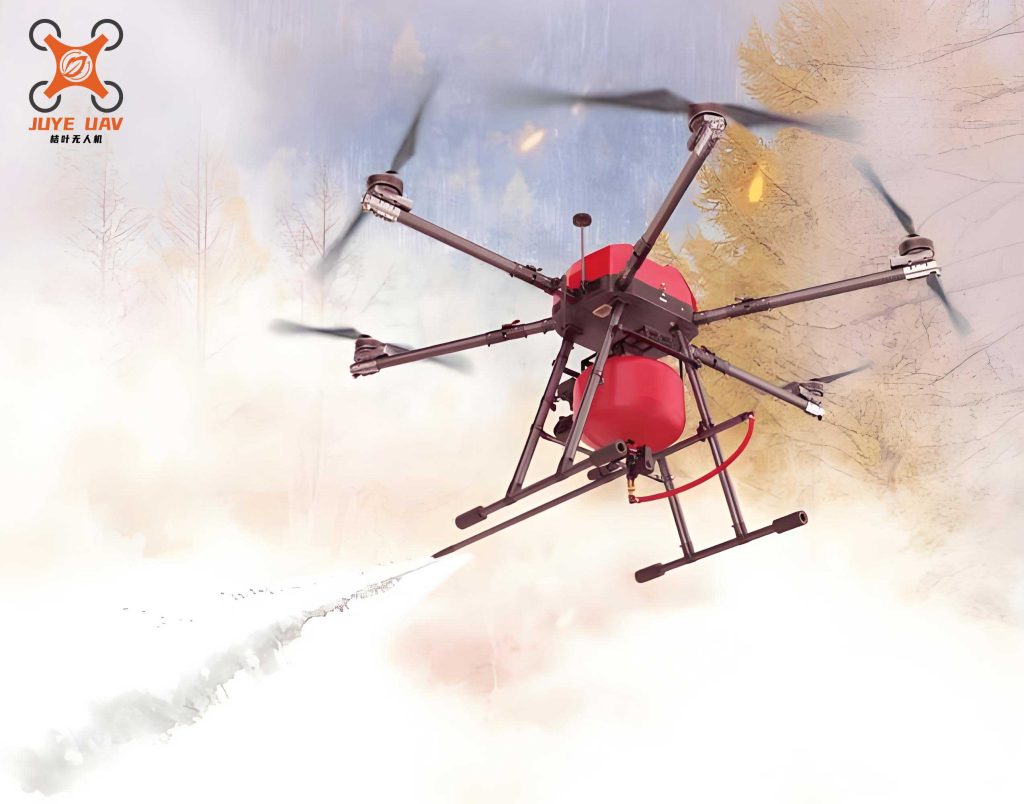
These characteristics collectively empower the fire drone to serve as an indispensable eye in the sky. To visualize a typical modern fire drone equipped for such duties, consider the following image which showcases a robust model designed for fire service use:
The core of a fire drone‘s value lies in its data acquisition suite. In my operations, the ability to gather and interpret data in real-time has repeatedly proven decisive. The primary data modules include high-definition visual imaging, infrared thermography, gas detection, and 3D mapping. Each module follows specific physical and mathematical principles. For visual imaging, the resolution and field of view are paramount. The ground sample distance (GSD), which determines the pixel size on the ground, is given by $$ GSD = \frac{H \times s}{f} $$ where \( H \) is the flight altitude, \( s \) is the sensor pixel size, and \( f \) is the lens focal length. A lower GSD means higher detail, crucial for identifying victims or structural details through a fire drone‘s camera.
Infrared thermal imaging is perhaps one of the most transformative capabilities of a fire drone. It allows us to see through smoke and darkness by detecting heat signatures. The radiated power per unit area, according to the Stefan-Boltzmann law, is $$ P = \epsilon \sigma T^4 $$ where \( P \) is the power, \( \epsilon \) is the emissivity of the material, \( \sigma \) is the Stefan-Boltzmann constant, and \( T \) is the absolute temperature. The fire drone‘s thermal sensor captures this radiation, creating a heat map that identifies hotspots, trapped individuals, and fire spread patterns. This data is often represented in a false-color image where temperature \( T \) maps to a color value \( C \), often using a linear or logarithmic scale: $$ C(T) = a \cdot \ln(T – T_{ambient}) + b $$ where \( a \) and \( b \) are calibration constants, and \( T_{ambient} \) is the background temperature.
Gas detection is another critical function. Fire drones can be outfitted with electrochemical or semiconductor sensors to detect toxic gases like CO, H₂S, or volatile organic compounds. The sensor response \( S \) is typically proportional to gas concentration \( [G] \), often following a relationship like $$ S = k \cdot [G]^n $$ where \( k \) is a sensitivity coefficient and \( n \) is an exponent close to 1 for many sensors. Early detection via a fire drone allows for timely warnings and the adjustment of respiratory protection for ground crews.
For spatial awareness, 3D modeling via photogrammetry is revolutionary. A fire drone captures overlapping images from multiple angles, and software reconstructs a 3D model. The process relies on structure-from-motion algorithms. The key equation involves the collinearity condition: $$ x – x_0 = -f \frac{m_{11}(X – X_0) + m_{12}(Y – Y_0) + m_{13}(Z – Z_0)}{m_{31}(X – X_0) + m_{32}(Y – Y_0) + m_{33}(Z – Z_0)} $$ $$ y – y_0 = -f \frac{m_{21}(X – X_0) + m_{22}(Y – Y_0) + m_{23}(Z – Z_0)}{m_{31}(X – X_0) + m_{32}(Y – Y_0) + m_{33}(Z – Z_0)} $$ where \( (x, y) \) are image coordinates, \( (x_0, y_0) \) are principal point coordinates, \( f \) is focal length, \( (X, Y, Z) \) are object space coordinates, \( (X_0, Y_0, Z_0) \) are camera position coordinates, and \( m_{ij} \) are elements of the rotation matrix. This enables the creation of accurate digital twins of the fire scene, invaluable for planning ventilation, entry points, and resource allocation.
The auxiliary functions of a fire drone significantly extend its utility beyond mere reconnaissance. In rescue scenarios, these functions can mean the difference between life and death. I have compiled the primary auxiliary roles into the following table:
| Auxiliary Function | Technical Implementation | Operational Benefit |
|---|---|---|
| Payload Delivery | Equipped with winch or release mechanisms. Payload capacity \( M_{payload} \) often follows \( M_{payload} \leq \alpha (T_{max} – W_{drone}) \), where \( T_{max} \) is max thrust, \( W_{drone} \) is drone weight, and \( \alpha \) is a efficiency factor (~0.3-0.5). | Delivers life-saving supplies (medication, food, communication devices) to trapped victims in inaccessible areas, establishing initial contact and support before ground teams can arrive. |
| Emergency Broadcasting | Integrated loudspeaker with power output \( P_{audio} \). Sound intensity at distance \( d \) follows $$ I = \frac{P_{audio}}{4 \pi d^2} $$ neglecting absorption. | Provides clear instructions to civilians, guiding evacuations and reducing panic, with the fire drone acting as a mobile public address system covering wide areas. |
| Emergency Illumination | High-intensity LED arrays with luminous flux \( \Phi_v \) (lumens). Illuminance \( E_v \) on a surface is $$ E_v = \frac{\Phi_v \cdot \cos(\theta)}{4 \pi d^2} $$ where \( \theta \) is angle of incidence. | Illuminates dark or smoke-obscured scenes, enhancing both aerial imaging and ground operations, ensuring that rescue efforts can continue safely throughout the night. |
| Emergency Communication Relay | Acts as a wireless repeater. The link budget equation: $$ P_{rx} = P_{tx} + G_{tx} + G_{rx} – L_{path} – L_{losses} $$ where \( P \) is power, \( G \) gain, \( L_{path} \) path loss (\( \propto 20\log_{10}(d) \)). | Establishes or boosts communication networks in areas where infrastructure is damaged, ensuring uninterrupted command and control via the fire drone network. |
Moving to active fire suppression, the fire drone transitions from a passive observer to an active intervention platform. The direct application of extinguishing agents via fire drones is a game-changer for certain fire classes. The fundamental mechanics involve precision dropping. The trajectory of a released payload can be modeled using ballistic equations. Ignoring air resistance for simplicity, the horizontal distance \( x \) traveled from release point at height \( h \) with forward velocity \( v_0 \) is $$ x = v_0 \sqrt{\frac{2h}{g}} $$ where \( g \) is acceleration due to gravity. For more accurate planning, drag force \( F_d = \frac{1}{2} C_d \rho A v^2 \) must be considered, where \( C_d \) is drag coefficient, \( \rho \) air density, \( A \) cross-sectional area, and \( v \) velocity. This allows a fire drone to accurately place water, foam, or dry chemical agents onto targeted hotspots, especially in high-rise or industrial settings where traditional ladder trucks may have limited reach.
Moreover, innovative approaches such as using low-frequency acoustic waves for fire suppression are being explored. The acoustic pressure \( p \) from a fire drone-mounted speaker can disrupt flame combustion zones. The relationship between sound pressure level (SPL) and distance is $$ SPL(d) = SPL_0 – 20 \log_{10}\left(\frac{d}{d_0}\right) $$ where \( SPL_0 \) is the reference level at distance \( d_0 \). At certain frequencies (30-60 Hz), these waves can separate fuel from oxygen, aiding in extinguishing small, contained fires. While still experimental, it showcases the versatility of the fire drone platform for novel firefighting techniques.
The effectiveness of a fire drone in fire suppression can be quantified by the rate of heat absorption or fuel removal. For water droplets, the heat absorbed \( Q \) is $$ Q = m_w c_w \Delta T + m_w L_v $$ where \( m_w \) is mass of water, \( c_w \) specific heat, \( \Delta T \) temperature change, and \( L_v \) latent heat of vaporization. A fire drone carrying a payload of water or retardant can thus directly contribute to cooling and smothering flames.
For the sustainable integration of fire drones into fire departments, a structured development pathway is essential. Based on my involvement in standardization efforts, I emphasize three core areas: regulatory frameworks, training protocols, and technological innovation. Firstly, establishing clear operational guidelines is crucial. This includes airspace coordination, privacy considerations, and interoperability standards. A risk assessment matrix often used involves calculating a risk score \( R \): $$ R = P \times S $$ where \( P \) is probability of an incident and \( S \) is severity. Policies must ensure that fire drone operations minimize \( R \).
Secondly, specialized training programs are non-negotiable. A comprehensive curriculum covers flight mechanics, sensor operation, data interpretation, and emergency procedures. The proficiency of an operator can be modeled as a learning curve: $$ T_n = T_1 n^{-b} $$ where \( T_n \) is time to complete the \( n \)-th mission, \( T_1 \) is time for first mission, and \( b \) is learning index. Regular simulated exercises with fire drones in varied scenarios (urban, wildland, industrial) hone skills and build muscle memory.
Thirdly, continuous research and development will push the boundaries of what fire drones can achieve. Areas like swarm robotics, where multiple fire drones collaborate, are promising. The coordination in a swarm can be described by flocking algorithms, such as Reynolds’ rules: separation, alignment, and cohesion. The net force on a fire drone \( i \) in a swarm might be $$ \vec{F}_i = w_s \vec{F}_s + w_a \vec{F}_a + w_c \vec{F}_c $$ where \( w \) are weights and \( \vec{F}_s, \vec{F}_a, \vec{F}_c \) are separation, alignment, and cohesion forces respectively. Swarms could perform distributed sensing or coordinated payload delivery over large fire zones.
Furthermore, enhancing battery technology and alternative power sources (e.g., hydrogen fuel cells) is critical for extending mission duration. The energy density \( \rho_E \) of a power source relates to flight time: $$ E_{flight} = \frac{\rho_E \times V_{source}}{P_{total}} $$ where \( V_{source} \) is volume of the source. Advances here will directly increase the operational window of fire drones.
In conclusion, the fire drone has cemented its role as a cornerstone of modern firefighting and rescue strategy. From providing unparalleled situational awareness through advanced data acquisition to executing direct life-saving and fire-suppressing actions, these systems amplify our capabilities while protecting responder lives. The journey forward involves solidifying regulations, investing in human capital through training, and relentlessly pursuing technological advancements. As I reflect on the evolution I’ve witnessed, it is clear that the fire drone is not just an accessory but a transformative force. Its continued integration, guided by experience and innovation, will undoubtedly lead to more resilient and effective emergency response ecosystems, saving more lives and safeguarding communities against the devastating impact of fires.