
The landscape of emergency response is undergoing a profound transformation, driven by the integration of advanced unmanned aerial systems. As a practitioner deeply engaged in this technological evolution, I have witnessed firsthand how the fire drone has transitioned from a novel gadget to an indispensable tool on the frontline of public safety. The increasing complexity of urban environments, industrial facilities, and natural terrains presents unique challenges that traditional firefighting and rescue methods often struggle to address efficiently and safely. This article explores, from my professional perspective, the multifaceted applications of unmanned aerial vehicles (UAVs), with a particular focus on the specialized fire drone, in revolutionizing fire suppression and search-and-rescue missions. By leveraging their unique capabilities, these systems empower responders to operate with unprecedented precision, agility, and situational awareness, ultimately enhancing life-saving outcomes and minimizing property damage.
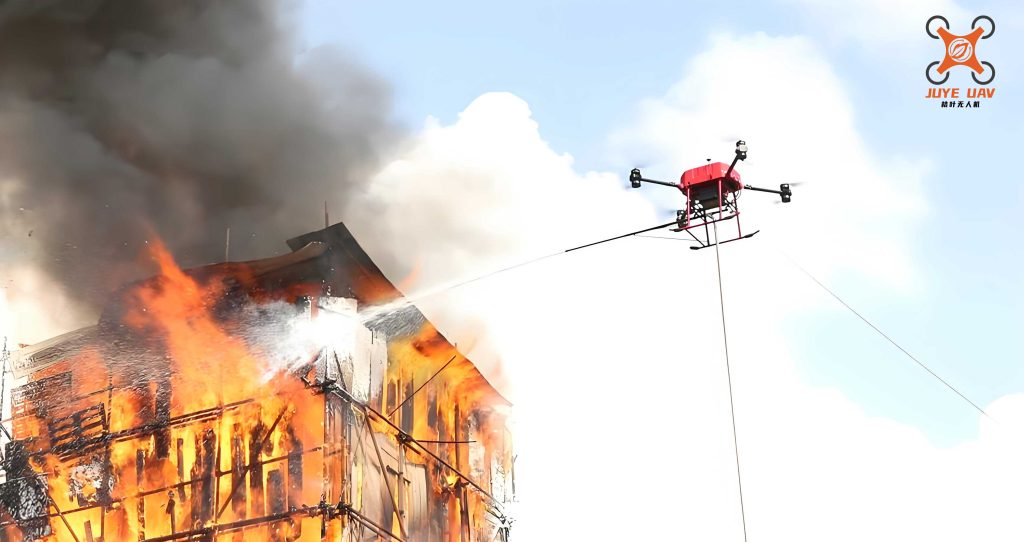
The fundamental advantage of deploying a fire drone lies in its ability to act as a force multiplier and a risk mitigator. The core benefits can be systematically categorized, and their impact is substantial. The integration of a fire drone fundamentally shifts operational paradigms, offering capabilities that were previously unattainable or came with significant risk and cost.
The primary and most critical advantage is the enhancement of responder safety. A fire drone serves as a remote sensor platform that can penetrate hazardous environments—collapsing structures, toxic atmospheres, raging wildfires, or unstable terrain—without endangering human life. This allows for risk assessment and strategic planning from a position of safety. For instance, a fire drone equipped with a thermal imaging camera can identify structural hot spots or trapped victims within a smoke-filled building, information that is crucial for deciding on entry points and crew deployment. The operational safety gain can be conceptually represented by a risk reduction factor ($R_{rf}$) introduced by drone reconnaissance before human entry:
$$R_{rf} = 1 – \frac{P_{hazard|drone}}{P_{hazard}}$$
where $P_{hazard}$ is the probability of a hazardous event (e.g., structural collapse, flashover) during initial reconnaissance, and $P_{hazard|drone}$ is the significantly reduced probability after a fire drone has provided critical situational data, enabling informed and cautious entry.
Secondly, fire drones provide dramatically faster response times for situational assessment. While ground units may be delayed by traffic, obstructed roads, or difficult topography, a fire drone can be launched within minutes and travel in a direct line-of-sight to the incident. This rapid aerial deployment provides commanders with a real-time, overarching view long before the first engine arrives, enabling more effective initial resource allocation and strategy formulation. The time advantage ($\Delta T_{gain}$) can be modeled as:
$$\Delta T_{gain} = T_{ground\_to\_visual} – T_{drone\_to\_visual}$$
where $T_{ground\_to\_visual}$ is the time for ground crews to reach a position offering a comprehensive view of the incident, and $T_{drone\_to\_visual}$ is the time for the fire drone to achieve the same, invariably resulting in a positive $\Delta T_{gain}$ that is critical in dynamic emergencies.
Thirdly, the data collection capabilities of a modern fire drone are unparalleled. They are no longer simple flying cameras but integrated sensor platforms. A single fire drone can simultaneously or sequentially capture:
- Visual Spectrum HD Video/Photography: For general assessment, damage documentation, and public information.
- Thermal Imaging: For seeing through smoke, identifying heat signatures of fire, victims, or hot electrical components.
- Multispectral/Gas Detection Sensors: For identifying chemical leaks, monitoring air quality for toxic compounds like CO or H2S, or assessing vegetation health in wildfire management.
- Lidar (Light Detection and Ranging): For creating precise 3D maps of structures or terrain, useful for planning tactical operations and measuring volume/area.
This sensor fusion creates a rich, multi-layered data stream that feeds directly into the incident command system, transforming decision-making from reactive to proactive and data-driven.
Finally, from a resource management perspective, the fire drone offers a highly cost-effective solution. While the initial investment exists, the operational costs are minimal compared to manned aircraft like helicopters. A single fire drone team can perform extended reconnaissance, mapping, and monitoring tasks that would otherwise require multiple ground teams or expensive aerial assets. The cost-effectiveness ($CE_{drone}$) over traditional methods for a given surveillance task can be approximated as:
$$CE_{drone} = \frac{C_{traditional}}{C_{drone}}$$
where $C_{traditional}$ represents the cost (financial, temporal, and resource-based) of using ground teams or manned aircraft, and $C_{drone}$ is the total cost of deploying the UAV system. This ratio consistently favors the fire drone for a wide range of tasks, leading to optimized budget utilization.
| Operational Advantage | Key Capability | Direct Impact |
|---|---|---|
| Enhanced Safety | Remote Hazard Assessment | Reduces risk to firefighter lives during reconnaissance and monitoring. |
| Faster Response | Rapid Aerial Deployment | Provides critical situational awareness minutes sooner, shaping initial attack strategy. |
| Advanced Data Collection | Multi-sensor Fusion (Visual, Thermal, Gas, Lidar) | Delivers comprehensive, real-time intelligence for superior tactical decision-making. |
| Cost-Effectiveness | Low Operational Cost vs. Manned Assets | Enables extensive aerial support without the high cost of helicopters, maximizing resource efficiency. |
Application in Fire Suppression: The Fire Drone as an Aerial Tactical Asset
In the domain of active fire suppression, the fire drone transitions from a mere observer to an active participant in the tactical workflow. Its applications are diverse and deeply integrated into modern fireground operations.
Aerial Reconnaissance and Intelligence Gathering: This is the foundational application. Upon arrival, the first fire drone launched provides the incident commander with an immediate “God’s-eye view.” It answers critical initial questions: What is the fire’s seat and extent? How is it spreading? What are the exposure hazards? What are the best access and egress routes? This intelligence is streamed live to command vehicles and tablets in the field, creating a common operational picture. The aerial perspective allows for calculating fire front speed and predicting growth using simple models based on observed spread rate ($v_{fire}$), wind vector ($\vec{w}$), and fuel type coefficient ($\alpha_{fuel}$):
$$\vec{S}_{predicted} = \vec{S}_{current} + (v_{fire} \cdot \hat{w} + \alpha_{fuel}) \cdot \Delta t$$
where $\vec{S}$ represents the fire front position vector.
Monitoring Fire Behavior and Dynamics: Beyond the initial assessment, a fire drone is crucial for persistent surveillance. In structural fires, it monitors for signs of impending flashover or backdraft by tracking heat build-up and smoke behavior. In wildfires, it tracks the fire’s movement, identifying spot fires ahead of the main front and monitoring the effectiveness of control lines. The thermal imaging capability is paramount here, visualizing convection currents and temperature gradients invisible to the naked eye. This allows for dynamic resource allocation, pulling crews from areas of imminent danger and reinforcing positions where the firefight is most critical.
Identifying and Mapping Hotspots: Post-knockdown or during mop-up operations, a fire drone with a thermal camera becomes an indispensable tool for finding hidden hotspots. In a structure, it can pinpoint smoldering fires within walls or attic spaces. After a wildfire, it can systematically scan vast swathes of burnt landscape to locate lingering heat sources that could re-ignite. This process is far more efficient, thorough, and safe than manual probing by ground crews. The efficiency of hotspot detection ($E_{detect}$) using a fire drone with a thermal sensor with sensitivity $\Delta T_{min}$ over an area $A$ can be compared to ground crews:
$$E_{detect} = \frac{A}{t_{drone}} \gg \frac{A}{t_{ground}}$$
and
$$P_{detect}(drone) \approx 1 \text{ for } \Delta T > \Delta T_{min}, \text{ whereas } P_{detect}(ground) < 1 \text{ and is spatially inconsistent.}$$
Aerial Delivery of Suppressants and Equipment: This is an emerging and highly potent application. Specialized heavy-lift fire drone platforms are now capable of delivering payloads. Their applications are twofold:
1. Targeted Suppressant Delivery: These drones can carry small tanks of water, foam, or retardant gel. They are particularly effective for hard-to-reach fires, such as in high-rise facades, electrical substations, or wildfires on steep slopes. They can make precise, targeted drops to cool hotspots or protect specific assets. The required volume of agent ($V_{agent}$) for a targeted drop can be estimated based on the hotspot area ($A_{hotspot}$) and desired application rate ($\rho_{rate}$):
$$V_{agent} = A_{hotspot} \cdot \rho_{rate}$$
The fire drone‘s payload capacity determines the number of sorties needed.
2. Logistical Support: Drones can deliver essential equipment to firefighters operating on upper floors of a building or in remote areas—additional air cylinders, tools, medical kits, or communication devices. This extends operational endurance and safety for crews in extended operations.
| Fire Suppression Phase | Fire Drone Application | Key Technologies Used | Operational Outcome |
|---|---|---|---|
| Initial Attack | Aerial Reconnaissance & Size-up | HD Camera, Live Video Downlink | Rapid, accurate situational awareness for effective initial strategy. |
| Active Firefighting | Fire Behavior & Spread Monitoring | Thermal Imaging Camera, Telemetry | Dynamic resource management, prediction of fire growth, enhanced crew safety. |
| Overhaul & Mop-up | Hotspot Identification & Mapping | High-Sensitivity Thermal Camera, GIS Mapping Software | Thorough extinguishment, prevention of rekindle, efficient use of mop-up crews. |
| Specialized Tactics | Aerial Suppressant/Equipment Delivery | Heavy-Lift Platform, Precision Release Mechanism | Access to inaccessible fires, logistical support, protection of exposures. |
Application in Technical Rescue and Search Operations: The Fire Drone as a Lifesaving Scout
In the complex and time-sensitive realm of technical rescue and search operations, the fire drone proves its value as a versatile scout and data relay, dramatically expanding the capabilities of rescue teams.
Providing Real-Time Situational Awareness for Rescue Command: Similar to firefighting, the first benefit in any rescue scenario is immediate visual access. For incidents like building collapses, trench rescues, swift water events, or hazardous material releases, a fire drone can quickly survey the scene from above. It identifies the scale of the collapse, locates potential void spaces, assesses the stability of the environment, and identifies safe staging areas for rescue teams. This overhead view is integrated with ground-level observations to build a complete 3D understanding of the incident, which is critical for planning a safe and effective extraction. The total situational awareness ($SA_{total}$) can be thought of as a function of both ground ($SA_g$) and aerial ($SA_a$) inputs:
$$SA_{total} = f(SA_g, SA_a) = \sqrt{SA_g^2 + SA_a^2}$$
where the aerial component provided by the fire drone adds an orthogonal and crucial dimension of information.
Supporting Search and Rescue (SAR) Missions: This is perhaps one of the most publicized and impactful uses of fire drone technology. In wilderness SAR, missing person cases, or disaster zones (earthquakes, floods), drones cover search grids orders of magnitude faster than ground teams. Equipped with thermal cameras, they can detect human heat signatures day or night, even through light foliage. High-resolution cameras can be used with software for automated object detection, scanning for colors, shapes, or patterns associated with the missing subject. The probability of detection ($P_D$) over a large search area ($A_{search}$) using a fire drone with sensor sweep width ($W$) flying at speed ($v$) for time ($t$) is given by:
$$P_D \approx 1 – e^{-\frac{W \cdot v \cdot t}{A_{search}}}$$
This model shows how a fire drone significantly increases $P_D$ by enabling high $v$ and $t$ over large $A_{search}$ with a meaningful $W$, especially with thermal imaging.
Delivery of Supplies to Inaccessible Locations: In extended rescue operations, sustaining both victims and responders is a challenge. A fire drone can act as a rapid logistics courier. It can deliver critical supplies like water, food, medicine, blankets, or two-way radios to trapped survivors before ground teams can reach them. This capability is vital in scenarios like hikers stranded on a cliff face, people trapped on a flooded rooftop, or in the immediate aftermath of an earthquake where roads are destroyed. The payload capacity and flight range of the fire drone determine the scale and frequency of these lifesaving deliveries.
Creating 3D Maps and Structural Analysis: Using photogrammetry software with data from the fire drone‘s camera or via integrated Lidar, rescuers can generate highly accurate 3D models of a collapse site or disaster area. These models allow commanders to measure distances, assess angles of lean, plan shoring and cribbing points, and virtually “walk through” the debris pile to plan the safest and most efficient extraction path. This digital twin of the incident scene is an invaluable planning tool that reduces uncertainty and risk during the delicate rescue process.
Establishing Emergency Communication Links: In remote areas or disaster zones where cellular infrastructure is damaged, a fire drone can be equipped with a portable cellular or radio repeater payload. Hovering at altitude, it can act as a temporary communication tower, restoring critical voice and data links between isolated rescue teams, command posts, and even survivors with cell phones. This reconnects the operational fabric of the response effort.
| Rescue Operation Type | Fire Drone Application | Key Technologies Used | Lifesaving Outcome |
|---|---|---|---|
| Urban Search & Rescue (USAR) | Collapse Site Mapping & Victim Location | Thermal Camera, HD Zoom Camera, Photogrammetry Software | Identifies survivor locations and structural hazards, enabling precise and safe extraction plans. |
| Wilderness SAR | Large-Area Search Grid Coverage | Thermal Imaging, Automated Object Detection, Long-Endurance Platform | Dramatically increases search speed and area coverage, improving probability of quick location. |
| Hazardous Materials | Remote Scene Assessment & Gas Detection | Multispectral/Gas Sensors, HD Camera | Identifies leak sources and plume dispersion without exposing responders, informing evacuation zones. |
| Swiftwater/Flood Rescue | Victim Spotting & Situation Monitoring | Stabilized Zoom Camera, GPS Tagging | Locates victims in water, monitors changing flood dynamics, guides boat teams. |
| Technical Rescue (High-Angle, Trench) | Overhead Perspective & Equipment Delivery | HD Live Feed, Payload Release System | Provides optimal vantage point for command, delivers ropes, tools, or medical supplies to rescuers/victims. |
Conclusion: The Indispensable Fire Drone
The integration of the fire drone into contemporary firefighting and rescue operations is not merely an adoption of new technology; it signifies a fundamental shift in emergency response doctrine. From my vantage point within the field, the fire drone has evolved from a supplementary tool to a core component of the incident command system. Its dual role as an aerial sensor and a tactical logistics platform addresses critical gaps in safety, efficiency, and effectiveness. By providing eyes in the sky, ears in silent zones, and hands in inaccessible places, the fire drone empowers responders to make better decisions faster, manage risk more proactively, and execute complex operations with greater precision. As battery technology, artificial intelligence for data analysis, airspace integration, and payload capabilities continue to advance, the potential of the fire drone will only expand further. We are witnessing the dawn of a new era in public safety, one where the courageous human responder is augmented and protected by the silent, vigilant, and capable fire drone, working in unison to save lives and safeguard communities.