
The integration of Unmanned Aerial Vehicle (UAV) technology into the sports domain represents a paradigm shift in how events are captured, analyzed, and experienced. From my perspective as a practitioner and observer of this technological convergence, the advent of sophisticated drone systems has unlocked unprecedented capabilities. This discussion delves beyond basic aerial videography to explore the comprehensive ecosystem of drone applications in sports, with a particular emphasis on the emerging and spectacular field of the drone light show. I will examine the technical foundations, operational methodologies, artistic implications, and data-centric advantages, utilizing formulas and tables to crystallize the concepts that are reshaping the sports industry.
1. A Technical Overview of Modern Drone Systems for Sports
At its core, a drone is an unmanned aircraft system comprising several integrated subsystems that enable autonomous or remotely piloted flight. For professional sports applications, multi-rotor platforms are predominant due to their exceptional stability, vertical take-off and landing (VTOL) capability, and precise hovering control. The flight dynamics of a standard quadcopter can be simplified by considering the thrust forces ($T_i$) generated by each rotor and the resulting torques. The net thrust ($T$) and the angular accelerations ($\dot{p}, \dot{q}, \dot{r}$) around the body axes are governed by:
$$ T = \sum_{i=1}^{4} T_i, \quad \begin{bmatrix} \dot{p} \\ \dot{q} \\ \dot{r} \end{bmatrix} = \mathbf{I}^{-1} \left( \begin{bmatrix} L(T_2 – T_4) \\ M(T_1 – T_3) \\ \sum \tau_{drag_i} \end{bmatrix} – \begin{bmatrix} p \\ q \\ r \end{bmatrix} \times \mathbf{I} \begin{bmatrix} p \\ q \\ r \end{bmatrix} \right) $$
where $\mathbf{I}$ is the inertia matrix, $L$ and $M$ are geometric constants, and $\tau_{drag}$ represents drag torque. This precise control is managed by the Flight Controller (FC), the system’s brain, which processes data from an array of sensors.
The operational efficacy of a sports drone hinges on its key subsystems, as summarized below:
| Subsystem | Core Components | Function in Sports Applications |
|---|---|---|
| Propulsion & Airframe | Motors, Electronic Speed Controllers (ESCs), Propellers, Frame | Provides lift, agility, and speed for dynamic tracking; durability for outdoor conditions. |
| Flight Control & Navigation | IMU (Gyroscope, Accelerometer), GPS/GNSS, Barometer, Compass | Ensures rock-steady hover, precise position hold, and autonomous waypoint navigation for repeatable shots. |
| Communication & Telemetry | Radio Controller, Video Downlink, Telemetry Uplink | Enables real-time pilot control, First-Person View (FPV) for framing, and data transmission. |
| Payload & Gimbal | High-resolution Camera (4K/8K), 3-axis Stabilized Gimbal, Optional LiDAR/Spectrometer | Captures cinematic, stable footage; specialized sensors can gather biomechanical or environmental data. |
| Power System | High-Capacity Lithium Polymer (LiPo) Batteries, Power Distribution Board | Determines flight endurance, a critical factor for covering long-duration events like marathons. |
The real-time communication link is vital. The achievable data rate $R$ for the video downlink, determining live feed quality, can be modeled by the Shannon-Hartley theorem:
$$ R = B \cdot \log_2\left(1 + \frac{S}{N}\right) $$
where $B$ is the channel bandwidth and $\frac{S}{N}$ is the signal-to-noise ratio, which can be challenged by crowded stadium interference.
2. Technical and Artistic Imperatives for Sports Cinematography
Deploying drones in a live sports environment is a discipline that balances rigorous safety protocols with creative cinematography. The primary constraint is regulatory compliance. Pilots must operate within visual line-of-sight (VLOS) rules, adhere to strict altitude ceilings (often 400 ft/120m AGL), and obtain necessary waivers for flights over assemblies of people, which is common in stadiums. Pre-flight planning involves 3D mapping of the venue to identify no-fly zones, obstacle corridors, and safe emergency landing sites. Risk assessment models often employ a simple probability-impact matrix:
$$ \text{Risk Score} = P(\text{Failure}) \times C(\text{Consequence}) $$
where $P$ is the probability of a system or operational failure, and $C$ quantifies the potential consequence (e.g., injury, property damage).
Masterful piloting transcends basic flight. It involves executing complex, smooth flight paths that translate into compelling shots. The gimbal’s orientation $\theta_g(t)$ must be coordinated with the drone’s flight path $\vec{p}(t)$ to keep the subject centered. A common tracking shot involves a combination of lateral flight and panning:
$$ \vec{p}(t) = \begin{bmatrix} v_x \cdot t \\ R \cdot \sin(\omega t) \\ h_0 \end{bmatrix}, \quad \theta_g(t) = \arctan\left(\frac{R \cdot \sin(\omega t)}{v_x \cdot t}\right) $$
This synergy creates the “reveal” or “orbit” shot, fundamental to sports coverage.
The artistry of aerial sports photography lies in perspective and motion. Different shot types evoke distinct emotional responses and analytical insights, as detailed below:
| Shot Type (Flight Path) | Mathematical / Control Basis | Visual & Analytical Outcome in Sports |
|---|---|---|
| Reveal / Pull-Back | Linear flight along $-Z$ (down) axis while pitching gimbal up. $\vec{p}(t)=[0,0, -v_z t]$, $\theta_g(t)=\theta_0 + \omega t$. | Starts tight on an athlete (e.g., a quarterback) and reveals the expanding tactical field (receivers downfield). |
| Orbit / Circular Tracking | Circular path around subject. $\vec{p}(t)=[R\cos(\omega t), R\sin(\omega t), h]$. Gimbal yaw locked to subject. | Provides 360° view of a solo athlete (skier, climber) or dynamic action (cycling peloton), emphasizing speed and form. |
| Crane / Pedestal | Vertical ascent/descent. $\vec{p}(t)=[0,0, h_0 \pm v_v t]$. | Simulates a camera crane, used for ceremonial moments (national anthem, trophy lift) or to show stadium scale. |
| Follow / Linear Track | Match velocity vector $\vec{v}_d$ with subject velocity $\vec{v}_s$. $\vec{v}_d(t) = \vec{v}_s(t) + \vec{\Delta}_{safe}$. | Ideal for tracking marathon leaders, a bobsled, or a racing car, creating a immersive sense of speed. |
| Top-Down / Nadir | Gimbal pointed straight down ($\theta_g = -90^\circ$), drone in hover or slow lateral movement. | Reveals geometric patterns of play (soccer formations, American football routes), offering unique tactical analysis. |
3. Comparative Advantages: A Data-Centric Revolution
The transition from solely ground-based cameras to an integrated aerial system offers transformative benefits. The table below quantifies and qualifies this shift across several dimensions:
| Aspect | Traditional Ground-Based Coverage | Drone-Enhanced Coverage | Quantifiable Impact / Advantage |
|---|---|---|---|
| Perspective & Coverage | Limited to fixed or dolly-based camera positions at or near field level. Significant blind spots. | Unlimited vantage points from any point in 3D space above and around the venue. Full spatial awareness. | Coverage area increase can be modeled as moving from a 2D plane to a 3D hemisphere. $\frac{V_{coverage(drone)}}{V_{coverage(trad)}} \to \infty$. |
| Operational Flexibility & Speed | Repositioning cameras is slow, logistically heavy, and often impossible mid-play. | Rapid redeployment between shots or locations within seconds. Dynamic shot adaptation. | Setup/Repositioning Time Reduction: Often from minutes/hours to seconds. |
| Capital & Operational Expenditure | High-cost equipment (cranes, cable cams, helicopters), large crews, complex infrastructure. | Lower upfront hardware cost, smaller crew (1 pilot + 1 spotter), minimal venue footprint. | Cost reduction for equivalent shots can exceed 60-80%, especially eliminating helicopter hire. |
| Data Acquisition & Analytics | Primarily visual recording. Metric extraction (speed, position) is post-hoc and less precise. | Direct geospatial telemetry ($\vec{p}(t), \vec{v}(t)$) for every tracked object. Real-time data fusion. | Enables real-time athlete kinematics: $v(t)=\|\vec{v}(t)\|$, $a(t)=\frac{dv}{dt}$. Immediate performance analytics. |
| Audience Immersion | Passive viewing from fixed, director-chosen angles. | Active, immersive experience through unique “player-like” or “bird’s-eye” perspectives. | Increased viewer engagement metrics (watch time, social shares) by presenting novel visual narratives. |
4. Core Application Domains in the Sports Ecosystem
The utility of drones permeates the entire lifecycle of a sporting event.
Pre-Event Promotion and Cinematic Storytelling: High-production-value promotional films leverage drone cinematography to capture the grandeur of venues and the intensity of athletes in training, generating anticipation. The sweeping, majestic shots achievable only from the air serve as powerful marketing assets.
In-Depth Athletic Training and Performance Analysis: This is where drones transition from a filming tool to a scientific instrument. By tracking an athlete with high frequency, coaches can extract precise biomechanical data. For example, a sprinter’s center-of-mass trajectory and stride parameters can be calculated from video using photogrammetry. The change in an athlete’s postural angle $\phi(t)$ during a ski jump can be derived and correlated with jump length $L$:
$$ L \propto \int_{t_{takeoff}}^{t_{landing}} v(t) \cdot \cos(\phi(t)) \, dt $$
Such data-driven insights are invaluable for technique refinement.
Live Broadcast Enhancement: Drones are now integral broadcast assets. They provide the “hero shots” for opens, transitions, and replays. For large, linear events like marathons, cycling races, or sailing regattas, drones are the only platform that can keep pace with leaders while simultaneously showcasing the scale of the competition and the beauty of the course, delivering a broadcast narrative impossible with traditional methods.
Drone Light Shows: The Pinnacle of Technological Spectacle
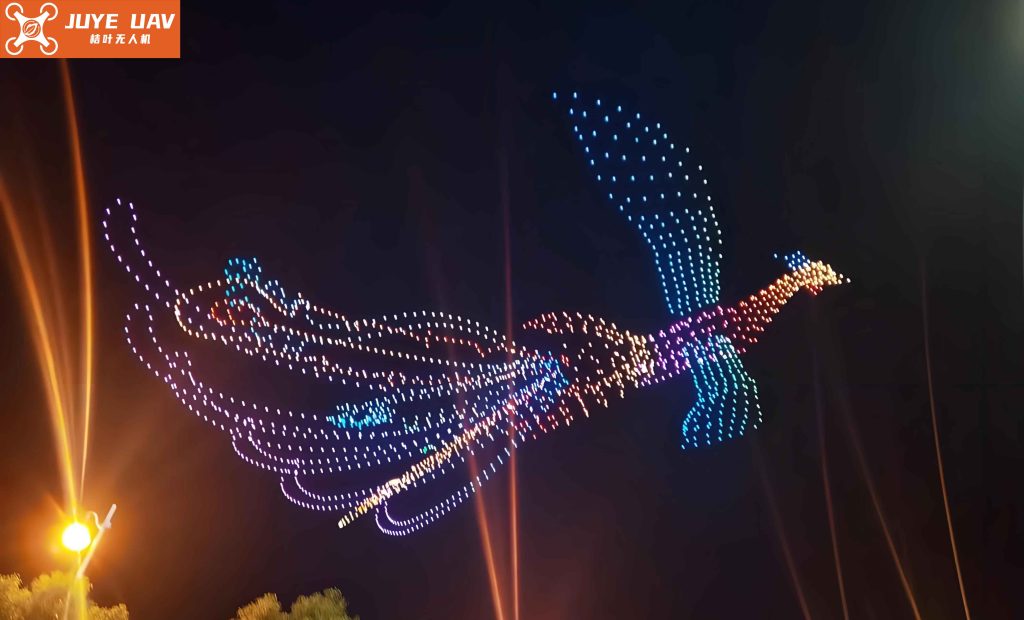
While aerial filming captures reality, the drone light show creates a new, synthetic reality in the sky. This application represents the zenith of coordinated UAV technology in entertainment. A drone light show involves hundreds, even thousands, of drones equipped with RGB LEDs, forming a synchronized flying display. The core technology is a distributed swarm system. Each drone $i$ in the swarm of size $N$ must compute its target position $\vec{T}_i(t)$ for each frame of the show, based on a central timeline.
The fundamental challenge is collision avoidance. A simple rule-based model for each drone involves adjusting its path to maintain a minimum safe distance $d_{safe}$ from neighbors:
$$ \vec{F}_{avoid, i} = \sum_{j \neq i}^{N} k \cdot \frac{1}{\|\vec{p}_i – \vec{p}_j\|^2} \cdot \hat{\mathbf{r}}_{ij} \quad \text{for} \quad \|\vec{p}_i – \vec{p}_j\| < d_{safe} $$
where $k$ is a repulsion constant and $\hat{\mathbf{r}}_{ij}$ is the unit vector away from drone $j$. This vector is then integrated into the flight path planning. The artistic creation of a drone light show involves converting 3D storyboards into time-coded flight paths and color commands. The creation pipeline for a major sports drone light show, such as an Olympic Games opening ceremony, can be summarized as:
- Artistic Conceptualization: Designing 2D/3D animations (logos, mascots, dynamic scenes).
- Voxelization & Path Planning: Converting the 3D model into a point cloud (voxels) assignable to individual drones. Solving the optimal assignment problem to minimize total flight energy: $\min \sum_{i=1}^{N} \int \|\vec{v}_i(t)\|^2 \, dt$.
- Trajectory Smoothing & Simulation: Ensuring paths are dynamically feasible (respecting max velocity $v_{max}$ and acceleration $a_{max}$). Running countless simulations to verify safety and visual continuity.
- Show File Deployment & Execution: Uploading the final time-synchronized command file to the swarm. Relying on ultra-precise RTK-GPS for centimeter-level positioning.
The application of a drone light show in sports is multifaceted: it can form the event logo during opening ceremonies, animate the championship trophy, depict historical moments, or create a breathtaking backdrop for the awarding of medals. It is a potent tool for branding and creating viral social media moments, leaving a lasting impression of innovation and scale. The mathematical beauty of swarm coordination finds its most visually stunning expression in the modern drone light show.
5. Conclusion: A Future Defined by Autonomous Intelligence
The application of drone technology in sports has evolved from a novel camera angle to an indispensable, multi-faceted tool. It enhances storytelling, democratizes breathtaking cinematography, provides granular performance data, and culminates in the creation of entirely new art forms like the coordinated drone light show. Looking forward, the integration of Artificial Intelligence (AI) will drive the next leap. We can anticipate fully autonomous drones that can predict play development, automatically frame the most relevant action using computer vision, and even make direct editorial decisions. The fusion of real-time biometric data from athletes with live drone footage could offer personalized viewing experiences. Ultimately, drones are not just observing sports; they are actively reshaping its production, analysis, and consumption, solidifying their role as a cornerstone of the future sports technology stack.