
In my journey as a designer and observer of interactive technologies, I have consistently been drawn to creations that dissolve the barriers between abstract concepts and tangible play. The most profound innovations are those that speak directly to the innate curiosity of a child, transforming learning into an adventure of discovery. Today, I wish to delve into two exemplary projects that embody this philosophy: a system for musical composition using physical blocks and, more extensively, a mesmerizing bionic butterfly drone. These are not mere toys; they are gateways to understanding complex worlds through hands-on interaction and aesthetic wonder.
The first project reimagines music theory as a landscape of colorful, interconnected blocks. The core insight is that sound, an inherently temporal and invisible phenomenon, can be given spatial and visual form. I see this as a fundamental shift in pedagogical approach. Children compose not by reading sheet music but by assembling modules that represent distinct musical elements—melody, rhythm, instrumentation, and dynamics. The arrangement operates on two axes: a horizontal sequence that dictates the temporal flow (rhythm and volume) and a vertical stack that organizes musical phrases into coherent sections. This spatial logic allows a child to “see” the structure of a nursery rhyme they are building.
The technology enabling this is elegantly minimalist. Radio-frequency identification (RFID) tags embedded within each block allow the base unit to identify which module is placed and where. Coupled with flexible printed circuits, this creates a robust yet child-friendly interface. The system can be represented through a simple state table, mapping physical configurations to audio outputs:
| Block Type (RFID Code) | Horizontal Position (X-coordinate) | Vertical Layer (Y-coordinate) | Output Parameter | Value Range |
|---|---|---|---|---|
| Melody_A | 1 to 8 | 1 | Note Pitch | C4 to C5 |
| Rhythm_Quarter | 1 to 8 | 1 | Note Duration | 0.5s |
| Instrument_Piano | N/A | 2 | Timbre | Piano Sample Bank |
| Dynamics_f | 5 | 1 | Amplitude | 70 dB |
The mathematical foundation of music is thus made manipulable. For instance, the relationship between note pitch and frequency can be explored. The standard pitch A4 is 440 Hz. The frequency \( f \) of any note can be calculated from its MIDI note number \( n \) using the formula:
$$ f = 440 \times 2^{(n-69)/12} $$
In the block system, placing a “Melody_A” block at a specific horizontal position could correspond to a specific \( n \), making this exponential relationship a physical experience rather than a memorized rule. The combinatorial possibilities are vast. If we have \( m \) types of melody blocks, \( r \) types of rhythm blocks, and \( i \) instrument blocks, the total unique musical phrases \( P \) achievable for an \( s \)-slot sequence is given by:
$$ P = (m \cdot r)^s \cdot i $$
For a simple 8-slot sequence with 5 melody, 3 rhythm, and 4 instrument choices, this yields \( P = (5 \cdot 3)^8 \cdot 4 = 15^8 \cdot 4 \approx 2.56 \times 10^9 \) possibilities—a universe of creativity from a finite set.
This tactile engagement with music theory fosters a deep, intuitive understanding. It demystifies composition, presenting it as a playful act of combination, akin to mixing colors. The child becomes an active composer, their hands directly shaping soundscapes. This philosophy of embodied learning finds a even more captivating expression in the realm of flight and biomimicry.
My fascination with nature-inspired design leads me to a profound appreciation for the bionic butterfly drone. This device is a masterpiece of interdisciplinary design, merging robotics, aerodynamics, material science, and pure visual poetry to create an educational tool for children aged eight and above. The central premise of the bionic butterfly drone is to capture the essence of a butterfly’s flight—its graceful, erratic, yet efficient locomotion—and replicate it not just mechanically, but aesthetically. The goal is to inspire not only technical curiosity but also a renewed attention to the natural world.
The design process for the bionic butterfly drone begins with a meticulous study of lepidopteran morphology and kinematics. The wing stroke of a butterfly is a complex figure-eight motion that generates both lift and thrust. This can be abstracted into a simplified aerodynamic model. The lift \( L \) generated by a flapping wing can be approximated by modifying the standard lift equation for revolving wings:
$$ L = \frac{1}{2} \rho v_{eff}^2 S C_L(\alpha) \phi(t) $$
Here, \( \rho \) is air density, \( v_{eff} \) is the effective velocity of the wing through the air, \( S \) is the wing area, \( C_L \) is the lift coefficient dependent on the angle of attack \( \alpha \), and \( \phi(t) \) is a periodic function describing the flapping motion. For a bionic butterfly drone, the wing kinematics are engineered to maximize stability and mimic natural appearance rather than raw efficiency.
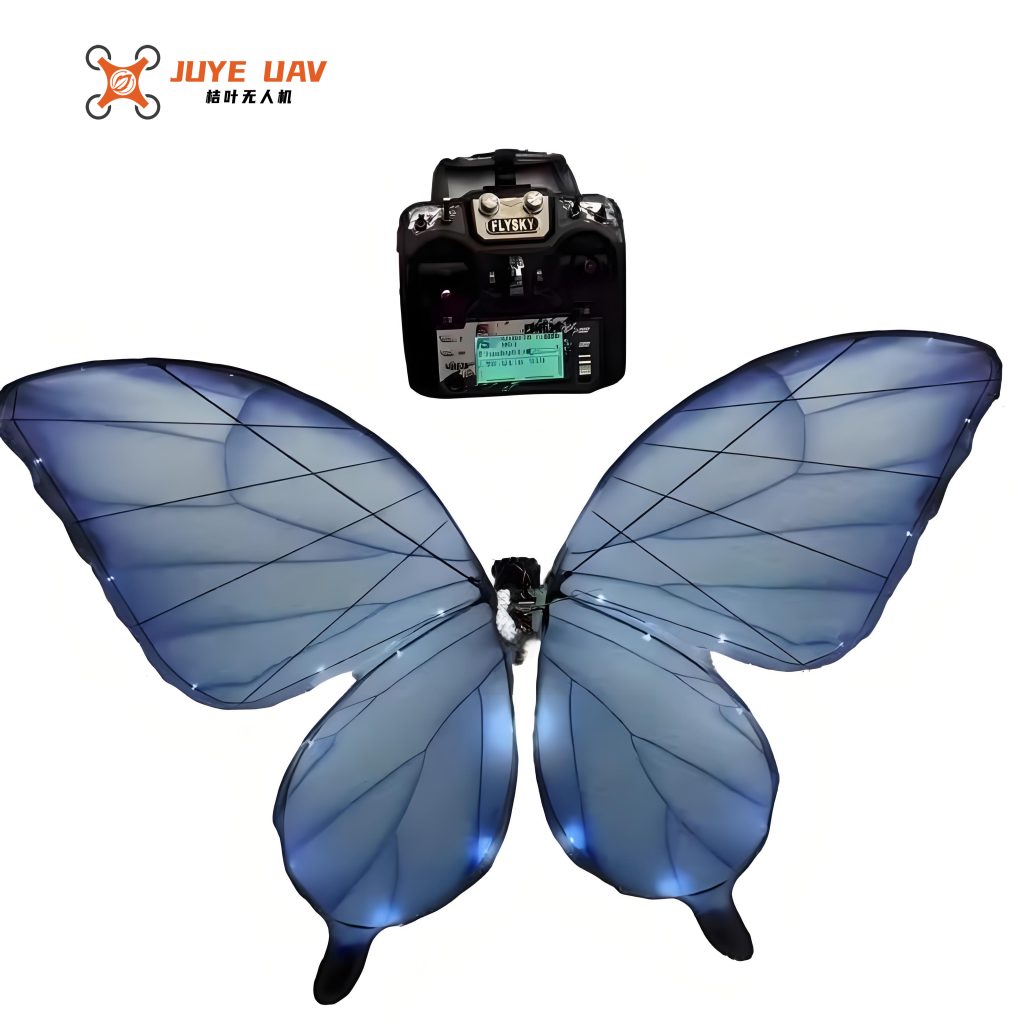
The true genius of the bionic butterfly drone lies in its biomimetic aesthetics. The chassis is sculpted to resemble the body of a butterfly, while the wings are the primary canvas. Through a sophisticated combination of lightweight polymers, micro-textures, and integrated LED arrays, the drone can simulate the iridescent sheen and vivid patterns of various butterfly species. The color \( I \) perceived from a wing can be a function of material reflectance \( R(\lambda) \), incident light \( L_0(\lambda) \), and the dynamic LED emission \( E(\lambda, t) \):
$$ I(\lambda, t) = [R(\lambda) \cdot L_0(\lambda)] + E(\lambda, t) $$
This allows a single bionic butterfly drone to morph its visual identity, perhaps mimicking a Monarch’s orange and black one moment and a Blue Morpho’s shimmering blue the next. This is not mere decoration; it is an invitation to careful observation. When a child pilots this bionic butterfly drone, they are not just controlling a machine—they are engaging with a artifact that begs comparison to its living counterpart, prompting questions about wing patterns, flight behavior, and ecology.
The technical specifications and educational outcomes facilitated by the bionic butterfly drone can be summarized in the following comparative table, which also contrasts it with the musical block system to highlight their shared design ethos:
| Design Feature | Musical Building Blocks System | Bionic Butterfly Drone |
|---|---|---|
| Core Educational Domain | Abstract Music Theory & Composition | Aerodynamics, Biomimicry, & Natural Science |
| Primary Interaction Modality | Tactile Assembly & Spatial Reasoning | Kinesthetic Control & Visual Tracking |
| Key Technology Enablers | RFID, Flexible Circuits | Flapping-wing Mechanism, Programmable LEDs, Gyro-stabilization |
| Mathematical Model | Combinatorics, Exponential Frequency Relations | Fluid Dynamics, Periodic Motion, Color Theory |
| Creativity Output | Unique Musical Sequences (Auditory) | Flight Patterns & “Butterfly Species” Simulation (Visual/Kinetic) |
| Target Cognitive Skills | Pattern Recognition, Sequential Logic | Hand-Eye Coordination, Systems Thinking, Observational Skills |
Operating the bionic butterfly drone involves understanding basic flight dynamics. The pilot, typically a child, uses a simplified controller that translates commands into adjustments of wing stroke amplitude \( A \) and frequency \( f_w \), and tail rudder angle \( \delta \). The drone’s trajectory in a 2D plane (ignoring altitude for simplicity) can be modeled. If we denote the heading angle as \( \theta \), the equations of motion might be linearized as:
$$ \dot{x} = v \cos(\theta) $$
$$ \dot{y} = v \sin(\theta) $$
$$ \dot{\theta} = k_\delta \cdot \delta $$
Here, \( v \) is a forward speed proportional to the wing flapping frequency \( f_w \), and \( k_\delta \) is a control gain. The elegance of the bionic butterfly drone is that these underlying physics are experienced intuitively through play; the child learns to anticipate how a gentle turn of the rudder will curve the flight path, much like a real butterfly adjusting to a breeze.
The societal and educational impact of such a bionic butterfly drone is multifaceted. First, it serves as a powerful STEM (Science, Technology, Engineering, and Mathematics) tool. By deconstructing the magic of flight into a controllable, beautiful artifact, it makes concepts like lift, thrust, and biomimicry accessible. Second, it fosters environmental consciousness. The very act of mimicking a butterfly encourages children to look closer at the insects in their garden, to appreciate biodiversity, and to understand the fragility and brilliance of natural designs. Every flight of the bionic butterfly drone is a lesson in appreciating natural form and function.
Furthermore, the development cycle for a product like the bionic butterfly drone involves iterative prototyping and testing. Key performance metrics such as flight time \( T \), stability index \( \sigma \), and aesthetic fidelity score \( F \) must be optimized. These can be combined into a simple objective function \( O \) for design evaluation:
$$ O = w_1 \cdot T + w_2 \cdot (1/\sigma) + w_3 \cdot F $$
where \( w_1, w_2, w_3 \) are weighting factors reflecting design priorities (e.g., safety, ease of use, visual appeal). This quantitative approach ensures the final bionic butterfly drone is not only captivating but also robust and educational.
In reflecting on both designs, I perceive a common thread: the translation of complexity into intuitive, engaging interaction. The musical blocks give form to sound; the bionic butterfly drone gives engineered life to a natural wonder. They represent two points on a spectrum of embodied learning. The blocks are about internalizing abstract relationships through hand-eye coordination and logical arrangement. The bionic butterfly drone is about externalizing curiosity through spatial navigation and visual-motor feedback. Both are critically dependent on their physicality—the weight of a block, the flutter of a drone’s wing—to create a memorable learning impression.
The future of such interactive designs is boundless. Imagine a next-generation bionic butterfly drone equipped with simple environmental sensors, allowing it to respond to light or heat, making its behavior even more lifelike. Or consider networking multiple musical block sets to enable collaborative symphonies. The principles remain: make the complex tangible, the invisible visible, and the educational delightful.
To conclude, as a designer committed to enriching childhood experience, I believe products like the musical block system and the bionic butterfly drone are vital. They are not passive entertainments but active invitations to create, explore, and understand. The bionic butterfly drone, in particular, stands as a testament to how engineering can wear the guise of art, transforming a scientific principle into a flying jewel that inspires awe and inquiry in equal measure. It is through such thoughtful design that we can hope to nurture a generation of creative thinkers, keen observers, and passionate learners, all while reminding them of the profound beauty inherent in both music and the natural world.