
In recent years, I have observed the broader agricultural machinery market in my region facing significant headwinds, with sales of traditional equipment declining. However, within this challenging landscape, one segment has emerged as a beacon of innovation and growth: the agricultural drone. This technology has captivated numerous enterprises and entrepreneurs, drawing them into various nodes of its expanding ecosystem. The rapid maturation of agricultural drone technology, coupled with the continuous exploration of new application scenarios, signals a profound shift in modern farming practices.
The plant protection agricultural drone stands as a quintessential example of high-tech integration into agriculture. It embodies the convergence of cutting-edge advancements in information technology, software, aviation, flight control, image recognition, and autonomous navigation. Yet, at its core, an agricultural drone remains a production tool deployed within an agricultural context. Its ultimate value is determined by its ability to perform high-quality field work while delivering a satisfactory return on investment for owners and operators.
Currently, the primary application for these agricultural drones is in crop protection, specifically the unified prevention and control operations for large field crops. However, similar to many traditional machines, they face a critical limitation: functional singularity. This leads to short effective operational windows, low return on investment (ROI), and extended payback periods, hindering sustainable development for professional operators.
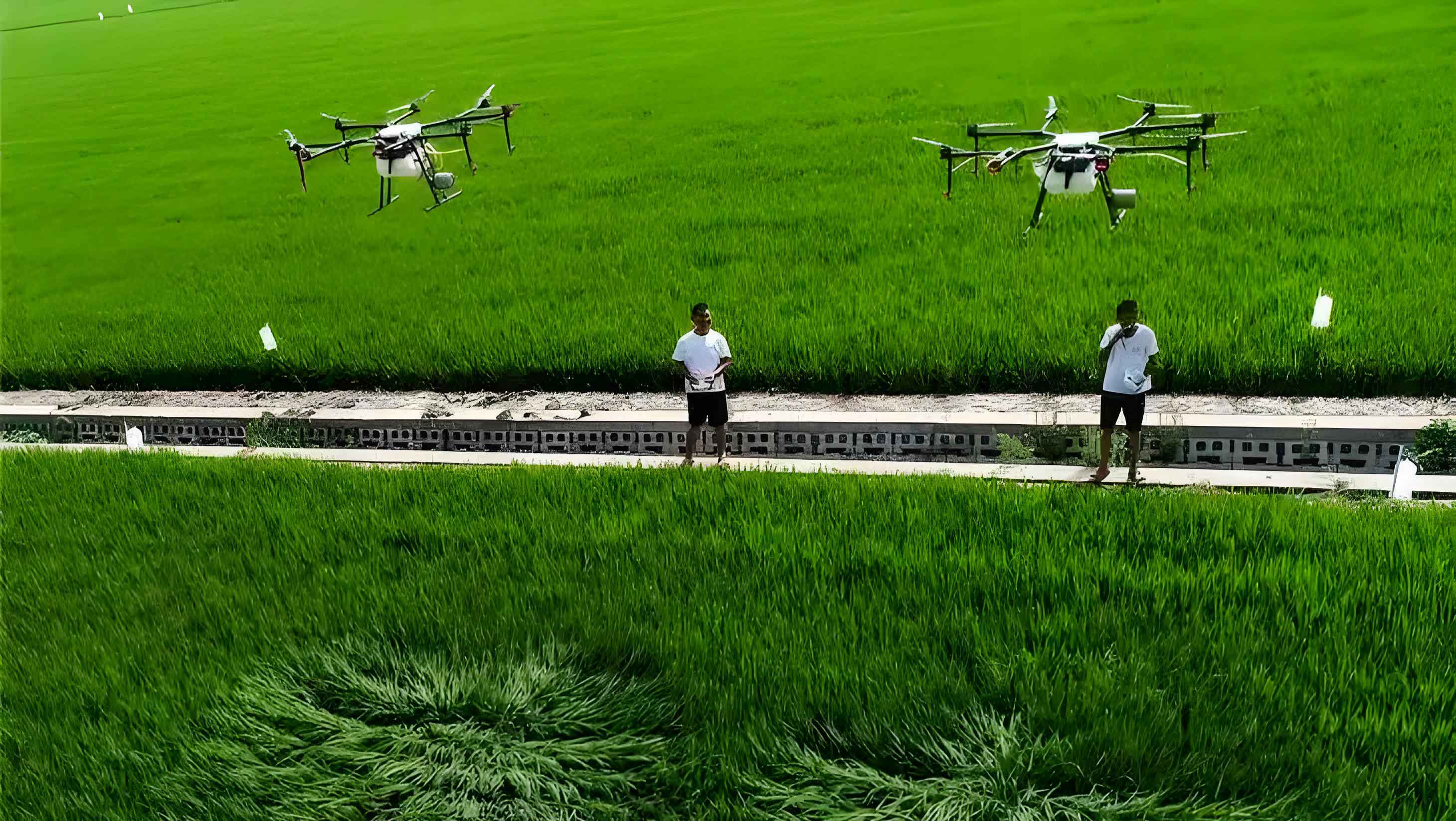
While efficiency is the undisputed advantage of the agricultural drone—outperforming ground rigs by a factor of 10–20 and manual labor by 50–100—this advantage is diluted when the machine is confined to a single task. An operator’s income potential and the asset’s ROI are inherently capped. The solution, from my perspective, lies in a decisive strategic expansion. This involves not only broadening the crop types for protection (e.g., orchards, tea plantations, cotton) but, more significantly, venturing into entirely new operational domains. The most promising frontier is the broadcasting and seeding market.
To unlock these new applications, the agricultural drone must evolve from a specialized sprayer into a versatile aerial platform. This necessitates the development and integration of various modular attachments or implements:
- Granular broadcast spreaders (for fertilizer, seed).
- Powder/powdery substance dispensers.
- Liquid fertilizer applicators.
- Aquaculture feed spreaders.
The future viability and growth of the agricultural drone industry hinge on this very principle of multifunctionality. The equation for sustainable operator profit becomes clearer with more applications:
$$ \text{Total Annual Revenue}_\text{operator} = \sum_{i} (A_i \times P_i) $$
where \( A_i \) is the area covered for application type \( i \) (e.g., spraying, seeding, fertilizing), and \( P_i \) is the service price per unit area for that application. Diversifying \( i \) directly increases revenue potential.
The Rush Towards the Broadcasting Frontier
The broadcasting market encompasses two major sub-sectors: aerial seeding (for agriculture, forestry, and land rehabilitation) and aerial spreading (primarily for fertilizers—granular, powdered, liquid—and fish feed). For the agricultural drone industry, these represent vast blue ocean markets—largely uncontested spaces with high growth potential.
It was inevitable that industry pioneers would stake their claim. One of the earliest movers was a pioneering company that recognized this potential years ago, launching a multi-functional agricultural drone capable of solid fertilizer spreading, seed sowing, and powder application. This same entity claims to have introduced the world’s first precision seed-sowing agricultural drone, equipped with 5–10 rows, currently being refined and promoted for rice cultivation.
This lucrative opportunity has not gone unnoticed by the industry’s giants. DJI Agri introduced an optional granular fertilizer spreader attachment in 2018. More recently, XAG made a high-profile entry into the drone broadcasting market, promoting a fully autonomous seeding agricultural drone utilizing high-speed airflow for direct rice seeding, boasting an operational efficiency of approximately 5.33 hectares per hour.
This activity suggests a brewing battle for market share in broadcast drones. It is plausible that dozens of small and medium brands will introduce their own versions, potentially shifting the industry’s hotspot from plant protection to broadcasting within a short period.
| Crop Type | Total Area (Billion ha) | Estimated Direct Seeding Rate (%) | Addressable Seeding Area (Billion ha) | Estimated Drone Demand (10,000 units)* | Service Price (USD/ha)** | Potential Annual Service Market (Billion USD)** |
|---|---|---|---|---|---|---|
| Rice | 0.302 | 50 | 0.151 | 7.5 (200 ha/unit) | 30 | 4.53 |
| Wheat | 0.240 | 30 | 0.072 | 3.6 (200 ha/unit) | 40 | 2.88 |
| Rapeseed | 0.067 | 50 | 0.033 | 5.0 (66.7 ha/unit) | 50 | 1.65 |
| Others | 0.200 | 20 | 0.040 | 3.0 (133.3 ha/unit) | 50 | 2.00 |
| Total | 0.809 | 0.296 | 19.1 | ~11.06 |
* Demand estimation based on assumed annual coverage per drone.
** Prices and market size converted to USD for illustrative purposes; original analysis was in CNY.
Broadcasting: A Vast Blue Ocean Exceeding Plant Protection
For traditional ground-based seeders and spreaders, the broadcasting market is a fiercely competitive red ocean. For the agricultural drone, however, it remains a classic blue ocean. The defining characteristics are present: immense market space, limited current competitors, and an early-stage, non-mature industry ripe with opportunity.
We can attempt a rudimentary market sizing. For aerial seeding, while many crops could theoretically be direct-seeded, practical agronomic considerations limit widespread adoption. Currently, a significant portion of rice cultivation, for instance, uses direct seeding. If agricultural drone technology proves reliable and gains acceptance, the adoption rate for aerial rice seeding could realistically reach 50%, opening a service market worth billions.
The market for aerial fertilizer application is potentially even larger. First, most field crops require basal or top-dressing fertilization. Second, fertilization is a multi-frequency operation within a single growing season. Third, the trend towards high-concentration, slow-release, and liquid fertilizers—often lighter and more suitable for aerial application—favors the use of agricultural drones.
The combined economic scale of aerial seeding and spreading likely surpasses that of the current plant protection drone market. Furthermore, the technical requirements for broadcasting are often less stringent than for precise liquid application, making it a more accessible blue ocean for manufacturers and service providers.
The core competitive advantage can be expressed in terms of effective field capacity:
$$ \text{Effective Field Capacity (EFC)} = \frac{\text{Swath Width} \times \text{Travel Speed} \times \text{Field Efficiency}}{\text{Time per Unit}} $$
For an agricultural drone, the travel speed is significantly higher than for ground machinery, and it is unimpeded by terrain or crop lines, leading to a higher field efficiency factor for broadcasting tasks, thus a vastly superior EFC.
Disruptive Impact on Traditional Broadcasting Machinery
The introduction of a new, highly efficient production tool inevitably disrupts existing paradigms. The agricultural drone‘s incursion into broadcasting promises a transformative, if not颠覆性的, impact on traditional ground-based spreaders and seeders.
The first major shift is the potential transition from “ground-based machinery supremacy” to “aerial dominance.” Contemporary agricultural systems and agronomy are largely designed around the capabilities and limitations of tractors and implements. Widespread adoption of agricultural drones for key tasks could reorient farming practices to prioritize aerial efficiency, making the drone the primary tool for tasks like seeding and top-dressing.
Second, it accelerates the shift from the fossil fuel era to the new energy era. Traditional农机 relies heavily on diesel and gasoline engines. Agricultural drones, prioritizing economy, light weight, and precise control, are predominantly powered by batteries and other renewable energy sources. This energy revolution will eventually influence ground machinery as well.
Third, it disrupts the existing industrial landscape. This is a classic case of cross-industry competition. Established manufacturers of traditional broadcasters face a challenger that attacks from a different dimension—the air. Their key weakness in this battle is the very metric where the agricultural drone excels: operational speed and area coverage efficiency. The competitive displacement can be modeled by comparing the total cost of operation per hectare:
$$ \text{TCO}_\text{per ha} = \frac{\text{Capital Cost} + \text{Fuel/Labor Cost} + \text{Maintenance}}{\text{Annual Hectares Covered}} $$
The high annual coverage of a multifunctional agricultural drone can drive its TCO per hectare below that of a dedicated, low-utilization ground machine, making it the more economical choice despite a potentially higher initial capital cost.
| Parameter | Traditional Tractor + Spreader | Multifunctional Agricultural Drone |
|---|---|---|
| Primary Power Source | Diesel Engine | Electric Battery / New Energy |
| Typical Operational Speed | 5-10 km/h | 30-50 km/h (ground speed equivalent) |
| Terrain Sensitivity | High (requires smooth, dry fields) | Very Low (operates over crop canopy) |
| Soil Compaction | Significant | None |
| Functional Flexibility | Low (requires implement change) | High (modular payload swap) |
| Labor Requirement | Driver required | Minimal (autonomous operation) |
| Optimal Field Size | Large, contiguous | Highly flexible, from small to large |
Traditional manufacturers may find their defenses limited, forced to retreat to niches where aerial machines are currently unsuitable, such as deep placement fertilization or heavy, high-volume bulk spreading. The agility and technological evolution pace of the agricultural drone sector presents a formidable challenge.
The Path Forward: Integration and Intelligence
The future development of the broadcasting agricultural drone will not be limited to mechanical attachment design. It will increasingly integrate with precision agriculture data systems. Variable Rate Application (VRA) for seeding and fertilizing will become standard, driven by prescription maps. The seeding rate \( R_s \) could be dynamically adjusted based on soil and yield potential data:
$$ R_s(x,y) = f(\text{Soil EC}(x,y), \text{OM}(x,y), \text{Yield Potential}(x,y)) $$
where \( R_s(x,y) \) is the seeding rate at coordinate \( (x, y) \), and the function \( f \) is derived from agronomic models.
Furthermore, the next generation of agricultural drones will incorporate real-time sensing and decision-making. Onboard sensors could assess soil moisture post-seeding or crop nitrogen status pre-fertilization, creating a closed-loop system for input management. This elevates the agricultural drone from a simple broadcasting tool to an intelligent field management agent.
| Timeframe | Core Broadcasting Functions | Enabling Technologies | Integration Level |
|---|---|---|---|
| Present – Near Term (1-3 yrs) | Uniform Granular Spreading (Fertilizer, Seed), Basic Liquid Fertilizer | Mechanical Spreaders, Simple Flow Control, RTK Navigation | Task-Specific Payloads, Manual Map Upload |
| Medium Term (3-5 yrs) | Precision VRA Seeding & Fertilizing, Powder Application | Electromechanical Metering, Multispectral Imaging for Prescriptions, AI-powered Flight Planning | Full integration with Farm Management Software (FMS), Automated Prescription Execution |
| Long Term (5+ yrs) | Multi-input Simultaneous Application (e.g., Seed + Micro-granular Fertilizer), Adaptive In-flight Rate Adjustment | Advanced Onboard AI/ML, Real-time Biomass/Nutrient Sensors, Swarm Coordination | Autonomous Scouting-Treatment-Scouting Cycles, Integrated Crop Intelligence Platform |
In conclusion, the pivot of the agricultural drone industry towards the broadcasting and seeding market is a logical and necessary evolution. It addresses the critical constraint of functional singularity, unlocking greater value for the entire ecosystem. The market potential is substantial, representing a true blue ocean. This move is not merely an expansion of product lines; it is the beginning of a broader technological disruption that challenges established agricultural machinery paradigms, promotes sustainable energy use, and paves the way for a more efficient, data-driven, and aerial-centric future for farming. The success of this pivot will depend on continuous technological refinement, agronomic validation, and the development of robust business models for service providers. The era of the multifunctional, intelligent agricultural drone as a central pillar of production agriculture is dawning.