
In my years of experience in fire rescue, I have observed a significant shift towards technological integration, particularly with the advent of unmanned aerial vehicles (UAVs). As a fire safety professional, I firmly believe that fire UAVs are revolutionizing chemical fire rescue operations. These sophisticated devices offer unparalleled capabilities in hazardous environments, where traditional methods often fall short. The integration of fire UAVs not only enhances situational awareness but also minimizes risks to human responders. This article delves into the comprehensive application of fire UAVs in chemical fire scenarios, emphasizing their conceptual framework, advantages, technical requirements, functional implementations, and practical applications. I will use tables and formulas to summarize key points, ensuring a detailed exploration of this critical topic.
The concept of a fire UAV revolves around an unmanned aircraft system designed specifically for fire rescue missions. Typically, a fire UAV comprises a flight platform, sensors, communication links, and a ground control station. From my perspective, the modular design allows for customization based on mission needs. For instance, in chemical fires, fire UAVs can be equipped with thermal cameras, gas detectors, and payload delivery mechanisms. The core components include:
- Flight Platform: This can be multi-rotor, fixed-wing, or hybrid models. Multi-rotor fire UAVs are prevalent due to their vertical take-off and landing capabilities, making them ideal for confined spaces.
- Sensors: These include infrared thermography, multispectral cameras, and environmental sensors that collect real-time data.
- Communication System: It ensures data transmission via 4G/5G networks or satellite links, enabling command centers to receive live feeds.
- Ground Control Station: This serves as the hub for piloting and data analysis, often integrated with fire rescue software.
To illustrate, consider the energy release in a chemical fire. If 3000 kg of gasoline ignites, the heat release can be approximated using the formula: $$ Q = m \cdot \Delta H_c $$ where \( Q \) is the total heat released (in kJ), \( m \) is the mass (in kg), and \( \Delta H_c \) is the heat of combustion (for gasoline, approximately 44.5 MJ/kg). Thus, $$ Q = 3000 \, \text{kg} \times 44.5 \, \text{MJ/kg} = 133,500 \, \text{MJ} = 133,500,000 \, \text{kJ} $$ This immense energy underscores the need for advanced tools like fire UAVs to assess such hazards safely.
Chemical fires present unique challenges that demand specialized responses. In my analysis, these fires are characterized by three primary features: sudden onset, massive chemical energy release, and interconversion between explosion, leakage, and combustion. A summary is provided in Table 1.
| Characteristic | Description | Impact on Rescue |
|---|---|---|
| Sudden Onset | Often triggered by leaks of flammable substances reacting with oxygen, leading to rapid ignition. | Requires immediate response; fire UAVs enable quick reconnaissance. |
| Chemical Energy Release | Combustion releases vast heat and toxic byproducts (e.g., temperatures up to 2000°C). | Fire UAVs with thermal sensors can map heat zones without exposing personnel. |
| Interconversion | Fire may lead to explosions or further leaks, creating a dynamic, hazardous environment. | Fire UAVs monitor changes in real-time, aiding in adaptive strategy formulation. |
For example, the rate of heat release per unit area can be modeled as: $$ \dot{q}” = \chi \cdot \dot{m}” \cdot \Delta H_c $$ where \( \dot{q}” \) is the heat flux (in kW/m²), \( \chi \) is the combustion efficiency, and \( \dot{m}” \) is the mass loss rate per unit area. This formula helps in predicting fire spread, which fire UAVs can validate through aerial measurements.
The advantages of fire UAVs in chemical fire rescue are manifold. From my operational standpoint, their environmental adaptability, accuracy, cost-effectiveness, flexibility, and broad视野 make them indispensable. Table 2 compares key advantages with traditional methods.
| Aspect | Fire UAV | Traditional Method |
|---|---|---|
| Environmental Adaptability | Can operate in toxic, high-temperature, or confined spaces; multi-rotor fire UAVs are less affected by terrain. | Limited by human physical constraints and safety protocols. |
| Measurement Accuracy | Equipped with high-precision sensors (e.g., LiDAR, gas analyzers) for data collection; error margins below 5%. | Relies on manual readings, often prone to human error and delays. |
| Operational Cost | Lower long-term costs due to reusable platforms and minimal maintenance; electric fire UAVs reduce fuel expenses. | High costs associated with personnel training, equipment, and potential casualties. |
| Flexibility | Compact designs allow for rapid deployment and maneuverability; some fire UAVs can be launched from a palm. | Bulky equipment and slower mobilization times. |
| Field of View | Wide-angle and zoom cameras provide comprehensive aerial perspectives; infrared capabilities for night operations. | Ground-level views are often obstructed, limiting situational awareness. |
Mathematically, the coverage area of a fire UAV can be expressed as: $$ A = \pi \cdot (h \cdot \tan(\theta/2))^2 $$ where \( A \) is the area covered (in m²), \( h \) is the飞行 altitude (in m), and \( \theta \) is the camera’s field of view angle (in radians). This shows how fire UAVs optimize surveillance efficiency.
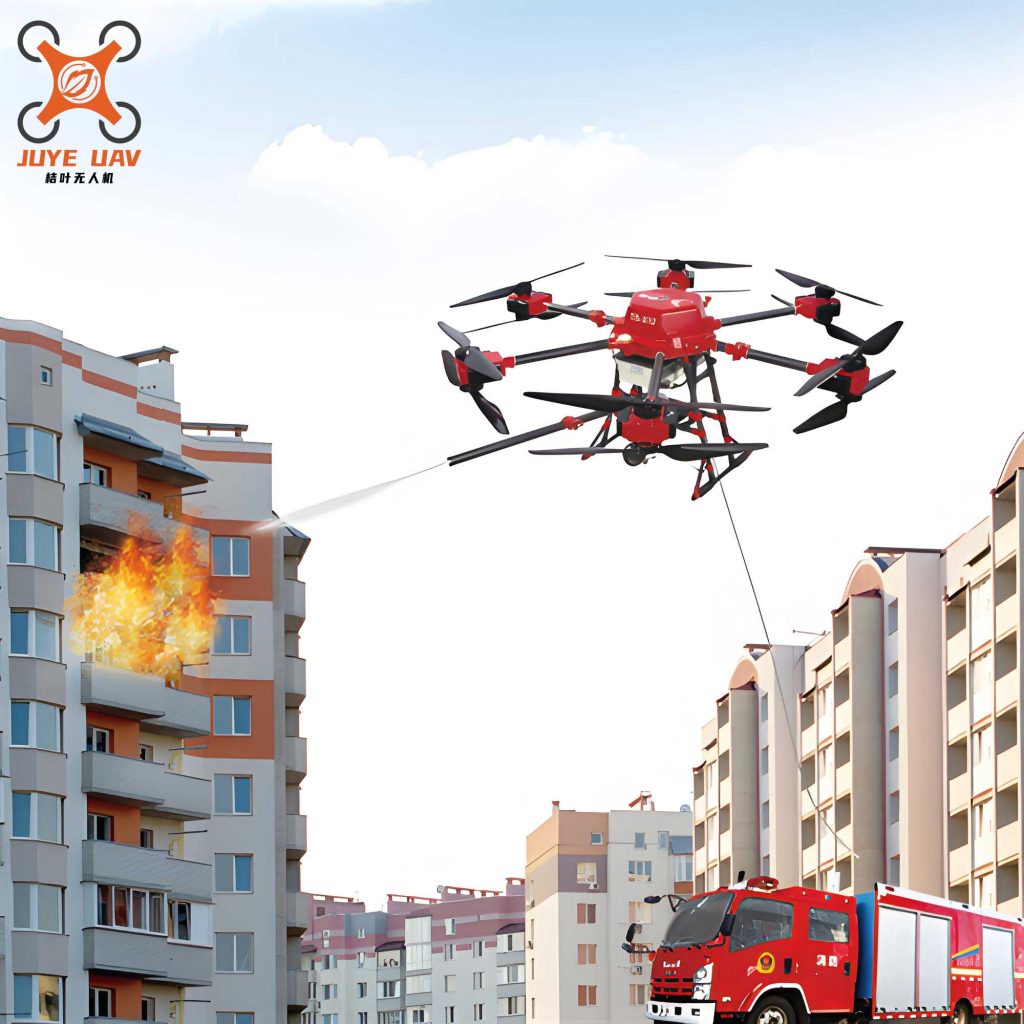
In my practice, I have found that the effective use of fire UAVs hinges on meeting specific technical requirements. These include reliability, controllability, stability, and integration compatibility. For instance, a fire UAV must withstand harsh conditions like high winds or electromagnetic interference. The reliability can be quantified using failure rate models: $$ \lambda(t) = \lambda_0 e^{-\beta t} $$ where \( \lambda(t) \) is the failure rate at time \( t \), \( \lambda_0 \) is the initial failure rate, and \( \beta \) is a decay constant. This emphasizes the need for robust design in fire UAVs. Controllability involves intuitive interfaces; I often advocate for simplified joystick or tablet-based controls to reduce pilot error. Stability is critical for accurate data collection, governed by dynamics equations: $$ \tau = I \cdot \alpha $$ where \( \tau \) is the torque applied by rotors, \( I \) is the moment of inertia, and \( \alpha \) is the angular acceleration. Fire UAVs with gyroscopic stabilization ensure smooth flights. Integration compatibility allows fire UAVs to interface with existing fire rescue systems, enabling seamless data flow. Table 3 outlines these requirements.
| Requirement | Description | Implementation in Fire UAV |
|---|---|---|
| Reliability | Consistent performance under extreme conditions (e.g., heat, smoke). | Use of heat-resistant materials and redundant systems. |
| Controllability | Ease of operation to ensure quick response during emergencies. | User-friendly software with automated flight modes. |
| Stability | Maintaining steady flight for precise sensor data acquisition. | Advanced flight controllers and GPS stabilization. |
| Integration Compatibility | Ability to connect with command centers and other rescue equipment. | Standardized communication protocols (e.g., MAVLink). |
The functional implementation and expansion of fire UAVs are where their true potential shines. Based on my observations, these functions can be categorized into aerial monitoring, auxiliary firefighting,辅助救援, language interaction, and illumination. For aerial monitoring, fire UAVs employ sensors to detect heat signatures and gas concentrations. The data can be processed using algorithms for fire spread prediction: $$ \frac{\partial T}{\partial t} = \alpha \nabla^2 T + \frac{q”’}{\rho c_p} $$ where \( T \) is temperature, \( \alpha \) is thermal diffusivity, \( q”’ \) is heat generation rate per volume, \( \rho \) is density, and \( c_p \) is specific heat. Fire UAVs feed real-time data into such models. Auxiliary firefighting involves deploying extinguishing agents via fire UAVs; for example, a fire UAV can carry dry chemical powder for electrical fires. The payload capacity can be calculated as: $$ P_{\text{max}} = T_{\text{total}} – W_{\text{UAV}} $$ where \( P_{\text{max}} \) is the maximum payload, \( T_{\text{total}} \) is the total thrust, and \( W_{\text{UAV}} \) is the weight of the fire UAV. In辅助救援, fire UAVs deliver supplies like ropes or masks to trapped individuals. Language interaction uses onboard speakers to guide evacuations, while illumination systems provide lighting in dark environments. Each function enhances the versatility of fire UAVs, making them multi-role assets in chemical fire scenarios.
In practical applications, fire UAVs excel in several domains. From我的 experience, they are pivotal in灾情侦查, information acquisition,指挥调度, fire suppression, and prevention. For灾情侦查, fire UAVs conduct initial assessments without endangering responders. They can identify leak sources using gas sensors, with detection limits modeled as: $$ C_{\text{min}} = \frac{S}{\kappa \cdot d} $$ where \( C_{\text{min}} \) is the minimum detectable concentration, \( S \) is the sensor sensitivity, \( \kappa \) is a path factor, and \( d \) is the distance. This allows fire UAVs to pinpoint hazards accurately. Information acquisition involves transmitting video and sensor data to command centers, where it is stored for analysis. The data rate required can be expressed as: $$ R = f_r \cdot (N_{\text{pixels}} \cdot B_{\text{depth}}) $$ where \( R \) is the data rate (in bps), \( f_r \) is the frame rate, \( N_{\text{pixels}} \) is the number of pixels, and \( B_{\text{depth}} \) is the bit depth. Fire UAVs with high-bandwidth links ensure seamless streaming. In指挥调度, fire UAVs improve efficiency by providing real-time insights, enabling faster decision-making. For fire suppression, fire UAVs can approach inaccessible areas to apply灭火 agents; I have seen cases where fire UAVs extinguished small-scale chemical fires before they escalated. Prevention is another key area; fire UAVs conduct routine inspections of chemical plants using infrared cameras to identify hotspots, potentially preventing disasters. Table 4 summarizes these applications.
| Application | Process | Outcome |
|---|---|---|
| Disaster Reconnaissance | Fire UAVs fly over the fire zone, capturing thermal and visual images. | Rapid assessment of火势 and hazards, reducing response time by up to 70%. |
| Information Acquisition | Sensors collect data on temperature, gas levels, and structural integrity. | Comprehensive datasets for analysis and strategy development. |
| Command and Dispatch | Live feeds integrate with指挥 systems, facilitating coordinated efforts. | Enhanced situational awareness and resource allocation. |
| Fire Suppression | Fire UAVs deploy extinguishing agents directly onto火源. | Containment of fires in high-risk areas, minimizing damage. |
| Fire Prevention | Regular aerial patrols detect anomalies like leaks or overheating. | Proactive risk mitigation, preventing incidents before ignition. |
Moreover, the use of fire UAVs aligns with modern fire rescue paradigms. In my view, their ability to operate in concert with other technologies, such as AI for image recognition, further amplifies their impact. For instance, AI algorithms can analyze fire UAV footage to predict explosion risks using formulas like the TNT equivalent for chemical releases: $$ W_{\text{TNT}} = \frac{E_{\text{exp}}}{4.184 \, \text{MJ/kg}} $$ where \( W_{\text{TNT}} \) is the equivalent mass of TNT (in kg), and \( E_{\text{exp}} \) is the explosion energy (in MJ). Fire UAVs provide the input data for such calculations, enabling preemptive actions.
In conclusion, as a fire rescue specialist, I assert that fire UAVs are indispensable in chemical fire operations. Their multifaceted capabilities address the unique challenges of such environments, from initial侦查 to active suppression. The integration of tables and formulas in this article underscores the technical depth behind fire UAV applications. Looking ahead, I anticipate continued advancements in fire UAV technology, such as increased autonomy and enhanced sensor suites, which will further revolutionize fire rescue. By embracing fire UAVs, we not only improve operational efficiency but also safeguard the lives of responders and victims alike. The future of chemical fire rescue is inextricably linked to the evolution of fire UAVs, and I am committed to promoting their adoption in practice.