
As a firefighter with years of experience in emergency response, I have witnessed firsthand the transformative impact of technology on our field. Among the most groundbreaking advancements is the integration of unmanned aerial vehicles, specifically fire drones, into firefighting and rescue operations. The evolution of drone technology and aerial photography has reached a point where these tools are no longer mere gadgets but essential assets in high-risk scenarios. From resource exploration and environmental monitoring to disaster relief and structural assessment, fire drones are revolutionizing how we approach emergencies. In this article, I will delve into the technical advantages, applications, and future prospects of fire drones in firefighting, emphasizing their role in enhancing data accuracy, situational awareness, and operational efficiency. By leveraging tables and formulas, I aim to provide a comprehensive analysis that underscores why every fire rescue team should prioritize adopting fire drones.
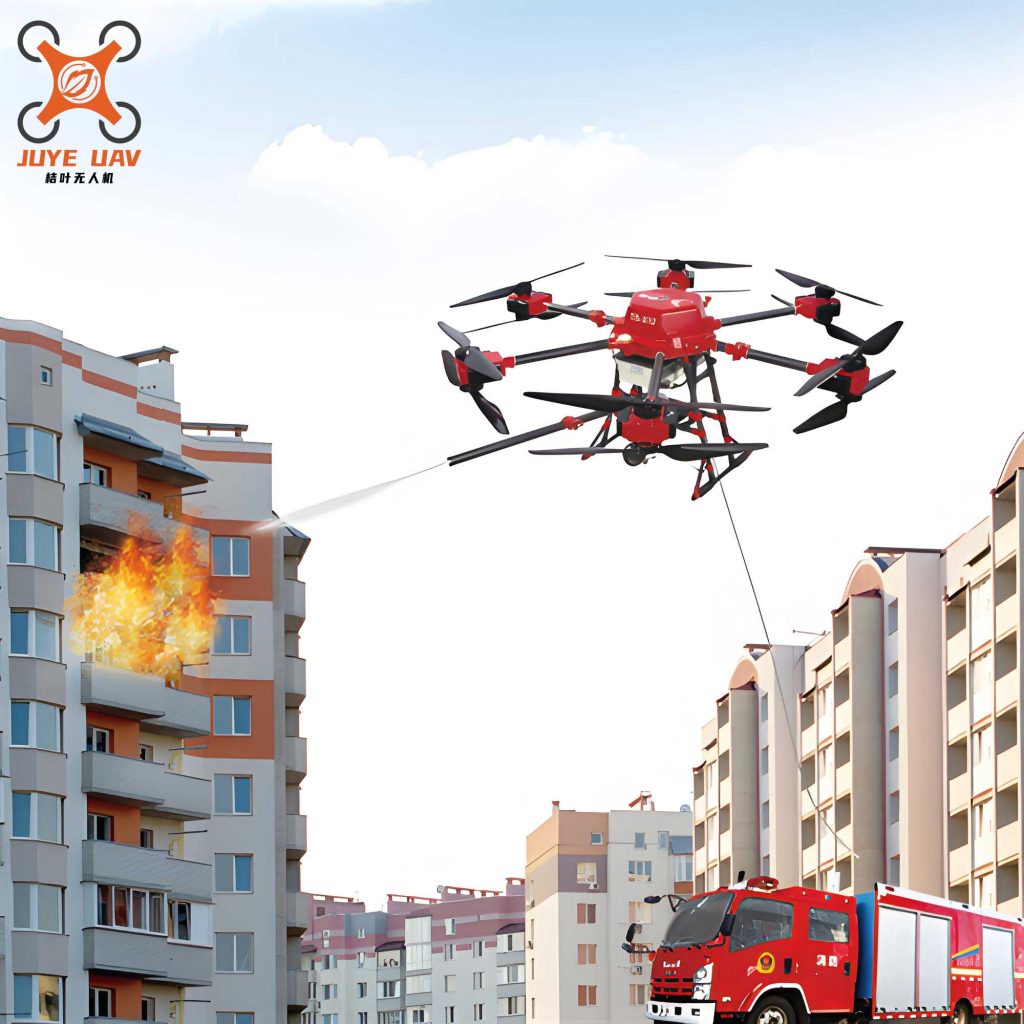
In my work, I often face dangerous situations where quick, accurate information is crucial for saving lives. Traditional reconnaissance methods, such as manual scouting, can be slow and perilous, especially in environments with toxic gases, collapsing structures, or inaccessible terrain. Here, fire drones offer a game-changing solution. These devices are not just flying cameras; they are integrated systems that provide real-time data, thermal imaging, and communication support. The term “fire drone” encapsulates a range of UAVs designed for firefighting, equipped with features like infrared sensors, gas detectors, and payload delivery mechanisms. Throughout this discussion, I will repeatedly highlight the importance of fire drones, as their versatility and reliability make them indispensable in modern fire rescue operations.
Technical Advantages of Fire Drones
The adoption of fire drones is driven by their distinct technical benefits, which I have observed in numerous drills and real-world incidents. Below, I outline these advantages using a combination of descriptive analysis, tables, and mathematical models to quantify their impact.
Mobility and Flexibility
One of the most striking features of fire drones is their exceptional mobility. Typically weighing only a few kilograms, these devices can be transported and deployed by a single operator. Their low takeoff requirements—often needing just a small clear area—allow for rapid deployment at disaster sites. The agility of fire drones is further enhanced by their ability to change speed and direction quickly, with a small turning radius. This mobility translates into faster response times, a critical factor in firefighting where every second counts. To illustrate, consider the response time formula for a fire drone:
$$ T_{response} = \frac{D}{V} + T_{deploy} $$
where \( D \) is the distance to the target, \( V \) is the average speed of the fire drone, and \( T_{deploy} \) is the deployment time. For a typical fire drone, \( V \) can range from 10 to 20 m/s, and \( T_{deploy} \) is often under 30 seconds, significantly outperforming manual scouts. The following table summarizes key mobility parameters:
| Parameter | Typical Value for Fire Drones | Impact on Firefighting |
|---|---|---|
| Weight | 2-5 kg | Easy portability by personnel |
| Maximum Speed | 15-25 m/s | Rapid coverage of large areas |
| Turn Radius | 1-3 meters | Maneuverability in confined spaces |
| Deployment Time | < 30 seconds | Quick initiation of reconnaissance |
In practice, I have used fire drones to reach hazardous zones like chemical spill sites or burning buildings, providing aerial views without risking human lives. The fire drone’s ability to hover and adjust altitude allows for multi-angle inspections, which are vital for assessing structural integrity and identifying trapped individuals.
Ease of Operation
Another advantage I appreciate is the simplicity of operating fire drones. Modern fire drones are designed with user-friendly interfaces, leveraging networked systems and software that connect to ground stations via public internet or dedicated links. This lowers the technical barrier, allowing firefighters with minimal training to pilot them effectively. Control is typically through remote controllers, smartphones, or tablets, with real-time video feeds from onboard cameras and gimbals. The operational efficiency can be modeled using a usability score \( U \):
$$ U = \frac{E_{task}}{T_{training}} $$
where \( E_{task} \) is the effectiveness in completing tasks (e.g., scouting accuracy) and \( T_{training} \) is the training time required. For fire drones, \( U \) tends to be high due to intuitive controls and automated features like obstacle avoidance. Moreover, the integration of auxiliary devices—such as zoom lenses and thermal imaging modules—enables operators to gather detailed visuals effortlessly. In my team, we have trained new recruits to operate fire drones within hours, emphasizing how this technology democratizes access to aerial reconnaissance.
Comprehensive Visibility and Safety
Fire drones excel in providing comprehensive situational awareness while ensuring safety. Their ability to fly at various altitudes and angles allows for full-coverage imaging, from wide-area surveys to close-up inspections. With high-resolution cameras and infrared capabilities, fire drones can operate in low-light or smoky conditions, revealing heat signatures that indicate fire hotspots or human presence. The safety aspect is paramount: fire drones can enter environments that are too dangerous for humans, such as areas with explosive materials, high temperatures, or toxic fumes. This reduces the risk to firefighters and enables data collection in extreme conditions. To quantify the safety benefit, consider the risk reduction factor \( R \):
$$ R = 1 – \frac{P_{incident, drone}}{P_{incident, human}} $$
where \( P_{incident} \) is the probability of an incident (e.g., injury). For fire drones, \( R \) approaches 1, as they eliminate direct human exposure. The table below contrasts fire drone capabilities with traditional methods:
| Aspect | Fire Drone Performance | Traditional Method Limitations |
|---|---|---|
| Visibility Range | Up to 500 meters with zoom | Limited by line-of-sight and obstacles |
| Operational Conditions | Functions in rain, heat, and darkness | Often hindered by weather and hazards |
| Safety for Personnel | No direct exposure to dangers | High risk in toxic or collapsing areas |
| Data Accuracy | High-resolution real-time feeds | Relies on human reports, prone to errors |
In my experience, deploying a fire drone for initial assessment has repeatedly prevented potential casualties by identifying hidden dangers, such as gas leaks or unstable floors, before sending in teams. The fire drone’s reliability in harsh conditions makes it a trustworthy tool for continuous monitoring during extended operations.
Application Prospects of Fire Drones in Fire Rescue Teams
Looking ahead, the potential applications of fire drones in firefighting are vast and evolving. Based on my observations and industry trends, I will explore three key areas: disaster reconnaissance, monitoring and tracking, and auxiliary rescue support. Each application leverages the unique strengths of fire drones, and I will use tables and formulas to highlight their effectiveness.
Disaster Reconnaissance
Fire drones are invaluable for initial disaster reconnaissance, offering a swift and safe alternative to human scouts. When responding to incidents like building fires or natural disasters, I rely on fire drones to gather real-time data from inaccessible or hazardous locations. The benefits include faster information acquisition, reduced risk, and enhanced decision-making. For instance, the time saved in reconnaissance can be expressed as:
$$ \Delta T_{recon} = T_{manual} – T_{drone} $$
where \( T_{manual} \) is the time for manual scouting (often 10-30 minutes) and \( T_{drone} \) is the time for a fire drone (typically 2-5 minutes). This time savings directly translates to quicker rescue interventions. Additionally, fire drones can be equipped with sensors to detect gases, temperatures, or structural weaknesses, providing a holistic view of the scene. The following table outlines reconnaissance applications:
| Scenario | Fire Drone Function | Outcome |
|---|---|---|
| Urban Fire | Aerial thermal imaging to locate hotspots | Targeted fire suppression, reduced water damage |
| Chemical Spill | Gas detection and aerial mapping | Safe perimeter setup, evacuation guidance |
| Earthquake | Rapid assessment of collapsed structures | Identification of survivor locations, prioritization of efforts |
| Flood | Overhead views of submerged areas | Rescue route planning, damage estimation |
In practice, I have used fire drones to scout forest fires, where their aerial perspective revealed fire spread patterns that were invisible from the ground. The fire drone’s ability to transmit live video to command centers enables collaborative analysis, ensuring that all team members have a shared understanding of the situation. This application of fire drones not only boosts efficiency but also safeguards firefighters by minimizing unnecessary entries into danger zones.
Monitoring and Tracking
Beyond initial reconnaissance, fire drones play a critical role in continuous monitoring and tracking during ongoing incidents. Disaster scenes are dynamic, with conditions changing rapidly due to factors like wind shifts, structural collapses, or spreading flames. A fire drone can hover over the area, providing real-time updates that inform tactical adjustments. This capability is especially useful in large-scale incidents where manual monitoring is impractical. The effectiveness of monitoring can be modeled using a coverage ratio \( C \):
$$ C = \frac{A_{monitored}}{A_{total}} $$
where \( A_{monitored} \) is the area covered by the fire drone’s sensors and \( A_{total} \) is the total incident area. With a fire drone, \( C \) can approach 1 for areas up to several square kilometers, thanks to pan-tilt cameras and automated flight paths. Furthermore, fire drones can be integrated into broader surveillance systems, linking with fire command platforms to store and analyze video data for future reference. This supports predictive analytics, such as identifying potential flare-ups or structural failures. For example, in post-disaster scenarios, I have deployed fire drones for 24/7 surveillance of disaster-prone sites, using their feeds to detect early signs of re-ignition or landslides. The table below summarizes monitoring benefits:
| Monitoring Aspect | Fire Drone Contribution | Operational Impact |
|---|---|---|
| Real-Time Updates | Live video feeds to command centers | Informed decision-making, adaptive strategies |
| Long-Term Surveillance | Continuous aerial patrols | Early warning of hazards, preventive measures |
| Data Integration | Automated upload to cloud systems | Historical analysis, improved preparedness |
| Multi-Sensor Fusion | Combining visual, thermal, and gas data | Comprehensive situational awareness |
The fire drone’s role in monitoring extends to post-incident reviews, where recorded footage helps debrief teams and refine protocols. By leveraging fire drones for tracking, fire rescue units can maintain a constant watch over evolving threats, enhancing both safety and operational coherence.
Auxiliary Rescue Support
Fire drones also serve as versatile tools for auxiliary rescue support, acting as transport vehicles, communication relays, and pathfinders. In complex rescue operations—such as those in mountainous or aquatic environments—fire drones can deliver essential supplies, establish communication links, or assist in rope deployment. This expands the toolkit available to firefighters, enabling innovative rescue methods. The payload capacity of a fire drone, though limited, is sufficient for critical items like first-aid kits, communication devices, or lightweight tools. The delivery efficiency can be expressed as:
$$ E_{delivery} = \frac{W_{payload}}{T_{round trip}} $$
where \( W_{payload} \) is the weight of the delivered item and \( T_{round trip} \) is the time for the fire drone to complete a delivery cycle. For typical fire drones, \( W_{payload} \) ranges from 1-5 kg, and \( T_{round trip} \) depends on distance but is often faster than manual delivery in rough terrain. Additionally, fire drones can function as communication hubs in areas where infrastructure is damaged, such as after earthquakes. By acting as aerial repeaters, they restore wireless networks, ensuring that rescue teams stay connected. I have witnessed this in drills where fire drones bridged communication gaps in underground or remote settings, allowing for coordinated efforts. The following table highlights auxiliary applications:
| Support Type | Fire Drone Implementation | Rescue Enhancement |
|---|---|---|
| Payload Delivery | Transporting medical supplies or tools to inaccessible spots | Faster aid to trapped victims, extended operational range |
| Communication Relay | Deploying as a temporary base station for radios | Restored command chains, improved team coordination |
| Rope Assistance | Guiding ropes across gaps or heights for human rescue | Safer extraction methods, reduced physical strain on rescuers |
| Pathfinding | Using aerial views to identify safe routes for ground teams | Minimized exposure to hazards, optimized rescue paths |
In one instance, a fire drone was used to drop a life jacket to a flood victim while we planned a boat rescue, showcasing its immediate utility. The integration of fire drones into rescue protocols not only augments traditional methods but also opens new avenues for saving lives in challenging scenarios.
Future Directions and Concluding Thoughts
As fire drone technology continues to mature, its integration into firefighting will likely deepen, driven by advancements in autonomy, sensor fusion, and artificial intelligence. From my perspective, the future will see fire drones operating in swarms for large-area coverage, equipped with advanced AI for real-time hazard prediction. However, challenges remain, such as regulatory hurdles, battery limitations, and the need for robust cybersecurity. To address these, ongoing research focuses on improving endurance through better batteries or solar power, with flight time \( T_{flight} \) modeled as:
$$ T_{flight} = \frac{E_{battery}}{P_{consumption}} $$
where \( E_{battery} \) is the energy capacity and \( P_{consumption} \) is the power consumption rate. Innovations aim to increase \( T_{flight} \) beyond the current 30-60 minutes, enabling longer missions. Moreover, standardization of interfaces and protocols will ensure interoperability with existing firefighting equipment, maximizing the fire drone’s utility.
In conclusion, the fire drone represents a pivotal innovation in modern firefighting, offering unmatched advantages in mobility, safety, and data acquisition. Through applications in reconnaissance, monitoring, and rescue support, fire drones enhance our ability to respond to emergencies efficiently while protecting both firefighters and victims. As I reflect on my experiences, I am convinced that widespread adoption of fire drones is not just beneficial but essential for the evolution of fire rescue services. By embracing this technology, we can build more resilient and effective teams, ready to face the unpredictable nature of disasters. The fire drone is more than a tool; it is a partner in our mission to save lives and safeguard communities.