
As I delve into the rapid urbanization sweeping across the globe, I cannot help but notice the escalating challenges of traffic congestion and environmental pollution. In my view, these pressing issues have catalyzed the emergence of urban air mobility (UAM) as a revolutionary aviation frontier. At the heart of this transformation lies the unmanned electric vertical take-off and landing aircraft, commonly referred to as the VTOL drone. From my perspective, this technology is not merely an incremental innovation but a paradigm shift that promises to redefine urban transportation. I have observed that VTOL drones are attracting unprecedented attention from aerospace corporations, automotive industries, transportation sectors, governments, military entities, and academic institutions alike. In this article, I aim to systematically review the current research landscape of VTOL drones, both internationally and domestically, while critically examining the hurdles and opportunities that UAM faces. Looking ahead, I am convinced that with robust policy support and technological advancements, VTOL drones will fundamentally alter human lifestyles, ushering us into a new era of flight.
My exploration begins with the development status and trends of electric vertical take-off and landing aircraft. The VTOL drone, by definition, is capable of vertical ascent and descent using its own propulsion system, eliminating the need for runways. This unique capability, coupled with autonomous flight technologies, makes VTOL drones a focal point of research worldwide. I have categorized the progress into international and domestic spheres to provide a comprehensive overview.
Internationally, I have seen significant strides in the development of manned and unmanned VTOL drones. Companies like Airbus and Boeing, along with startups such as Volocopter, have pioneered various models. For instance, Airbus’s Vahana, an autonomous single-passenger VTOL drone, completed numerous flight tests, showcasing the viability of electric propulsion. Similarly, Volocopter’s VoloCity, designed for short-haul urban trips, emphasizes safety and efficiency with its multi-rotor configuration. To encapsulate these advancements, I present a table summarizing key parameters of prominent VTOL drones:
| Model | Manufacturer | Max Payload (kg) | Cruise Speed (km/h) | Endurance (min) | Power Source | Notable Features |
|---|---|---|---|---|---|---|
| Vahana | Airbus | 100 | 110 | 30 | Electric | 8 electric propellers, autonomous flight |
| VoloCity | Volocopter | 200 | 110 | 35 | Electric | 18 rotors, stable hovering capability |
| EHang 184 | EHang | 100 | 100 | 23 | Electric | Autonomous, foldable design for compact storage |
In my analysis, these VTOL drones leverage electric propulsion to reduce emissions and noise—a critical factor for urban integration. The performance metrics often hinge on aerodynamic efficiency and power management. For example, the thrust generated by a VTOL drone’s rotors can be modeled using the following formula:
$$ T = \rho n^2 D^4 C_T $$
where \( T \) is the thrust, \( \rho \) is the air density, \( n \) is the rotational speed, \( D \) is the propeller diameter, and \( C_T \) is the thrust coefficient. This equation highlights how VTOL drone design optimizes parameters for vertical lift and cruise efficiency. Additionally, endurance calculations for electric VTOL drones involve energy consumption rates. I often use:
$$ E = P_{battery} \times t = \frac{1}{2} C V^2 $$
where \( E \) is the energy, \( P_{battery} \) is the battery power, \( t \) is time, \( C \) is battery capacity, and \( V \) is voltage. This underscores the importance of battery technology in extending VTOL drone operational ranges.
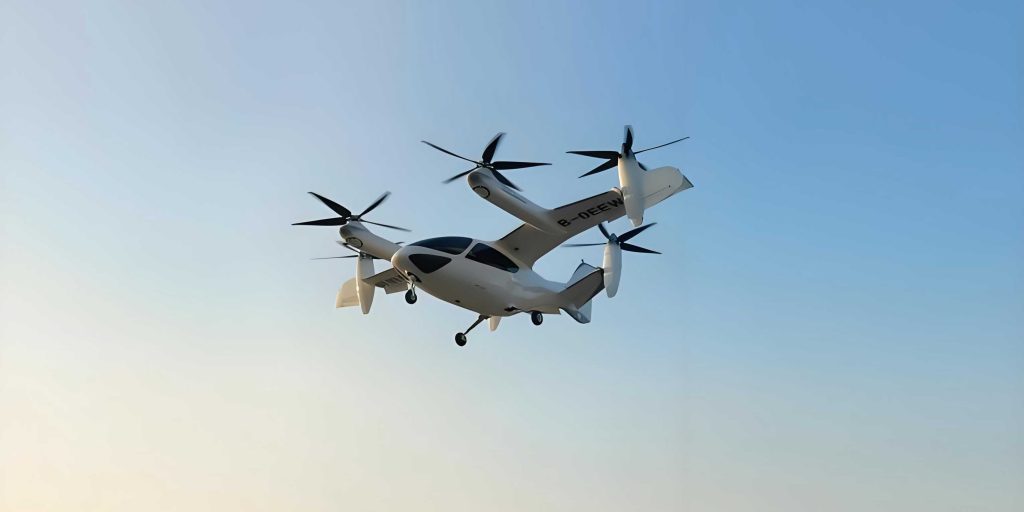
Domestically, I have followed China’s proactive stance in promoting VTOL drone development. Policies from the Civil Aviation Administration of China (CAAC) have set ambitious goals for UAM by 2035, including the integration of manned and unmanned systems. EHang, a leading Chinese company, has made remarkable progress with its EHang 184 VTOL drone, which has undergone extensive testing globally. This VTOL drone serves as an “air taxi,” targeting short-distance urban transport with autonomous capabilities. The table above includes its specs, reflecting competitive performance. In my research, I have noted that domestic efforts focus on scaling production and enhancing airworthiness certifications, positioning VTOL drones as viable commercial solutions.
Turning to the challenges, I identify several critical barriers that VTOL drones must overcome to realize UAM’s potential. First, the operational infrastructure—both hardware and software—requires substantial investment. Cities were not designed with aerial networks in mind, necessitating retrofitting or new constructions for vertiports and charging stations. From a software perspective, UAM demands advanced communication, navigation, and surveillance (CNS) systems. I propose that a robust UAM traffic management (UTM) system must integrate with existing air traffic control, employing real-time data analytics. This can be expressed through network flow models:
$$ \text{Maximize } \sum_{i,j} f_{ij} \text{ subject to } \sum_{j} f_{ij} \leq C_i \forall i $$
where \( f_{ij} \) is the flow between nodes \( i \) and \( j \), and \( C_i \) is the capacity of node \( i \). Such optimization ensures efficient VTOL drone routing in congested urban skies.
Second, the lack of a global standard system poses interoperability risks. In my experience, regulatory fragmentation hinders VTOL drone deployment across borders. I advocate for harmonized standards covering safety, noise, and emissions. For instance, noise levels for VTOL drones can be quantified using:
$$ L_p = 10 \log_{10}\left(\frac{p^2}{p_0^2}\right) $$
where \( L_p \) is the sound pressure level, \( p \) is the measured pressure, and \( p_0 \) is the reference pressure. Standardizing such metrics will facilitate international acceptance.
Third, market and business models remain uncertain. While companies like Uber and Airbus explore ride-sharing and logistics services, the high initial costs of VTOL drone fleets deter widespread adoption. I have analyzed revenue models using:
$$ \text{Revenue} = \sum_{k} (P_k \times Q_k) – C_{fixed} – C_{variable} $$
where \( P_k \) is the price per service \( k \), \( Q_k \) is the quantity, and \( C \) represents costs. This formula highlights the need for economies of scale to make VTOL drone operations profitable.
Fourth, societal and public acceptance is crucial. Trust in autonomous VTOL drones builds over time through demonstrated safety and reliability. I emphasize that public perception can be modeled via surveys and statistical analyses, often represented as:
$$ \text{Acceptance Rate} = \frac{\text{Positive Responses}}{\text{Total Responses}} \times 100\% $$
Engaging communities through demonstrations and transparency will be key for VTOL drone integration.
To delve deeper into technical aspects, I have compiled a table comparing the aerodynamic and power characteristics of VTOL drones, which influences their design and performance:
| Aspect | Formula/Parameter | Impact on VTOL Drone |
|---|---|---|
| Lift Efficiency | $$ L = \frac{1}{2} \rho v^2 S C_L $$ | Determines vertical take-off capability; higher \( C_L \) allows smaller wings for VTOL drones. |
| Power Consumption | $$ P = T \times v / \eta $$ | Where \( \eta \) is propulsion efficiency; critical for optimizing VTOL drone battery life. |
| Range Estimation | $$ R = v \times \frac{E_{battery}}{P_{avg}} $$ | Guides VTOL drone mission planning; dependent on energy density improvements. |
| Noise Propagation | $$ \text{dB} = 20 \log_{10}(p/p_0) $$ | Affects urban acceptance; quieter VTOL drones use distributed electric propulsion. |
In my view, these formulas underscore the interdisciplinary nature of VTOL drone development, merging aerodynamics, electrical engineering, and environmental science. For example, the transition from hover to cruise in VTOL drones involves complex control algorithms, often governed by differential equations:
$$ m \ddot{x} = F_x – D_x, \quad m \ddot{y} = F_y – D_y $$
where \( m \) is mass, \( \ddot{x} \) and \( \ddot{y} \) are accelerations, \( F \) are thrust forces, and \( D \) are drag forces. Solving these enables smooth VTOL drone maneuvers in urban canyons.
Looking ahead, I am optimistic about the future of VTOL drones in UAM. Governments worldwide are incentivizing green aviation, with research funding flowing into electric propulsion and autonomy. I predict that within the next decade, VTOL drones will become commonplace for passenger transport, emergency services, and logistics. The convergence of 5G connectivity and artificial intelligence will enhance VTOL drone swarm coordination, enabling efficient traffic management. In my vision, cities will evolve with multi-level transportation networks, where VTOL drones operate alongside ground vehicles, reducing congestion and carbon footprints.
To summarize, I have outlined the current state of VTOL drones, highlighting international and domestic advancements through detailed tables and formulas. The challenges—infrastructure, standards, business models, and social acceptance—are significant but surmountable with collaborative effort. I believe that continued innovation in VTOL drone technology, supported by proactive policies, will unlock the full potential of urban air mobility. As we stand on the brink of this aerial revolution, I urge stakeholders to invest in research and public engagement, ensuring that VTOL drones lead us into a sustainable and connected future. The journey has just begun, and every breakthrough in VTOL drone design brings us closer to a world where the sky is no longer a limit but a highway for progress.