
The integration of small Unmanned Aerial Vehicles (UAVs), or drones, into the maintenance and inspection workflows of power grid infrastructure represents a significant technological leap. This innovation directly addresses the persistent challenges associated with traditional manual inspection methods, which are often costly, time-consuming, and hazardous, especially for transmission lines traversing rugged mountains, vast lakes, or dense forests. The use of drones for power line inspection enhances efficiency, improves data quality, and drastically reduces the safety risks for human personnel. Consequently, there is a growing imperative to transition experienced grid maintenance staff into competent drone pilots and data acquisition specialists. However, this transformation is not trivial. The path from a novice with no prior experience to a certified, reliable drone operator for critical infrastructure is fraught with complexity. Traditional or ad-hoc drone training programs frequently suffer from critical shortcomings: compressed timelines that undermine foundational knowledge, batch training that minimizes hands-on practice, and unclear progression pathways that lead to operational errors, damaged equipment, and eroded trainee confidence. This article explores the application of the Plan-Do-Check-Act (PDCA) cycle—a cornerstone of Total Quality Management—as a rigorous, systematic framework for structuring an effective drone training curriculum. The goal is to establish a clear, phased, and self-correcting process that ensures each trainee develops the requisite theoretical knowledge, practical skills, and situational awareness necessary for safe and effective grid inspection operations.
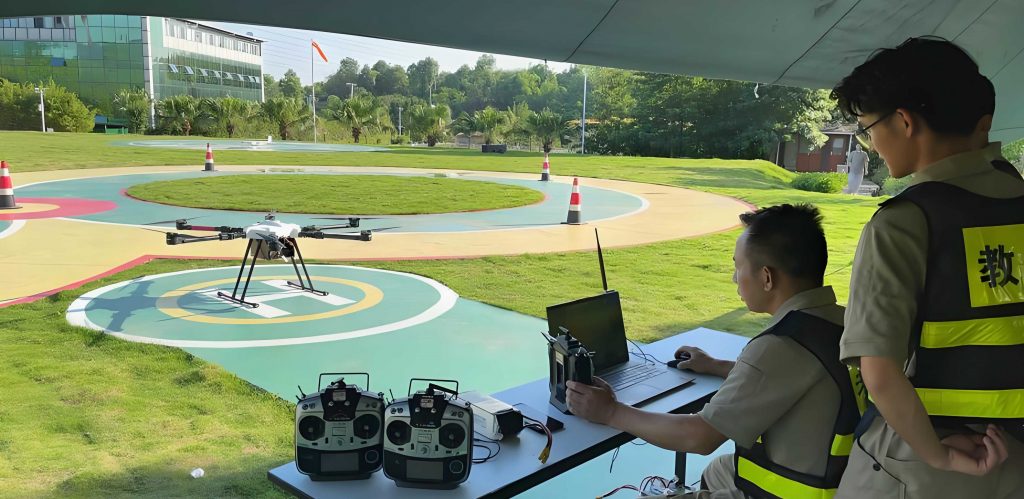
Why PDCA for Drone Training?
The PDCA cycle, also known as the Deming Cycle, is a four-stage iterative model for continuous improvement. Its power lies in its simplicity and universal applicability to any process-oriented management activity. The drone training process, characterized by its multifaceted knowledge domains, sequential skill dependencies, and variable learning curves, is an ideal candidate for PDCA management.
- Plan: Identify objectives, requirements, and methods for a specific phase of drone training.
- Do: Implement the plan on a small scale, executing the training exercises.
- Check: Study the results, assess performance against the objectives, and identify any gaps or deviations.
- Act: Take corrective action to address the root cause of deficiencies. Standardize successful practices and begin the next cycle with the lessons learned.
For a structured drone training program, the overarching process can be decomposed into distinct, sequential phases. Each phase constitutes its own PDCA macro-cycle. Crucially, advancement to the next phase is only permitted upon successful completion and “Act” stage standardization of the current one. This gating mechanism ensures quality and foundational competence at every step, directly mitigating the common pitfalls of rushed or superficial training.
The Phased PDCA Framework for Drone Training
Based on the operational requirements for power line inspection using multi-rotor drones, a comprehensive drone training program can be stratified into five sequential phases. The table below outlines the core focus and exit criteria for each phase.
| Training Phase | Primary Focus | Exit Criteria (Check Point) |
|---|---|---|
| 1. Theoretical Foundation | Aviation regulations, aerodynamics, systems knowledge. | Pass a written examination with a score ≥ 90%. |
| 2. Simulator Proficiency | Stick control, orientation, basic maneuver muscle memory. | Complete advanced simulator missions without crashes. |
| 3. Systems Maintenance & Pre-flight | Hardware assembly, calibration, diagnostics, and logistics. | Perform a full system pre-flight checklist flawlessly. |
| 4. Basic Flight Maneuvers (Live) | Take-off, hover, landing, and basic translation in a controlled field. | Demonstrate stable hover (position hold) in winds ≤ 10 kts. |
| 5. Operational Mission Training | Grid-focused flight patterns, sensor (camera) operation, data capture. | Capture inspection-grade imagery/video of a mock transmission line. |
Each phase is governed by its own detailed PDCA cycle. The formula for successful phase progression can be conceptually represented as:
$$ \text{Phase Completion} = \left( \text{Plan}_{detailed} \xrightarrow{\text{Do}} \text{Execute} \right) \xrightarrow[\text{Check}]{\text{Evaluate vs. Criteria}} \left\\{ \begin{array}{ll} \text{If Pass: } & \text{Act to Standardize} \rightarrow \text{Next Phase} \\ \text{If Fail: } & \text{Act to Correct} \rightarrow \text{Repeat Cycle} \end{array} \right. $$
Phase 1: Theoretical Foundation (Plan-Do-Check-Act)
Plan: The objective is to build a robust knowledge base. The curriculum must include:
- P1: Drone flight principles (aerodynamics, multi-rotor physics).
- P2: National and local aviation regulations (airspace, permits).
- P3: Detailed study of the specific drone model, controller, and ground station software.
- P4: Operational procedures and safety protocols for grid environments.
- P5: Basic meteorology and its impact on UAV flight.
Do: Trainees undergo structured classroom sessions, e-learning modules, and textbook study.
Check: Knowledge is validated through a formal written examination. The performance metric is the score, with a minimum passing threshold (e.g., 90%). The pass rate for the cohort is a key performance indicator (KPI) for the drone training plan itself.
$$ \text{Phase 1 Pass Rate} = \frac{\text{Number of Trainees Scoring} \geq 90\%}{\text{Total Number of Trainees}} \times 100\% $$
A pass rate below 95% triggers the Act stage.
Act: Analyze failed exam sections. This may lead to corrective actions such as revising training materials (P), providing remedial tutoring for specific trainees (D), or modifying the examination method (C). The successful training materials and methods are documented as the standard for all future drone training cohorts.
Phase 2: Simulator Proficiency (Plan-Do-Check-Act)
Plan: The goal is to develop psychomotor skills and operational instincts in a zero-risk environment. The simulator training plan is quantified.
| Simulator Module | Minimum Duration | Performance Target | Success Metric |
|---|---|---|---|
| Basic Orientation & Hover | 5 hours | Maintain stable hover in a 2m cube for 60 sec. | $$ T_{\text{stable}} \geq 60s $$ |
| Quadrant Hover (Nose-In, etc.) | 10 hours | Hold position facing all 4 directions in wind ≤ 15 kts. | Position deviation $$ \Delta_{xy} < 1m $$ |
| Basic Navigation (Square Pattern) | 10 hours | Fly a precise 20x20m square at constant altitude. | $$ \max(\text{Alt. Error}) < 0.5m $$ |
| Advanced Challenge Courses | 15 hours | Complete obstacle course without collision. | Collision count = 0 |
Do: Trainees log mandatory hours on the simulator, practicing the prescribed modules.
Check: Proficiency is assessed via a final simulator check-ride, where the trainee must complete a composite mission incorporating all target maneuvers. Failure in any segment (e.g., a crash) indicates insufficient skill.
Act: Trainees who fail are not advanced. Their specific deficiency (e.g., tail-in hover stability) is identified, and a targeted, additional simulator regimen (a new, micro drone training Plan) is prescribed before re-evaluation.
Phase 3: Systems Maintenance & Pre-flight (Plan-Do-Check-Act)
Plan: Shift focus to the physical hardware. The plan involves mastering maintenance and pre-flight procedures through demonstration and guided practice.
- P1: Airframe assembly/disassembly, propeller balancing, motor inspection.
- P2: Gimbal and camera sensor calibration and cleaning.
- P3: Remote controller function mapping, calibration, and failsafe configuration.
- P4: Ground station software setup, telemetry link verification, mission planning basics.
- P5: LiPo battery management, charging safety, and health assessment (Voltage per Cell, Internal Resistance).
Do: Hands-on workshops where trainees perform tasks under instructor supervision.
Check: Assessment is practical. The trainee is given a “cold” system and must execute a comprehensive pre-flight checklist, verbalizing each step. The instructor uses a standardized grading rubric. A critical error (e.g., missing a cracked arm) results in failure.
Act: Any missed checklist item triggers immediate corrective action—re-demonstration and practice until the procedure is performed flawlessly from memory. The standardized checklist becomes a non-negotiable ritual for all subsequent live-flight drone training.
Phase 4: Basic Flight Maneuvers – Live (Plan-Do-Check-Act)
This is the first high-stakes PDCA cycle involving actual flight. Risk management is paramount.
Plan: Every live session requires a micro-plan.
- P1 (Site Risk Assessment): Use a formula to score the training site: $$ R_{\text{site}} = w_1 \cdot W_{\text{wind}} + w_2 \cdot D_{\text{obstacle}} + w_3 \cdot P_{\text{public}} $$ where W is wind speed, D is obstacle density, P is public presence, and w are weights. Only sites with \( R_{\text{site}} \) below a threshold are approved.
- P2 (Weather Check): Confirm wind < 10 kts, no precipitation.
- P3 (Flight Briefing): Define the session’s goal: “Achieve 10 consecutive stable take-off/hover/land cycles.”
Do: The trainee, under direct supervision, performs the flights. The instructor is poised on a “buddy-box” system for immediate takeover.
Check: The instructor assesses qualitative and quantitative metrics: smoothness of control, recovery from drift, consistency of landing spot. A successful “cycle” is strictly defined (e.g., take-off to 5m, hold for 30s ±0.5m, land within 1m of origin).
Act: If the trainee exhibits nervousness, instability, or violates safety protocols, the session is stopped (Act: Emergency Stop). The cause is analyzed—often it links back to insufficient simulator time (Phase 2) or knowledge gaps (Phase 1). The corrective action may be to regress to a prior PDCA cycle before attempting live flight again. Success leads to standardizing the pre-flight briefing format and advancing to more complex maneuvers (e.g., figure-8 patterns).
Phase 5: Operational Mission Training (Plan-Do-Check-Act)
The final phase integrates all skills for the actual job.
Plan: Mission planning for a simulated grid inspection.
- P1 (Mission Planning): Use ground station software to plot a flight path along a mock transmission line, ensuring optimal camera angles and regulatory compliance (stand-off distances). Calculate estimated flight time: $$ T_{\text{flight}} = \frac{\text{Total Path Length}}{\text{Average Speed}} + \text{Hover Time for Inspection Points} $$ Ensure \( T_{\text{flight}} < 0.8 \times \text{Battery Endurance} \) for safety margin.
- P2 (Sensor Configuration): Plan camera settings (ISO, shutter speed) for typical lighting conditions.
- P3 (Contingencies): Identify abort points and emergency landing zones.
Do: Execute the mission. The trainee manages the flight, toggles between flight modes (e.g., GPS hold for stable shooting), operates the camera gimbal, and captures still images and video of specified components (e.g., insulators, connectors).
Check: The deliverable is the captured data. Image quality is assessed for focus, clarity, and proper framing of the component. Flight path adherence and safety compliance are reviewed from logs. The evaluation uses a scoring matrix.
| Criterion | Weight | Score (0-5) | Weighted Score |
|---|---|---|---|
| Image Sharpness & Coverage | 40% | ||
| Flight Path Adherence & Safety | 30% | ||
| Efficiency (Time/Battery Use) | 20% | ||
| Data Organization & Logging | 10% | ||
| Total Score | 100% | $$ S_{\text{total}} = \sum (Weight \times Score) $$ |
A minimum score (e.g., 4.0/5.0) is required to pass.
Act: A failing score necessitates analysis. Was the image blurry due to incorrect camera settings (knowledge gap in P2 of this phase) or unstable flight (regression to Phase 4 skills)? The corrective action is targeted retraining. Upon passing, the entire mission planning and execution protocol is standardized as the company’s official field procedure for drone training graduates.
Advantages and Long-Term Impact of the PDCA Training Model
Implementing a PDCA-based drone training program offers transformative advantages over unstructured approaches.
1. Quality Assurance through Gated Progression: The model enforces a “quality gate” at the end of each phase. This prevents the dangerous scenario of a trainee with poor simulator skills attempting live flight. The progression rule is hard-coded into the system: $$ \text{Advance to Phase}_{n+1} \iff \text{Check(Phase}_{n}) = \text{Pass} $$ This is the single most critical factor in building competent, confident operators.
2. Continuous Improvement of the Training Program Itself: The PDCA cycle works on two levels: for the trainee’s learning and for the training curriculum’s evolution. Every “Act” stage that identifies a common point of failure (e.g., many trainees struggle with battery management calculations) provides data to improve the “Plan” for the next cohort. The training program becomes a learning system.
3. Risk Mitigation and Cost Reduction: By front-loading risk in simulators and rigorously checking pre-flight actions, the incidence of costly crashes during training plummets. The return on investment (ROI) for a systematic drone training program can be approximated as: $$ \text{ROI}_{\text{training}} = \frac{\text{Cost of Avoided Incidents} + \text{Value of Improved Inspection Quality}}{\text{Cost of PDCA Training Program}} $$ where avoided incidents include drone losses, property damage, and regulatory fines.
4. Development of Professional Standards: The “Act to Standardize” step in each phase creates a library of best practices, checklists, and performance benchmarks. This not only ensures consistency across trainees but also elevates the overall professionalism and safety culture of the organization’s drone operations.
In conclusion, the transition of utility personnel into drone operators is a strategic necessity for modern grid management. This transformation must be managed with the same rigor applied to critical infrastructure itself. The PDCA cycle provides an ideal, scalable framework for structuring this essential drone training. By decomposing the complex learning journey into managed, iterative phases with clear quality gates, organizations can ensure their personnel are not merely familiar with drones, but are truly proficient, safety-conscious, and mission-ready professionals. This systematic approach to drone training ultimately translates into higher grid reliability, lower operational costs, and enhanced safety for both the workforce and the public.