
The domain of unmanned aerial vehicles (UAV drones) is undergoing a revolutionary expansion, transcending the traditional boundaries of the sky to embrace the aquatic world. This convergence has given birth to Hybrid Aerial Underwater Vehicles (HAUVs), a class of robotic systems capable of seamless operation in both air and water. These innovative UAV drones combine the rapid deployment, high mobility, and broad situational awareness of aerial platforms with the extended endurance, stealth, and subsurface exploration capabilities of underwater vehicles. The potential applications are vast, spanning critical areas such as maritime surveillance, underwater infrastructure inspection, search and rescue in complex coastal or disaster scenarios, and environmental monitoring of oceans and lakes.
Among the various configurations of HAUVs—including bio-inspired flapping-wing models, fixed-wing variants, and multi-rotor designs—the tandem dual-rotor architecture presents a uniquely promising platform. This design, reminiscent of coaxial helicopters, offers significant advantages for a cross-domain UAV drone. Its elongated, streamlined fuselage minimizes hydrodynamic drag underwater, enabling efficient cruising. The tandem rotor setup provides a large allowable center-of-gravity range and excellent hovering efficiency in air. Perhaps most importantly, its slender profile allows for enhanced maneuverability in confined underwater spaces, such as narrow canyons or around submerged structures, where bulkier multi-rotor UAV drones might struggle.
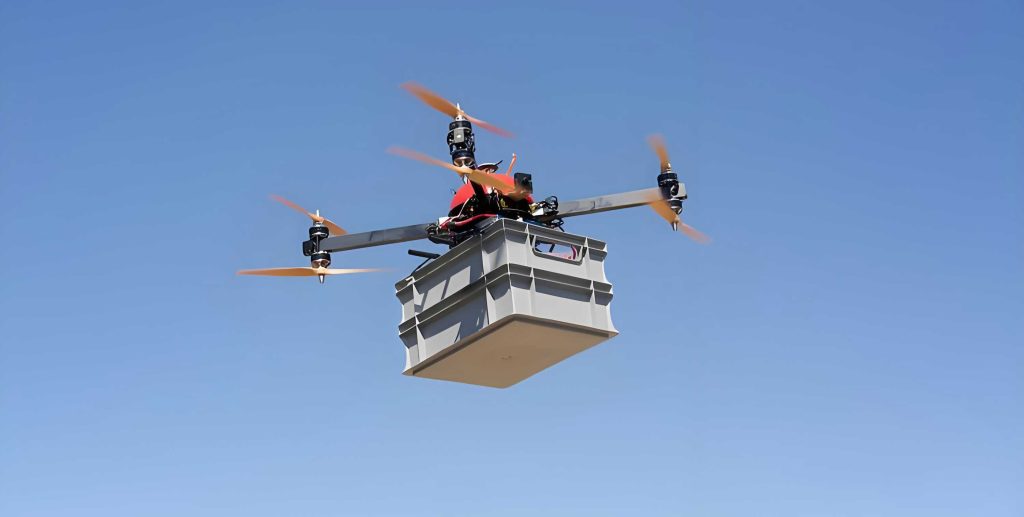
However, the very feature that makes this tandem dual-rotor UAV drone so versatile—its operation in two distinct fluid media—introduces formidable control challenges. The vehicle exhibits profoundly different dynamic characteristics in air versus water. In aerial flight, it behaves as an underactuated system, where position control in the horizontal plane is achieved indirectly through attitude manipulation, typically using two main rotors and servo mechanisms for control. During underwater transit, it transforms into a fully-actuated unmanned underwater vehicle (UUV), propelled and controlled by a separate set of thrusters and control surfaces. This fundamental shift in dynamics and actuation mechanisms between domains necessitates a sophisticated control strategy to ensure stable and reliable transitions—specifically during the critical phases of water entry and exit.
The core problem addressed in this discourse is the design of a robust control methodology for the vertical take-off, aerial hover, and vertical diving maneuvers of a tandem dual-rotor HAUV, with a focus on maintaining stable attitude and precise height tracking throughout the medium transition. The controller must accommodate the switching dynamics, manage different actuator sets, and reject disturbances from both aerodynamic and hydrodynamic origins, such as crosswinds and water currents.
Modeling the Cross-Domain Dynamics
Accurate modeling is the cornerstone of effective control for any complex system, and this cross-domain UAV drone is no exception. To describe its motion, we define two primary coordinate frames: the Earth-fixed inertial frame $\{E\}$ and the body-fixed frame $\{B\}$ attached to the vehicle’s center of mass. The vehicle’s pose is given by its position $\boldsymbol{\xi}_1 = [x, y, z]^T$ and its orientation in Euler angles $\boldsymbol{\xi}_2 = [\phi, \theta, \psi]^T$ (roll, pitch, yaw). The body-frame linear and angular velocities are denoted as $\mathbf{V} = [u, v, w]^T$ and $\mathbf{W} = [p, q, r]^T$, respectively.
The kinematic equations relating these quantities are:
$$
\dot{\boldsymbol{\xi}}_1 = \mathbf{R}_E^B \mathbf{V}, \quad \dot{\boldsymbol{\xi}}_2 = \mathbf{T} \mathbf{W}
$$
where $\mathbf{R}_E^B$ is the rotation matrix from $\{B\}$ to $\{E\}$ and $\mathbf{T}$ is the transformation matrix relating body angular rates to Euler angle rates.
The unified dynamic model for the HAUV in both media can be expressed using the Newton-Euler formulation:
$$
\mathbf{M}^\sigma \dot{\mathbf{v}}_o + \mathbf{C}^\sigma(\mathbf{v}_o)\mathbf{v}_o + \mathbf{D}^\sigma(\mathbf{v}_r) + \mathbf{g}^\sigma(\boldsymbol{\eta}) = \boldsymbol{\tau}_c^\sigma + \boldsymbol{\tau}_d^\sigma
$$
Here, $\boldsymbol{\eta} = [\boldsymbol{\xi}_1^T, \boldsymbol{\xi}_2^T]^T$ and $\mathbf{v}_o = [\mathbf{V}^T, \mathbf{W}^T]^T$. The superscript $\sigma$ denotes the operating mode: $\sigma=1$ for aerial flight and $\sigma=2$ for underwater navigation. The terms are:
- $\mathbf{M}^\sigma$: Inertia matrix (including added mass for underwater).
- $\mathbf{C}^\sigma(\mathbf{v}_o)$: Coriolis and centripetal matrix.
- $\mathbf{D}^\sigma(\mathbf{v}_r)$: Damping matrix (hydrodynamic for underwater, negligible for aerial).
- $\mathbf{g}^\sigma(\boldsymbol{\eta})$: Restoring forces/moments (gravity/buoyancy).
- $\boldsymbol{\tau}_c^\sigma$: Control forces and moments from actuators.
- $\boldsymbol{\tau}_d^\sigma$: Disturbance forces and moments.
The key distinction between the two modes lies in the specific formulation of these matrices. For the aerial UAV drone mode ($\sigma=1$), the inertia matrix is diagonal, damping is neglected, and control inputs are derived from the forces and moments generated by the two tilted main rotors. The control input vector is:
$$
\boldsymbol{\tau}_c^1 = [0, -s_{\eta_f}c_T\Omega_f^2 – s_{\eta_r}c_T\Omega_r^2, c_{\eta_f}c_T\Omega_f^2 + c_{\eta_r}c_T\Omega_r^2, \tau_x, \tau_y, \tau_z]^T
$$
where $\Omega_{f,r}$ are front/rear rotor speeds, $\eta_{f,r}$ are their tilt angles, $c_T$ is the thrust coefficient, and $\tau_{x,y,z}$ are the resulting control moments.
For the underwater UUV mode ($\sigma=2$), the model incorporates significant added mass and nonlinear hydrodynamic damping. The control is effected by five thrusters and a tail rudder. The control forces and moments are given by:
$$
\boldsymbol{\tau}_c^2 = \mathbf{B} \cdot [T_1, T_2, T_3, T_4, T_5]^T
$$
where $\mathbf{B}$ is the thrust configuration matrix mapping individual thruster forces $T_i$ to body-frame forces and moments, and the rudder angle $\delta$ provides additional directional control.
Key model parameters for a representative tandem dual-rotor HAUV are summarized below:
| Parameter | Symbol | Value | Unit |
|---|---|---|---|
| Mass | $m$ | 5.0 | kg |
| Roll Inertia | $I_{xx}$ | 0.0076 | kg·m² |
| Pitch Inertia | $I_{yy}$ | 0.3177 | kg·m² |
| Yaw Inertia | $I_{zz}$ | 0.3163 | kg·m² |
| Thrust Coefficient | $c_T$ | 0.3163 | N·s²/rad² |
| Buoyancy Center (z) | $z_B$ | 0.005 | m |
A Switching Control Architecture
Given the stark differences in dynamics and actuation, using a single controller for both operational modes of this UAV drone is suboptimal and potentially unstable. A more effective approach is to treat the HAUV as a switched system, where different controllers are designed for each subsystem (aerial and underwater) and a switching rule governs the transition between them.
The overall control objective is to track a desired trajectory, specifically a vertical ascent from underwater (e.g., $z=-1$ m) to an aerial hover point ($z=1$ m), maintain hover, and then descend back, while keeping attitude angles ($\phi, \theta, \psi$) near zero for stability. The control architecture is illustrated in the following block diagram, which highlights the switching logic between the aerial and underwater controllers and their respective actuator allocation modules.
The switching signal is naturally chosen based on the vehicle’s depth $z$. A simple yet effective rule is:
$$
\boldsymbol{U} = \begin{cases}
\boldsymbol{U}_{\text{air}}, & \text{if } z \geq 0 \quad \text{(Aerial Mode)} \\
\boldsymbol{U}_{\text{water}}, & \text{if } z < 0 \quad \text{(Underwater Mode)}
\end{cases}
$$
where $\boldsymbol{U}_{\text{air}}$ and $\boldsymbol{U}_{\text{water}}$ are the control signals computed by the aerial and underwater controllers, respectively. This rule ensures that the controller and actuator set are always matched to the predominant medium.
Controller Design: Adaptive Super-Twisting Sliding Mode Control
To address model uncertainties and external disturbances inherent to the operation of UAV drones in harsh environments, a robust control technique is essential. Sliding Mode Control (SMC) is renowned for its robustness against matched uncertainties. The Super-Twisting Algorithm (STA) is a particular variant of higher-order SMC that effectively mitigates the chattering phenomenon while maintaining robustness for systems with relative degree one. Furthermore, an adaptive version is employed to handle disturbances with unknown bounds, automatically tuning the control gains.
The core design begins by defining tracking errors for position/orientation and their derivatives:
$$
\mathbf{e}_1 = \boldsymbol{\eta} – \boldsymbol{\eta}_d, \quad \mathbf{e}_2 = \dot{\boldsymbol{\eta}} – \dot{\boldsymbol{\eta}}_d
$$
A linear sliding surface is then defined:
$$
\mathbf{s} = \boldsymbol{\lambda} \mathbf{e}_1 + \mathbf{e}_2
$$
where $\boldsymbol{\lambda} = \text{diag}(\lambda_x, \lambda_y, \lambda_z, \lambda_\phi, \lambda_\theta, \lambda_\psi) > 0$. Convergence to this surface guarantees the convergence of tracking errors to zero.
1. Underwater Controller Design:
For the fully-actuated underwater mode, the control law can be derived directly. Taking the derivative of the sliding surface and using the dynamic model, we aim to enforce the super-twisting reaching law:
$$
\dot{s}_i = -b_i |s_i|^{1/2} \text{sign}(s_i) + \epsilon_i, \quad \dot{\epsilon}_i = -c_i \text{sign}(s_i)
$$
for each channel $i \in \{x,y,z,\phi,\theta,\psi\}$. This leads to the underwater control law:
$$
\boldsymbol{U}_{\text{water}} = \mathbf{M} \mathbf{J}^{-1} \left( -\boldsymbol{\lambda} \mathbf{e}_2 – \mathbf{b}_2 \cdot \text{sig}(\mathbf{s}) + \boldsymbol{\epsilon}_2 + \ddot{\boldsymbol{\eta}}_d \right) + \mathbf{g}(\boldsymbol{\eta}) – \mathbf{N}’
$$
where $\text{sig}(\mathbf{s}) = |\mathbf{s}|^{1/2}\text{sign}(\mathbf{s})$, $\mathbf{b}_2, \boldsymbol{\epsilon}_2$ are the ST parameters for water, $\mathbf{J}$ is the kinematic transformation matrix, and $\mathbf{N}’$ contains Coriolis, damping, and other known dynamic terms.
2. Aerial Controller Design:
The aerial mode of this UAV drone is underactuated. Control is typically implemented via a cascaded structure: an outer loop for horizontal $(x,y)$ position and height $(z)$ control, and an inner loop for attitude $(\phi, \theta, \psi)$ control. The outer loop generates desired roll and pitch angles $\phi_d, \theta_d$, which are then tracked by the inner loop.
The vertical dynamics are: $ \ddot{z} = (u_1 \cos\theta \cos\phi)/m – g $. Defining a virtual input $u_z = \ddot{z}_d – \lambda_{z}e_{\dot{z}} – …$, the total thrust $u_1$ is:
$$
u_1 = \frac{m (u_z + g)}{\cos\theta \cos\phi}
$$
The horizontal $(x,y)$ dynamics are coupled through attitude. Virtual control inputs $u_x, u_y$ are defined from the desired linear accelerations. The desired roll and pitch angles are then solved as:
$$
\phi_d = \arcsin(u_x \sin\psi_d – u_y \cos\psi_d), \quad \theta_d = \arcsin\left( \frac{u_x – \sin\phi_d \sin\psi_d}{\cos\phi_d \cos\psi_d} \right)
$$
The inner-loop attitude controller and the outer-loop $u_z$ command also utilize the adaptive super-twisting law. For example, the roll moment control is:
$$
u_2 = -I_{xx} \left( \lambda_{\phi} e_{\dot{\phi}} + b_{\phi} |s_\phi|^{1/2} \text{sign}(s_\phi) – \epsilon_{\phi} + \ddot{\phi}_d \right)
$$
Similar equations hold for pitch ($u_3$) and yaw ($u_4$) moments. Thus, the aerial control vector is $\boldsymbol{U}_{\text{air}} = [u_x, u_y, u_1, u_2, u_3, u_4]^T$.
3. Adaptive Law:
The adaptive gains $b_i$ and $c_i$ for each channel are updated online to minimize overestimation and improve performance. A standard adaptation law is:
$$
\dot{b}_i = \begin{cases}
\eta_{b} \cdot \text{sign}(|s_i| – \mu), & \text{if } b_i > b_{m} \\
\eta_{d}, & \text{if } b_i \leq b_{m}
\end{cases}, \quad c_i = \eta_c b_i
$$
where $\eta_b, \mu, b_m, \eta_d, \eta_c$ are positive constants. This ensures the gains increase when the sliding variable deviates from a boundary layer ($\mu$) and decrease otherwise, maintaining just sufficient control effort.
Stability Analysis of the Switched System
The stability of the overall switched system under the proposed control law is crucial. Using Lyapunov theory for switched systems, we can demonstrate asymptotic stability.
For each subsystem ($\sigma = 1,2$), consider a candidate Lyapunov function based on the super-twisting algorithm states:
$$
V_\sigma(\mathbf{Z}_\sigma) = \mathbf{Z}_\sigma^T \mathbf{P}_\sigma \mathbf{Z}_\sigma, \quad \text{where } \mathbf{Z}_\sigma = \begin{bmatrix} |\mathbf{s}|^{1/2} \\ \boldsymbol{\epsilon} \end{bmatrix}
$$
and $\mathbf{P}_\sigma$ is a symmetric, positive definite matrix of the form:
$$
\mathbf{P}_\sigma = \begin{bmatrix} \beta_\sigma + 4\varepsilon_\sigma^2 & -2\varepsilon_\sigma \\ -2\varepsilon_\sigma & 1 \end{bmatrix}, \quad \beta_\sigma, \varepsilon_\sigma > 0
$$
The total Lyapunov function for the switched system is taken as $V(\mathbf{x}) = \sum_{\sigma=1}^{2} V_\sigma$.
Taking the derivative of $V_\sigma$ along the trajectories of the closed-loop system and after substantial algebraic manipulation involving Young’s inequality, one can arrive at the following condition for negative definiteness:
$$
\dot{V}_\sigma \leq -\frac{1}{|\mathbf{z}_{\sigma 1}|} \left[ (p_{\min}(\mathbf{Q}_\sigma) – 1) \|\mathbf{Z}_\sigma\|^2 – \|\mathbf{L}^T\mathbf{P}\|^2 \right]
$$
where $p_{\min}(\mathbf{Q}_\sigma)$ is the minimum eigenvalue of a matrix $\mathbf{Q}_\sigma$ constructed from control parameters $b_\sigma, c_\sigma, \beta_\sigma, \varepsilon_\sigma$, and $\mathbf{L}$ contains the bounded disturbance terms $\boldsymbol{\tau}_d^\sigma$.
Theorem (Stability): For the HAUV switched system (5) under the switching controller (52) with the adaptive super-twisting law, if the controller parameters are chosen such that $p_{\min}(\mathbf{Q}_\sigma) > 1$ for $\sigma=1,2$, and the system states satisfy $\|\mathbf{Z}_\sigma\| > \sqrt{ \|\mathbf{L}^T\mathbf{P}\|^2 / (p_{\min}(\mathbf{Q}_\sigma) – 1) }$, then the derivative of the total Lyapunov function is negative definite ($\dot{V} = \dot{V}_1 + \dot{V}_2 < 0$). This ensures that the switching system is asymptotically stable, and the tracking errors converge to zero.
Simulation Results and Performance Evaluation
To validate the proposed switching control strategy for the tandem dual-rotor UAV drone, comprehensive numerical simulations were conducted in a MATLAB/Simulink environment. The mission profile involves a vertical ascent from $z_0 = -1$ m to $z_d = 1$ m at 0.2 m/s, a 20-second aerial hover, and a vertical descent back to the starting point, with all desired attitude angles set to zero. The simulation includes model uncertainties and external disturbances: random torque noise underwater and a significant lateral wind gust (simulating a 6-level wind) during the aerial hover phase at t=10 s.
The proposed Adaptive Super-Twisting (AST) switching controller is compared against several benchmark controllers:
- PID: Conventional Proportional-Integral-Derivative control.
- SMC: Standard Sliding Mode Control.
- STSMC: Super-Twisting SMC with fixed gains.
- FTSMC-NN: A Fast Terminal SMC enhanced with a Neural Network approximator.
The performance is evaluated based on tracking accuracy, disturbance rejection, smoothness of medium transition, and control effort.
Tracking Performance without Disturbances
In the nominal case, the AST controller demonstrates superior tracking performance. The x-position deviation during the medium transitions (at t=5s and 35s) is negligible for AST, while other controllers show visible errors (PID: ~0.03m, SMC: ~0.01m, STSMC/FTSMC-NN: <0.005m). The z-height tracking error for AST is the smallest, with a maximum of 0.05 m and zero steady-state error. The attitude, particularly the pitch angle $\theta$, remains most stable with AST during the switch, showing minimal deviation compared to others (e.g., PID showed a 5° spike).
Robustness under Disturbances
The introduction of disturbances critically tests the controller’s robustness. The lateral wind gust causes a y-position deviation. The recovery performance is a key metric:
| Controller | Max Y-Deviation (m) | Settling Time after Gust | Max Roll Angle (°) Used for Recovery |
|---|---|---|---|
| SMC | ~0.7 | Longest | ~8 |
| FTSMC-NN | ~0.2 | Medium | ~12 |
| STSMC | ~0.1 | Fast (~3s) | ~15 |
| AST (Proposed) | ~0.1 | Fast (~3s) | ~15 |
While both STSMC and AST show similar speed in rejecting the gust, the AST controller exhibits smaller post-transient error and significantly smoother behavior during the medium-switching events. Furthermore, the adaptive gains of the AST controller effectively adjust to the changing dynamics, as shown in the gain evolution plots. The pitch and yaw angles also remain more stable with AST under the effect of underwater disturbance torques.
The control signals for the AST method, while showing necessary activity to counteract disturbances and manage transitions, remain within realistic bounds for the actuators of this UAV drone. The adaptation mechanism prevents excessive gain overestimation, leading to a reasonable control effort.
Conclusion
The development of reliable Hybrid Aerial Underwater Vehicles represents a significant frontier in the evolution of UAV drones. This work has focused on addressing the core control challenge for a sophisticated tandem dual-rotor HAUV: achieving stable and precise pose control during the dynamic and disruptive process of water entry and exit. By framing the problem within the paradigm of switched systems, we have developed a dedicated control architecture that seamlessly toggles between an aerial and an underwater controller, each matched to its respective actuator set and dynamic model.
The adoption of the Adaptive Super-Twisting Sliding Mode Control algorithm as the foundational control technique for both subsystems provides a powerful solution. It ensures robustness against model uncertainties and external disturbances—a non-negotiable requirement for UAV drones operating in unpredictable aerial and marine environments. The adaptive component further refines this robustness by tuning control gains online, optimizing performance and mitigating chattering. Lyapunov-based stability analysis formally guarantees the asymptotic stability of the overall switched closed-loop system.
Simulation results affirm the efficacy of the proposed strategy. The AST-based switching controller outperforms conventional and advanced alternatives like PID, SMC, fixed-gain STSMC, and a neural-augmented terminal SMC. It demonstrates minimal tracking error, excellent disturbance rejection with quick recovery, and, most importantly, smooth and stable transitions across the water-air interface. This research provides a solid theoretical and practical framework for the control of multi-modal, multi-domain UAV drones, paving the way for more advanced autonomous missions that leverage the full potential of cross-domain mobility.