
From my earliest memories, I have been captivated by the idea of flight—the freedom to soar above the ground, to see the world from a perspective reserved for birds. This fascination crystallized around remote-controlled helicopters, those intricate machines that promised control over the skies. Yet, as I delved deeper, I encountered a stark reality: these devices were notoriously difficult to master. The challenge of managing multiple degrees of freedom in real-time control was a barrier that few could overcome. It was this very frustration that planted the seed of a dream within me: to create something that could tame the chaos, to build an intelligent system that would make stable, autonomous flight accessible to all. This dream would eventually become my life’s work, deeply intertwined with the rise of the China drone industry.
My academic journey provided the initial canvas for this ambition. As a student in an electronics program, I chose a final year project focused on developing an autonomous control system for model helicopters. The core problem was achieving stable hover—a task that requires precise real-time feedback. The fundamental principle relies on sensor fusion: integrating data from an Inertial Measurement Unit (IMU), Global Positioning System (GPS), and a digital compass to estimate the aircraft’s state and generate corrective commands. The control logic can be summarized by a simplified feedback equation for a single axis:
$$ \tau = -K_p (\theta – \theta_{desired}) – K_d \dot{\theta} $$
Here, \( \tau \) is the control torque applied, \( \theta \) is the current angular position, \( \theta_{desired} \) is the target angle, and \( K_p \) and \( K_d \) are the proportional and derivative gain constants, respectively. This forms the basis of a PID (Proportional-Integral-Derivative) controller, ubiquitous in flight stabilization. My initial prototype, however, was a lesson in humility. During the final demonstration, the helicopter failed to hold its position and crashed. This setback, while disappointing, only hardened my resolve. It became clear that bridging the gap between theoretical models and robust physical systems was the real challenge—a challenge that would define the future of consumer China drone technology.
Undeterred, I dedicated myself to solving these problems. I moved to a major tech hub, immersing myself in relentless prototyping. The breakthrough came with the development of a reliable flight controller. This device is the brain of any modern China drone, performing sensor fusion at high frequencies. A key mathematical framework used is the Kalman Filter, which optimally estimates the system’s state from noisy sensor data. The prediction and update steps are given by:
$$ \hat{x}_{k|k-1} = F_k \hat{x}_{k-1|k-1} + B_k u_k $$
$$ P_{k|k-1} = F_k P_{k-1|k-1} F_k^T + Q_k $$
for prediction, and
$$ \tilde{y}_k = z_k – H_k \hat{x}_{k|k-1} $$
$$ S_k = H_k P_{k|k-1} H_k^T + R_k $$
$$ K_k = P_{k|k-1} H_k^T S_k^{-1} $$
$$ \hat{x}_{k|k} = \hat{x}_{k|k-1} + K_k \tilde{y}_k $$
$$ P_{k|k} = (I – K_k H_k) P_{k|k-1} $$
for update. Here, \( \hat{x} \) is the state estimate, \( P \) is the error covariance, \( F \) is the state transition model, \( H \) is the observation model, and \( K \) is the Kalman gain. Implementing this efficiently on embedded hardware was crucial for creating a stable and responsive China drone.
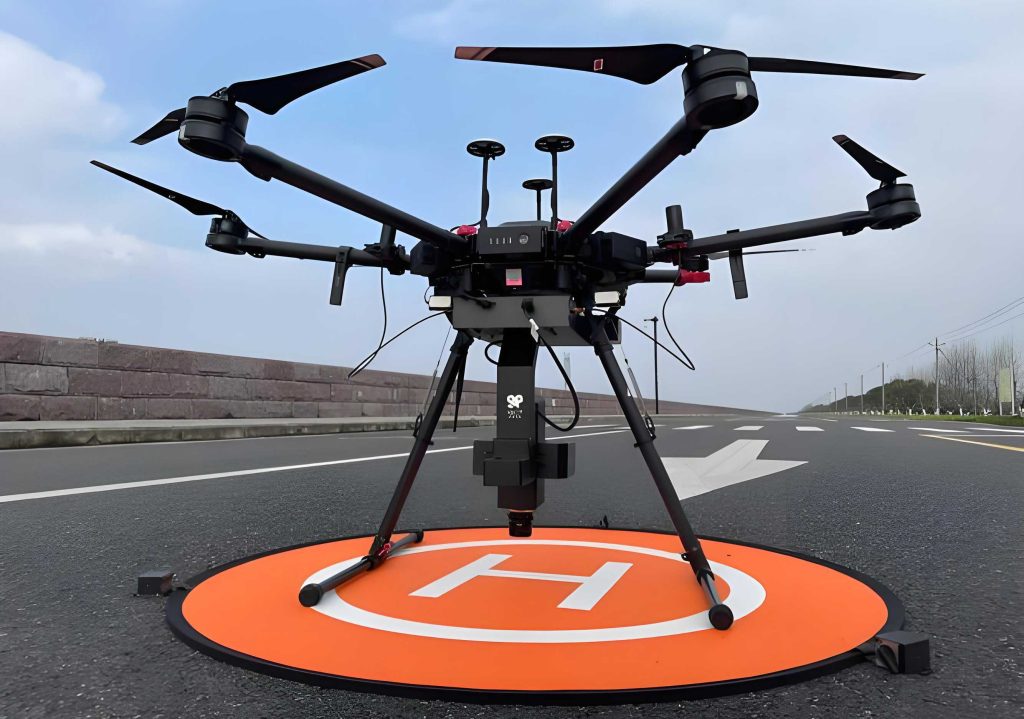
The journey from a working prototype to a commercial product was a gauntlet of entrepreneurial trials. Initial partnerships dissolved under pressure, funding was perpetually scarce, and retaining talented engineers was a constant struggle. Yet, these hardships taught a vital lesson: only by focusing obsessively on the core technological problem could one navigate the turbulent path of building a deep-tech venture. The first product that gained traction was a helicopter autopilot system. Its success was not accidental; it was born from a philosophy of prioritizing performance and reliability over all else—a philosophy that would later become a hallmark of high-end China drone products.
However, the true revolution was not in perfecting helicopter controls but in recognizing the potential of multi-rotor platforms. Drones with four, six, or eight rotors offered superior mechanical simplicity and control stability compared to single-main-rotor helicopters. The dynamics of a quadcopter, for instance, can be modeled using Newton-Euler equations. The total thrust \( T \) and the torques \( \tau_\phi, \tau_\theta, \tau_\psi \) around the roll, pitch, and yaw axes are related to the speeds of the four motors (\( \omega_1, \omega_2, \omega_3, \omega_4 \)):
$$
\begin{bmatrix} T \\ \tau_\phi \\ \tau_\theta \\ \tau_\psi \end{bmatrix} =
\begin{bmatrix}
k_F & k_F & k_F & k_F \\
0 & -l k_F & 0 & l k_F \\
-l k_F & 0 & l k_F & 0 \\
k_M & -k_M & k_M & -k_M
\end{bmatrix}
\begin{bmatrix} \omega_1^2 \\ \omega_2^2 \\ \omega_3^2 \\ \omega_4^2 \end{bmatrix}
$$
where \( k_F \) is the thrust coefficient, \( k_M \) is the torque coefficient, and \( l \) is the arm length. Solving the inverse of this matrix allows the flight controller to translate desired motions into precise motor commands. Shifting focus to these multi-rotor systems opened the floodgates for innovation.
The product evolution followed a clear trajectory from components to integrated solutions. The breakthrough moment came with the launch of a fully integrated, ready-to-fly model. This was not just another remote-controlled toy; it was a meticulously engineered platform that bundled a stabilized airframe, advanced flight controller, and intuitive remote control into one package. It democratized aerial photography, putting capabilities once reserved for film studios into the hands of consumers and creators worldwide. This product became a pivotal milestone for the China drone sector, proving that innovation from this region could lead, not just follow, in a global high-tech market.
The pace of innovation only accelerated. Subsequent generations introduced transformative features: 360-degree gimbal-stabilized cameras, obstacle sensing, and intelligent flight modes. These were made possible by continuous advancements in core technologies. The following table summarizes the evolution of key technological pillars in modern China drone development:
| Technology Pillar | Early Stage (c. 2006-2010) | Growth Stage (c. 2011-2015) | Maturation Stage (c. 2016-Present) |
|---|---|---|---|
| Flight Control | Basic PID for attitude stabilization; Manual tuning. | Advanced sensor fusion (EKF); Autonomous modes (e.g., hover, return-to-home). | AI-enhanced navigation; Real-time trajectory planning; Swarm intelligence protocols. |
| Propulsion & Power | Brushed motors; Limited flight time (~10 mins). | Brushless DC motors; Li-Po battery optimization (~20-25 mins). | High-efficiency motors & ESCs; Hybrid/electric propulsion research; >30 min flight time. |
| Sensing & Perception | IMU, GPS, Barometer. | Vision positioning systems (VPS); Ultrasonic sensors for altitude hold. | Multi-sensor suites (Stereo Vision, LiDAR, ToF); Omnidirectional obstacle avoidance. |
| Communication & Transmission | Analog 2.4 GHz for control; Basic video downlink. | Digital spread spectrum control; Low-latency digital HD video transmission. | 4G/5G cellular integration; OcuSync/lightbridge tech; Secure encrypted links. |
| Application Software | Basic configuration tools. | Comprehensive mobile apps for flight & editing; SDKs for developers. | AI-powered analytics platforms (photogrammetry, inspection analytics); Cloud-based fleet management. |
This technological march was paralleled by explosive market growth. The China drone industry evolved from a niche hobbyist community into a global economic force. The consumer, professional, and industrial segments each expanded rapidly. The table below provides a simplified snapshot of the global market penetration and application spectrum driven by China drone manufacturers:
| Market Segment | Primary Applications | Estimated Global Share Led by China Drone Tech (Circa 2023) | Key Growth Drivers |
|---|---|---|---|
| Consumer & Prosumer | Aerial photography & videography, recreational flying, racing. | >70% | Social media content creation, declining costs, ease of use. |
| Commercial & Enterprise | Infrastructure inspection, agriculture (spraying, mapping), search & rescue, surveying. | ~50-60% | Regulatory opening, proven ROI, advancements in payload & autonomy. |
| Government & Defense | Border surveillance, disaster management, public safety, reconnaissance. | Varies by region (significant presence) | Demand for cost-effective ISR solutions, dual-use technology. |
Seeing the “China drone” label achieve such dominance was profoundly gratifying, yet it came with a deep sense of responsibility. For decades, “Made in China” was often associated with low-cost, low-value-added manufacturing. My mission evolved from simply building flying machines to actively participating in reshaping that narrative. Every component, from the flight controller chip to the carbon fiber arm, had to meet an uncompromising standard of quality and innovation. The design philosophy extended even to packaging and user experience. This was not just about selling products; it was about demonstrating that a China drone could embody the pinnacle of engineering, design, and reliability—that it could be synonymous with premium quality.
The pursuit of this goal is relentless and mathematical. Consider the image quality from a drone’s camera, stabilized by a 3-axis gimbal. The gimbal’s job is to compensate for the aircraft’s angular movements. If the drone body rotates by angles \( (\alpha, \beta, \gamma) \), the gimbal motors must apply counter-torques to keep the camera frame inertially fixed. The control law involves precise inverse kinematics. Furthermore, the quality of the aerial data captured can be quantified. For a photogrammetry mission using a China drone, the ground sampling distance (GSD), which determines map resolution, is given by:
$$ GSD = \frac{H \times S_w}{f \times I_w} $$
where \( H \) is flight altitude, \( S_w \) is the sensor width, \( f \) is the lens focal length, and \( I_w \) is the image width in pixels. Optimizing all these parameters automatically for the user is part of the intelligent systems we develop.
Looking ahead, the frontier for China drone technology stretches far beyond current capabilities. The future lies in greater autonomy, swarm intelligence, and seamless integration into urban air mobility and the Internet of Things (IoT). Research is focused on algorithms for collaborative work. For a swarm of \( N \) drones, maintaining a formation while avoiding obstacles involves potential field methods or decentralized optimization. The cost function for a single agent \( i \) might be:
$$ J_i = \int ( \|\mathbf{p}_i(t) – \mathbf{p}_i^{des}(t)\|^2 + \sum_{j \neq i} \Phi(\|\mathbf{p}_i – \mathbf{p}_j\|) ) dt $$
where \( \mathbf{p}_i \) is the position of drone \( i \), \( \mathbf{p}_i^{des} \) is its desired position in the formation, and \( \Phi \) is a repulsive potential function for collision avoidance. Solving such problems in real-time for large \( N \) is key to applications in light shows, logistics, and coordinated mapping.
Another critical area is energy efficiency, the primary constraint on flight endurance. Research into new battery chemistries (like lithium-sulfur) and aerodynamic design is ongoing. The power required for steady hover, \( P_{hover} \), can be approximated by momentum theory:
$$ P_{hover} = \frac{T^{3/2}}{\sqrt{2 \rho A}} \cdot \frac{1}{\eta} $$
where \( T \) is thrust, \( \rho \) is air density, \( A \) is total rotor disk area, and \( \eta \) is the overall propulsive efficiency. Incremental improvements in every variable here translate directly into longer flight times, expanding the operational scope for every China drone.
The journey from a dream of easy flight to leading a wave of technological change has been the adventure of a lifetime. It underscores a fundamental belief: that passion, when coupled with relentless execution and a commitment to excellence, can transform an industry. The story of the China drone is not just about products filling the sky; it’s about a shift in perception, proving that innovation knows no geographical boundaries. The modern China drone stands as a testament to engineering prowess, creative potential, and the global spirit of exploration. My hope, my driving vision, is to continue pushing this boundary—to ensure that the next generation of aerial technology continues to bear the imprint of quality, intelligence, and inspiration that the world has come to associate with the very best of this field. The sky is not the limit; it is just the beginning.