
In recent years, the integration of vocational skills into higher education has become a pivotal focus, particularly with the introduction of the “1+X” certificate system. This initiative, spearheaded by national policies, aims to bridge the gap between academic learning and industry demands. As an educator and practitioner involved in drone training, I have witnessed firsthand the transformative impact of this system. Our institution, a technical university in China, embarked on a pilot program for the “1+X” drone pilot certification, which has reshaped our approach to drone training and education. This article delves into the operational logic and exploratory practices of this system, drawing from our experiences to provide insights into effective drone training methodologies.
The “1+X” certificate system, where “1” represents the academic diploma and “X” denotes various vocational skill level certificates, is designed to enhance students’ employability by aligning their skills with societal needs. In the context of drone training, this system emphasizes practical competencies alongside theoretical knowledge. Our journey began with a thorough analysis of industry requirements, leading to the development of a comprehensive drone training curriculum. The core objective was to foster skilled drone pilots who could thrive in diverse sectors such as agriculture, logistics, surveillance, and environmental monitoring. Through this pilot, we aimed to address common issues in traditional courses, such as limited hands-on opportunities and disconnection from real-world applications.
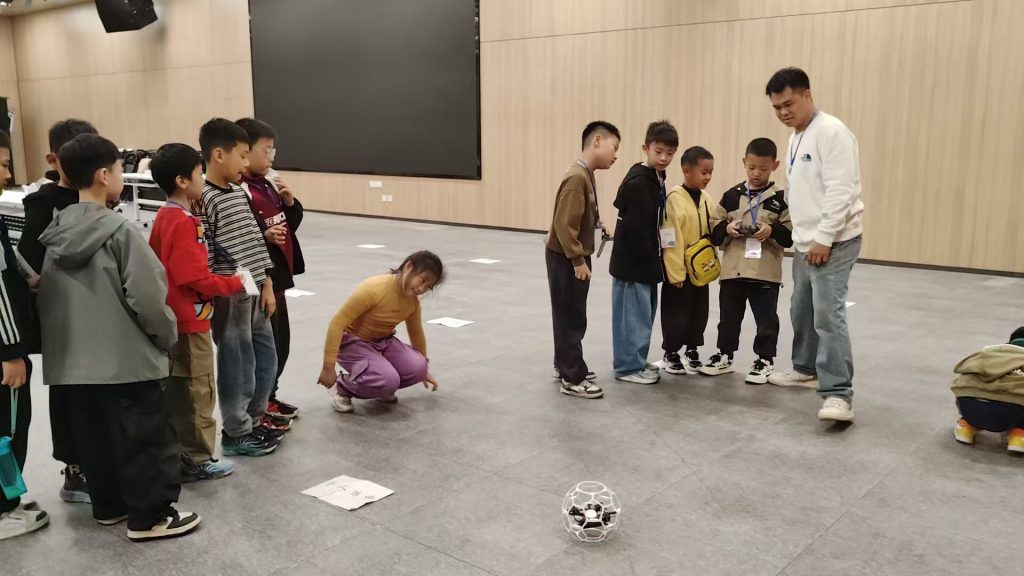
Drone training under the “1+X” framework is structured around three key competency areas: autonomous operation, fault diagnosis and maintenance, and industry application. These competencies form the backbone of our drone training program, ensuring that students not only learn to fly drones but also understand their maintenance and practical uses. To quantify learning outcomes, we introduced assessment formulas that evaluate student performance holistically. For instance, the overall competency score \( S \) is calculated as:
$$ S = w_A \cdot A + w_B \cdot B + w_C \cdot C $$
where \( A \), \( B \), and \( C \) represent scores in autonomous operation, fault diagnosis, and industry application, respectively, with weights \( w_A = 0.4 \), \( w_B = 0.3 \), and \( w_C = 0.3 \) reflecting their relative importance in drone training. This formula ensures a balanced emphasis on all aspects of drone training, promoting comprehensive skill development.
The drone training curriculum is divided into theoretical and practical modules. Theoretical components cover topics like drone safety, airspace regulations, and aerodynamics, while practical sessions involve simulator exercises and actual flight operations. We developed a project bank for hands-on activities, ranging from basic flight maneuvers to complex missions like aerial mapping or inspection. This structured approach to drone training enhances student engagement and skill acquisition. Moreover, we incorporated a “credit bank” system, allowing students to accumulate credits from various drone training activities, which can be exchanged for certification upon completion.
To illustrate the vocational skill levels, we defined standards for primary, intermediate, and advanced drone pilots. These levels are cumulative, with higher tiers encompassing lower-level skills. The table below summarizes the key requirements for each level in drone training:
| Skill Level | Key Competencies | Target Institutions | Applicable Industries |
|---|---|---|---|
| Primary | Assembly of multi-rotor drones, pre-flight checks, visual line-of-sight operations, basic maintenance. | Secondary vocational schools | Agriculture, media, logistics |
| Intermediate | System installation, beyond visual line-of-sight operations, advanced maintenance, task planning. | Higher vocational colleges | Surveying, emergency response, energy inspection |
| Advanced | Custom system integration, multi-scenario operations, data processing, emergency预案 design. | Applied undergraduate universities | Environmental monitoring, advanced manufacturing, research |
This tiered structure in drone training ensures that learners progress systematically, building expertise through incremental challenges. Our drone training program aligns with these standards, offering specialized modules for each level. For example, primary drone training focuses on safe takeoff and landing, while advanced drone training involves simulating real-world missions like power line inspections or crop monitoring.
In our exploration, we emphasized “course-certificate integration,” where the drone training curriculum is directly linked to the certification requirements. This approach eliminates redundancies and ensures that every learning activity contributes to certification goals. We redesigned courses to include competency-based assessments, where students choose from a set of tasks aligned with the three key competencies. The assessment process involves independent practice, followed by on-site evaluations. For autonomous operation, students must perform pre-flight checks and execute smooth flights; for fault diagnosis, they identify and repair simulated drone malfunctions; and for industry application, they design and implement drone-based solutions for hypothetical scenarios. This method not only enhances drone training effectiveness but also fosters self-directed learning.
To support this, we developed a detailed flowchart for the “1+X” assessment scheme, which guides students from topic selection to certification. The process begins with differentiated task selection based on student ability, followed by self-paced practice with instructor support, and culminates in on-site performance evaluations. This flowchart is embedded in our drone training materials, providing a clear roadmap for success. Additionally, we use formulas to calculate learning efficiency \( E \) in drone training:
$$ E = \frac{T + P + I}{3} $$
where \( T \) is theoretical test score, \( P \) is practical flight score, and \( I \) is innovation score from industry application tasks. This metric helps us refine drone training methods by highlighting areas for improvement.
Specialized training sessions are a cornerstone of our drone training program. These intensive workshops prepare students for certification exams by focusing on exam content, standards, and formats. They are open to跨-disciplinary students, industry professionals, and even external enthusiasts, broadening the impact of drone training. Our trainers include certified instructors with industry experience, ensuring that drone training is both relevant and up-to-date. We maintain a ratio where at least 20% of trainers are industry experts, and over 50% are dual-qualified teachers who blend academic and practical expertise in drone training.
The evaluation methodology in drone training has shifted from traditional exams to portfolio-based assessments. Portfolios compile student work over time, including flight logs, maintenance reports, and project designs. This approach offers a holistic view of skill development in drone training. For instance, we assess portfolios using a weighted rubric:
| Assessment Component | Weight | Description |
|---|---|---|
| Flight Performance | 40% | Based on accuracy, safety, and adherence to protocols in drone training exercises. |
| Technical Reports | 30% | Documentation of fault diagnoses, repairs, and maintenance activities in drone training. |
| Project Innovation | 30% | Creativity and effectiveness in applying drone training to solve industry problems. |
This method reduces exam anxiety and encourages continuous improvement in drone training. Moreover, we correlate portfolio scores with certification outcomes, finding that students with higher portfolio scores consistently excel in “1+X” exams. The relationship can be expressed as:
$$ C_{score} = 0.7 \cdot P_{portfolio} + 0.3 \cdot E_{exam} $$
where \( C_{score} \) is the final certification score, \( P_{portfolio} \) is the portfolio score, and \( E_{exam} \) is the score from a standardized practical exam. This formula underscores the importance of sustained effort in drone training.
Drone training also involves collaborative projects with local industries. For example, we partner with agricultural firms to provide drone training for crop spraying, or with logistics companies for delivery simulations. These partnerships enrich drone training by exposing students to real-world challenges. We measure the success of such collaborations through feedback loops, where industry mentors evaluate student performance and suggest enhancements to our drone training curriculum. This iterative process ensures that drone training remains aligned with market needs.
From a pedagogical perspective, drone training incorporates active learning strategies. We use simulation software to mimic various flight conditions, allowing students to practice without risk. The simulator performance \( Sim \) is tracked using metrics like stability \( \sigma \) and accuracy \( \alpha \):
$$ Sim = \frac{1}{n} \sum_{i=1}^{n} ( \sigma_i \cdot \alpha_i ) $$
where \( n \) is the number of simulation sessions in drone training. This data helps instructors personalize drone training for each student. Additionally, we organize drone training competitions to foster teamwork and innovation, further solidifying skills.
The impact of this drone training initiative has been profound. Since implementing the “1+X” drone pilot certification, our institution has seen a surge in student interest and employability. Enrollment in drone-related courses has increased by over 50%, and graduate employment rates in drone sectors have risen significantly. Students report higher confidence in their skills, attributing it to the hands-on nature of drone training. Furthermore, the certification has opened doors to diverse careers, from drone piloting to technical support roles. We attribute this success to the rigorous yet flexible drone training framework that adapts to individual learning paces.
Looking ahead, we plan to expand drone training by integrating emerging technologies like artificial intelligence and IoT into the curriculum. This will prepare students for advanced roles in autonomous drone systems. We also aim to establish a drone training center that serves as a regional hub for certification and research. By continuously refining our drone training methods, we hope to contribute to a skilled workforce capable of driving innovation in the drone industry.
In conclusion, the “1+X” drone pilot certification system represents a paradigm shift in vocational education. Through structured drone training, competency-based assessments, and industry collaboration, we have created a model that enhances both learning outcomes and career prospects. The key takeaways from our drone training experience include the importance of practical immersion, the value of portfolio evaluations, and the need for ongoing curriculum adaptation. As drone technology evolves, so must our approach to drone training, ensuring that learners are always equipped with relevant, in-demand skills. This journey in drone training has not only transformed our educational practices but also inspired a broader commitment to excellence in vocational training.