
The field of drone technology is expanding at a breathtaking pace, creating a substantial demand for skilled operators, technicians, and engineers. As an educator deeply involved in this domain, I have consistently faced a fundamental challenge: how to effectively impart the intricate balance of theoretical aeronautical knowledge and hands-on practical skills within the constrained timeframe of a typical academic course. Traditional drone training methods, heavily reliant on direct physical flight, present significant hurdles including high costs, safety risks, logistical complexities, and limited opportunities for repetitive practice. This gap between theoretical understanding and practical mastery is where Virtual Simulation Technology has emerged as a transformative force. My experience has led me to the firm conviction that building a dedicated virtual simulation platform is not merely an enhancement but a necessary evolution for effective, scalable, and safe drone education.
Virtual Simulation Technology (VST) can be broadly defined as a sophisticated synthesis of computer science, multimedia, and modeling techniques. It leverages computer graphics, image processing, and database systems to generate interactive, computer-based environments that mimic reality with high fidelity. In the context of drone training, VST creates a dynamic digital sandbox—a virtual airspace where every aspect of drone operation, from basic stabilization to complex mission execution, can be practiced, analyzed, and mastered without any real-world consequences.
The advantages of embedding this technology into the core of drone training curricula are multifaceted and profound. First and foremost, it decisively addresses the critical issue of safety. Novice pilots can experience and learn from catastrophic failures—such as motor loss, GPS signal dropout, or incorrect response to wind shear—in a consequence-free environment. This aspect of risk-free experimentation is invaluable for building confidence and instinct before transitioning to physical aircraft. Secondly, the cost-effectiveness is undeniable. The financial barrier to comprehensive drone training is dramatically lowered, as detailed in the following cost-benefit model contrasting traditional and simulation-augmented drone training programs:
| Cost Factor | Traditional Drone Training | Simulation-Augmented Drone Training |
|---|---|---|
| Initial Fleet Investment | High (Multiple drones, spare parts, batteries) | Low to Moderate (Fewer physical drones needed) |
| Operational & Crash Costs | Very High (Frequent repairs, part replacements) | Negligible (Virtual repairs are free and instant) |
| Training Space & Insurance | Substantial (Field rental, liability coverage) | Minimal (Requires only computer lab space) |
| Scalability | Limited by hardware and space | Highly Scalable (Limited only by software licenses) |
| Access to Diverse Scenarios | Limited, expensive to stage (e.g., fire, search & rescue) | Unlimited, instantly configurable |
$$ C_{traditional} = N_d \cdot (P_d + P_p \cdot f_{crash}) + C_{space} + C_{insurance} $$
$$ C_{simulation} = N_s \cdot L_s + C_{lab} + \alpha \cdot C_{traditional} $$
Where $C_{traditional}$ and $C_{simulation}$ are total training costs, $N_d$/$N_s$ are numbers of drones/simulators, $P_d$ is drone unit price, $P_p$ is average part cost, $f_{crash}$ is crash frequency, and $\alpha$ is a factor (<<1) representing the reduced need for physical assets.
Beyond safety and cost, virtual simulation for drone training enables unparalleled pedagogical depth. Complex theoretical concepts become tangible. For instance, the physics of flight can be visualized in real-time. Students can see the direct impact of changing a PID controller parameter on the drone’s stability, governed by its simplified rotational dynamics:
$$ I \cdot \dot{\omega} + \omega \times (I \cdot \omega) = \tau $$
Where $I$ is the inertia matrix, $\omega$ is the angular velocity vector, and $\tau$ is the control torque vector. Tweaking the control logic that generates $\tau$ and observing the virtual drone’s response provides an intuitive understanding unmatched by textbook diagrams. Furthermore, the technology fosters self-directed learning. Trainees can practice specific maneuvers—like precise figure-eight patterns or automated grid surveys—hundreds of times until muscle memory and procedural accuracy are perfected, something impossible with a limited fleet of physical drones.
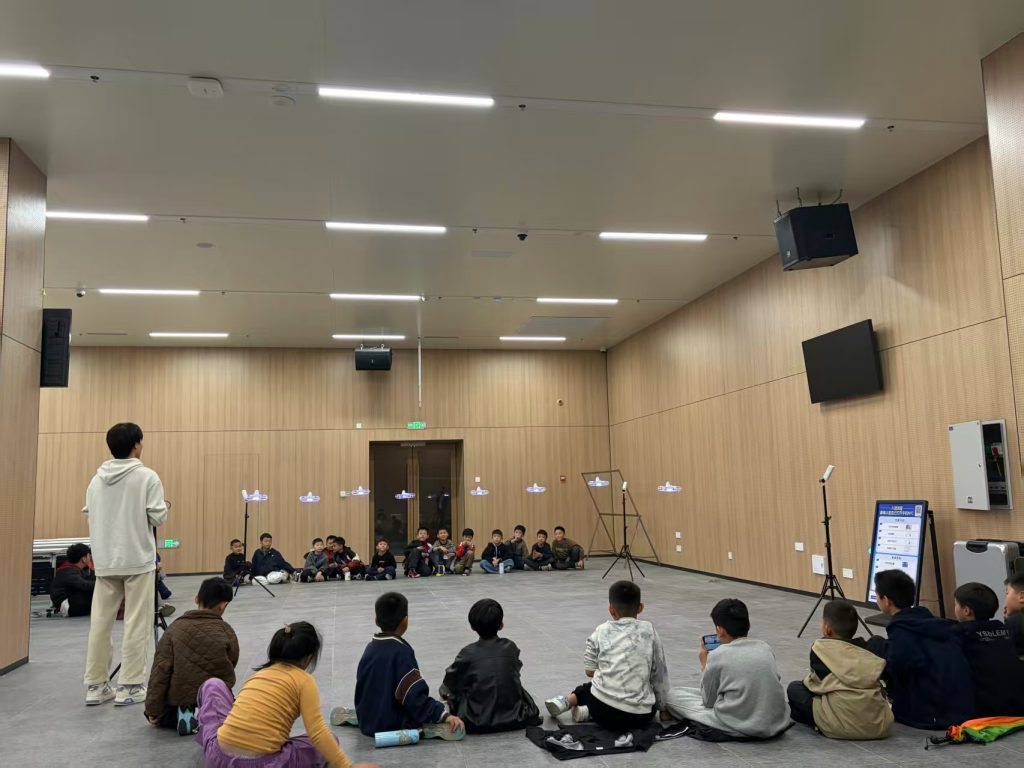
Building an effective virtual simulation platform for drone training is a strategic process best approached in distinct, cumulative phases. The first phase focuses on Activating Instructor Innovation. The cornerstone is selecting accessible development tools. Web-based VR editors that utilize WebGL and offer code-light, logic-driven interfaces (often using visual scripting or table-based input) are ideal. They allow instructors with domain expertise in aviation but not necessarily in computer science to become creators. The core activity here is project-based training. Instructors undergo immersive workshops where they learn to build virtual drone training modules—starting with a simple hover exercise and progressing to complex mission simulations. This hands-on process transforms them from passive users of educational technology into active architects of their own digital curriculum, directly aligning simulation content with their specific learning objectives for drone training.
The second phase aims at Fostering a Collaborative Innovation Ecosystem between students and faculty. This requires creating both a physical space and a digital toolkit. The physical “Drone Simulation Lab” is equipped with hardware that supports development and high-fidelity experience, as outlined below:
| Hardware Component | Primary Role in Drone Training Platform |
|---|---|
| High-Performance VR Workstations | Running & developing complex simulation environments in real-time. |
| Immersive VR Headsets (6-DOF) | Providing first-person pilot perspective and spatial awareness training. |
| Radio Controller Hardware Adapters | Allowing trainees to use real drone transmitters as input devices, building real-world muscle memory. |
| Large Format Touchscreen Displays | For collaborative mission planning, debriefing, and visualizing flight data analytics. |
| 360° Cameras & 3D Scanners | Captiving real-world environments (e.g., campus, local infrastructure) to create authentic training geographies. |
Digitally, the platform expands from a core VR editor to a suite of “low-floor, high-ceiling” creative tools. An AR (Augmented Reality) editor allows students to project virtual drone models or flight paths onto physical spaces via tablets or phones, ideal for pre-flight planning and maintenance procedures. An interactive media engine enables the creation of point-and-click tutorials for drone assembly or systems diagnostics. A digital museum tool empowers classes to collaboratively build interactive showcases on the history of drone technology or principles of aerodynamics. This diverse toolkit caters to different learning styles and project goals, making the process of creating for drone training engaging and multifaceted.
The third and culminating phase is dedicated to Cultivating Tangible, High-Impact Outcomes. The platform shifts from an internal teaching tool to a hub for applied projects and industry collaboration. Students use their drone training simulation skills to address real-world problems. For example, a team might develop a custom virtual simulation for inspecting a specific type of bridge or wind turbine, incorporating accurate 3D models and fault libraries. These projects can translate into competition entries (e.g., in “innovation” or “applied technology” challenges), entrepreneurship ventures, or direct contract work for local industries needing tailored training solutions. For instructors, the platform outputs form the basis for academic research, publications on pedagogical efficacy, and the development of standardized, shareable simulation modules that can benefit the wider drone training community. This phase measures success not just in grades, but in patents filed, startups launched, competitions won, and industry partnerships formed.
Evaluating the effectiveness of such a comprehensive drone training platform requires a multi-dimensional framework that looks beyond simple pass/fail metrics. We must assess its impact on skill acquisition, knowledge retention, and operational readiness. Key performance indicators (KPIs) can be organized as follows:
| Assessment Dimension | Metric / Method | Role in Evaluating Drone Training |
|---|---|---|
| Skill Proficiency & Transfer | Compare performance metrics (e.g., hover stability, mission completion time, accuracy) between simulation-only, simulation-first, and traditional-only training cohorts in final real-flight tests. | Quantifies the real-world skill transfer from virtual drone training. |
| Theoretical Understanding | Pre- and post-test scores on aerodynamics, regulations, and systems knowledge, correlated with simulation usage logs. | Measures depth of conceptual learning enabled by interactive visualization. |
| Decision-Making & Risk Management | Analysis of trainee choices in simulated emergency scenarios (e.g., loss of link, battery failure, intruding aircraft). | Evaluates development of critical safety-minded judgment, a core goal of advanced drone training. |
| Student Engagement & Motivation | Surveys, platform usage analytics (time spent, modules completed voluntarily), and project portfolio diversity. | Assesses the intrinsic motivation and exploratory learning driven by the platform. |
| Operational & Cost Efficiency | Reduction in physical drone damage rates, accelerated time-to-competency for new pilots, and scalability of training throughput. | Calculates the tangible return on investment for the drone training program. |
A formal model for skill progression in a blended (simulation + physical) drone training program could be represented as:
$$ S(t) = S_{max} \cdot (1 – e^{-\lambda t}) + \beta \cdot \log(1 + N_{sim}) $$
Where $S(t)$ is the skill level at time $t$, $S_{max}$ is the maximum achievable skill, $\lambda$ is the learning rate from physical practice, $N_{sim}$ is the number of targeted simulation sessions, and $\beta$ is a coefficient representing the effectiveness of simulation in accelerating learning. This model captures the synergistic effect where virtual practice logarithmically accelerates the initial phase of skill acquisition, leading to faster and safer achievement of competency in real-world drone training.
The application assessment consistently reveals that students who undergo substantial virtual simulation training demonstrate markedly faster proficiency curves when they transition to physical drones. They exhibit smoother control inputs, better spatial awareness, and, most importantly, a more methodical and safety-conscious approach to pre-flight checks and in-flight problem-solving. The simulation environment provides immediate, quantitative feedback that is often elusive in real flight—exact deviation from a planned path, energy consumption efficiency, or control surface deflection angles. This data-rich debriefing capability turns every virtual flight, successful or not, into a powerful learning event, solidifying the principles of modern drone training.
In conclusion, the integration of virtual simulation technology is fundamentally reshaping the landscape of drone training. It transcends being a simple cost-saving or safety tool; it is a comprehensive pedagogical framework that enables deeper conceptual understanding, accelerates skill acquisition, and fosters an innovative mindset. The phased platform development strategy—empowering instructors, engaging students with creative tools, and driving toward tangible outcomes—ensures the technology is effectively embedded into the educational ecosystem. As simulation fidelity continues to improve with advances in physics engines, graphics, and AI-driven scenario generation, the line between virtual and real drone training will further blur. The future of proficient, safe, and innovative drone operations will undoubtedly be built upon the foundational skills honed in these sophisticated virtual skies. The ultimate goal is a training paradigm where aspiring aviators can make and learn from a thousand virtual mistakes, so they make none when it truly matters.