
As a practitioner deeply involved in the modernization of crop protection, I have witnessed the transformative role of agricultural UAV technology. These remotely piloted or autonomous systems represent a significant leap from traditional ground-based sprayers. Their core advantages—operational agility, uniform spray atomization, zero soil compaction, minimal damage to field bunds, remarkable efficiency in water and chemical usage, and enhanced safety—have solidified their position as a cornerstone of precision agriculture. This discussion synthesizes the operational principles, application methodologies, and strategic integration of agricultural UAV platforms within intensive rice and wheat cropping systems, drawing from extensive field observation and data analysis.
Technological Foundation and Key Parameters of Agricultural UAVs
The efficacy of an agricultural UAV is governed by a synergy of aerodynamic design, propulsion, and precision application systems. The most common configuration for crop protection is the multi-rotor electric UAV, prized for its vertical take-off and landing (VTOL) capability and exceptional maneuverability in complex field geometries. The application system typically consists of a liquid tank, a pump, a network of supply lines, and an array of nozzles mounted on spray booms. Modern systems employ ultra-low volume (ULV) or very-low volume (VLV) spraying techniques, generating droplets in the range of 50-300 microns. Precise control over these parameters is critical for canopy penetration and deposition efficiency.
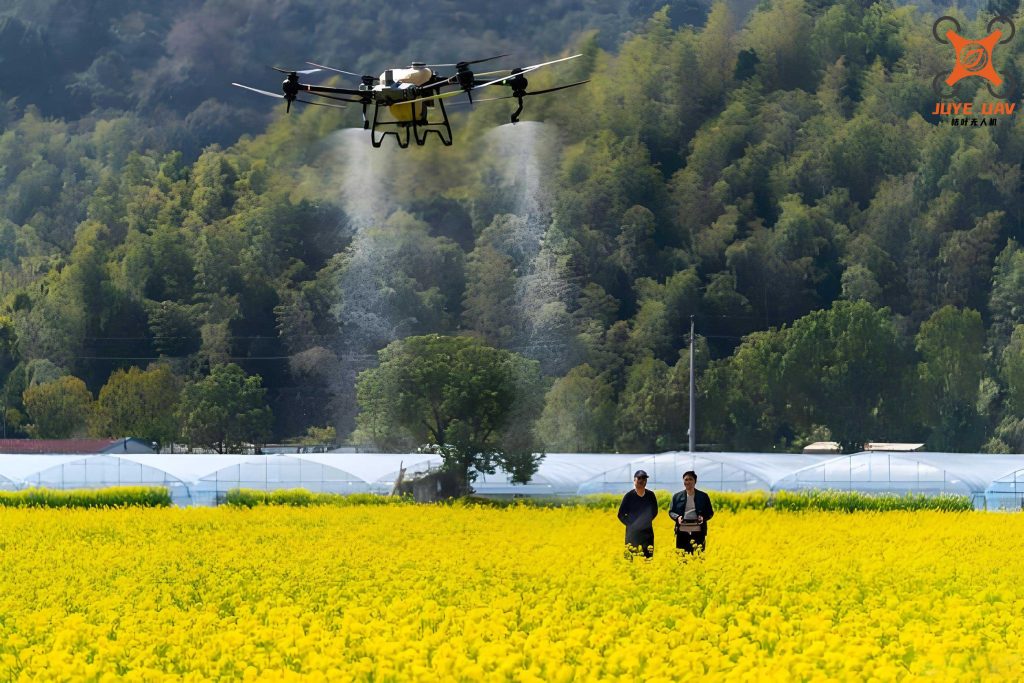
Key operational parameters for an agricultural UAV mission are interdependent. Flight altitude (H) and speed (V) directly influence the swath width (W_swath) and the application rate (AR). The fundamental relationship is given by:
$$ AR = \frac{Q}{V \times W_{swath}} $$
where Q is the total flow rate from all nozzles. Optimizing these variables is essential. For instance, a typical mission for a medium-capacity agricultural UAV might involve a flight altitude of 2-3 meters above the crop canopy, a speed of 4-6 m/s, and a resulting swath width of 4-6 meters. The following table summarizes critical specifications and their impact on performance:
| Parameter | Typical Range/Value | Impact on Operation |
|---|---|---|
| Payload Capacity | 10 – 40 kg | Determines operational endurance per sortie; larger tanks reduce refill frequency but may affect agility. |
| Battery Endurance | 10 – 25 minutes | Limits continuous operational time; necessitates efficient logistics for battery swapping/charging. |
| Spray System Flow Rate | 0.8 – 2.5 L/min | Dictates the liquid application rate; must be calibrated with flight speed. |
| Nozzle Type | Centrifugal, Hydraulic | Centrifugal nozzles are preferred for ULV applications and consistent droplet size across viscosity changes. |
| Ground Sample Distance (GSD) | ~1 cm/pixel (for mapping) | High-resolution imagery enables precise prescription map generation for variable-rate application. |
Strategic Application in Rice and Wheat Cultivation
The adoption of agricultural UAV technology must be contextualized within the specific pest, disease, and weed pressure dynamics of the target crop. Its application is not universally superior but is strategically advantageous in specific growth stages and scenarios.
Rice Production Protocols
In rice systems, the canopy architecture evolves dramatically, from open water/seedling stages to a dense, closed canopy post-tillering. This progression dictates the optimal use of an agricultural UAV.
- Pre- and Early Post-Transplanting Weed Control: For mechanically transplanted rice, the pre-emergence herbicide application is an ideal task for an agricultural UAV. The field is clear of young plants, allowing for rapid, uniform soil surface coverage without risk of crop damage. Post-transplant application must be carefully timed—only after seedlings are firmly rooted (typically 5-7 days after transplanting) to prevent “drifting” or lodging caused by rotor downwash.
- Early to Mid-Season Pest/Disease Management: During the early vegetative stages (before canopy closure), pests like the white-backed planthopper (Sogatella furcifera) and the second generation of rice leaf folder (Cnaphalocrocis medinalis), along with initial infections of sheath blight (Rhizoctonia solani), are effectively targeted. The agricultural UAV‘s fine droplets can penetrate the open canopy. The principle of “one spray, multiple targets” is efficiently executed here.
- Limitations in Late Season: During the reproductive and ripening phases, the rice canopy becomes highly dense. Key threats like stem borers, brown planthopper (Nilaparvata lugens), and the basal phase of sheath blight reside within the lower canopy. The limited droplet penetration of an agricultural UAV from above can be suboptimal. In these scenarios, high-volume sprayers (e.g., backpack or boom sprayers) that can deliver larger volumes of liquid to the base are often more effective.
Wheat Production Protocols
Wheat presents a different architecture, generally less dense than mature rice. The agricultural UAV is highly effective across most growth stages for foliar diseases and pests.
- Foliar Disease and Aphid Control: For diseases like powdery mildew (Blumeria graminis), rusts (Puccinia spp.), and aphid colonies, which colonize the upper and middle canopy, UAV application provides excellent coverage. This is particularly true for mid- to late-season fungicide applications targeting Fusarium head blight (scab), where precise, timely application at flowering is critical.
- Context-Dependent Use for Severe Outbreaks: Under conditions of a major epidemic or pest outbreak (e.g., a massive migration of aphids), the absolute deposition quantity per unit area might become a limiting factor. While the agricultural UAV remains a valuable tool, the operational parameters (e.g., flight speed, application rate) and the need for possible follow-up applications must be carefully evaluated against the infestation pressure.
The comparative performance data consistently narrows the perceived efficacy gap between agricultural UAVs and conventional sprayers. A representative field trial comparing control efficacy for rice sheath blight illustrates this point:
| Treatment Method | Diseased Hill Incidence (%) | Control Efficacy on Hills (%) | Diseased Plant Incidence (%) | Control Efficacy on Plants (%) |
|---|---|---|---|---|
| Agricultural UAV | 10.00 | 87.50 | 3.87 | 91.37 |
| Backpack Sprayer | 5.00 | 93.75 | 1.47 | 96.72 |
| Untreated Control | 81.00 | — | 44.83 | — |
Modeling and Economic Analysis of UAV Operations
The decision to integrate agricultural UAV technology is underpinned by technical and economic models. From a physics perspective, the deposition pattern of spray droplets is a function of multiple variables. A simplified model for the normalized deposition D(x) across a swath can be represented as a distribution:
$$ D(x) = \frac{1}{\sigma \sqrt{2\pi}} e^{-\frac{1}{2}\left(\frac{x – \mu}{\sigma}\right)^2} \cdot \eta_{evap} \cdot \eta_{drift} $$
where \(x\) is the lateral distance from the flight line center, \(\mu\) is the center of the deposition swath, \(\sigma\) characterizes the spread of the deposit pattern, and \(\eta_{evap}\) and \(\eta_{drift}\) are efficiency factors accounting for evaporation and drift losses, respectively. Overlap between adjacent swaths is calculated to ensure uniformity, with the required overlap (Or) being a function of the effective swath width (Weff) and the nominal swath width (Wswath):
$$ O_r = \left(1 – \frac{W_{eff}}{W_{swath}}\right) \times 100\% $$
Path planning for a rectangular field of length L and width W, with a headland space Hs, involves calculating the number of flight lines (N):
$$ N = \left\lceil \frac{W – 2H_s}{W_{swath} \cdot (1 – O_r/100)} \right\rceil $$
The total flight path distance Dtotal is then approximately:
$$ D_{total} \approx N \times L $$
The economic viability is assessed through a cost-benefit analysis. The total cost per hectare (Cha) for a service provider includes fixed and variable costs:
$$ C_{ha} = \frac{C_{fixed}}{A_{annual}} + C_{variable} $$
Where \(C_{fixed}\) includes the capital cost of the agricultural UAV (depreciated over its lifespan), insurance, and storage. \(A_{annual}\) is the total area serviced annually. \(C_{variable}\) includes costs per hectare for batteries (energy), maintenance, labor for the pilot/spotter, and the chemicals applied.
The benefit stems from multiple factors: significant reduction in water usage (often over 90% compared to conventional sprayers), precise chemical application reducing input costs by 10-30%, and unparalleled labor productivity. A single agricultural UAV team can typically cover 20-40 hectares per day, a rate 20-50 times faster than manual backpack spraying. The economic break-even point for ownership depends heavily on the scale of operation. A simplified model for the minimum annual area (Amin) required for ownership to be preferable over rental is:
$$ A_{min} = \frac{C_{fixed}}{(R_{rental} – C_{variable}^{owner}) + (C_{variable}^{renter} – C_{variable}^{owner})} $$
where \(R_{rental}\) is the market rental fee per hectare, and the variable cost superscripts denote owner-operated versus renter-operated scenarios (often similar for chemicals but different for labor/energy).
Integrated Implementation Strategy and Future Outlook
Successful integration of agricultural UAV technology requires a strategic approach tailored to farm size and structure. The technology’s trajectory shows rapid adoption, but bottlenecks remain, such as the initial capital investment and the need for a robust support network for maintenance and repair.
Strategic recommendations for different stakeholders are clear:
- Small-Scale Farmers (< 20 ha): Ownership is rarely economical. The optimal strategy is to engage with professional agricultural UAV service providers who offer per-hectare contracting. This provides access to the technology without the burdens of capital outlay, pilot training, and maintenance.
- Large-Scale Farms, Cooperatives, and Collective Farms (> 50 ha): In-house ownership becomes highly viable. The high annual utilization rate spreads fixed costs, and the ability to control timing for critical applications (e.g., fungicide at flowering) offers significant agronomic value. Training full-time pilots ensures operational excellence.
- Professional Service Organizations: These entities are the growth engine for democratizing access. Their strategy must focus on scaling their fleet (agricultural UAV保有量), standardizing high-quality operations, investing in advanced pilot training, and expanding service coverage. They benefit from economies of scale and can offer competitive pricing.
The future of agricultural UAV technology lies in increased automation and data integration. The convergence of UAVs with other precision agriculture tools is key. This includes:
- AI-Powered Scouting: UAVs equipped with multispectral sensors can autonomously detect pest hotspots, nutrient deficiencies, or weed patches, generating prescription maps for targeted spraying.
- Fully Autonomous Swarms: Networks of cooperating agricultural UAVs managed by a central fleet control system, capable of simultaneously scouting and treating large, heterogeneous fields.
- Advanced Formulation Science: Development of ULV-optimized formulations and adjuvants that enhance droplet adhesion, spreading, and rainfastness, pushing the biological efficacy closer to that of high-volume applications.
In conclusion, the agricultural UAV is not merely a new sprayer but a fundamental component of a digital, data-driven farming system. Its strategic application in rice and wheat—leveraging its strengths in open canopies, early-season applications, and broad-acre efficiency—delivers tangible economic and environmental benefits. The path forward involves tailored adoption strategies, continued technological refinement, and the development of robust service ecosystems to fully realize the potential of this transformative technology in global cereal production.