
The acceleration of urbanization and the consequent increase in population density have led to a rise in the frequency and complexity of fire incidents, posing significant threats to life and property. Traditional firefighting and rescue methodologies often struggle to meet the demands of these modern, dynamic emergencies. In this context, the rapid advancement of Unmanned Aerial Vehicle (UAV) technology presents a transformative opportunity. This article delves into the innovative applications of fire UAV technology within fire suppression and rescue work, examining its potential to enhance operational efficiency, mitigate risks, and ensure the safety of both responders and civilians. By providing a comprehensive analysis of the roles and functionalities of the fire UAV, this discussion aims to offer substantial theoretical support and practical guidance for the future of emergency response.
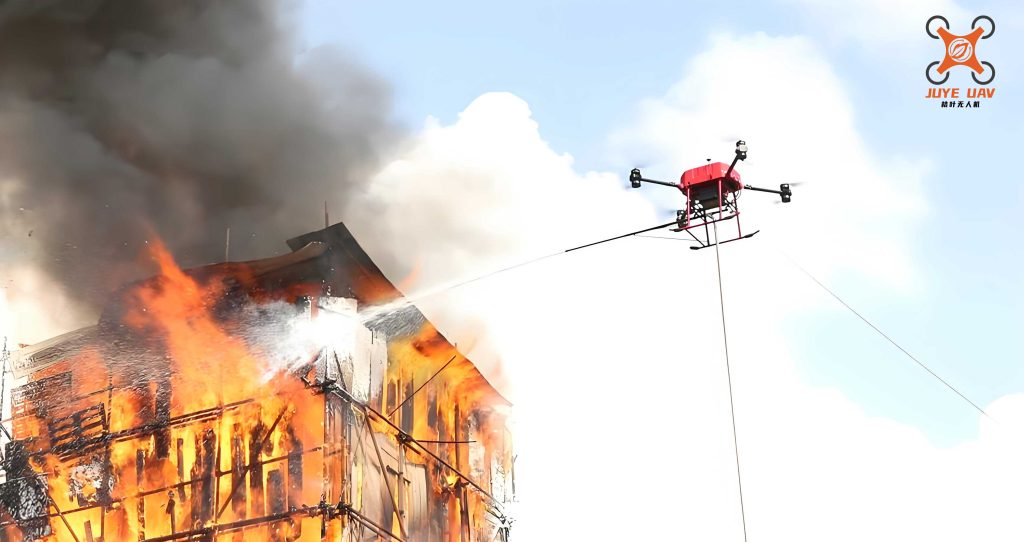
Advantages of Fire UAVs in Firefighting and Rescue Operations
The integration of fire UAV systems into emergency response protocols offers a paradigm shift, characterized by several distinct advantages over conventional approaches.
Enhanced Flexibility and Rapid Deployment
A primary advantage of the fire UAV is its exceptional flexibility. Characterized by simple operation, high mobility, and rapid response times, a fire UAV can navigate complex and hazardous environments inaccessible or perilous to ground teams. Upon deployment, a fire UAV can quickly reach the incident site and, equipped with an array of advanced sensors, provide immediate situational awareness. This capability allows for dynamic adaptation to evolving fireground conditions.
Cost-Effective Reconnaissance
Traditional fire reconnaissance often requires substantial investments in manpower, equipment, and time. The fire UAV dramatically reduces these costs. It can conduct prolonged, stable aerial surveillance over a fire scene, gathering rich datasets with minimal human resource allocation. The economic efficiency of using a fire UAV for reconnaissance not only optimizes budgetary resources but also alleviates pressure on personnel, enabling fire departments to respond more agilely to multiple or protracted incidents.
Superior Reconnaissance Efficiency and Data Fidelity
Equipped with high-definition cameras, thermal imaging sensors, and multi-gas detectors, the fire UAV delivers unparalleled reconnaissance efficiency. It provides comprehensive, multi-angle visual and thermal data in real-time, uncovering critical details that may be obscured from ground level. The real-time data transmission capability of a fire UAV ensures that this information is instantly available to incident commanders, facilitating data-driven decision-making and strategic adjustments. The quality and speed of intelligence provided by a fire UAV directly translate to more effective and safer firefighting operations.
| Feature | Traditional Reconnaissance (Ground Teams/Aircraft) | Fire UAV-Based Reconnaissance |
|---|---|---|
| Response Time | Slower (mobilization, access issues) | Very Rapid (immediate aerial deployment) |
| Operational Risk | High (exposure to direct hazards) | Low (remote operation, no crew risk) |
| Data Perspective | Limited, ground-level or broad aerial | Comprehensive, flexible aerial perspectives |
| Cost per Mission | High (fuel, crew, maintenance) | Significantly Lower (electric, minimal crew) |
| Real-time Data Feed | Often delayed or fragmented | Continuous, real-time streaming |
| Night/Low-Visibility Operation | Limited and hazardous | Highly effective with thermal sensors |
Challenges and Limitations in Fire UAV Application
Despite the clear benefits, the effective deployment of fire UAV technology in firefighting faces several technical and operational hurdles that must be addressed for its full potential to be realized.
Limited Endurance and Payload Capacity
The operational duration, or endurance, of a fire UAV is a critical constraint. Most electric multirotor fire UAV platforms are limited by battery technology, offering flight times typically between 20 to 45 minutes. This can be insufficient for prolonged monitoring of large-scale incidents. The relationship between endurance (E), battery capacity (C in Ah), voltage (V), and average power draw (P in W) can be simplified as:
$$E \approx \frac{C \cdot V}{P}$$
This equation highlights the direct trade-off between payload power requirements (sensors, communications) and flight time. Furthermore, the payload capacity itself limits the number and type of sensors a single fire UAV can carry, potentially requiring multiple specialized units for complex missions.
Inadequate Resistance to Extreme Environments
Firegrounds present extreme conditions—intense heat, dense smoke, potential explosive atmospheres, and water exposure—that challenge the robustness of standard fire UAV systems. Current platforms often lack sufficient thermal shielding, ingress protection (IP ratings), and intrinsic safety or explosion-proof certifications required for operations near flammable gases or vapors. This limits how close a fire UAV can safely approach the core of a fire or certain industrial incidents.
Interoperability and Communication Challenges
The lack of standardization across different fire UAV manufacturers leads to weak system interoperability. Proprietary communication protocols, control systems, and data formats hinder the seamless integration of diverse fire UAV assets from various vendors into a unified command and control framework. This fragmentation complicates joint operations, data sharing, and system maintenance. The effective bandwidth (B_eff) for data downlink from a fire UAV swarm in a shared spectrum can be negatively impacted by interference, modeled as:
$$B_{eff} = B_{total} \cdot \eta_{sync} \cdot (1 – \alpha_{interference})$$
where $\eta_{sync}$ represents synchronization efficiency and $\alpha_{interference}$ is the interference factor from non-cooperative systems.
| Challenge | Description | Potential Impact on Operation |
|---|---|---|
| Thermal Stress | High radiant and convective heat damaging electronics and airframe. | Reduced operational ceiling/time, risk of system failure. |
| Smoke & Particulate Ingress | Dense smoke obscuring sensors and clogging moving parts. | Loss of visual/thermal data, motor/ESC failure. |
| EMI/RFI Interference | Electromagnetic/RF interference from fireground equipment. | Loss of control link, corrupted sensor data. |
| Atmospheric Corrosives | Exposure to corrosive gases (e.g., from chemical fires). | Long-term degradation of sensors and structural components. |
| Precipitation & Water Exposure | Operation in rain or during firefighting water discharge. | Short-circuit risk, sensor obstruction, increased weight. |
Specific Applications of Fire UAVs in Firefighting and Rescue
The practical deployment of fire UAV technology spans a wide spectrum of critical functions that enhance every phase of emergency response.
Acquisition and Transmission of Real-Time Fireground Data
A fundamental application is the use of a fire UAV as a mobile data acquisition platform. By integrating various sensors, the fire UAV creates a multi-layered data picture:
- Visual Spectrum Imaging: HD/4K cameras provide real-time video and high-resolution geotagged photographs for damage assessment, structural monitoring, and investigative purposes.
- Thermographic Mapping: Infrared (IR) sensors detect heat signatures, identifying hidden hot spots, tracing fire spread within structures, and locating victims through smoke. The temperature measurement relies on capturing infrared radiation, governed by Planck’s law.
- Environmental Sensing: Gas detectors (e.g., for CO, H2S, VOCs) and meteorological sensors (anemometers) assess toxic threats and wind conditions, feeding data for dispersion modeling and personnel safety.
This integrated data stream is transmitted via secure, high-bandwidth links to command vehicles or cloud-based Common Operating Picture (COP) platforms, enabling shared situational awareness.
| Sensor Type | Primary Function | Data Output |
|---|---|---|
| Zoom RGB Camera | Visual inspection, documentation, search. | HD Video & Stills |
| Radiometric Thermal Camera | Heat source detection, victim search, progress monitoring. | Temperature Matrix, Video |
| Multi-Gas Sensor | Detection of toxic/flammable gases. | Gas Concentration (ppm/ppb) |
| LiDAR / Photogrammetry | 3D mapping, volume calculation (e.g., for hazmat). | 3D Point Cloud, Digital Surface Model |
| Communications Relay | Extending radio coverage for ground teams. | Amplified RF Signal |
Detailed Fire Scene Reconnaissance and Assessment
Beyond simple data collection, the fire UAV is instrumental in conducting detailed tactical reconnaissance. It can safely approach a structure to assess entry points, window conditions, and roof integrity. For wildfires, a fire UAV can map the fire perimeter, identify rate-of-spread vectors, and locate spot fires ahead of the main front. The fusion of visual and thermal data allows commanders to discern the fire’s phase (growth, fully developed, decay) and make informed decisions about offensive vs. defensive strategies. The rate of perimeter growth (R) in a wildfire can be estimated from sequential fire UAV maps:
$$R = \frac{\Delta P}{2 \cdot \Delta t}$$
where $\Delta P$ is the change in perimeter length over time interval $\Delta t$.
Assisting in Resource Dispatch and Command Coordination
The aerial perspective of a fire UAV provides an unparalleled tool for operational management. Commanders can use the live feed to monitor the placement and effect of fire streams, track the movement of crews, and identify emerging hazards like potential collapse zones or flare-ups. This facilitates dynamic resource allocation, improving the efficiency and safety of ground operations. The fire UAV effectively acts as an airborne command observation post.
Forest Fire Monitoring and Prevention
In wildland fire management, fire UAV systems are revolutionizing patrol and monitoring. They are used for:
- Preventive Patrols: Covering vast, inaccessible areas to detect ignitions early, when suppression is most effective.
- Operational Intelligence: During a wildfire, providing continuous data on fire behavior, containment line integrity, and the effectiveness of aerial drops.
- Post-Fire Analysis: Mapping burn severity and monitoring for re-ignition in smoldering hotspots.
The area coverage rate (A_c) of a fire UAV for patrol is a function of speed (v), scan width (w), and endurance (E):
$$A_c = v \cdot w \cdot E$$
Search and Location of Personnel
In both structural collapse and wide-area search scenarios, the fire UAV significantly accelerates victim localization. Thermal cameras can detect human body heat signatures through smoke, light foliage, or even some building debris. Equipped with powerful spotlights and loudspeakers, a fire UAV can also illuminate search areas and communicate with survivors. Furthermore, by dropping GPS markers or transmitting precise coordinates, the fire UAV guides rescue teams directly to the victim’s location, minimizing search time—a critical factor in survival outcomes. The probability of detection (P_d) in a search grid using a fire UAV with sensor sweep width (W) can be modeled as:
$$P_d \approx 1 – e^{-\frac{W \cdot L}{A}}$$
where L is the total search path length and A is the area of the search grid.
Conclusion
In summary, the multifaceted application of the fire UAV in firefighting and rescue work demonstrates its transformative potential through enhanced flexibility, cost-effective reconnaissance, and superior operational efficiency. The integration of a fire UAV into response protocols enables real-time data acquisition, detailed fire assessment, improved command coordination, effective wildland monitoring, and rapid victim search. However, the full utilization of fire UAV technology is contingent upon overcoming persistent challenges related to endurance, resilience in extreme environments, and system interoperability. Addressing these limitations through continued research and development in battery technology, materials science, and communication standards is imperative. As these advancements materialize, the fire UAV will evolve from a valuable tactical tool into a cornerstone of intelligent, integrated, and highly effective next-generation firefighting and rescue systems, offering profound benefits for responder safety and mission success.