
The persistent and escalating threat of forest fires presents a formidable challenge to ecosystems, economies, and communities worldwide. Traditional monitoring methods, often reliant on satellite imagery and human patrols, are plagued by limitations such as latency, low resolution under cloud cover, and significant operational risks in dangerous terrain. In this context, the emergence and rapid evolution of Unmanned Aerial Vehicles (UAVs), specifically engineered or employed as **fire drone** systems, have initiated a paradigm shift. From my perspective as a practitioner in this converging field of robotics and environmental stewardship, the integration of **fire drone** technology is not merely an incremental improvement but a foundational upgrade to our capacity for proactive protection and intelligent response. This article delves into the technical architecture, operational methodologies, and transformative potential of **fire drone** systems in safeguarding our forested landscapes.
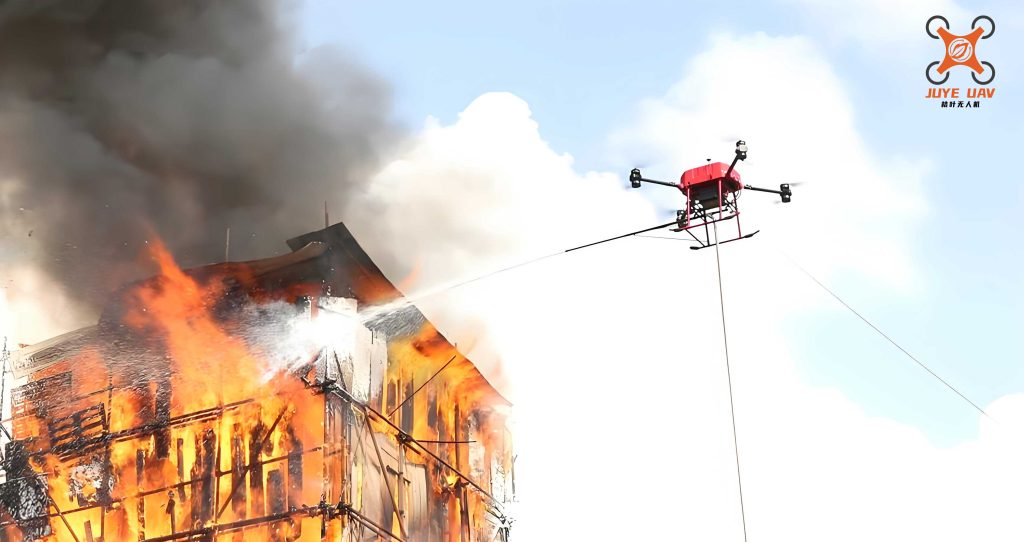
The core advantage of a dedicated **fire drone** platform lies in its synthesis of mobility, sensor versatility, and data immediacy. Unlike manned aircraft or static camera towers, a **fire drone** can be deployed rapidly, navigate complex topography autonomously, and provide real-time, high-fidelity data streams directly to incident commanders. The fundamental technological pillars of an advanced **fire drone** system are summarized in the table below:
| System Component | Description & Capabilities | Contribution to Fire Monitoring |
|---|---|---|
| Airframe & Propulsion | Multi-rotor (for hover, VTOL) and/or Fixed-wing (for long endurance, large area). Often hybrid designs. Electric or fuel-powered for varying flight times. | Enables access to remote, rugged areas; provides stable platform for sensors; allows for both broad surveys and focused inspection. |
| Navigation & Communication | GPS/RTK for precision location; Inertial Measurement Units (IMUs); Automated Flight Planning software; long-range digital data links (e.g., 4G/5G, satellite relay). | Ensures accurate, repeatable patrol paths; enables Beyond Visual Line of Sight (BVLOS) operations; guarantees continuous data telemetry. |
| Sensor Suite (Key Payload) |
|
Provides the “eyes” for detection. TIR is critical for initial ignition and hotspot discovery. Multispectral data aids in risk assessment. LiDAR supports fire behavior modeling and burn severity analysis. |
| Onboard Processing & AI | Embedded computing units running machine learning algorithms for real-time object detection, fire classification, and change analysis. | Reduces data bandwidth needs; enables immediate onboard alerts for fire-like thermal anomalies, accelerating the detection-to-notification loop. |
| Ground Control Station (GCS) | Software interface for mission planning, real-time drone control, live data visualization, and geospatial analysis. | Serves as the command hub where all sensor data converges, is interpreted, and is disseminated to firefighting teams. |
The operational workflow of a **fire drone** system can be modeled as a continuous cycle of data acquisition, processing, and decision support. A critical mathematical concept underpinning early detection is the analysis of thermal anomalies. The radiometric data from a thermal sensor on a **fire drone** can be processed to identify pixels whose temperature significantly exceeds the background environmental temperature. A simplified detection threshold can be expressed as:
$$ T_{anomaly} = T_{pixel} – (T_{background} + \Delta T_{seasonal} + \Delta T_{solar}) > \Theta $$
Where:
- $T_{pixel}$ is the measured radiance temperature of a specific image pixel,
- $T_{background}$ is the mean temperature of the surrounding non-fire pixels,
- $\Delta T_{seasonal}$ and $\Delta T_{solar}$ are corrections for seasonal baselines and direct solar heating on rocks, etc.,
- $\Theta$ is a predefined threshold temperature difference indicative of a potential fire.
When an AI model onboard the **fire drone** flags a cluster of pixels satisfying this condition, it triggers an alert. The geolocation $(X_{fire}, Y_{fire})$ is calculated using the drone’s GPS position $(X_{drone}, Y_{drone}, Z_{drone})$, the sensor’s boresight angles $(pitch, yaw, roll)$, and the pixel’s location in the focal plane array, following a collinearity equation model common in photogrammetry:
$$ \begin{bmatrix} X_{fire} \\ Y_{fire} \\ Z_{fire} \end{bmatrix} = \begin{bmatrix} X_{drone} \\ Y_{drone} \\ Z_{drone} \end{bmatrix} + \lambda \cdot R \cdot \begin{bmatrix} x \\ y \\ -f \end{bmatrix} $$
Here, $R$ is the rotation matrix derived from the drone’s attitude, $(x, y)$ are the image coordinates of the hotspot relative to the principal point, $f$ is the camera’s focal length, and $\lambda$ is a scaling factor. This allows a **fire drone** to pinpoint a fire’s origin with remarkable accuracy, often within a few meters, which is crucial for initial attack planning.
The applications of a **fire drone** extend far beyond simple detection. Its roles can be categorized across the disaster management cycle:
| Phase | Fire Drone Application | Key Metrics & Outputs |
|---|---|---|
| 1. Prevention & Preparedness |
|
FMC maps, Risk Heatmaps, 3D Terrain Models. Patrol coverage (km²/flight), anomaly detection rate. |
| 2. Detection & Early Warning |
|
Time from ignition to detection (Goal: <10 mins). Geolocation accuracy (m). Alert confidence level. |
| 3. Active Firefighting & Response |
|
Live video feed latency (<2 sec). ROS calculation (m/min). Identification of crew safety threats. |
| 4. Damage Assessment & Recovery |
|
Burn scar area (hectares). Burn Severity Index (e.g., dNBR). Hotspot residual count. |
From a strategic operational standpoint, the deployment of a **fire drone** fleet fundamentally alters resource management. Consider the cost-benefit analysis over a five-year period for a regional forest service, comparing a traditional patrol system (ground crews + observation towers) with an integrated **fire drone** system. The model incorporates fixed costs (purchase, training), variable costs (maintenance, labor), and key effectiveness parameters like area coverage per day and detection probability.
Let $C_{total}$ represent the total cost, $A_{coverage}$ the daily area coverage, and $P_{detect}$ the probability of detecting a fire of a given size within a specified time. For the **fire drone** system ($D$), the coverage is a function of flight speed $v$, endurance $t$, and swath width $w$ of its sensors: $A_{coverage}^D \approx v \cdot t \cdot w$. Its detection probability $P_{detect}^D$ integrates the sensor’s field of view, resolution, and AI algorithm accuracy. For the traditional system ($T$), coverage $A_{coverage}^T$ is limited by road/trail networks and tower sightlines, and $P_{detect}^T$ heavily depends on human factors and visibility conditions. A simplified comparative effectiveness score $E$ could be:
$$ E = \frac{A_{coverage} \times P_{detect}}{C_{total}} $$
While real-world calculations are more complex, the **fire drone** system typically demonstrates a superior $E$ score over time due to its scalability, automation, and all-weather/day-night capabilities, justifying the initial capital investment. The enhanced situational awareness provided by the **fire drone** directly translates into more efficient allocation of firefighting assets—water bombers, crews, and machinery—thereby containing fires faster and reducing total suppression costs and ecological damage.
Looking forward, the trajectory of **fire drone** technology is poised for even greater integration and autonomy. Key frontiers include:
- Swarm Intelligence: Deploying coordinated fleets of heterogeneous **fire drone**s, where long-endurance fixed-wing craft scan vast areas and deploy multi-rotor **fire drone**s for close inspection of targets, all communicating via mesh networks.
- Advanced Predictive Analytics: Feeding real-time **fire drone** data (wind at canopy level, spot fire locations) into next-generation fire behavior simulation models (e.g., coupled atmosphere-fire models) for highly accurate, dynamic forecasts of fire progression.
- Automated Suppression Support: Developing **fire drone** platforms capable of targeted delivery of retardant gels or of igniting precision backfires as part of controlled burnout operations, always under human supervision.
- Integrated Satellite-UAV Architectures: Using satellites for continental-scale hot spot detection and then tasking regional **fire drone** networks for immediate, high-resolution confirmation and tracking, creating a seamless multi-layer monitoring system.
In conclusion, the **fire drone** has evolved from a novel reconnaissance tool into the central nervous system of a modern, data-driven forest fire management strategy. Its ability to provide persistent, precise, and immediate intelligence across all phases of the fire cycle—from risk assessment to recovery—empowers agencies to shift from a reactive stance to a proactive and predictive one. The continued miniaturization of sensors, breakthroughs in machine learning for environmental monitoring, and maturation of BVLOS regulations will only deepen this integration. As these autonomous systems become more pervasive and capable, the vision of a resilient forest landscape, monitored and protected by a silent fleet of intelligent **fire drone**s, moves steadily from science fiction to operational reality.