
As a professional deeply involved in emergency response and technological integration, I have witnessed firsthand the transformative impact of unmanned aerial systems, particularly fire drones, on firefighting and rescue operations. With the escalating frequency and complexity of natural disasters and large-scale fire incidents globally, driven by climate change and population density, the challenges faced by rescue personnel have become increasingly severe. Efficiently gathering real-time intelligence from disaster sites and executing comprehensive rescue strategies are critical hurdles that fire departments worldwide must overcome. In this context, the unique attributes of fire drones offer a promising solution, enabling faster, safer, and more effective emergency responses. This article explores the characteristics, advantages, and practical applications of fire drones in消防应急救援 (fire and emergency rescue), emphasizing their growing indispensability through detailed analysis, tables, and mathematical models.
The term “fire drone” refers specifically to unmanned aerial vehicles (UAVs) designed for fire and emergency rescue missions. These systems typically comprise several core components: the airframe, flight control system, payload system, ground control station, and data link. Initially developed for military purposes, fire drones have rapidly migrated to civilian applications, spurred by advancements in technology and the urgent need for improved rescue capabilities. A typical fire drone for emergency work includes modules for propulsion, navigation, high-definition imaging, thermal sensing, and communication, all integrated to support rapid deployment. The evolution of fire drones mirrors the broader trend towards automation and remote sensing in public safety.
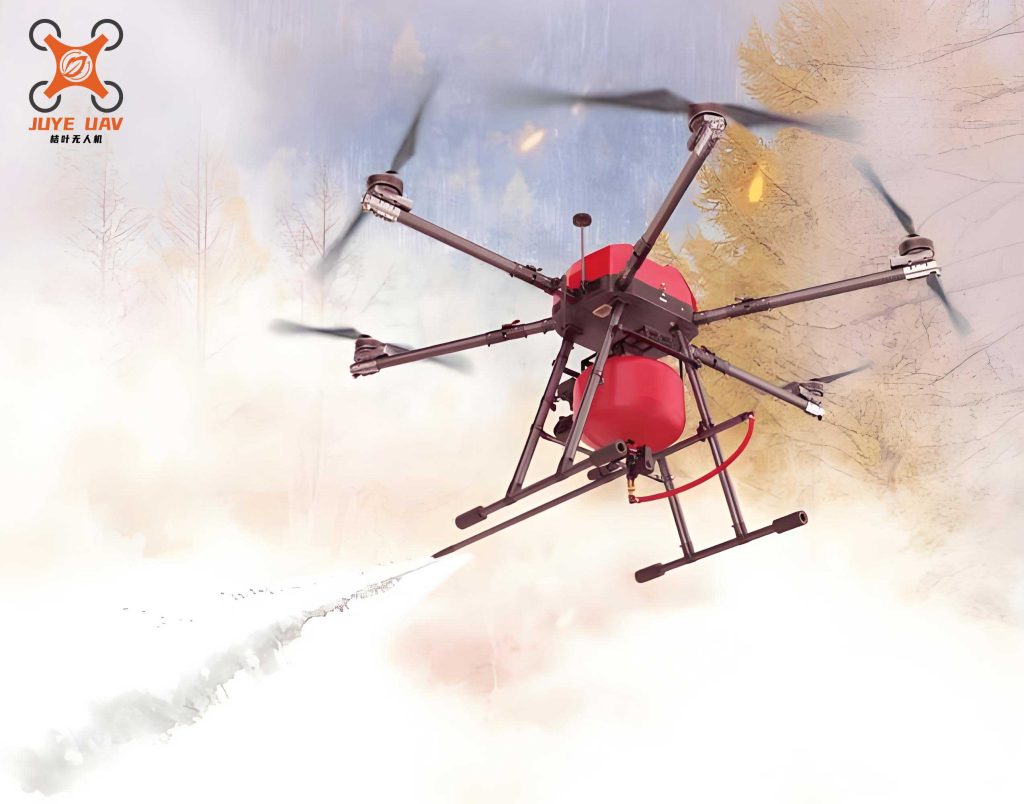
From my experience, the advantages of fire drones are multifaceted, making them superior to traditional methods in many scenarios. To systematically outline these benefits, consider the following table summarizing key attributes:
| Advantage Category | Description | Impact on Rescue Efficiency |
|---|---|---|
| High Mobility and Flexibility | Small fire drones are lightweight, cost-effective, and easily maneuverable in confined or hazardous areas. | Enables rapid aerial assessment where ground access is limited, reducing initial response time by up to 70% in some cases. |
| Ease of Operation | Automated systems allow remote control and pre-programmed flight paths, minimizing the need for extensive pilot training. | Lowers the barrier to entry for rescue teams, facilitating quick deployment even by non-specialists in urgent situations. |
| Multifunctional Capabilities | Fire drones can be equipped with various payloads: HD cameras, thermal imagers, loudspeakers, gas detectors, and life-sign sensors. | Provides comprehensive situational awareness and direct intervention tools, enhancing both reconnaissance and active rescue. |
| Low Operational Restrictions | Beyond visual line of sight (BVLOS) operations are possible via data links, expanding coverage area without physical presence. | Allows monitoring of large-scale disasters like forest fires or floods from a safe distance, improving personnel safety. |
These advantages are not merely theoretical; they translate into tangible improvements in rescue outcomes. For instance, the flexibility of a fire drone can be quantified using a simple model for area coverage. The effective area \(A\) surveyed by a fire drone in time \(t\) depends on its speed \(v\) and sensor footprint width \(w\):
$$A = v \times w \times t \times \eta$$
where \(\eta\) represents the efficiency factor accounting for overlapping paths and environmental conditions. Compared to ground teams, fire drones achieve significantly higher \(A\) values due to greater \(v\) and unobstructed views, accelerating intelligence gathering.
The applications of fire drones in emergency rescue are diverse and continually expanding. In decision support, fire drones serve as aerial eyes, capturing real-time video and imagery that is transmitted to command centers via 4G/5G networks. This allows commanders to assess disaster dynamics—such as fire spread patterns or flood extents—and formulate targeted strategies. For example, during an earthquake, a fire drone can quickly map collapsed structures and identify trapped individuals through thermal signatures, guiding ground teams efficiently. The data fusion from multiple fire drones can be modeled using collaborative filtering algorithms to enhance accuracy:
$$S_{combined} = \sum_{i=1}^{n} \alpha_i \cdot S_i$$
where \(S_i\) is the sensor data from the \(i\)-th fire drone, \(\alpha_i\) is a weight based on reliability, and \(S_{combined}\) is the integrated situational map. This approach minimizes errors and optimizes resource allocation.
Another critical application is situational control and prevention. In forested areas prone to wildfires, fire drones conduct regular patrols to monitor human activities and environmental conditions. By analyzing imagery with machine learning algorithms, they can detect early signs of fire ignition or illegal encroachments, enabling preemptive actions. The following table illustrates common fire drone payloads for different scenarios:
| Rescue Scenario | Recommended Fire Drone Payload | Primary Function |
|---|---|---|
| Forest Fire | Thermal camera, gas sensor, GPS tracker | Detect hotspots, monitor air quality, track fire perimeter |
| Urban Fire | HD camera, loudspeaker, illumination light | Assess structural integrity, broadcast warnings, provide light |
| Flood Disaster | Life-detection radar, floatation device dropper | Locate survivors, deliver emergency supplies |
| Earthquake | Multi-spectral imager, seismic activity sensor | Identify rubble voids, assess aftershock risks |
In direct emergency rescue, fire drones excel by reaching inaccessible zones faster than human teams. During flash floods or landslides, a fire drone can deploy life-saving equipment—such as life jackets or medical kits—to stranded individuals while simultaneously relaying their precise coordinates. The time savings are crucial; if \(t_{response}\) is the total response time, using a fire drone can reduce the aerial assessment component \(t_{assessment}\) dramatically:
$$t_{response} = t_{dispatch} + t_{travel} + t_{assessment} + t_{action}$$
With a fire drone, \(t_{travel}\) and \(t_{assessment}\) are often merged and minimized due to rapid aerial deployment, directly increasing survival probabilities. Moreover, the integration of autonomous navigation allows fire drones to operate in GPS-denied environments using visual odometry, enhancing reliability in complex terrains.
However, effective utilization of fire drones requires careful attention to operational protocols. Flight safety is paramount; launch and recovery must occur in cleared areas to avoid injuring bystanders. Weather conditions like strong winds or heavy fog can impair fire drone performance, necessitating real-time adjustments. The maximum allowable wind speed \(V_{max}\) for stable flight can be expressed as:
$$V_{max} = k \cdot \sqrt{\frac{T}{A_{ref}}}$$
where \(T\) is thrust, \(A_{ref}\) is reference area, and \(k\) is a stability constant derived from the fire drone’s design. Operators must monitor such parameters continuously.
Compatibility and integration are also vital considerations. Fire drones must balance payload capacity with flight endurance. The total weight \(W_{total}\) includes the airframe weight \(W_{frame}\) and payload weight \(W_{payload}\), affecting flight time \(t_{flight}\):
$$t_{flight} = \frac{E_{battery}}{P_{avg}} \quad \text{with} \quad P_{avg} \propto W_{total}$$
where \(E_{battery}\) is battery energy and \(P_{avg}\) is average power consumption. Overloading a fire drone with excessive sensors can reduce \(t_{flight}\), compromising mission success. Therefore, modular designs that allow swift payload swaps are preferred, ensuring the fire drone can adapt to varying rescue needs—from gas detection to thermal imaging—without sacrificing performance.
Training for operators is another cornerstone of successful fire drone deployment. Personnel should hold certified qualifications, such as remote pilot licenses, and undergo regular simulations covering emergency scenarios. A structured training program might include modules on flight dynamics, data interpretation, and maintenance. The competency level \(C\) of an operator can be modeled as a function of training hours \(h\) and experience factors \(f\):
$$C = \beta_0 + \beta_1 \ln(h) + \beta_2 f$$
where \(\beta\) coefficients are determined through performance metrics. Investing in such training ensures that fire drones are piloted proficiently, maximizing their potential during crises.
Looking ahead, the future of fire drones in emergency rescue is bright, with advancements in AI and swarm technology poised to revolutionize the field. Imagine a fleet of interconnected fire drones autonomously coordinating to cover vast disaster zones, sharing data in real-time to create dynamic 3D maps. Such swarms could optimize search patterns using algorithms like particle swarm optimization (PSO), where each fire drone adjusts its position based on collective intelligence:
$$\vec{x}_i(t+1) = \vec{x}_i(t) + \vec{v}_i(t+1)$$
$$\vec{v}_i(t+1) = w \vec{v}_i(t) + c_1 r_1 (\vec{p}_{best} – \vec{x}_i(t)) + c_2 r_2 (\vec{g}_{best} – \vec{x}_i(t))$$
Here, \(\vec{x}_i\) and \(\vec{v}_i\) represent the position and velocity of the \(i\)-th fire drone, with \(\vec{p}_{best}\) and \(\vec{g}_{best}\) being personal and global best solutions for target detection. This approach could drastically reduce search times in large-area disasters.
In conclusion, fire drones have emerged as indispensable tools in modern emergency rescue, offering unparalleled advantages in speed, safety, and versatility. From aiding decision-making through real-time imagery to directly saving lives via equipment delivery, these systems augment human capabilities in high-risk environments. As technology evolves, fire drones will likely become even more integrated into standard rescue protocols, potentially incorporating advanced features like self-charging stations or AI-driven predictive analytics. For fire departments worldwide, embracing fire drone technology is not merely an upgrade but a necessity to enhance public safety in an era of increasing uncertainties. The continuous refinement of fire drone designs, coupled with rigorous training and operational guidelines, will ensure that these aerial assets fulfill their potential, safeguarding both responders and communities during emergencies.
To further illustrate the operational parameters, consider the following table comparing different classes of fire drones used in rescue work:
| Fire Drone Class | Typical Wingspan/Size | Endurance (minutes) | Max Payload Capacity (kg) | Primary Use Case |
|---|---|---|---|---|
| Nano/Micro | < 50 cm | 15-30 | 0.1-0.5 | Indoor reconnaissance, narrow space inspection |
| Small | 50 cm – 2 m | 30-60 | 0.5-2 | Rapid aerial assessment, small item delivery |
| Medium | 2 m – 5 m | 60-120 | 2-10 | Extended patrols, heavier sensor suites |
| Large | > 5 m | 120+ | 10-50 | Long-range missions, bulk supply transport |
Additionally, the economic efficiency of deploying fire drones can be analyzed through cost-benefit models. If \(C_{drone}\) is the total cost of a fire drone system (including acquisition, maintenance, and training), and \(B_{rescue}\) represents the benefits from reduced damage and saved lives per mission, the return on investment (ROI) over \(n\) missions is:
$$ROI = \frac{\sum_{i=1}^{n} B_{rescue,i} – C_{drone}}{C_{drone}} \times 100\%$$
Studies suggest that ROI becomes positive quickly due to the high value of early intervention enabled by fire drones.
In summary, the integration of fire drones into消防应急救援 (fire and emergency rescue) frameworks is a testament to technological innovation serving humanity. As I reflect on my experiences, the agility of a fire drone swooping over a disaster zone to relay critical information remains a powerful image of progress. By leveraging these systems, we not only enhance operational efficiency but also uphold the fundamental goal of preserving life in the face of adversity. The journey of fire drones from niche gadgets to essential rescue tools underscores their transformative potential, and ongoing research will undoubtedly unlock new applications, solidifying their role as pillars of modern emergency response.