
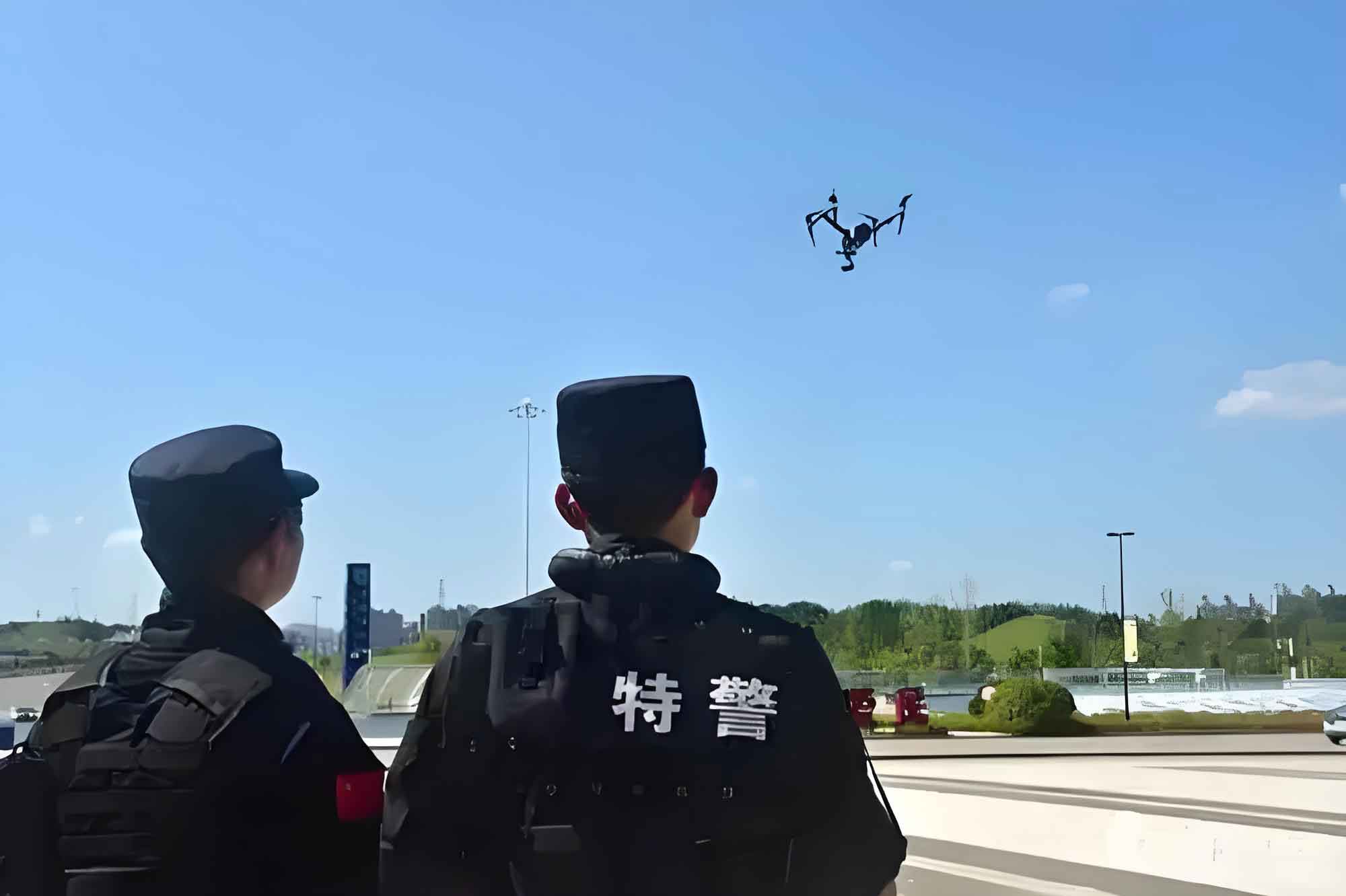
The rapid advancement of technology has positioned unmanned aerial vehicles (UAVs) as a cornerstone of modern policing. In recent years, police UAV systems, leveraging their low cost, high maneuverability, and operational stability, have become indispensable tools for law enforcement agencies worldwide. They are extensively deployed for aerial surveillance, routine patrols, search and tracking operations, significantly enhancing operational capabilities. As a high-tech asset, the police UAV serves as a new driver for modernizing police work, making the cultivation of specialized talent an urgent and critical mission for educational institutions serving the law enforcement community.
The ultimate goal of police academies is to cultivate high-caliber, application-oriented, and inter-disciplinary professionals who can adeptly utilize police UAV technology to serve police command, law enforcement operations, and training. These professionals must align with the modernization and professionalization of police forces, embody core values, and possess a robust legal consciousness, innovative spirit, and the ability to apply rule-of-law principles in solving practical policing problems. This article, employing methodologies such as literature review, interviews, and questionnaires, investigates the competency requirements for police UAV personnel within law enforcement agencies, aiming to define the objectives for talent development in this field.
I. Current State of Police UAV Deployment and Personnel
The integration of police UAV systems, characterized by high levels of intelligence and informatization, has begun to yield positive outcomes in various police operations, garnering significant attention from agencies nationwide.
| Category | Key Practices & Achievements |
|---|---|
| Organizational Integration | Establishment of dedicated UAV units within special police departments; equipping local police stations with UAV assets; integration of UAV management systems into unified command platforms; incorporation of UAV assets into rapid response units. |
| Operational Efficacy |
|
Despite these advancements, the development and application of police UAV systems face several persistent challenges that directly impact talent requirements.
| Challenge Area | Specific Issues |
|---|---|
| System Integration | Low integration with core policing applications; UAVs often used merely for basic environmental data capture without seamless linkage to backend video analysis and intelligence-led decision-making platforms; lack of universal technical and operational standards hinders optimal performance. |
| Personnel Proficiency | Insufficient training leads to unskilled operation of UAVs and payloads; training systems lag behind rapid technological evolution; a critical shortage of personnel capable of commanding multi-UAV协同 operations. |
| Data Security & Privacy | Vulnerabilities in data transmission risking interception or tampering; inadequate application of encryption technologies on some platforms; heightened risks of privacy infringement due to powerful sensors, compounded by insufficient awareness among some operators. |
Personnel Development Status Quo
The construction of a police UAV talent pipeline is in its nascent stages and faces structural issues:
- Late Start and Lag: Development of specialized UAV application and counter-UAV teams began late, trailing behind the rapid evolution of the low-altitude security landscape and industry advancements.
- Unbalanced Team Structure: An overabundance of basic UAV pilots versus a severe shortage of tactical commanders, operators skilled in multi-role payloads, maintenance technicians, and R&D personnel. Counter-UAV expertise is particularly underdeveloped.
- Inadequate Training Pathways: Lack of professional, sustained capacity-building channels. Short-term training fails to cover evolving scenarios, and a lack of foundational knowledge limits long-term adaptability. Standardized drill and exercise mechanisms are absent.
- Insufficient Academic Support: While many police academies have initiated related courses or modules, systematic discipline construction, professional programs, and integrated talent cultivation systems for police UAV application and management remain underdeveloped.
II. Problems in Police UAV Talent Team Construction
The gap between technological adoption and human resource development is pronounced, manifesting in two core areas:
A. Severe Shortage of Practical Talent
The demand for competent personnel far exceeds supply, creating operational inefficiencies. This can be modeled as a simple deficit equation:
$$ T_{\text{deficit}} = D_{\text{operational}} – (S_{\text{existing}} + E_{\text{trainee}}) $$
where $T_{\text{deficit}}$ is the talent shortage, $D_{\text{operational}}$ is the demand generated by deployed UAV assets, $S_{\text{existing}}$ is the current skilled personnel pool, and $E_{\text{trainee}}$ represents personnel in training pipelines.
- “UAVs Without Operators”: Many units possess advanced police UAV equipment but lack personnel trained to operate them effectively, leading to unused assets.
- Superficial Application: Widespread lack of in-depth research into tactics and application methods for specific policing scenarios results in tokenistic use of UAVs without maximizing their potential utility.
- Unreasonable Personnel Hierarchy: Heavy reliance on auxiliary police officers with civilian UAV experience for piloting roles. While skilled in basic operation, this group often lacks the deep policing education and innovative capacity needed to drive advanced police UAV application development.
- Lack of Command Talent: A critical scarcity of personnel who possess both professional policing command skills and a sound understanding of UAV technology to plan, coordinate, and lead complex UAV-involved operations.
B. Lagging Talent Cultivation Mechanisms
- Unsystematic Academic Education: Existing degree programs (e.g., “Unmanned Aircraft Systems Engineering”) are often engineering-focused, producing “technical” rather than “application-oriented” talent. Emerging policing application specializations are still in exploratory phases, struggling to keep pace with the expanding tactical functionalities of modern police UAV systems.
- Disconnect Between Training and Practical Needs: Standard in-service training frequently focuses solely on basic flight control certification. It fails to address the higher-order skill of “application”—training on integrated payload operation, tactical employment in real-world scenarios, and solving practical policing problems using the police UAV platform, leading to the phenomenon of “licensed but incapable” operators.
III. Analysis of Police UAV Talent Requirements
A dual-perspective analysis—from the learners (students) and the employers (police agencies)—reveals clear vectors for talent development.
A. Analysis of Student Learning Demands
Feedback from students specializing in UAV policing applications highlights a strong preference for practice-oriented education:
- Program Identity: Emphasis should be on policing application characteristics rather than purely engineering/technical aspects.
- Curriculum Structure: Increased proportion of hands-on, practical training courses relative to pure technical theory.
- Content Design: Theory should focus on the role, trends, and status of police UAV as equipment; training should be mission-scenario-driven rather than mechanical flight skill repetition.
- Course Interest: Greater interest and perceived value in applied skill courses over purely technical elective courses.
B. Analysis of Practical Unit Requirements for Competency and Literacy
Police实战 units require personnel who understand the police UAV ecosystem and can fulfill specific roles. The required competency $C_{\text{total}}$ for a graduate can be expressed as a function of foundational knowledge $K_f$, technical skill $S_t$, and applied policing ability $A_p$:
$$ C_{\text{total}} = \alpha K_f + \beta S_t + \gamma A_p $$
where $\alpha$, $\beta$, and $\gamma$ are weighting coefficients, and for police UAV roles, $\gamma > \beta \ge \alpha$, emphasizing applied ability.
| Police Department/Unit | Primary Post-Graduation Roles | Core UAV-Related Competency Requirements |
|---|---|---|
| Police Logistics / UAV Office | Equipment management, regulation &需求 research, training organization. | Strategic understanding of police UAV assets, policy analysis, instructional skills. |
| Criminal Investigation | Search & pursuit, investigative evidence collection. | Stealthy surveillance, forensic video capture, area search patterns using police UAV. |
| Special Police (SWAT) & Counter-Terrorism | Tactical辅助 reconnaissance, arrest support, strike operations, counter-UAV. | High-risk tactical deployment, coordinated air-ground operations, threat detection & mitigation of hostile drones. |
| Traffic Police | Aerial traffic monitoring, accident scene investigation, enforcement. | Traffic flow analysis, accident reconstruction via aerial imagery, violation documentation. |
| Anti-Narcotics | Illicit crop surveillance and identification. | Multispectral/thermal imaging analysis, large-area patrol patterns. |
| Border/Coastal Police | Tracking and surveillance of smuggling vehicles/vessels. | Long-endurance patrols, over-water operation skills, cross-border coordination awareness. |
A critical, cross-cutting requirement is familiarity with the operational trends of the police UAV industry. Talent must be cultivated to bridge the “police-enterprise integration” model, translating实战 needs into technical requirements and focusing research on task payloads rather than just the aerial platform.
IV. Research on Training Objectives for Police UAV Talent Competency and Literacy
Synthesizing the above analyses, the cultivation of police UAV talent must be firmly rooted in “policing application.” The goal is to produce复合型 professionals who, based on essential UAV常识 and basic flight skills, leverage applied technical theory and payload operation to serve公安 operations,辅助 tactical actions, and engage in related teaching and training. The objectives are framed across three dimensions: Knowledge, Ability, and Quality.
A. Knowledge Objectives
Personnel must establish a comprehensive knowledge architecture $K_{\text{total}}$, comprising ideological-political ($K_i$), legal-policing ($K_l$), general education ($K_g$), specialized policing ($K_s$), and UAV-specific ($K_u$) knowledge components:
$$ K_{\text{total}} = K_i \cup K_l \cup K_g \cup K_s \cup K_u $$
- Ideological & Political Foundation ($K_i$): Mastery of core political theories and national strategies; understanding of policies related to public security work.
- Legal & Policing Foundation ($K_l$): Systematic knowledge of law and policing science; understanding of national requirements for police force construction.
- General Knowledge ($K_g$): Broad knowledge in humanities, social and natural sciences, foreign languages, information technology, and application writing.
- Specialized Policing Knowledge ($K_s$): History of policing, professional前沿 trends, police command and tactics, emergency scene management, and principles of反恐处突.
- UAV-Specific Knowledge ($K_u$): UAV fundamentals, relevant laws/regulations/standards, equipment technology,侦察 and command application theories, and counter-UAV principles and technologies for低空 security threats.
B. Ability Objectives
The ability set $A_{\text{total}}$ is the practical manifestation of knowledge, crucial for effective police UAV deployment. It can be modeled as:
$$ A_{\text{total}} = f(A_b, A_p, A_u) $$
where $A_b$ represents baseline policing abilities, $A_p$ represents professional policing abilities, and $A_u$ represents UAV-specific abilities.
- Baseline Policing Abilities ($A_b$): Includes personal protection, emergency first aid, legal use of weapons, social observation, critical thinking, research, communication, IT application, foreign language use, and basic management skills.
- Professional Policing Abilities ($A_p$): The core ability to apply专业 theory to solve real problems. This encompasses individual tactical skills for violent crime scenes, team action organization for突发事件, comprehensive command capability using modern tools, and tactical training instruction skills.
- UAV-Specific Abilities ($A_u$): The pivotal能力 for integrating technology into policing. This includes basic police UAV flight control, operation of various payload devices, and, most importantly, the ability to leverage UAV technology to solve diverse policing challenges. It also includes the capability to conduct counter-UAV detection and neutralization using appropriate technical means based on the operational environment.
The enhancement in police operational efficiency $\Delta E$ provided by a skilled police UAV operator can be conceptualized as a function of mission success rate $R_s$, time saved $T_s$, and risk reduction $R_r$:
$$ \Delta E = k_1 \cdot R_s + k_2 \cdot \frac{1}{T_s} + k_3 \cdot R_r $$
where $k_1$, $k_2$, $k_3$ are positive coefficients specific to the mission type.
C. Quality Objectives
Beyond knowledge and ability, the requisite professional quality $Q_{\text{total}}$ forms the ethical and psychological bedrock for police UAV personnel. This is a non-linear, essential precondition for effective performance.
- Political Quality: Unwavering political stance, loyalty, and adherence to core socialist values and people’s警察 core values.
- Professional Ethics: Strong sense of discipline, teamwork, sacrifice, public service orientation, and a strict保密意识.
- Holistic Literacy: Scientific and humanistic素养, innovative spirit, international perspective, physical fitness, and mental health resilient enough for high-pressure, high-risk执法 environments typical of反恐处突 work.
- Technical Application Mindset: The intrinsic motivation and素养 to proactively explore how police UAV and other high-tech tools can be harnessed to提升警务行动 efficiency and实战 outcomes, driving continuous improvement in operational capabilities.
The overall risk $Risk_{\text{mission}}$ in a UAV-involved operation can be considered inversely related to the operator’s quality level $Q$, particularly regarding data security and procedural compliance:
$$ Risk_{\text{mission}} \propto \frac{1}{Q_{\text{operator}}} $$
This highlights the critical importance of cultivating high-quality personnel to mitigate operational and ethical risks.
In conclusion, the cultivation of talent for the police UAV domain is a complex, multi-dimensional endeavor requiring a balanced, integrated approach. It must navigate the tension between technical understanding and practical application, ensuring that personnel are not merely technicians but are, first and foremost, highly capable policing professionals who can intelligently wield advanced technological tools. The frameworks for knowledge, ability, and quality objectives provide a structured pathway for公安院校 to develop the next generation of professionals who will define the effective and responsible use of police UAV technology in safeguarding public security.