
The traditional paradigm of perimeter security for prisons, jails, and detention centers has long been defined by formidable walls, layered fencing, advanced surveillance cameras, and rigorous personnel screening protocols. This paradigm, however, has been fundamentally two-dimensional, focused on terrestrial and subsurface ingress points. The rapid proliferation and increasing sophistication of civilian unmanned aerial vehicles (UAVs), or drones, have decisively shattered this flat security model. The airspace above correctional institutions has emerged as a critical and vulnerable third dimension, a new frontier for illicit activity that demands an immediate and robust response. The development and deployment of comprehensive low-altitude anti-drone security systems are no longer a speculative future consideration but an urgent operational necessity for maintaining the integrity, safety, and order of these facilities.
The Evolving Threat Landscape: Drones as a Vector for Contraband and Chaos
The threat posed by drones is not theoretical; it is a documented and growing global phenomenon. These compact, agile, and increasingly accessible devices provide a silent, remote, and difficult-to-intercept method for breaching secure perimeters. The core threats can be systematically categorized, as detailed below.
| Threat Category | Primary Objectives | Typical Payload/Activity | Operational Risk Level |
|---|---|---|---|
| Contraband Delivery | Supply inmates with prohibited items, sustaining internal black markets and undermining institutional control. | Drugs, narcotics, mobile phones & chargers, SIM cards, tobacco, weapons (small knives, tools), cash. | Very High (Most frequent incident type, direct catalyst for internal disorder) |
| Information Reconnaissance & Theft | Gather intelligence on facility layout, security patterns, and operational routines for planning or public dissemination. | High-resolution photography, video recording of yards, cell blocks, guard patrol routes, and perimeter defenses. | High (Enables more sophisticated attacks, breaches operational security) |
| Escape Assistance & Coordination | Facilitate or directly enable inmate escape attempts through the provision of tools or real-time coordination. | Delivery of cutting tools, maps, communication devices, keys (3D printed), or even firearms and cash for post-escape. | Critical (Direct threat to public safety and fundamental institutional failure) |
| Terrorist or Aggressive Action | Incite panic, cause injury, or damage infrastructure through direct kinetic or chemical attack. | Explosive devices, incendiary materials, chemical irritants (e.g., pepper spray), or bio-hazards deployed over populations. | Severe (Low probability but catastrophic potential impact) |
| Non-Malicious Incursions | Typically involve hobbyists, journalists, or curious individuals operating without criminal intent but in violation of airspace rules. | Accidental overflight, aerial photography for personal or media use. | Moderate (Can trigger security lockdowns, cause accidents (e.g., crash/fire), and waste resources) |
The quantitative risk of a drone incursion can be conceptualized as a function of several variables. A simplified model for the likelihood of a successful breach attempt might consider:
$$ P_{breach} = f(T, V, C, D) $$
Where:
$P_{breach}$ = Probability of a successful security breach.
$T$ = Threat actor capability and intent (from curious hobbyist to organized crime).
$V$ = Vulnerability of the facility’s airspace (lack of detection, weak response protocols).
$C$ = Capability/cargo of the drone (payload capacity, stealth features, autonomy).
$D$ = Environmental and operational factors (darkness, weather, guard shift changes).
Without a dedicated anti-drone capability, the vulnerability factor $V$ remains unacceptably high, making $P_{breach}$ significant even for moderate threat levels $T$.
The Converging Demand for Aerial Security Integration
The urgency to address this vulnerability stems from a powerful convergence of strategic, operational, and technological drivers.
1. Strategic Mandate for Modernized Policing and Corrections: National and regional strategies for “Smart Policing” and “Intelligent Corrections” explicitly call for the integration of advanced technologies. These policies recognize that security must be multi-dimensional. Investment in anti-drone systems represents a direct alignment with these modernization agendas, moving from reactive, ground-centric models to proactive, integrated air-ground domain awareness.
2. Unavoidable Operational Reality: The market saturation of drones is a key driver. With millions of units sold annually, the barrier to entry for malicious use is lower than ever. Correctional administrators worldwide are witnessing this threat materialize, driving a pragmatic and immediate demand for countermeasures. The operational requirement is clear: the ability to detect, identify, track, and mitigate unauthorized drones is now as fundamental as controlling the front gate.
3. Innovation Feedback Loop: The security challenge presented by drones has catalyzed a specialized industry in counter-UAV (C-UAV) technology. Manufacturers are now developing solutions specifically tailored for the fixed-site, high-security needs of correctional facilities. This includes scalable systems that can protect a single building (“point defense”), an entire campus (“area defense”), or even provide mobile protection for inmate transport (“convoy defense”). This specialization makes effective solutions more accessible and reliable. Simultaneously, forward-thinking facilities are pioneering the use of “defensive drones” or drone catchers as part of their active response, creating a dynamic anti-drone ecosystem.
Constructing a Layered Anti-Drone Defense: A Multi-Path Roadmap
Building an effective anti-drone security posture requires a holistic approach that extends beyond simply purchasing hardware. It involves regulatory, tactical, technical, and human resource components working in concert.
1. Expanding the Security Mindset: The Regulatory and Collaborative Framework
A robust defense begins with a supportive and enforced legal and operational framework.
“Top Cover” – Enforced No-Fly Zones: While most jurisdictions designate prisons as restricted airspace, this legal prohibition must be technologically enforced. Collaboration with aviation authorities (like the FAA in the U.S. or CAAC in China) is crucial to implement and “harden” geofencing. This involves creating precise, digitally defined volumetric exclusion zones (not just 2D circles) around facilities. Penalties for violations must be meaningful and consistently applied to create a deterrent.
“External Support” – Multi-Agency Coordination: No prison is an island. Effective anti-drone security requires seamless coordination.
| Agency/Entity | Primary Role in Anti-Drone Security |
|---|---|
| Correctional Facility Command | Internal threat assessment, activation of response protocols, containment and search operations inside the perimeter, evidence collection from downed drones. |
| Perimeter Security Forces (e.g., Armed Guards) | Primary operators of fixed and mobile detection/jamming systems, first line of alert and low-level interdiction. |
| Local/State Law Enforcement | Investigation and apprehension of ground-based pilots outside the facility; forensic analysis of seized control equipment; community outreach on no-fly rules. |
| Aviation Regulatory Authority | Establishing and digitally enforcing mandatory geofences; regulating drone sales and operator licensing. |
| Drone Manufacturers | Implementing robust, tamper-resistant geofencing firmware; supporting remote identification (Remote ID) protocols. |
“Clear Targeting” – Integrated Response Protocols: Internal Standard Operating Procedures (SOPs) must define every step: from initial detection alert in the control room, to scrambling response teams, activating signal jammers, locking down affected yards, conducting contraband sweeps, and preserving evidence for law enforcement partners. This entire workflow must be drilled regularly.
2. Deploying the Technical Shield: Detection, Identification, and Mitigation
Selecting the right mix of technologies is critical. The optimal system uses a layered, sensor-fused approach to cover the weaknesses of any single technology.
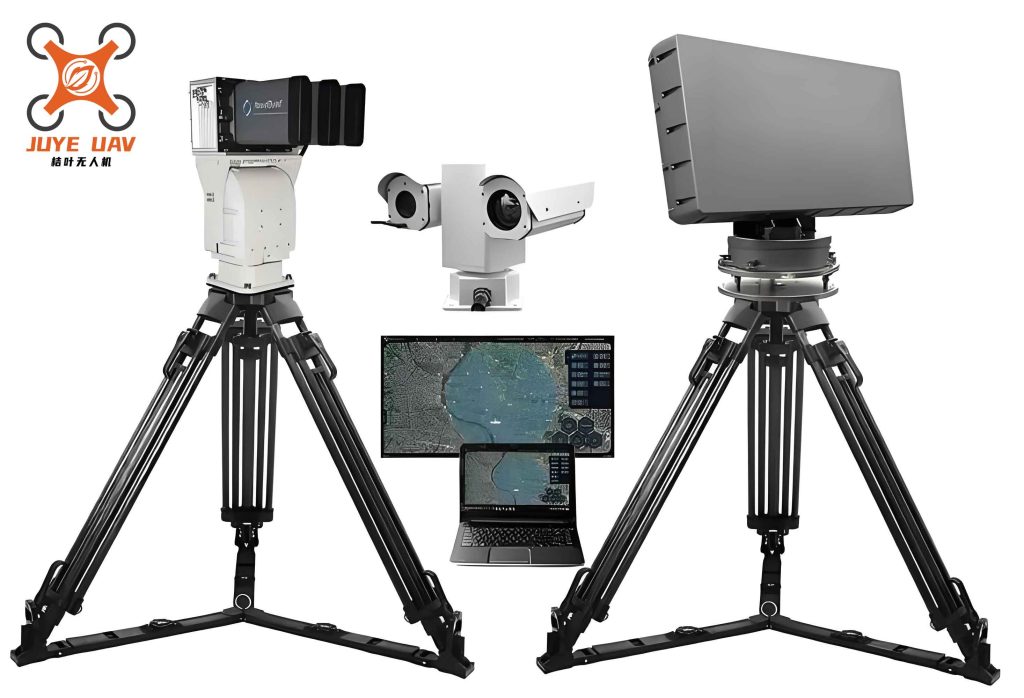
Detection & Identification Layer: The goal is early warning and classification. No single sensor is perfect, so a combination is best.
- Radio Frequency (RF) Scanners: Ideal for prisons. They passively listen for communication links between a drone and its controller, providing early detection, identifying drone type, and locating the pilot. They are cost-effective, have no emissions, and work in most weather. Multiple units can be networked on perimeter towers for full coverage. The effective detection range $R_{det}$ for an RF system can be approximated in clear conditions, but is heavily influenced by signal power $P_t$ and environmental clutter $C_e$: $$ R_{det} \propto \frac{\sqrt{P_t}}{C_e} $$
- Primary Surveillance Radar (PSR): Effective for detecting small objects at longer ranges, regardless of whether their RF is active. However, they can struggle with slow-moving drones close to the ground (clutter) and are more expensive.
- Electro-Optical/Infrared (EO/IR) Cameras: Provide visual confirmation and tracking. Pan-Tilt-Zoom (PTZ) cameras with AI-based video analytics can automatically detect and classify UAVs based on their visual signature, but performance degrades in poor weather or darkness (where IR helps).
- Acoustic Sensors: Can detect the unique acoustic signature of drone motors, useful as a tertiary, short-range backup system, but easily masked by ambient noise.
Mitigation & Neutralization Layer: Once a threat is confirmed, safe and proportional countermeasures are needed. For correctional facilities, kinetic destruction (lasers, missiles) is inappropriate due to collateral risk. The focus is on non-kinetic, reversible effects.
| Mitigation Type | Mechanism of Action | Typical Effect on Drone | Pros for Corrections | Cons for Corrections |
|---|---|---|---|---|
| RF Jamming (Disruption) | Overwhelms the command & control (C2) and GPS/GNSS signals with high-power noise. | Forced landing, return-to-home, or uncontrolled crash. Loss of operator control. | Immediate effect, long range, proven technology, widely available in fixed and handheld forms. | Can cause collateral jamming to nearby legitimate communications; less effective against pre-programmed autonomous drones. |
| GNSS Spoofing (Deception) | Broadcasts fake GPS signals to trick the drone’s navigation system. | Drone is hijacked and guided to a safe landing zone chosen by the defender. | More precise and controlled than jamming; allows for safe recovery of evidence; no broad-spectrum interference. | Technologically more complex; effective range can be shorter; requires precise knowledge of target. |
| Drone Capture Nets | Physical interception using nets launched from another drone or ground launcher. | Drone is entangled and brought down in a controlled manner. | Physical capture ensures evidence preservation; no electronic emissions. | Very short range; requires highly skilled operator; weather-dependent; risk of mid-air collision. |
The choice of mitigation often follows a layered “escalation of force” model, starting with warning via directed radio (if a channel can be accessed), then targeted GNSS spoofing if possible, followed by directional RF jamming as the primary tool, with net-based capture as a last-resort, close-range option for high-value targets.
3. Building the Human Foundation: Training and System Integration
Technology is useless without trained personnel and seamless integration.
Specialized Personnel Training: Operating an anti-drone system is a technical skill. Dedicated personnel must be trained not only on the “buttonology” of the equipment but also on:
– Drone model recognition and threat assessment.
– Legal rules of engagement for airspace denial.
– Sensor fusion interpretation (correlating radar, RF, and video tracks).
– Maintenance and troubleshooting of complex electronic systems.
Regular “live-fly” training exercises with friendly drone targets are essential to maintain proficiency.
Deep System Integration: The anti-drone system cannot be a standalone “stovepipe.” It must be integrated into the facility’s existing security ecosystem.
– Command & Control (C2): Alerts, drone tracks, and camera feeds must populate the main security operations center (SOC) situational awareness display alongside ground camera feeds and alarm points.
– Data Fusion: The system should automatically cue PTZ cameras to slew to a detected drone’s location, providing visual verification.
– Record Keeping: All detection events, responses, and outcomes must be automatically logged for after-action review, forensics, and reporting to law enforcement partners.
In conclusion, the vulnerability of correctional facilities to unmanned aerial systems is a clear and present danger. The demand for anti-drone security is driven by irreversible trends in technology proliferation and criminal innovation. Addressing this threat requires a fundamental shift from a two-dimensional to a three-dimensional security mindset. The path forward is a holistic one, combining enforceable regulations, inter-agency collaboration, a carefully selected mix of detection and mitigation technologies, and, most importantly, the development of specialized human expertise to operate within an integrated security platform. By proactively building this layered anti-drone defense, correctional institutions can secure their airspace, protect their personnel and inmates, and uphold their mandate for safe, secure, and orderly custody.