
As I reflect on the rapid evolution of modern warfare, I am consistently drawn to the transformative role of military drones. These unmanned systems have shifted from niche reconnaissance tools to cornerstone assets in defense strategies worldwide. My perspective, shaped by years of observation and analysis, is that we are at the precipice of a new era where military drones will redefine aerial combat, surveillance, and electronic warfare. The convergence of economic pressures, technological breakthroughs, and evolving battlefield requirements is fueling an unprecedented surge in drone development. In this comprehensive exploration, I will delve into the key trends shaping military drones and the critical technologies that will unlock their full potential, using tables and mathematical models to crystallize these complex concepts.
The fundamental allure of military drones lies in their inherent advantages over manned platforms. Structurally, they are simpler, often 40% smaller than equivalent manned aircraft by eliminating the cockpit and life-support systems. This reduction directly translates to enhanced performance parameters. From a safety standpoint, military drones remove pilots from harm’s way during high-risk missions, preserving invaluable human capital. Operationally, they liberate design from human physiological limits, allowing for extreme maneuvers, extended endurance, and stealth profiles impossible for human crews. For instance, a military drone can sustain over 15g accelerations and perform sustained inverted flight, radically improving survivability and tactical surprise. The core technical demands for modern military drones are multifaceted: advanced information technology for data fusion and autonomous targeting; modular, miniaturized avionics; low-observable antennas; compact precision munitions; efficient, storable propulsion systems; and sophisticated mission management software. The following sections will dissect the most promising drone categories through my analytical lens.
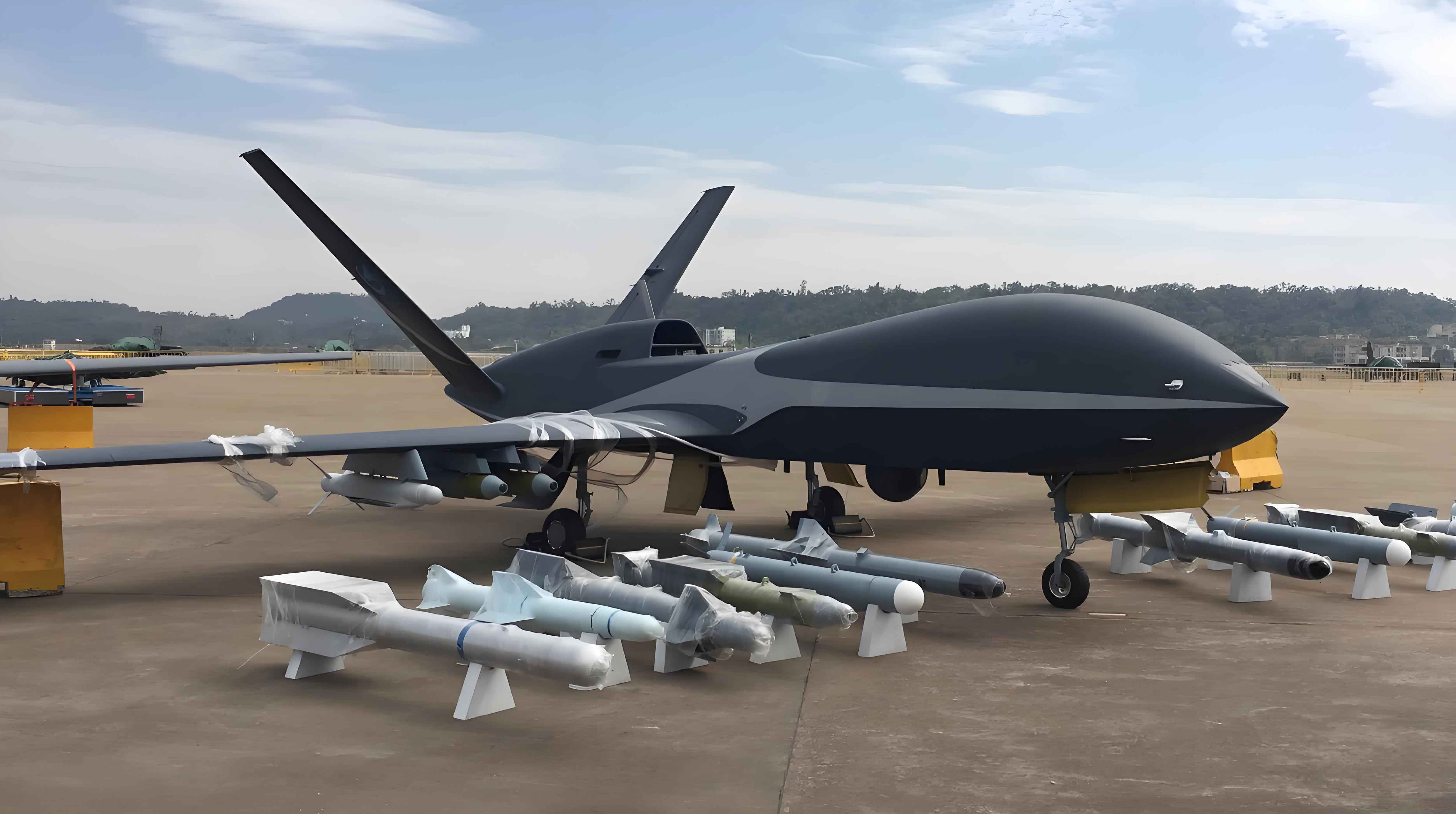
One of the most significant trends I observe is the rise of the Unmanned Electronic Warfare Aircraft (UEWA). These military drones are evolving beyond simple signal intelligence gatherers into active platforms for suppression and deception. Their value proposition is powerful: they can loiter for extended periods in contested airspace, positioning themselves optimally to jam enemy radars and communications with a lower risk of detection and loss compared to manned jets. The key technologies for these military drones are formidable. First is advanced low-observability (stealth) to penetrate defended airspace. Second is the capability for stand-off jamming, requiring high-power, directed energy systems. Third, and most challenging, is the autonomous ability to locate, identify, and prioritize threat emitters in a dense electromagnetic spectrum. This involves complex algorithms for signal processing and emitter fingerprinting. We can summarize the capability progression of such military drones as follows:
| Function | Traditional Military Drone | Modern UEWA Military Drone |
|---|---|---|
| Primary Role | Reconnaissance, Observation | Electronic Attack, SEAD/DEAD |
| Key Technology | Basic Sensors, Radio Link | Cognitive EW Suite, Low-Probability-of-Intercept (LPI) Radar |
| Autonomy Level | Remote-Piloted or Pre-Programmed | High Autonomy in Threat Response & Evasion |
| Survivability Metric | Low to Medium | High (RCS < $$0.001 m^2$$) |
The mathematical challenge in designing these military drones often involves optimizing jamming power against detection risk. A simplified model for effective jamming range considers the power density required at the target receiver: $$P_{req} = \frac{P_t G_t G_r \lambda^2}{(4\pi R)^2 L}$$, where $$P_t$$ is the transmitted power, $$G_t$$ and $$G_r$$ are antenna gains, $$\lambda$$ is the wavelength, $$R$$ is the range, and $$L$$ represents system losses. For a military drone, minimizing $$P_t$$ (to reduce detectability) while maintaining $$P_{req}$$ requires maximizing $$G_t$$ and employing advanced waveforms, a delicate balance captured by this equation.
Perhaps the most disruptive concept on the horizon is the Unmanned Combat Aerial Vehicle (UCAV), or the “uninhabited combat air vehicle.” In my assessment, these military drones represent a paradigm shift. They are not merely support assets but potential replacements for manned fighters in the initial, highest-risk phases of conflict, performing suppression of enemy air defenses (SEAD) and deep strike missions. A UCAV swarm, operating within a networked C4ISR architecture, could saturate defenses with coordinated attacks. The key attributes are affordability, lethality, survivability, and supportability. The technological hurdles are substantial. First is the need for robust Intelligence, Surveillance, and Reconnaissance (ISR) fusion to provide a common operational picture. Second is autonomous target recognition and engagement decision-making, requiring artificial intelligence that can distinguish between combatants and civilians in complex environments. Third is the development of compact, lethal payloads. A critical enabler I believe will be revolutionary is the widespread adoption of Electro-Mechanical Actuators (EMAs) or All-Electric Actuators, replacing traditional hydraulic systems. This reduces weight, maintenance, and thermal signature. The control dynamics for such an agile military drone can be modeled. For a high-angle-of-attack maneuver, the simplified roll dynamics might be: $$\dot{p} = L_p p + L_{\delta_a} \delta_a$$, where $$p$$ is the roll rate, $$L_p$$ and $$L_{\delta_a}$$ are stability derivatives, and $$\delta_a$$ is the aileron deflection commanded by the EMA. The challenge is designing control laws that stabilize the aircraft at these extremes without a pilot in the loop.
| Key Technology Area for UCAV Military Drones | Specific Challenge | Potential Solution/Measure |
|---|---|---|
| Autonomous Mission Systems | Real-time tactical planning & adaptive jamming | Machine Learning-based decision engines |
| Precision Targeting | Non-GPS navigation and target identification in GPS-denied environments | Algorithmic scene matching, AI-based image classification |
| Vehicle Management | Integration of flight control, propulsion, and payload management | Modular open-system architecture (MOSA) |
| Survivability | Low Radar Cross-Section (RCS) and Infrared Signature | Shape design, Radar Absorbent Materials (RAM), engine thermal management (e.g., $$T_{exhaust} < 500K$$) |
Another frontier I am closely monitoring is the High-Altitude, Long-Endurance (HALE) military drone. These platforms are poised to become pseudo-satellites, providing persistent communications relay, wide-area surveillance, and signals intelligence. Their strategic value in establishing “information dominance” is immense. A single HALE military drone can cover a vast operational area for days, streaming high-definition video and data to tactical units on the ground. The technical demands are unique. Propulsion is paramount; engines must operate efficiently in the thin air at altitudes above 18,000 meters. Options include turbocharged piston engines with advanced cooling, turbofans, and even hybrid systems. The endurance, $$E$$, is a function of fuel mass $$m_f$$ and specific fuel consumption $$SFC$$: $$E = \frac{m_f}{SFC \cdot T}$$, where $$T$$ is thrust. For a HALE military drone, minimizing $$SFC$$ is critical, often pushing $$SFC$$ values below $$0.3 \text{ lb/(lbf·hr)}$$. Communication is another hurdle. These military drones must manage multiple data links simultaneously—from SATCOM to line-of-sight tactical nets—without mutual interference. The data rate $$R$$ required for full-motion video can be modeled by Shannon’s theorem: $$R = B \log_2(1 + \frac{S}{N})$$, where $$B$$ is bandwidth and $$S/N$$ is the signal-to-noise ratio. Achieving rates of 277 Mbps for command and control links demands high-gain antennas and efficient compression algorithms, all within the size, weight, and power (SWaP) constraints of a military drone.
At the opposite end of the size spectrum lies what I find to be one of the most fascinating developments: the Micro Air Vehicle (MAV) or miniature military drone. Envisioned for squad-level reconnaissance, these palm-sized systems are designed to fill the surveillance gap below satellites and larger drones. Their stealth comes from minimal physical and radar signatures. The technological challenges here are profoundly interdisciplinary. First, component miniaturization: electric motors, sensors, and actuators must be shrunk to centimeter scales. Second, micro-propulsion: providing sufficient energy density for useful flight times. Battery technology is a key limiter, with energy density often expressed as $$E_d = \frac{C \cdot V}{m}$$, where $$C$$ is capacity, $$V$$ is voltage, and $$m$$ is mass. For a MAV, achieving $$E_d > 400 \text{ Wh/kg}$$ is a common target. Third, aerodynamics at low Reynolds numbers ($$Re < 100,000$$) are non-intuitive, where viscous forces dominate. Some designs mimic bio-inspired “flapping wings” utilizing unsteady flow mechanisms. The lift coefficient $$C_L$$ for such wings is time-dependent and often higher than for fixed wings at similar scales. Fourth, autonomous control in gusty urban environments requires robust, lightweight algorithms. The dynamics can be modeled with high degrees of non-linearity: $$\ddot{x} = \frac{1}{m}(F_{thrust} – D) – g \sin(\theta)$$, where $$D$$ is drag, a complex function of velocity and orientation. Developing stable flight control for these miniature military drones is a monumental software challenge.
| Military Drone Category | Representative Size/Spec | Core Mission | Dominant Technical Challenge |
|---|---|---|---|
| Unmanned Electronic Warfare Aircraft (UEWA) | Wingspan: 10-20m, Endurance: 24h+ | Radar Jamming, Signals Intelligence | Low-Probability-of-Intercept (LPI) Jamming & Emitter Geolocation |
| Unmanned Combat Aerial Vehicle (UCAV) | Wingspan: 8-15m, Payload: 2000kg+ | Air-to-Ground Strike, SEAD | Autonomous Target Engagement Decision-Making & Survivability (Stealth) |
| High-Altitude, Long-Endurance (HALE) | Wingspan: 30-40m, Altitude: >18km, Endurance: 40h+ | Persistent ISR, Communications Relay | High-Efficiency Propulsion at Low Air Density & Multi-Channel Data Fusion |
| Micro Air Vehicle (MAV) | Size: < 15cm, Weight: < 500g | Close-Range Reconnaissance for Infantry | Micro-Power Systems & Stable Flight Control in Turbulent Air |
Beyond these categories, the overarching technological ecosystem for military drones is equally critical. I see sensor fusion as a linchpin. Data from electro-optical, infrared, radar, and signals intelligence sensors on a military drone must be combined into a coherent track. This is often framed as a Bayesian estimation problem: $$P(T|D) = \frac{P(D|T) P(T)}{P(D)}$$, where $$P(T|D)$$ is the posterior probability of a target given sensor data $$D$$. Furthermore, the concept of “swarming” for military drones introduces complex coordination problems. A simple model for maintaining formation while avoiding collisions can use potential fields or consensus algorithms, where each drone’s desired velocity $$v_i^{des}$$ is a function of its neighbors’ states: $$v_i^{des} = \sum_{j \in N_i} f(||x_i – x_j||) (x_j – x_i)$$, where $$N_i$$ is the set of neighbors. The integration of these military drones into joint all-domain command and control (JADC2) networks presents another layer of complexity, requiring secure, resilient datalinks and common data standards.
In my view, the economic calculus is a powerful driver for military drones. The lifecycle cost $$C_{life}$$ of a system includes development $$C_{dev}$$, production $$C_{prod}$$, and operations & support $$C_{O&S}$$: $$C_{life} = C_{dev} + N \cdot C_{prod} + T \cdot C_{O&S}$$, where $$N$$ is the number of units and $$T$$ is the service life. For military drones, $$C_{prod}$$ and $$C_{O&S}$$ are often significantly lower than for manned equivalents, making them attractive for mass procurement. However, this affordability hinges on achieving sufficient reliability and autonomy to reduce the need for extensive ground control stations and maintenance crews. The trend toward modularity and open architectures will further compress these costs, allowing for rapid upgrades of sensors and software on fielded military drone platforms.
As I project into the future, I anticipate several converging trends. First, the line between different categories of military drones will blur. A single platform may be reconfigured from a HALE sensor platform to a UCAV by swapping payload pods. Second, artificial intelligence will move from a tool to a core component of the military drone’s “brain,” enabling collaborative autonomous missions where drones negotiate tasks among themselves. Third, counter-drone technologies will spur a continuous innovation cycle in stealth, electronic warfare, and maneuverability for military drones. The ultimate measure of a military drone’s effectiveness in a contested environment might be summarized by a mission success probability $$P_{success}$$, which integrates survivability $$P_{survive}$$, sensor performance $$P_{detect}$$, and weapon effectiveness $$P_{kill}$$: $$P_{success} \approx P_{survive} \cdot P_{detect} \cdot P_{kill}$$. Designers will strive to maximize this product under constraints of cost and size.
In conclusion, from my vantage point, the trajectory for military drones is unmistakably upward. They are evolving from supportive tools to central warfighting systems. The key technologies—spanning autonomy, propulsion, stealth, miniaturization, and networking—are advancing rapidly, albeit with significant hurdles remaining. The successful development and integration of these military drones will not merely augment existing forces but will fundamentally reshape military doctrines, tactics, and the very character of future conflicts. The nation or alliance that masters the synthesis of these technologies will possess a decisive advantage, fielding fleets of intelligent, resilient, and cost-effective military drones capable of dominating the skies and the information spectrum. My analysis confirms that we are not just witnessing an evolution in aviation; we are participating in the dawn of a new age of automated, unmanned warfare.