
In today’s rapidly evolving aerospace and defense sectors, I observe a significant convergence of advanced materials and unmanned systems. As an analyst, I believe that the integration of composite technologies, such as those seen in next-generation tiltrotor aircraft, is paving the way for transformative capabilities in military drone platforms. This article delves into the recent advancements in composite airframe manufacturing and provides a comprehensive forecast for the global military drone market, emphasizing growth trajectories, regional dynamics, and technological drivers. The keyword ‘military drone’ will be frequently highlighted to underscore its centrality in modern warfare and security strategies.
The successful integration of composite wings and fuselages in next-generation vertical lift aircraft represents a milestone in aerospace engineering. For instance, a leading aerospace company recently completed the mating of composite wings and nacelles to the fuselage of a tiltrotor demonstrator, the V-280 Valor, at its assembly center in Texas. This achievement leverages decades of tiltrotor experience and composite material expertise, utilizing carbon fiber-reinforced polymers for wings, fuselage, and empennage components. The design employs innovative manufacturing techniques like large-unit carbon core technology, which replaces traditional skin-stringer structures. Reports indicate that this approach reduces costs by over 30% compared to previous models, such as the V-22, when scaled similarly. The use of adhesively bonded wing skins and ribs further simplifies maintenance and lowers lifecycle expenses. From my perspective, these advancements are crucial for enhancing agility, speed, range, and payload capacity while ensuring cost-effectiveness. The demonstrator is poised for validation in the coming months, with engine and transmission installations scheduled, highlighting a commitment to risk reduction and accelerated deployment for future vertical lift programs. This progress underscores how composite materials are enabling lighter, more durable airframes that directly benefit military drone development by informing design principles for unmanned variants.
Shifting focus to the unmanned aerial sector, the military drone market is experiencing exponential growth driven by geopolitical tensions, technological innovations, and shifting defense priorities. I estimate that global expenditures on unmanned systems will surge over the next decade, with military drones dominating the landscape. The following table summarizes projected global military drone market values from 2015 to 2024, based on industry analyses.
| Year | Global Military Drone Market Value (USD billions) | Annual Growth Rate (%) |
|---|---|---|
| 2015 | 5.7 | 6.5 |
| 2016 | 6.1 | 7.0 |
| 2017 | 6.5 | 6.6 |
| 2018 | 7.0 | 7.7 |
| 2019 | 7.5 | 7.1 |
| 2020 | 8.1 | 8.0 |
| 2021 | 8.8 | 8.6 |
| 2022 | 9.5 | 8.0 |
| 2023 | 10.2 | 7.4 |
| 2024 | 11.0 | 7.8 |
From 2015 to 2024, the cumulative spending on military drones is projected to reach approximately $81 billion, accounting for nearly 90% of total drone expenditures. The compound annual growth rate (CAGR) can be expressed using the formula:
$$ CAGR = \left( \frac{FV}{PV} \right)^{\frac{1}{n}} – 1 $$
where \( FV \) is the future value ($11.0 billion in 2024), \( PV \) is the present value ($5.7 billion in 2015), and \( n \) is the number of years (9). Plugging in the values:
$$ CAGR = \left( \frac{11.0}{5.7} \right)^{\frac{1}{9}} – 1 \approx 0.0633 \text{ or } 6.33\% $$
This growth is fueled by increasing demand for intelligence, surveillance, reconnaissance (ISR), and combat missions. I note that military drones are becoming integral to modern armed forces, with their share in new military aviation platform deliveries rising from 8% in 2010 to an estimated 15% by 2018. In terms of quantity, drones (excluding micro types) may constitute up to 49% of new deliveries by 2018, reflecting a shift toward unmanned systems. Countries like the United States, Israel, and China are leading this transition, with plans to integrate military drones into over 50% of their air forces by 2030. The versatility of military drones—from tactical to strategic roles—makes them indispensable for border patrol, battlefield surveillance, and targeted strikes. For example, the demand for tactical military drones is expected to be the largest segment, while combat drones could see markets exceeding $3 billion annually by 2020, with growth rates over 70%. This underscores the strategic importance of investing in military drone technologies.
To better understand market dynamics, I analyze regional contributions. The United States remains the largest market for military drones, but emerging economies in Asia, the Middle East, and Latin America are rapidly expanding their capabilities. In the Middle East, regional conflicts have catalyzed military drone acquisitions, with market values potentially reaching $1 billion over a decade. Countries like Russia, India, and South Korea are developing indigenous military drone programs, reducing reliance on imports. Meanwhile, in Africa and Southeast Asia, nations are seeking affordable military drones for surveillance and reconnaissance, indicating untapped potential. The following table breaks down the global military drone market by region for 2024.
| Region | Projected Market Share in 2024 (%) | Key Drivers |
|---|---|---|
| North America | 40% | High defense budgets, R&D investments |
| Asia-Pacific | 30% | Territorial disputes, modernization programs |
| Europe | 15% | Collaborative defense initiatives |
| Middle East | 10% | Regional instability, security needs |
| Rest of World | 5% | Growing awareness, limited budgets |
The image below illustrates a typical military drone used in modern operations, highlighting its design features that align with market trends.
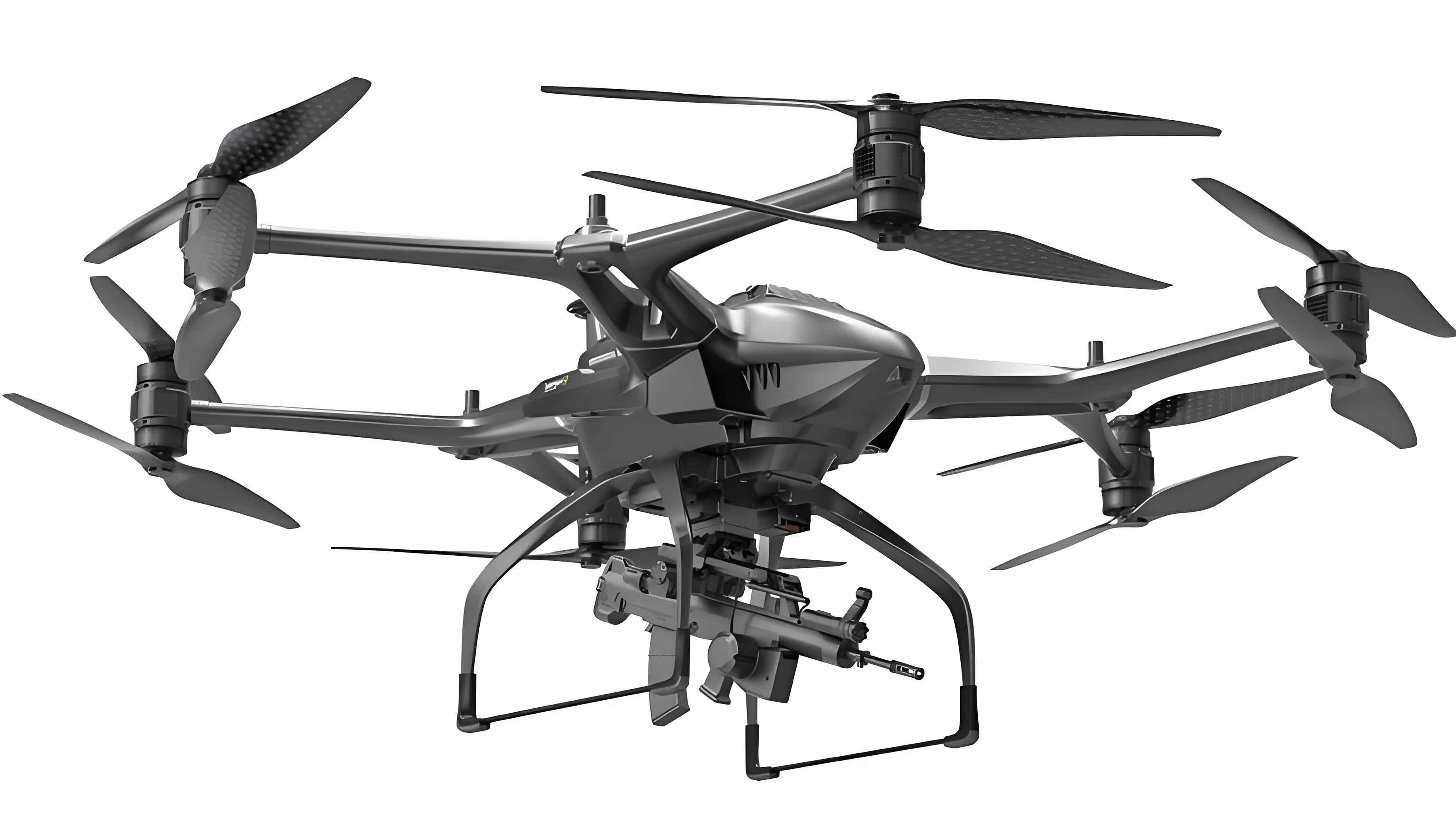
This visual representation complements my analysis, showing how military drones incorporate advanced materials for stealth, endurance, and payload capacity. From my viewpoint, the adoption of composites in military drones mirrors trends in manned aircraft, reducing weight and enhancing performance. For instance, carbon fiber structures allow for longer flight times and greater sensor integration, critical for ISR missions. As military drone technologies evolve, I anticipate increased use of autonomous systems, swarming capabilities, and AI-driven decision-making, further boosting market value.
Focusing on the domestic front, the military drone market in China is poised for robust growth. Based on recent reports, I project that demand will rise from $0.57 billion in 2013 to $2.0 billion in 2022, with a cumulative total of $12 billion over the decade. The CAGR for this period is calculated as:
$$ CAGR = \left( \frac{2.0}{0.57} \right)^{\frac{1}{9}} – 1 \approx 0.15 \text{ or } 15\% $$
This outstrips global averages, reflecting heightened investment in indigenous military drone programs. Currently, military drones account for about 0.5% of China’s defense equipment spending, akin to U.S. levels in the 1990s, suggesting substantial room for expansion. Over the next five years, I expect procurement to emphasize tactical and strategic military drones, with estimates of 250 units excluding micro types. Looking ahead two decades, demand for unmanned combat aerial vehicles (UCAVs) could range from 750 to 1000 units, translating to over 50 annually. These figures underscore the strategic focus on enhancing military drone fleets for regional security and power projection. Research institutions and enterprises are collaborating on developments, from small reconnaissance military drones to high-altitude long-endurance (HALE) models, often leveraging composite materials for airframes. The synergy between composite advancements and military drone manufacturing is evident, as seen in global trends.
To quantify the economic impact, I employ a simple model for market valuation. Let \( M_t \) represent the military drone market value in year \( t \), with growth influenced by factors like defense budgets (\( D \)), technological adoption rate (\( \alpha \)), and geopolitical risk index (\( R \)). A simplified equation could be:
$$ M_t = M_0 \times e^{(g \cdot t)} $$
where \( M_0 \) is the initial market value, \( g \) is the continuous growth rate, and \( t \) is time in years. For the global market from 2015 to 2024, using \( g \approx 0.0633 \), we get:
$$ M_{2024} = 5.7 \times e^{(0.0633 \times 9)} \approx 11.0 \text{ billion USD} $$
This exponential trend highlights the compounding effect of innovation and demand. Additionally, the share of military drones in total aviation spending can be expressed as:
$$ S = \frac{M_t}{A_t} \times 100\% $$
where \( A_t \) is total aviation expenditure. With \( S \) projected to rise from 8% to 15%, it’s clear that military drones are becoming a cornerstone of military aviation. From my analysis, I emphasize that investments in composite materials—reducing costs and improving durability—are directly correlated with the scalability of military drone production. For example, the cost savings from composite wing structures can be reinvested into sensor payloads or autonomy software, enhancing the value proposition of military drones.
In conclusion, the intersection of composite material innovations and military drone market expansion is reshaping defense landscapes worldwide. I have explored how advancements in carbon fiber composites are lowering costs and improving performance in aircraft like the V-280, which informs future military drone designs. Simultaneously, the military drone market is on a steep growth trajectory, with global expenditures expected to surpass $11 billion by 2024 and domestic markets in regions like China growing at 15% annually. The frequent mention of ‘military drone’ throughout this analysis underscores its pivotal role in modern warfare, from tactical reconnaissance to strategic strikes. As technologies mature, I anticipate increased integration of composites, AI, and swarm tactics, further propelling the military drone sector. For stakeholders, understanding these trends is essential for strategic planning and investment. The future will likely see military drones dominating aerial operations, driven by continuous innovation in materials and autonomous systems.