
As a firefighter and emergency responder with years of experience in the field, I have witnessed firsthand the transformative impact of technology on our operations. In the context of “all-disaster, big-emergency” rescue systems, the complexity of firefighting and social assistance tasks has increased exponentially. Among the technological advancements, multi-rotor unmanned aerial vehicles, commonly referred to as fire drones, have emerged as a game-changer. These fire drones play a crucial role in fire prevention, on-site detection, and rescue coordination, effectively reducing casualties and enhancing operational efficiency. In this article, I will delve into the principles, advantages, applications, and future directions of fire drones, drawing from personal insights and industry trends.
The integration of fire drones into firefighting and rescue missions is no longer a novelty but a necessity. From explosions and landslides to forest fires and collapse incidents, fire drones have proven invaluable. They provide communication support, monitoring and early warning, sampling and decontamination, 3D modeling, and decision-making assistance. However, challenges such as limited functional modules and insufficient endurance persist. This discussion aims to explore how we can better leverage fire drones to augment firefighting and rescue efforts, ensuring they become an indispensable tool in our arsenal.
Working Principles of Fire Drones
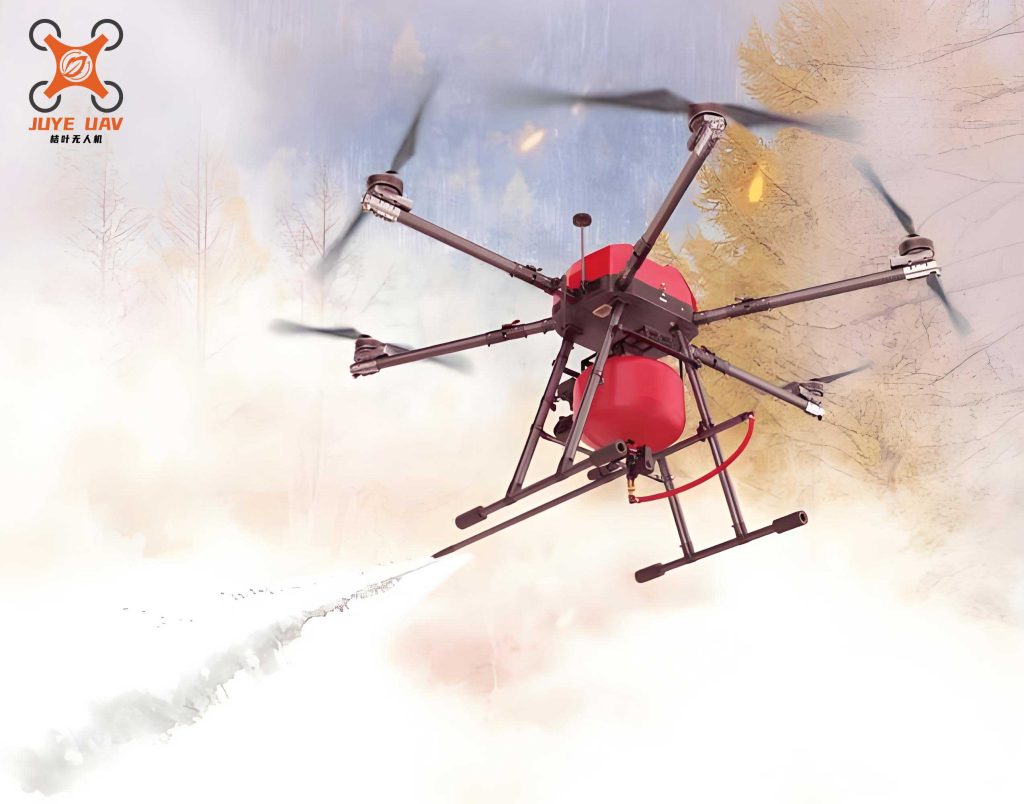
Fire drones are unmanned aerial vehicles operated via wireless remote control and automatic control systems. Most fire drones used in消防救援 are multi-rotor types, with theoretical endurance times around 38 minutes, operational radii of up to 8000 meters, and payload capacities ranging from 1 kg to 5 kg depending on the model. These fire drones are equipped with various functional module devices and consist of several key components: the airframe, power system, flight control system, and data link system. The flight control system is the core, managing stability, navigation, and payload operations.
To understand the performance of fire drones, we can model their endurance using a simple formula. The flight time $$ T $$ is a function of battery capacity $$ C $$ (in ampere-hours) and power consumption $$ P $$ (in watts). Assuming constant power draw, we have:
$$ T = \frac{C \times V}{P} $$
where $$ V $$ is the voltage of the battery. For instance, if a fire drone has a battery capacity of 10000 mAh (or 10 Ah) at 22.2 V and consumes 200 W on average, the endurance can be calculated as:
$$ T = \frac{10 \times 22.2}{200} = 1.11 \text{ hours} \approx 66.6 \text{ minutes} $$
However, real-world factors like wind resistance, payload weight, and operational maneuvers reduce this time. Table 1 summarizes typical specifications for fire drones used in消防救援.
| Parameter | Typical Value | Notes |
|---|---|---|
| Endurance Time | 30-40 minutes | Varies with model and conditions |
| Operational Radius | 5000-8000 meters | Depends on communication technology |
| Payload Capacity | 1-5 kg | Allows for modular attachments |
| Weight | 0.9-10 kg | Lightweight for easy deployment |
| Flight Control System | GPS/GLONASS assisted | Ensures precise navigation |
The flight control system relies on algorithms for stability and autonomy. For example, the attitude control can be described by Euler’s equations of motion. Let $$ \phi $$, $$ \theta $$, and $$ \psi $$ represent roll, pitch, and yaw angles, respectively. The dynamics can be approximated as:
$$ I \dot{\omega} + \omega \times (I \omega) = \tau $$
where $$ I $$ is the inertia matrix, $$ \omega $$ is the angular velocity vector, and $$ \tau $$ is the torque vector from rotors. This mathematical foundation allows fire drones to maintain hover and execute complex maneuvers in turbulent environments.
Advantages of Fire Drones
Fire drones offer numerous advantages that make them ideal for消防救援 scenarios. Based on my experience, I can categorize these into four main areas, each enhanced by the unique capabilities of fire drones.
First, fire drones are highly mobile and flexible. Their lightweight design, such as the DJI Mavic 2 weighing only 907 grams, allows for rapid deployment. They require minimal takeoff space—just about 1 square meter—and can even launch from vehicle roofs. Operationally, they are simple, often needing only one or two personnel for control. This mobility enables fire drones to access constrained disaster sites quickly, providing immediate辅助救援.
Second, fire drones provide comprehensive视野. By integrating data link and broadband technologies with infrared and thermal imaging cameras, fire drones expand visual capabilities. They can conduct surveys from various angles and under different lighting conditions, capturing both wide-area shots and close-up details. This enhances situational awareness, allowing for better resource allocation and strategy development. For instance, during a forest fire, a fire drone can monitor火势 spread and identify hotspots using thermal imaging, which is critical for directing ground teams.
Third, fire drones are操作简单. Control is typically via a remote controller, with live video feed transmitted to ground stations. Clients can access public networks to control fire drones using devices like tablets or smartphones,进一步发挥了无人机的功能. This user-friendly interface reduces training time and allows for quick adoption by救援 personnel.
Fourth, fire drones are安全可靠. They can operate in harsh environments where human entry is risky, such as high-temperature zones, radiation areas, or toxic gas leaks. This reliability ensures continuous monitoring without endangering lives. Table 2 compares fire drones with traditional侦查 methods.
| Aspect | Fire Drones | Traditional Methods |
|---|---|---|
| Mobility | High; airborne access | Limited by terrain and safety |
| Risk to Personnel | Low; remote operation | High; direct exposure |
| Data Collection Speed | Fast; real-time streaming | Slow; manual processes |
| Environmental Adaptability | Excellent; works in extreme conditions | Poor; requires safe zones |
From a mathematical perspective, the coverage area $$ A $$ of a fire drone’s camera can be estimated using the formula for the field of view (FOV). If the camera has an angular FOV $$ \theta $$ (in radians) and flies at altitude $$ h $$, the ground coverage diameter $$ D $$ is:
$$ D = 2h \tan\left(\frac{\theta}{2}\right) $$
For example, with $$ \theta = 90^\circ $$ (or $$ \pi/2 $$ radians) and $$ h = 100 $$ meters, $$ D \approx 200 $$ meters. This allows fire drones to survey large areas efficiently, making them invaluable for灾情勘察.
Applications of Fire Drones in Firefighting and Rescue
Fire drones have diverse applications in消防救援, each leveraging their unique strengths. As a responder, I have utilized fire drones in multiple scenarios, and their impact is profound.
In灾情勘察, fire drones provide aerial侦察 for command centers and on-site指挥部. They offer panoramic views to monitor火势发展蔓延方向 and the distribution of灭火力量. With infrared thermal imaging cameras, fire drones can identify明火目标 and residual hotspots, guiding firefighters for precise extinguishment. Post-incident, they assist in creating 2D平面图 for after-action reviews, analyzing兵力部署 and进攻线路. In rescue operations, such as for trapped hikers or collapse sites, fire drones enhance搜救效率 by transmitting real-time audio and video via devices like satellite portable stations and 4G图传. They can penetrate difficult terrains, locating victims and assessing their conditions.
For灾害现场数据采集, fire drones excel in hazardous environments. Equipped with侦检 modules, they can detect泄漏物质, analyze fire smoke components and concentrations, and measure地理数据,风速,温度. This data enables comprehensive monitoring and the creation of 2D and 3D全景图 for informed decision-making. The data collection process can be modeled using sampling theory. If a fire drone takes $$ n $$ samples over an area, the accuracy of concentration measurements $$ \sigma $$ relates to sample variance $$ s^2 $$:
$$ \sigma = \frac{s}{\sqrt{n}} $$
Thus, increasing sample points with fire drones improves data reliability.
Fire drones also facilitate音视频传输功能. By capturing live footage and outputting via HDMI interfaces, they integrate with动中通,静中通,微波 systems to relay information to后方指挥中心. This real-time transmission is crucial for coordination. Additionally, for扩音喊话, fire drones搭载喊话器 can broadcast messages from altitude, overcoming ground noise in scenarios like high-rise建筑 or large洪涝灾害. This aids in信息传递 and calming trapped individuals.
In辅助灭火救援行动, fire drones transform into active救援装备. They can carry灭火器,氧气呼吸机,救援消防绳, and other tools to deliver payloads to指定位置. For example, in high-rise fires, fire drones can transport extinguishing agents to upper floors, supplementing ground efforts. The payload delivery efficiency can be expressed as a function of drone speed $$ v $$ and load weight $$ w $$. The energy required $$ E $$ is:
$$ E = \frac{1}{2} w v^2 + m g h $$
where $$ m $$ is drone mass, $$ g $$ is gravity, and $$ h $$ is altitude. Optimizing this balance is key for effective辅助灭火.
Fire drones contribute to辅助灭火救援预案制作 by capturing全景图 of critical areas, such as森林火灾频发 regions or flood-prone zones. These images help create detailed maps for预案 development, offering a “上帝视角” for prevention and response. Moreover,智能无人机集群技术 represents a frontier. Using ground and onboard computers, fire drones can operate in协同侦察,灭火,救援任务 modes. This shifts from one-operator-one-drone to one-operator-multiple-drone control, enhancing efficiency. Cluster coordination can be described by swarm algorithms, where each fire drone $$ i $$ follows rules like:
$$ \dot{x}_i = \sum_{j \neq i} f(x_i – x_j) $$
for position $$ x_i $$, enabling formations and collective behavior. This technology, combined with AI and big data, supports智慧消防指挥.
Table 3 summarizes key applications and their benefits.
| Application | Description | Impact on Rescue Efficiency |
|---|---|---|
| Disaster Reconnaissance | Aerial monitoring and thermal imaging | High; enables real-time decision-making |
| Data Collection | Environmental sensing and mapping | Medium; provides critical intel |
| Audio-Video Transmission | Live streaming to command centers | High; improves communication |
| Public Address | Broadcasting messages from air | Medium; enhances victim安抚 |
| Direct Assistance | Payload delivery for灭火救援 | High; extends operational reach |
| Preplanning Support | Mapping for预案制作 | Medium; aids in preparedness |
| Drone Swarm Technology | 协同任务 execution | High; maximizes resource use |
Development Directions for Fire Drones
Looking ahead, fire drones must evolve to meet the demands of消防救援. Based on my observations, several areas need attention to enhance their effectiveness.
First,恶劣环境飞行的可靠性 is paramount. Fire drones should possess抗风,防雨,耐高温,防爆炸 capabilities, along with advanced infrared monitoring. This ensures operation in extreme conditions common in fire scenes. Reliability can be quantified using mean time between failures (MTBF). For a fire drone, we aim for:
$$ \text{MTBF} = \frac{\text{Total Operational Time}}{\text{Number of Failures}} $$
Targeting high MTBF values, say over 1000 hours, will boost confidence in fire drone deployments.
Second,区别与民用机的操控性 is essential. Fire drones require extended endurance—preferably over 60 minutes—and broader operational radii, up to 20 kilometers. Additionally, airspace restrictions should be relaxed in禁飞区域 for emergency use, without compromising aviation safety. The endurance improvement can be modeled by enhancing battery energy density $$ \rho $$. If current density is $$ \rho_0 $$, future goals might double it:
$$ \rho_{\text{new}} = 2 \rho_0 $$
This directly increases flight time, making fire drones more versatile.
Third,飞控系统的稳定性 must be prioritized. Fire drones demand high-quality image transmission—清晰,连续可靠—with抗干扰能力. Stability involves robust communication protocols, perhaps using error-correcting codes. The signal-to-noise ratio (SNR) should be maximized:
$$ \text{SNR} = \frac{P_{\text{signal}}}{P_{\text{noise}}} $$
where $$ P $$ denotes power. High SNR ensures reliable data flow for critical decisions.
Fourth,集成拓展的兼容性 is crucial. Fire drones should support modular attachments for语音功能,距离判定,温度测定,气体探测,测量,测算,三维建模. This expands their utility beyond basic reconnaissance. Compatibility can be assessed via interface standards, such as API integrations for plug-and-play modules.
Table 4 outlines these development directions with target metrics.
| Direction | Target Specification | Importance Level |
|---|---|---|
| Environmental Reliability | Operate in winds > 50 km/h, rain, and up to 500°C | High |
| Operational Performance | Endurance > 60 min, radius > 20 km | High |
| Control System Stability | Image transmission latency < 100 ms, SNR > 30 dB | Medium |
| Integration Compatibility | Support for 10+ modular functions | Medium |
From a technological standpoint, advancements in materials and AI will drive these improvements. For instance, using composite materials can reduce weight while increasing durability. AI algorithms can enhance autonomous navigation, allowing fire drones to adapt to dynamic environments without constant human input. The path planning for a fire drone can be optimized using algorithms like A* or reinforcement learning, minimizing time to target:
$$ \min \int_{0}^{T} \| \dot{x}(t) \| \, dt $$
subject to obstacles and constraints. This optimization is vital for efficient救援行动.
Conclusion
In my experience, fire drones have already revolutionized消防救援 by providing critical support in communication, reconnaissance, and direct assistance. They are evolving from被动化,单任务化 tools toward自组化,多任务 systems. As technology progresses, fire drones will become even more integral to消防信息化建设, helping防范化解重大安全风险 and应对处置各类灾害事故. The future of fire drones lies in enhancing their reliability, performance, and integration, ensuring they meet the rigorous demands of emergency response. By embracing innovation, we can harness the full potential of fire drones to save lives and protect communities.
The journey of fire drones is just beginning. With continued research and development, these aerial platforms will undoubtedly play a pivotal role in shaping the future of firefighting and rescue operations worldwide. As a firefighter, I am optimistic about the advancements that will make fire drones more robust, intelligent, and indispensable in our mission to serve and safeguard.