
As we navigate the evolving landscape of global agriculture, the imperative to enhance productivity amidst challenges such as urbanization and an aging workforce has become increasingly apparent. In this context, agricultural UAVs, or unmanned aerial vehicles, emerge as a transformative technology poised to revolutionize crop protection and management. From my perspective as a researcher and advocate for agricultural innovation, I believe that the integration of agricultural UAVs into farming practices is not merely an option but a necessity for sustainable development. This article delves into the multifaceted aspects of agricultural UAVs, examining their operational advantages, current推广 hurdles, and strategic recommendations for widespread adoption. By employing tables and formulas, I aim to provide a comprehensive analysis that underscores the critical role of agricultural UAVs in shaping the future of agriculture.
The advent of agricultural UAVs stems from the urgent need to mechanize and modernize farming operations. With rural labor shortages escalating due to demographic shifts, traditional methods of crop spraying and monitoring are becoming untenable. Agricultural UAVs, designed specifically for plant protection, offer a viable solution by automating tasks that were once labor-intensive. These systems typically comprise a airframe, navigation and flight control systems, power systems, and spraying mechanisms. To better understand their diversity, let us categorize agricultural UAVs based on their structural design, as summarized in Table 1.
| Type | Key Features | Advantages | Disadvantages |
|---|---|---|---|
| Fixed-Wing Agricultural UAV | Requires runway for takeoff; aerodynamic design | Long endurance, high payload capacity, fast flight speed | Large area needed for takeoff/landing; less maneuverable |
| Single-Rotor Agricultural UAV | Vertical takeoff and landing; complex rotor mechanism | High efficiency in precise applications; suitable for varied terrains | High technical operation requirements; maintenance complexity |
| Multi-Rotor Agricultural UAV | Vertical takeoff and landing; multiple rotors for stability | Ease of operation, high reliability, adaptable to small plots | Limited flight time due to battery constraints; lower payload compared to fixed-wing |
The core of an agricultural UAV lies in its navigation and flight control system, which enables autonomous operations through advanced algorithms. For instance, the flight path can be optimized using mathematical models that minimize energy consumption while maximizing coverage. Consider the formula for area coverage efficiency: $$ E_c = \frac{A}{t} $$ where \( E_c \) represents the coverage efficiency in hectares per hour, \( A \) is the total area covered in hectares, and \( t \) is the time in hours. This efficiency is further enhanced by the spraying system, which utilizes雾化技术 to disperse chemicals uniformly. The droplet size distribution can be modeled using the Rosin-Rammler distribution: $$ P(d) = 1 – \exp\left(-\left(\frac{d}{d_c}\right)^n\right) $$ where \( P(d) \) is the cumulative fraction of droplets with diameter less than \( d \), \( d_c \) is the characteristic diameter, and \( n \) is the spread parameter. Such precision ensures that agricultural UAVs deliver agrochemicals effectively, reducing waste and environmental impact.
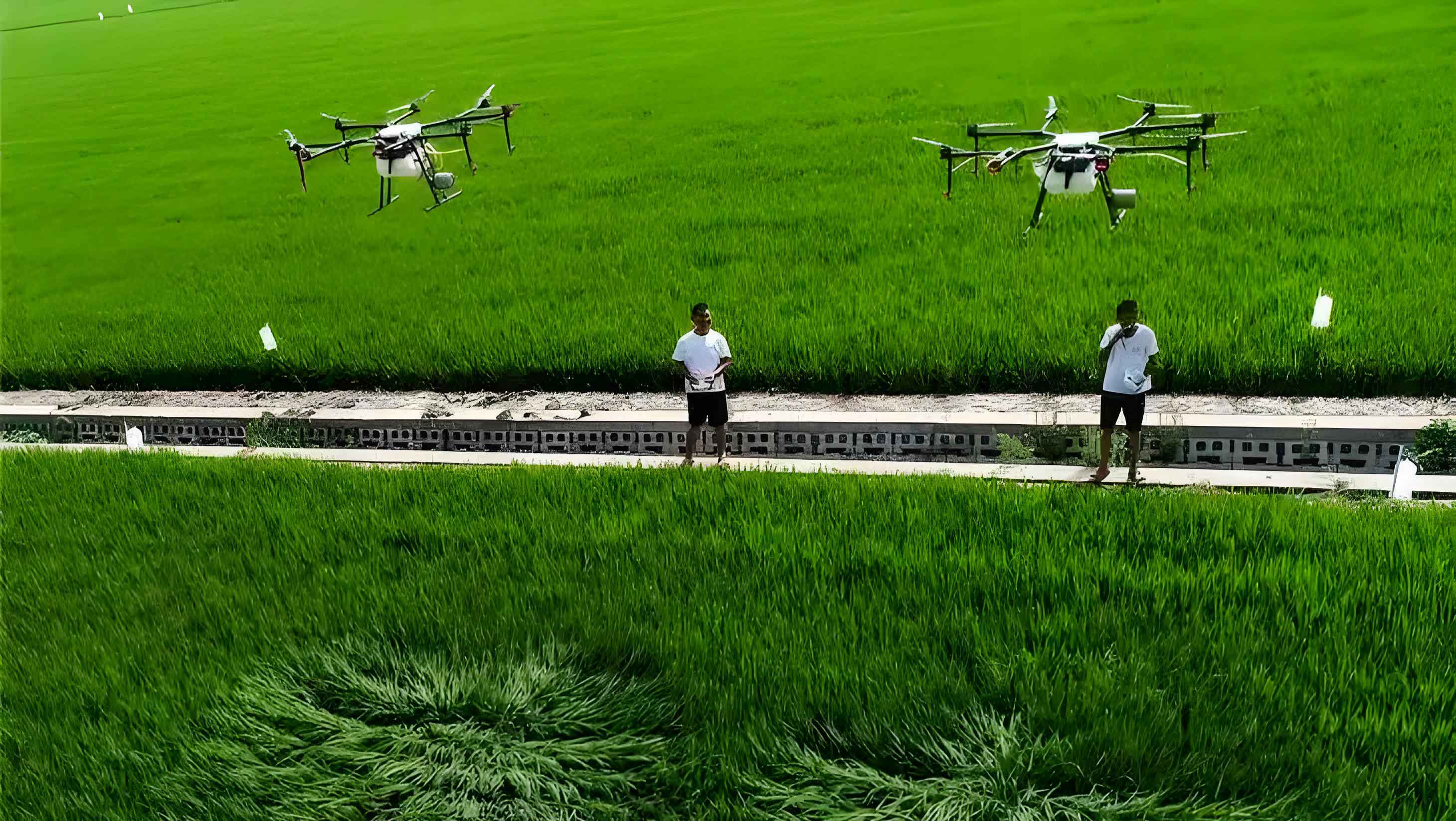
In my experience, the operational advantages of agricultural UAVs are profound and multifaceted. Firstly, their efficiency surpasses manual labor by orders of magnitude. As demonstrated in field trials, a typical agricultural UAV can carry 10 kg of liquid and cover approximately 1 hectare in 10 minutes. This translates to an hourly rate of 6 hectares and over 45 hectares per 8-hour workday. To quantify this, we can compute the relative efficiency ratio compared to manual spraying: $$ R_e = \frac{E_{UAV}}{E_{manual}} $$ where \( R_e \) is the efficiency ratio, \( E_{UAV} \) is the coverage efficiency of the agricultural UAV, and \( E_{manual} \) is that of manual methods. Given that manual spraying often achieves only 0.5 hectares per hour, \( R_e \) can exceed 12, highlighting the transformative potential of agricultural UAVs. Secondly, the防治效果 of pesticides is significantly improved due to better droplet penetration and coverage. The utilization rate of pesticides, defined as the proportion effectively deposited on crops, can be expressed as: $$ U_r = \frac{M_{deposited}}{M_{applied}} \times 100\% $$ where \( U_r \) is the utilization rate, \( M_{deposited} \) is the mass deposited on target, and \( M_{applied} \) is the total mass applied. Studies show that agricultural UAVs achieve \( U_r > 50\% \), whereas manual methods rarely exceed 30%. This enhancement not only boosts crop health but also aligns with sustainable practices by minimizing chemical runoff.
Moreover, agricultural UAVs mitigate physical damage to crops and health risks to operators. Since these devices operate aerially, they avoid trampling or compacting soil, which is common with ground-based machinery. The risk reduction for human health can be modeled using a hazard function: $$ H(t) = \lambda \cdot \exp(-\beta \cdot d) $$ where \( H(t) \) represents the health hazard over time \( t \), \( \lambda \) is the baseline hazard rate for manual spraying, \( \beta \) is a decay constant, and \( d \) is the distance maintained by the agricultural UAV operator. By keeping operators away from direct chemical exposure, \( d \) increases, thereby reducing \( H(t) \) substantially. Additionally, the ecological footprint is diminished through precise application, which curtails soil and water contamination. The reduction in environmental pollution can be quantified by the decrease in pesticide residue levels: $$ \Delta P = P_{manual} – P_{UAV} $$ where \( \Delta P \) is the reduction in pesticide residue, and \( P_{manual} \) and \( P_{UAV} \) are residue concentrations from manual and agricultural UAV applications, respectively. Empirical data often show \( \Delta P > 40\% \), underscoring the environmental stewardship offered by agricultural UAVs.
Despite these advantages, the推广 of agricultural UAVs faces significant barriers. From my analysis, the challenges can be categorized into regulatory, economic, human resource, technical, and售后 aspects. Table 2 summarizes these issues along with their implications.
| Challenge Category | Specific Issues | Impact on Adoption |
|---|---|---|
| Regulatory Framework | Insufficient laws on leasing, insurance, and维修; lack of national standards | Creates uncertainty for users and insurers; hampers大规模 deployment |
| Economic Factors | High initial cost of agricultural UAVs; expensive repairs; limited affordability for smallholders | Restricts access to technology; increases financial risk |
| Human Resources | Shortage of skilled pilots and technicians; inadequate training systems | Limits operational capacity; leads to inefficiencies during peak seasons |
| Technical Limitations | Short battery life; signal loss during flight; immature charging technologies | Reduces reliability and覆盖范围; increases downtime |
| 售后 Services | Sparse repair networks; complex insurance claims; lack of brand trust | Prolongs equipment outages; discourages investment |
To address these challenges, I propose a multifaceted strategy that involves stakeholders across government, industry, academia, and farming communities. Firstly, regulatory gaps must be filled through collaborative policymaking. This includes establishing national standards for agricultural UAV operations, insurance, and liability. For instance, a risk assessment model could be developed to standardize insurance premiums: $$ \text{Premium} = \alpha \cdot R + \beta \cdot C $$ where \( \alpha \) and \( \beta \) are coefficients, \( R \) is the risk score based on flight history, and \( C \) is the agricultural UAV value. Such公式化 approaches can streamline insurance processes and build confidence. Secondly, economic barriers can be lowered via subsidies and innovative business models. Governments should expand农机补贴 to include agricultural UAVs, and encourage leasing schemes to reduce upfront costs. The cost-benefit analysis for farmers can be expressed as: $$ \text{Net Benefit} = \sum_{t=1}^{T} \frac{B_t – C_t}{(1 + r)^t} $$ where \( B_t \) and \( C_t \) are benefits and costs in year \( t \), \( r \) is the discount rate, and \( T \) is the time horizon. By demonstrating positive net benefits through pilot programs, adoption rates can rise.
Thirdly, human resource development requires robust education and training systems. Vocational schools and universities should integrate agricultural UAV curricula, emphasizing hands-on experience. The skill acquisition rate can be modeled as: $$ S(t) = S_{\text{max}} \cdot (1 – e^{-kt}) $$ where \( S(t) \) is the skill level at time \( t \), \( S_{\text{max}} \) is the maximum proficiency, and \( k \) is the learning rate constant. Through simulated farming environments and certifications, we can accelerate \( k \) to produce competent pilots and technicians. Fourthly, technical advancements demand sustained research and development. Key areas include battery technology, where energy density improvements can extend flight time: $$ E_{\text{battery}} = \rho \cdot V $$ where \( E_{\text{battery}} \) is the energy stored, \( \rho \) is the energy density, and \( V \) is the volume. By increasing \( \rho \) through新材料 research, agricultural UAVs can cover larger areas per charge. Additionally, enhancing communication protocols and obstacle avoidance algorithms will boost reliability. For example, signal strength can be optimized using path loss models: $$ P_r = P_t \cdot G_t \cdot G_r \cdot \left( \frac{\lambda}{4\pi d} \right)^2 $$ where \( P_r \) and \( P_t \) are received and transmitted power, \( G_t \) and \( G_r \) are antenna gains, \( \lambda \) is the wavelength, and \( d \) is the distance. Minimizing \( d \) through relay stations or improved antennas can prevent signal dropouts.
Lastly,售后 and brand development are crucial for user trust. Companies should establish widespread service networks and simplify维修 processes. The mean time to repair (MTTR) is a critical metric: $$ \text{MTTR} = \frac{\sum \text{Downtime}}{\text{Number of Repairs}} $$ By reducing MTTR through efficient logistics and training, agricultural UAVs can maintain high operational availability. Furthermore, insurance claims should be digitized to expedite reimbursements, fostering a supportive ecosystem. To encapsulate these recommendations, Table 3 outlines an action plan with corresponding stakeholders and expected outcomes.
| Recommendation | Key Actions | Stakeholders Involved | Expected Impact |
|---|---|---|---|
| Regulatory Enhancement | Develop national laws for leasing, insurance, and safety; create certification bodies | Government agencies, legal experts, UAV associations | Increased legal clarity; higher insurance uptake |
| Economic Incentives | Expand subsidies; promote leasing models; offer tax breaks for agricultural UAV purchases | Policymakers, financial institutions, agricultural cooperatives | Lower entry barriers; improved affordability |
| Talent Cultivation | Integrate UAV courses in schools; organize workshops; establish skill certification programs | Educational institutions, industry trainers, farmers | Larger skilled workforce; reduced operational bottlenecks |
| Technical Innovation | Invest in R&D for batteries, sensors, and AI; foster跨学科 collaborations | Research institutes, tech companies, agricultural scientists | Longer endurance, smarter navigation, enhanced safety |
| 售后 Strengthening | Build repair centers; streamline insurance claims; launch user support platforms | UAV manufacturers, service providers, insurers | Higher equipment reliability; greater user satisfaction |
In conclusion, the integration of agricultural UAVs into modern farming practices represents a paradigm shift toward efficiency, sustainability, and safety. From my vantage point, the journey ahead requires concerted efforts to overcome regulatory, economic, and technical hurdles. By leveraging formulas for efficiency and risk assessment, and tables for structured analysis, we can systematically address these challenges. The repeated emphasis on agricultural UAVs throughout this discourse underscores their centrality in the agricultural revolution. As we advance, it is imperative that stakeholders collaborate to harness the full potential of agricultural UAVs, ensuring food security and environmental stewardship for generations to come. The future of farming is inextricably linked to the skies, where agricultural UAVs will continue to soar as beacons of innovation.