
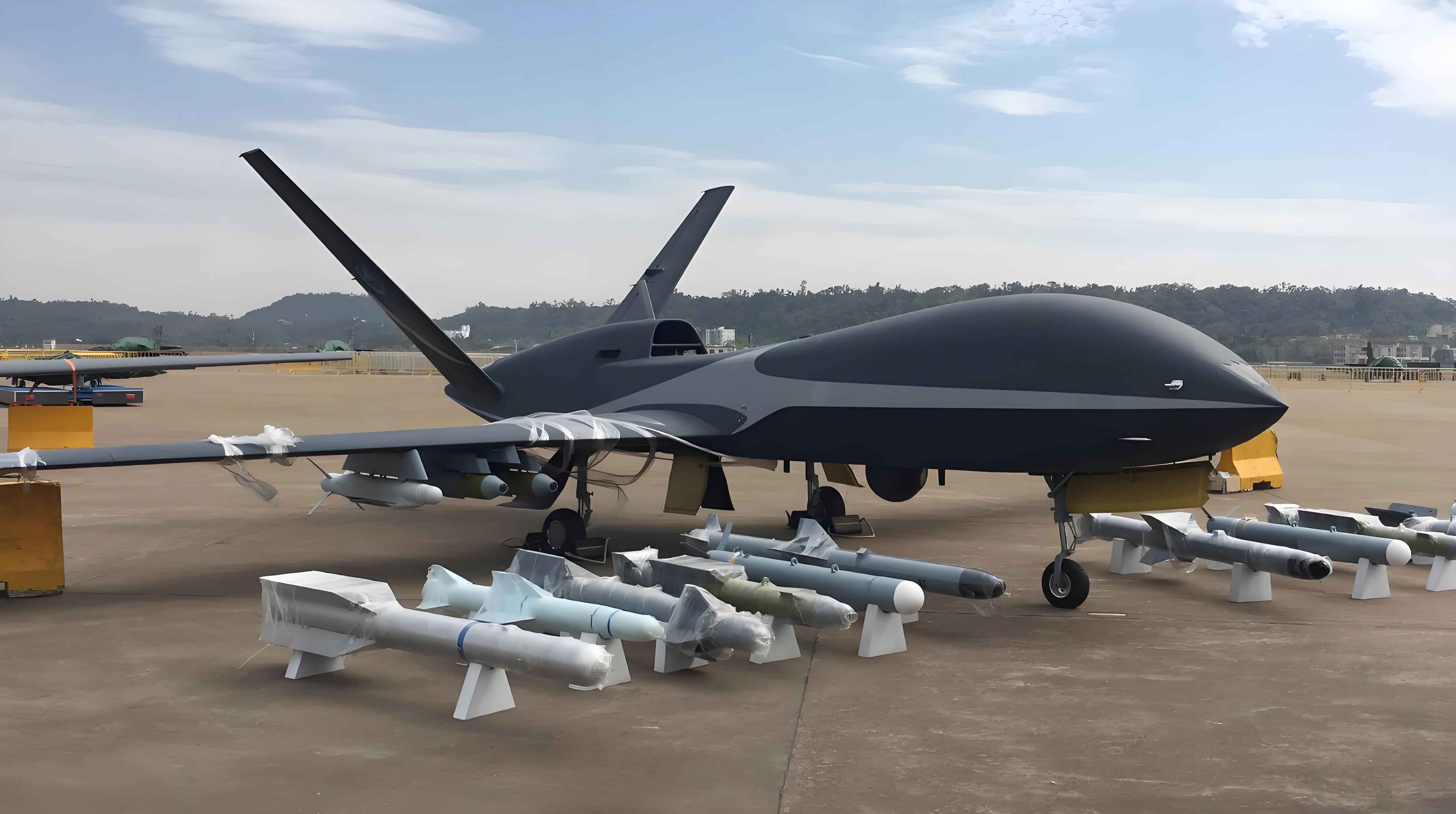
The advent of modern **military UAVs** has fundamentally altered the landscape of warfare. These unmanned systems, executing missions via remote control or pre-programmed autonomous routines, are pivotal assets in information-centric and network-centric warfare. Their successful battlefield deployment heralds a new era dominated by intelligent, long-range precision weaponry, shifting the paradigm towards non-contact engagements. This article explores the defining characteristics, diverse applications, core technologies, and strategic development considerations surrounding **military UAVs**.
### 1. System Composition of a Military UAV
A typical **military UAV** system is an integrated complex comprising several key subsystems:
* **Airframe & Structure:** The physical platform, designed with specific aerodynamic and stealth considerations.
* **Propulsion System:** The power source, ranging from piston engines to advanced turbofans and emerging technologies.
* **Flight Control & Navigation System:** The “brain” and “nervous system,” encompassing autopilots, sensors (IMUs, GPS), and control algorithms for stable flight and path following.
* **Mission Payload:** The “toolkit,” which includes sensors (EO/IR, SAR, SIGINT), communications relays, or weapon systems.
* **Command, Control, and Communications (C3) Link:** The critical data link for transmitting command/control signals and receiving sensor/payload data.
* **Ground Control Station (GCS):** The operator interface for mission planning, monitoring, and control.
* **Launch and Recovery System:** Equipment for safe deployment and retrieval (e.g., catapults, runways, nets, parachutes).
### 2. Defining Characteristics and Advantages
The versatility of **military UAVs** stems from a set of inherent advantages over manned platforms, primarily derived from the removal of the human pilot from the aircraft.
**2.1 Physical and Performance Flexibility**
The design parameters of a **military UAV** are not constrained by human physiological limits, allowing for extreme optimization.
* **Scalable Airframes:** Dimensions can vary drastically. High-Altitude Long-Endurance (HALE) UAVs require large wingspans for lift and solar cell area, while tactical and attack **military UAVs** trend towards compactness for survivability and deployability. Micro-UA Vs (MAVs) measure mere centimeters, and bio-mimetic flapping-wing drones resemble birds or insects.
* **Adaptable Flight Envelopes:** Unburdened by g-force limits on a pilot, UAVs can perform aggressive maneuvers (high-g turns, rapid climbs/dives) to evade threats. They can also operate at very low speeds for covert surveillance or at hypersonic speeds for rapid strike or reconnaissance. This operational envelope can be described by a set of performance parameters:
* Endurance, $T$: Often a key metric for ISR platforms.
* Operational Radius, $R$: Function of fuel/power and communications range.
* Service Ceiling, $H_{max}$.
* Maximum Speed, $V_{max}$.
* **Extended Persistence:** Loiter times range from minutes for tactical MAVs to weeks for solar-powered HALE **military UAVs**, enabling persistent stare over areas of interest.
**2.2 Operational and Survivability Enhancements**
* **Reduced Risk & Cost:** The most cited advantage is the removal of aircrew from risk of capture or casualty. Furthermore, the absence of life-support systems and tolerance for higher g-forces can lead to simpler, lower-cost airframes.
* **Stealth and Low Observability:** Smaller physical size and optimized shapes reduce radar cross-section (RCS). Advanced materials and coatings further diminish signatures across the electromagnetic spectrum (RF, IR, visual).
* **Rugged Deployability:** Diverse launch and recovery methods—catapult, hand-launch, vertical take-off and landing (VTOL), conventional runway—allow operation from forward, unprepared locations, ships, or other aircraft.
The following table contrasts key attributes of different **military UAV** categories:
| UAV Category | Typical Size/Span | Primary Role | Endurance | Key Characteristics |
| :— | :— | :— | :— | :— |
| **HALE (Strategic)** | Large (>25m) | ISR, Communications Relay | Days to Weeks | High altitude, satellite-like persistence |
| **MALE (Tactical)** | Medium (10-20m) | ISR, Strike, ELINT | 24-48 Hours | Multi-role, medium payload capacity |
| **Tactical (Group/Platoon)** | Small (1-5m) | Reconnaissance, Target Designation | 1-6 Hours | Portable, rapid deployment |
| **Attack/Unmanned Combat Air Vehicle (UCAV)** | Medium to Large | Air-to-Ground/ Air-to-Air Strike | Several Hours | High speed, stealth, internal weapons bay |
| **Mini/Micro (MAV)** | Very Small (<0.5m) | Close-range ISR, Indoor ops | <1 Hour | Covert, man-portable, bio-mimetic possible |
### 3. Expansive Spectrum of Military Applications
The utility of **military UAVs** spans the strategic, operational, and tactical levels of warfare.
**3.1 Intelligence, Surveillance, and Reconnaissance (ISR)**
This remains the cornerstone application. **Military UAVs** provide persistent, risk-free collection.
* **Strategic ISR:** HALE UAVs like the Global Hawk orbit at high altitudes, carrying sophisticated SAR and EO/IR sensors to provide wide-area, persistent surveillance, complementing satellite coverage with greater flexibility and often higher resolution.
* **Tactical ISR:** Smaller tactical UAVs provide real-time video and imagery to ground commanders for situational awareness, target identification, and battle damage assessment (BDA). The timely information flow can be modeled as reducing the “sensor-to-shooter” timeline, $t_{s2s}$.
$$ t_{s2s} = t_{detect} + t_{process} + t_{decide} + t_{engage} $$
UAVs minimize $t_{detect}$ and $t_{process}$ through on-board processing and direct data-links.
**3.2 Strike and Combat Operations**
The “hunter-killer” or “**military UAV**” concept integrates sensors and weapons for time-sensitive strikes.
* **Suppression/Destruction of Enemy Air Defenses (SEAD/DEAD):** UAVs can loiter in hostile airspace, identifying and engaging radar emitters with anti-radiation missiles.
* **Close Air Support (CAS) & Interdiction:** Armed UAVs provide precise, persistent fire support for ground troops or strike targets behind enemy lines.
* **Air-to-Air Combat (Emerging):** Next-generation **military UAVs** or “loyal wingmen” are envisioned to operate alongside manned fighters, engaging hostile aircraft and extending the tactical reach of a formation.
**3.3 Information and Electronic Warfare**
**Military UAVs** are ideal platforms for electronic attack (EA) and protection (EP).
* **Electronic Attack (EA):** UAVs can carry jammers to disrupt enemy communications, radars, and GPS signals. Their proximity to the target increases jamming effectiveness, governed by factors like the one-way link equation for jamming power, $P_{j}$:
$$ P_{j} \propto \frac{P_t G_t G_r \lambda^2}{(4\pi R)^2 B_r} $$
Where $P_t$ is jammer power, $G_t$ and $G_r$ are antenna gains, $\lambda$ is wavelength, $R$ is range, and $B_r$ is victim receiver bandwidth.
* **Decoy Operations:** Low-cost UAVs equipped with radar reflectors or infrared emitters can mimic combat aircraft, saturating and confusing enemy air defense systems.
**3.4 Communication and Data Relay**
UAVs act as aerial nodes to extend and resilientify networks.
* **Network Extension:** A **military UAV** can serve as a communications relay, connecting dispersed ground units beyond line-of-sight (LOS) or linking forward units to rear command centers.
* **Resilient Networking:** In a contested environment where satellites or ground networks are degraded, a mesh network of UAVs can provide a survivable, ad-hoc communications backbone.
### 4. Core Technological Drivers
The rapid evolution of **military UAVs** is fueled by breakthroughs in several key technological domains.
**4.1 Autonomy and Artificial Intelligence (AI)**
Moving beyond remote piloting towards intelligent autonomy is the paramount trend.
* **Advanced Autonomy:** This encompasses automatic take-off/landing, adaptive route planning, and complex swarm behaviors. Swarm intelligence, inspired by biological systems, allows numerous simple UAVs to collectively perform complex tasks (surveillance, jamming) through local rules. A simple model for swarm cohesion might involve potential fields or boid-like rules for separation, alignment, and cohesion.
* **AI/ML for Processing:** Machine learning algorithms enable real-time automatic target recognition (ATR), sensor data fusion, and predictive maintenance, reducing the cognitive load on human operators.
**4.2 Propulsion and Power Systems**
Endurance and performance are dictated by the powerplant.
* **Conventional & Advanced Engines:** While piston and turboprop engines dominate today, the push for higher speed and altitude drives development in turbojet, turbofan, and combined-cycle engines (e.g., Turbine-Based Combined Cycle for hypersonics).
* **Alternative Energy:** For extreme endurance, technologies like hydrogen fuel cells and high-efficiency solar panels paired with energy-dense batteries are critical. The power balance for a solar-powered HALE UAV must satisfy:
$$ P_{solar}(t) \cdot \eta_{charge} \geq P_{payload}(t) + P_{avionics}(t) + P_{propulsion}(t) + P_{losses} $$
where $P_{solar}$ varies with time of day and altitude.
**4.3 Stealth and Low-Observable (LO) Technologies**
Survivability in contested airspace is non-negotiable for high-value **military UAVs**.
* **Shaping:** Careful design of airframe contours, aligned edges, and internal weapon bays to deflect radar waves away from the source.
* **Materials:** Extensive use of radar-absorbent materials (RAM) and structures (RAS) to dissipate incident radar energy. Composite materials also reduce weight and can have inherent LO properties.
* **Multi-Spectral Signature Management:** Advanced coatings manage infrared (IR), visual, and acoustic signatures. Emerging concepts like plasma stealth and active cancellation are areas of research.
**4.4 Networking and Connectivity**
The value of a **military UAV** multiplies when integrated into a broader network.
* **Data Links:** Secure, resilient, high-bandwidth data links (e.g., Common Data Link (CDL), Tactical Targeting Network Technology (TTNT)) are essential for streaming sensor data and controlling the UAV. Anti-jam and low-probability-of-intercept (LPI) features are critical.
* **Manned-Unmanned Teaming (MUM-T):** Technologies enabling seamless communication and collaboration between manned aircraft (e.g., fighters, command posts) and **military UAVs**. This allows a single pilot to act as a “mission commander” for a group of UAVs.
**4.5 Modularity and Open Systems Architecture**
To control costs and enable rapid upgrades, modern **military UAV** designs emphasize modularity.
* **Plug-and-Play Payloads:** Standardized mechanical, power, and data interfaces allow sensors and effectors to be swapped quickly based on mission needs.
* **Open Mission Systems (OMS):** Software architectures that allow third-party applications to be integrated easily, fostering innovation and reducing vendor lock-in.
### 5. Key Considerations for Development and Integration
The proliferation of **military UAVs** necessitates holistic thinking that goes beyond mere platform acquisition.
**5.1 Balancing Offensive and Defensive Postures**
As one develops advanced **military UAVs**, one must simultaneously invest in counter-UAV (C-UAS) technologies. The offense-defense dynamic is perpetual. Effective C-UAS requires a layered approach combining radar/electro-optical detection, electronic warfare (jamming, spoofing), kinetic interceptors, and even directed energy weapons.
**5.2 Integrating with Legacy and Next-Gen Forces**
**Military UAVs** do not operate in a vacuum. Their development must be synchronized with:
* **Legacy Systems:** Ensuring data compatibility and tactical communication with existing air, land, and sea platforms.
* **New Warfighting Concepts:** Aligning UAV capabilities with emerging doctrines like Joint All-Domain Command and Control (JADC2), which requires seamless data sharing across all services.
**5.3 The Cyber and Electromagnetic Domains**
A **military UAV** is fundamentally a node in the cyber-electromagnetic spectrum. Its C2 links and onboard software are prime targets. Development must prioritize:
* **Cybersecurity:** Hardening against hacking, spoofing, and data corruption throughout the design lifecycle.
* **Electronic Resilience:** Ensuring operations can continue or gracefully degrade in heavily jammed or contested electromagnetic environments.
**5.4 Ethical, Legal, and Operational Doctrine**
The autonomous or remotely operated nature of **military UAVs**, especially armed ones, raises significant questions. It is imperative to develop:
* **Clear Rules of Engagement (ROE):** Defining the decision-making process for the use of lethal force, ensuring appropriate human judgment is involved (“human-in-the-loop” or “human-on-the-loop”).
* **Operational Doctrine:** Detailed tactics, techniques, and procedures (TTPs) for how different classes of UAVs will be used in conjunction with other forces to achieve tactical and strategic objectives.
### 6. Conclusion
The trajectory of **military UAV** development points towards greater autonomy, increased connectivity, and deeper integration into the combined arms team. From silent, persistent observers to agile, networked swarms and penetrating strike assets, the **military UAV** has cemented its role as a transformative technology in modern warfare. The future battlespace will increasingly be shaped by the interaction of intelligent unmanned systems, where success will depend not only on the technological sophistication of individual platforms but on the robustness of the networks that connect them and the wisdom of the doctrines that guide their employment. The continued evolution of **military UAVs** will remain a critical area of focus for defense establishments worldwide, demanding balanced investments in technology, operational concepts, and the human expertise to wield them effectively.