
From my perspective, the strategic and tactical landscape of modern warfare is being fundamentally reshaped by the proliferation and advancement of unmanned systems. The term ‘military drone’ no longer signifies a niche reconnaissance tool but encompasses a broad, sophisticated family of aerial systems central to defense planning. As I analyze the trajectory, it becomes clear that we are in the early stages of a profound shift, where the ‘military drone’ will assume roles of increasing responsibility, from persistent intelligence, surveillance, and reconnaissance (ISR) to direct combat and force multiplication. This analysis delves into the quantitative market forecasts, technological drivers, and strategic implications of this global phenomenon.
The demand for unmanned capabilities is experiencing exponential growth globally. Based on industry reports and defense budget analyses, I project a significant expansion in expenditure over the coming decade. The following table encapsulates the core market forecast for military drone systems, highlighting the transition from a substantial current investment to a near-dominant position in future aerial procurement.
| Metric | 2015 Benchmark | 2024 Projection | 10-Year Aggregate (2015-2024) | Compound Annual Growth Rate (CAGR) |
|---|---|---|---|---|
| Global Military Drone Annual Expenditure | $57 Billion | $99 Billion | $810 Billion | ~6.33% |
| Share of New Military Aircraft Delivery Value | ~8% (2010) | ~15% (2018 Est.) | N/A | N/A |
| Share of New Military Aircraft Delivery Units | ~35% (2010) | ~49% (2018 Est.) | N/A | N/A |
This data reveals a critical insight: the ‘military drone’ is growing not just in absolute financial terms but also in its relative importance within air forces. The unit share nearing 50% indicates a force structure transformation. The growth is not uniform and can be modeled as a function of technological maturity (T), operational necessity (O), and budgetary constraints (B). A simplified representation of the annual market size (M_t) could be:
$$ M_t = (M_0 \cdot e^{gt}) \cdot \frac{T_t \cdot O_t}{B_t} $$
Where \( M_0 \) is the initial market size, \( g \) is the base growth rate, and \( T_t \), \( O_t \), and \( B_t \) are time-variant coefficients for technology, operational need, and budget pressure, respectively. Currently, \( T_t \) and \( O_t \) are high drivers, while \( B_t \) acts as a modulating factor that varies by region.
Regional Market Dynamics and Segmentation
From my analysis, the global market for military drone systems is bifurcating. Established markets are focusing on high-end, networked capabilities, while emerging markets are driving demand for scalable, cost-effective solutions. The United States remains the single largest market and technology pioneer, with programs spanning from Group 1 mini-drones to Group 5 strategic platforms. However, the most dynamic growth is occurring elsewhere. Nations across the Middle East, Asia-Pacific (notably China, India, and South Korea), and Eastern Europe are rapidly building indigenous ‘military drone’ capabilities or procuring from international suppliers. Regions like South America and Africa represent latent markets with significant long-term potential as costs decrease and operational proofs of concept proliferate.
The ‘military drone’ market can be segmented by role, altitude, and endurance, each with distinct growth curves and technological requirements.
| Military Drone Market Segmentation & Forecast (Representative) | ||
|---|---|---|
| Segment | Key Characteristics | 2020 Market Value Projection |
| Tactical UAS | Medium Altitude, Long Endurance (MALE); Company/Battalion-level asset. | Largest segment by demand |
| Combat UAS (UCAV) | Weaponized, high-performance; often stealth characteristics. | ~$3 Billion (70%+ CAGR from mid-2010s) |
| Strategic UAS | High Altitude, Long Endurance (HALE); theater-wide coverage. | ~$2.1 Billion |
| Small/Mini/Micro UAS | Hand-launched, squad-level ISR; very high unit numbers. | Highest volume, lower unit cost |
The forecast for the combat ‘military drone’ segment is particularly striking. Its projected CAGR exceeding 70% over a five-year period signifies a strategic pivot towards delegating strike missions to unmanned platforms. The demand for a new generation ‘military drone’ can be expressed as a function of required fleet size (N), unit cost (C), and refresh rate (R, typically 15-20 years). For a nation aiming to replace a portion of its manned fleet, the procurement cost over a period P is:
$$ \text{Procurement Cost} = \sum_{t=1}^{P} (N_t \cdot C_t) $$
$$ \text{where } N_t = f(\text{Doctrine Shift, Threat Level, Attrition}) $$
The domestic Chinese market exemplifies this rapid expansion. My assessment aligns with projections indicating its ‘military drone’ market will grow from approximately $570 million in 2013 to over $2 billion by 2022, representing a domestic CAGR of around 15%. This growth is fueled by heavy state investment in R&D and a clear strategic focus on achieving parity and then advantage in unmanned systems. The procurement share of a ‘military drone’ as a percentage of total equipment spending, currently around 0.5%, is poised to rise significantly, mirroring the U.S. trajectory from earlier decades.
Technological Evolution as a Cost and Capability Driver
The advancement of the ‘military drone’ is inextricably linked to breakthroughs in materials science, propulsion, and manufacturing. A prime example is the evolution in airframe construction. Next-generation platforms are moving aggressively towards advanced composites to achieve radical improvements in performance, durability, and cost. The development of platforms like the V-280 Valor tiltrotor, while a manned-unmanned teaming candidate, showcases technologies directly transferable to high-performance ‘military drone’ design.
The key innovation lies in moving beyond traditional aluminum and simple laminate structures. The use of carbon fiber reinforced polymers (CFRP) in primary structures—wings, fuselage, and empennage—is becoming standard. The economic driver is a manufacturing paradigm shift. For instance, replacing conventional skin-stringer assemblies with integrated “Large Cell Carbon Core” structures can lead to reported cost reductions exceeding 30% for a complex component like a wing, while simultaneously reducing part count and improving structural efficiency. This has a direct impact on the lifecycle cost (LCC) equation for a ‘military drone’:
$$ LCC = C_{\text{Acquisition}} + C_{\text{Operations}} + C_{\text{Maintenance}} $$
$$ \text{Where } C_{\text{Acquisition}} = C_{\text{Materials}} + C_{\text{Labor}} + C_{\text{Integration}} $$
Advanced composites lower \( C_{\text{Labor}} \) and \( C_{\text{Integration}} \) through part consolidation and automated fabrication (e.g., automated fiber placement). They also reduce \( C_{\text{Maintenance}} \) due to superior corrosion and fatigue resistance compared to metals. The integration of such a wing and fuselage represents a major milestone in producing a more capable and affordable platform. This technological trend makes advanced ‘military drone’ capabilities accessible to a wider range of defense budgets.
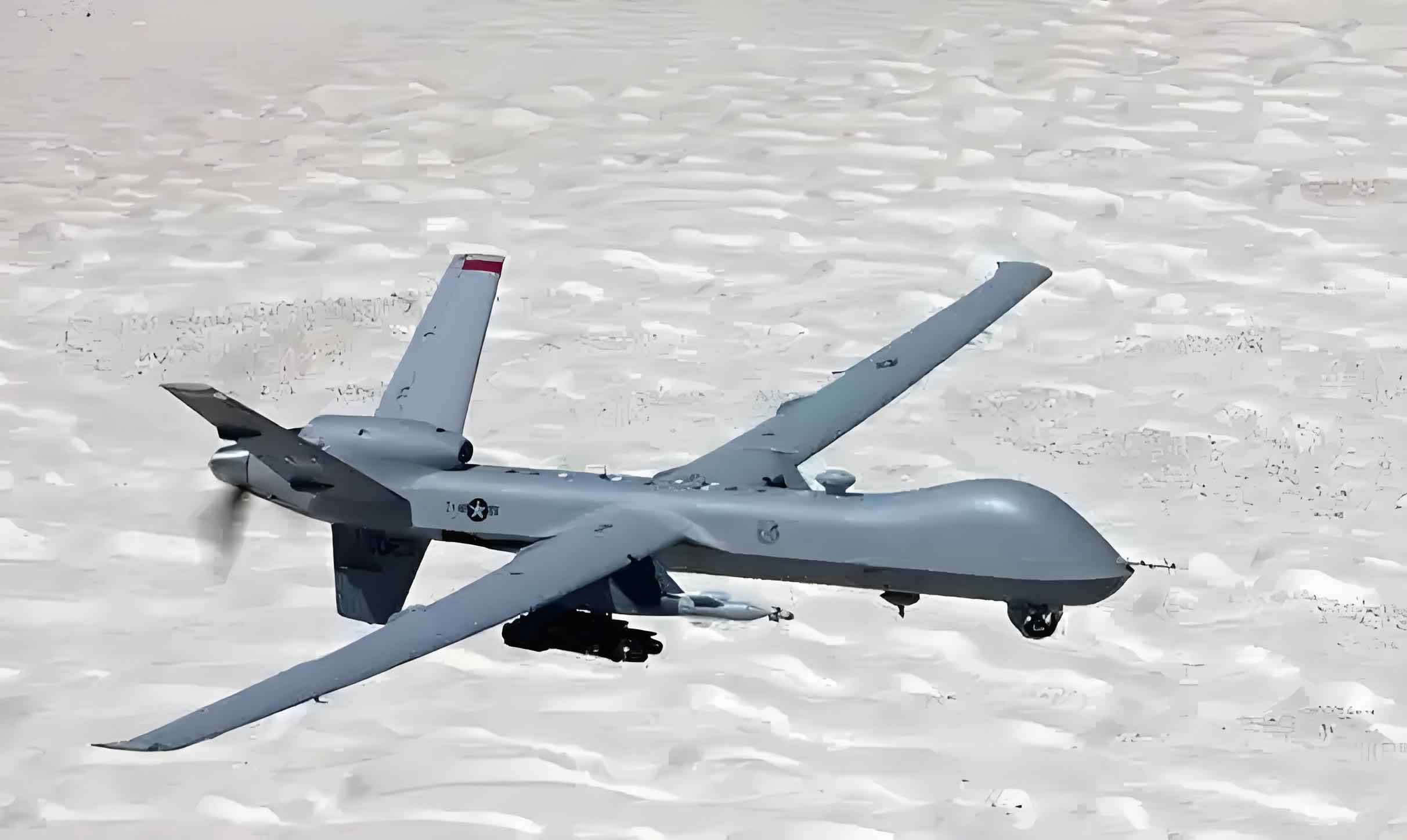
Furthermore, propulsion and power systems are evolving. The shift towards more efficient turboprop and turboshaft engines, and eventually hybrid-electric systems, directly increases the endurance and payload capacity of a ‘military drone’. The integration of these systems into optimized composite airframes creates a virtuous cycle of capability enhancement. The formula for endurance (E) highlights these dependencies:
$$ E \approx \frac{\eta \cdot \zeta \cdot \ln(\frac{m_{\text{initial}}}{m_{\text{final}}})}{g \cdot \text{SFC}} $$
Where \( \eta \) is propulsion efficiency, \( \zeta \) is the lift-to-drag ratio (greatly improved by advanced aerodynamics and lightweight structures), SFC is specific fuel consumption, and the mass ratio term is favored by lighter composite airframes. Every advance in materials and propulsion directly extends the operational reach of the ‘military drone’.
Strategic Implications and Force Structure Trajectory
The quantitative data and technological trends point towards an unambiguous strategic conclusion: the ‘military drone’ will become a central, if not dominant, component of 21st-century air power. We are witnessing a transition similar to the shift from propeller-driven to jet aircraft. Air forces are actively planning for a future where unmanned platforms constitute a major percentage of their inventory. The Israeli Air Force’s public goal of having over 50% of its fleet be unmanned by 2030 is a leading indicator. The U.S. Department of Defense’s long-range vision of 40% unmanned platforms by 2050 may prove conservative if current adoption rates accelerate.
This transformation will be phased. In the near term (next 5-10 years), the growth will be led by tactical and strategic ISR platforms and armed medium-altitude ‘military drone’ systems. In the medium term (10-20 years), we will see the operational introduction of loyal wingman-type drones and more sophisticated autonomous combat vehicles. The long-term vision includes fully autonomous swarms and high-performance stealth unmanned combat air vehicles (UCAVs) undertaking the most dangerous penetration missions. The demand for these advanced ‘military drone’ systems can be modeled on an S-curve adoption pattern:
$$ \text{Adoption Rate}(t) = \frac{1}{1 + e^{-k(t – t_0)}} $$
Where \( t_0 \) is the inflection point and \( k \) is the growth rate constant. I assess that the global ‘military drone’ market for high-end systems is currently on the steep upward slope of this curve. The procurement numbers support this: estimates suggest a future 20-year requirement for 750-1000 unmanned combat aircraft in some major markets, translating to an average annual demand of over 50 units, a figure that would represent a massive industrial undertaking.
Challenges and Concluding Synthesis
Despite the optimistic forecasts, the path forward for the ubiquitous ‘military drone’ is not without challenges. Regulatory frameworks for airspace integration, especially in contested electromagnetic environments, are lagging. Ethical and legal questions regarding autonomous lethal decision-making remain unresolved. Furthermore, the proliferation of these technologies lowers the barrier to entry for asymmetric threats, creating new defense dilemmas. The cost equation, while improving, still places cutting-edge ‘military drone’ systems out of reach for many nations, though this gap is narrowing due to the very manufacturing and design innovations discussed.
In my final analysis, the convergence of market demand, technological innovation, and strategic necessity creates a powerful, self-reinforcing cycle. The data indicates a global ‘military drone’ market that is robust, growing, and transitioning from early adoption to mainstream integration. The shift towards composite-intensive manufacturing is a critical enabler, reducing costs and enabling performance parameters—range, endurance, survivability—that were previously unattainable. As platforms evolve from simple remotely piloted vehicles to networked, intelligent nodes in a larger combat system, the very definition of air power is changing. The nation or alliance that most effectively masters the development, production, and operational integration of this new generation of ‘military drone’ will secure a decisive advantage in the future security environment. The next decade will be pivotal in determining the balance of power in this unmanned arena.