
The proliferation of unmanned aerial vehicles (UAVs) has fundamentally reshaped the modern battlespace. From tactical reconnaissance to coordinated swarm attacks, the anti-UAV challenge has become a paramount concern for defense forces worldwide. As a systems analyst focused on electronic warfare and integrated air defense, I observe that traditional kinetic solutions are often economically and tactically unsustainable against low-cost, numerous drone threats. This reality has propelled directed energy weapons, particularly High-Power Microwave (HPM) systems, to the forefront of next-generation anti-UAV research and deployment. The core promise of HPM technology lies in its ability to engage multiple targets at the speed of light, with a single shot having the potential to disable an entire swarm—a capability that redefines the cost-exchange ratio in favor of the defender.
The operational effectiveness of any anti-UAV system, however, is not solely determined by its raw power output. It hinges on a sophisticated decision-making cycle that begins with rapid threat assessment and prioritization. In this context, the methodologies used for radar database generation and target ranking, such as Multi-Attribute Decision Making (MADM), become directly relevant to the anti-UAV mission. We can conceptualize the incoming drone threat as a set of targets characterized by multiple, often conflicting, attributes. To allocate defensive resources optimally—whether they are HPM beams, laser interceptors, or electronic jammers—we must first rank these threats effectively.
Let me outline a generalized framework for anti-UAV threat assessment. Suppose we have a set of \( n \) UAV threats, \( U = \{U_1, U_2, …, U_n\} \), and a set of \( m \) evaluation criteria, \( C = \{C_1, C_2, …, C_m\} \). These criteria could include:
- \( C_1 \): Speed and maneuverability
- \( C_2 \): Radar cross-section (RCS)
- \( C_3 \): Observed payload or weaponization indicators
- \( C_4 \): Proximity to defended asset
- \( C_5 \): Behavioral intent (e.g., attack pattern, loitering)
Each UAV \( U_i \) receives a performance rating \( x_{ij} \) for each criterion \( C_j \). The core challenge is to synthesize these diverse ratings into a single threat priority score \( T_i \). A fundamental model is the weighted sum approach:
$$ T_i = \sum_{j=1}^{m} w_j \cdot x_{ij} $$
where \( w_j \) is the weight of criterion \( C_j \), subject to \( \sum_{j=1}^{m} w_j = 1 \) and \( w_j \geq 0 \). The determination of these weights is critical and non-trivial.
This is where analytical methods like the Analytic Hierarchy Process (AHP) prove invaluable for anti-UAV command and control. AHP provides a structured technique for organizing and analyzing complex decisions by breaking down the problem into a hierarchy. For our anti-UAV scenario, the goal (“Maximize Defensive Effectiveness”) sits at the top. The criteria (Speed, RCS, etc.) form the second level. The alternatives (the individual UAVs) form the third level. Decision-makers perform pairwise comparisons, judging the relative importance of one criterion over another (e.g., “Is Proximity more important than Speed for threat assessment?”). These judgments are formatted into a pairwise comparison matrix \( A \):
$$ A = [a_{kl}] = \begin{bmatrix}
1 & a_{12} & \cdots & a_{1m} \\
a_{21} & 1 & \cdots & a_{2m} \\
\vdots & \vdots & \ddots & \vdots \\
a_{m1} & a_{m2} & \cdots & 1
\end{bmatrix} $$
where \( a_{kl} \) represents the relative importance of criterion \( k \) over criterion \( l \), and \( a_{lk} = 1 / a_{kl} \). The principal eigenvector of this matrix yields the normalized weight vector \( \mathbf{w} = (w_1, w_2, …, w_m)^T \). Consistency of judgments is verified using the Consistency Index (CI) and Consistency Ratio (CR):
$$ CI = \frac{\lambda_{max} – m}{m – 1}, \quad CR = \frac{CI}{RI} $$
where \( \lambda_{max} \) is the principal eigenvalue and \( RI \) is the Random Index. A \( CR < 0.1 \) is generally acceptable. This rigorous process moves anti-UAV prioritization from intuition to quantified, defensible analysis.
To illustrate the application of this MADM framework in an anti-UAV context, consider the following hypothetical scenario with five detected UAVs. The performance ratings \( x_{ij} \) are normalized, and the weights \( w_j \) derived from an AHP process.
| UAV ID | Speed (C1) w=0.25 | RCS (C2) w=0.15 | Payload (C3) w=0.30 | Proximity (C4) w=0.20 | Intent (C5) w=0.10 | Threat Score \( T_i \) | Priority Rank |
|---|---|---|---|---|---|---|---|
| UAV-α | 0.9 | 0.2 | 0.8 | 0.7 | 0.9 | 0.755 | 1 |
| UAV-β | 0.7 | 0.8 | 0.6 | 0.9 | 0.5 | 0.700 | 2 |
| UAV-γ | 0.5 | 0.5 | 1.0 | 0.4 | 1.0 | 0.675 | 3 |
| UAV-δ | 0.8 | 0.3 | 0.3 | 0.6 | 0.7 | 0.520 | 4 |
| UAV-ε | 0.3 | 0.9 | 0.2 | 0.3 | 0.3 | 0.345 | 5 |
The calculation for UAV-α is: \( T_α = (0.25*0.9) + (0.15*0.2) + (0.30*0.8) + (0.20*0.7) + (0.10*0.9) = 0.755 \). This quantitative output directly informs the fire control sequence for anti-UAV assets.
Now, let’s integrate the HPM system as the primary effector. The engagement envelope of an HPM system is governed by physics distinct from kinetic weapons. A key metric is the power density \( S \) at a range \( R \) from the antenna. Using the Friis transmission formula as a starting point and assuming a directive antenna, we can express this as:
$$ S = \frac{P_t G_t}{4 \pi R^2} \cdot L_{atm} $$
where:
- \( P_t \) is the transmitted peak power.
- \( G_t \) is the antenna gain.
- \( R \) is the distance to the target.
- \( L_{atm} \) is the atmospheric loss factor (a function of frequency, humidity, etc.).
For an HPM system to achieve a disruptive or destructive effect on a UAV’s electronics, the incident power density \( S \) must exceed a certain vulnerability threshold \( S_{th} \) specific to that class of UAV’s electronic hardening. This creates a maximum effective range \( R_{max} \) for a given system configuration:
$$ R_{max} \propto \sqrt{\frac{P_t G_t}{S_{th}}} $$
This relationship highlights why advancements in compact, high-power microwave sources and efficient antennas are so crucial for practical, mobile anti-UAV HPM systems. The goal is to make \( P_t G_t \) (the Effective Radiated Power) as high as possible within size, weight, and power (SWaP) constraints.
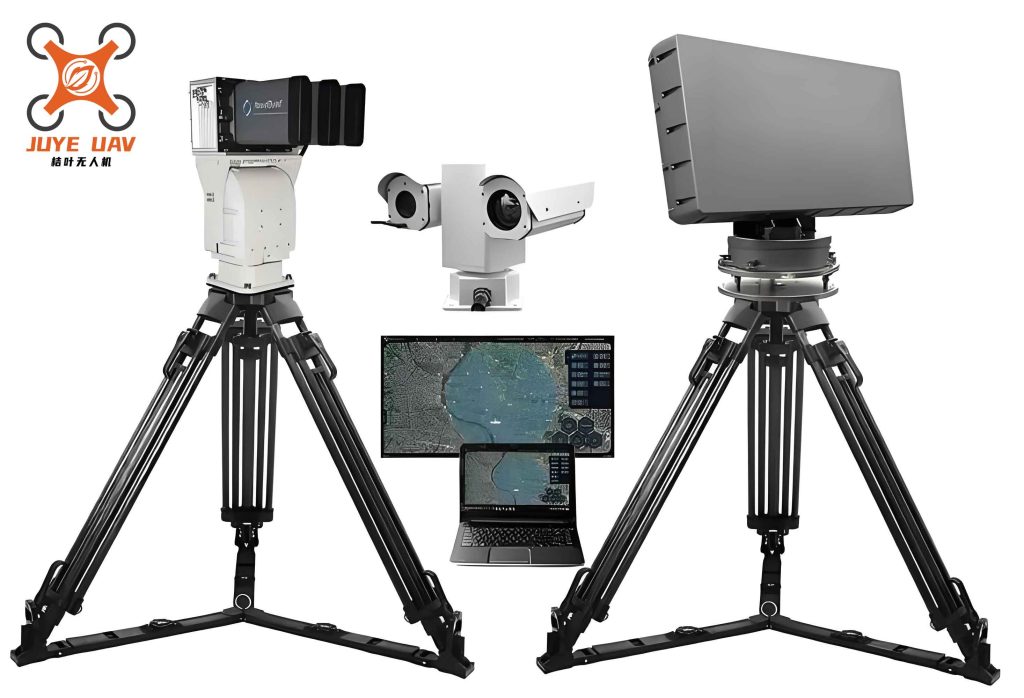
The synergy between advanced decision-making and directed energy is the cornerstone of modern anti-UAV architecture. An integrated system must perform a continuous OODA loop (Observe, Orient, Decide, Act). The “Observe” phase involves a sensor suite (radar, EW, electro-optical) building the threat database. The “Orient” and “Decide” phases employ the MADM/AHP models discussed to prioritize threats in real-time. Finally, the “Act” phase engages the highest-priority threat within the HPM’s engagement basket. This process can be modeled as an optimization problem subject to constraints:
Maximize: \( \sum_{i=1}^{n} T_i \cdot y_i \)
Subject to:
$$ \sum_{i=1}^{n} y_i \leq E_{total} $$
$$ y_i \in \{0, 1\} $$
$$ S_i(R_i) \geq S_{th}(U_i) \quad \text{for any } y_i = 1 $$
Where \( y_i \) is a binary decision variable (1 if UAV \( i \) is engaged, 0 otherwise), \( E_{total} \) is the total available “engagement resource” (which for an HPM system could be the number of shots before cooldown or the total energy budget), and the last constraint ensures the UAV is within the effective range for its specific hardness.
Let’s examine the key performance parameters of a notional advanced HPM system designed for counter-swarm anti-UAV missions. These parameters directly feed into the constraints of the engagement model above.
| Parameter | Symbol | Value | Unit |
|---|---|---|---|
| Peak Radiated Power | \( P_t \) | 100 – 500 | MW |
| Antenna Gain | \( G_t \) | 30 – 50 | dBi |
| Pulse Repetition Frequency | PRF | 10 – 100 | Hz |
| Central Frequency | \( f_c \) | 1 – 10 | GHz |
| Effective Range (vs. Group 1/2 UAVs) | \( R_{max} \) | 500 – 1500 | m |
| Behold Angle (Azimuth x Elevation) | – | 60° x 30° | deg |
| Target Revisit Time | \( T_{rev} \) | < 2 | s |
| System Reaction Time | \( T_{react} \) | < 5 | s |
The “Behold Angle” and “Target Revisit Time” are particularly important for swarm defense. A wide behold angle allows the system to engage multiple dispersed drones within a single pulse or a rapid sequence. The fast revisit time enables effects assessment and follow-on engagement if necessary, closing the kill chain rapidly in a dynamic anti-UAV fight.
Looking forward, the development trajectory for HPM-based anti-UAV systems focuses on several key areas. First, improving power source efficiency and thermal management to allow for higher duty cycles and more engagements per mission. Second, integrating artificial intelligence and machine learning (AI/ML) directly into the MADM loop. Instead of static weights from AHP, an AI model could dynamically adjust criteria weights \( w_j(t) \) based on the tactical context, learned adversary patterns, and observed swarm behaviors. The threat score could become a dynamic, predictive measure:
$$ T_i(t) = f( \mathbf{x}_i(t), \mathbf{w}(t), \mathbf{h}(t) ) $$
where \( \mathbf{h}(t) \) represents a hidden state from a recurrent neural network modeling temporal threat evolution. Third, the move towards networked, cooperative HPM systems. Multiple emitters could be synchronized to concentrate energy on a single high-value target or to create overlapping zones of coverage for area denial against UAV swarms. The combined power density from \( N \) cooperative systems at a point in space can be approximated (ignoring complex interference effects) as:
$$ S_{coop} \approx \sum_{k=1}^{N} \frac{P_{t,k} G_{t,k}}{4 \pi R_k^2} $$
This cooperative approach could significantly extend the effective defended area and complicate the attacker’s mission planning.
In conclusion, the fight against adversarial UAVs is a complex systems challenge demanding a fusion of advanced physics, real-time decision science, and robust systems engineering. The HPM effector provides a game-changing kinematic capability for scalable anti-UAV defense, particularly against swarms. However, its potential is fully unlocked only when coupled with intelligent, automated decision-making frameworks that can rapidly prioritize threats from a sea of contacts. By formalizing the threat assessment process through Multi-Attribute Decision Making and hierarchical analysis, and by tightly integrating this with the physical engagement model of HPM systems, we move closer to achieving a decisive, sustainable advantage in the critical domain of anti-UAV warfare. The continuous refinement of both the “brain” (the decision algorithms) and the “muscle” (the directed energy effector) will define the next generation of integrated air and missile defense architectures.