
As a military strategist with decades of experience in aerospace technology, I have observed the rapid ascent of military drones from mere reconnaissance tools to pivotal assets in modern warfare. The Gulf War and Kosovo conflict marked turning points, where these unmanned systems excelled in missions such as surveillance, target acquisition, and deception, capturing global military attention. Based on these successes, predictions emerged that by 2040, fewer than 10% of combat aircraft might be manned, with high-performance military drones advancing toward automation, intelligence, stealth, and endurance—capable of loitering at high altitudes for months and delivering precise strikes upon command. I am convinced that as cutting-edge technologies permeate aviation, 21st-century military drones will see profound advancements in stealth, endurance, miniaturization, and offensive capabilities, reshaping future air combat landscapes.
The integration of military drones into operational theaters has been nothing short of revolutionary. Initially deployed in the Vietnam War during the 1960s, their role expanded in recent conflicts, notably in NATO operations against Yugoslavia. However, vulnerabilities in stealth led to high attrition rates. In today’s asymmetric, non-contact warfare emphasizing long-range strikes and precision, enhancing the stealth of military drones has become a critical imperative. Nations like Israel, with rich expertise in models such as Scout and Harpy, now focus on developing high-altitude, long-endurance stealth drones to evade missile threats. Similarly, the U.S. Navy prioritizes stealth in its drone contracts. While stealth technologies for military drones are still evolving, advancements in radar-absorbent materials and design will undoubtedly bolster their survivability. For instance, radar cross-section reduction can be modeled by the equation: $$RCS = \frac{4\pi A^2}{\lambda^2}$$, where \(A\) is the target area and \(\lambda\) the radar wavelength, illustrating how minimizing physical signatures enhances invisibility.
| Country/Entity | Drone Model | Primary Role | Stealth Features | Status |
|---|---|---|---|---|
| Israel | Classified HALE Stealth Drone | Interceptor/Attack | Low-observable materials, integrated air-to-air missiles | Under development |
| United States | Naval Stealth UAV | Reconnaissance/Strike | Reduced infrared and radar signatures | Contract phase |
| Global Trends | Various prototypes | Multi-role | Advanced composites, shape optimization | R&D ongoing |
Long-endurance military drones, defined by loiter times exceeding 24 hours—or even 48 hours by some standards—address the need for persistent surveillance. Traditional reconnaissance and satellite gaps necessitate real-time aerial platforms over battlefields. Enhanced electronic warfare and camouflage tactics further drive demand for extended endurance. I have analyzed how strategic surveillance drones, operating above 20,000 meters, require prolonged flight to cover vast areas, while tactical variants support pre-, during-, and post-operation assessments. The endurance time \(T\) can be expressed as: $$T = \frac{E_{total}}{P_{avg}}$$, where \(E_{total}\) is the total energy available and \(P_{avg}\) the average power consumption. Advances in solar power and efficient propulsion are pushing these limits, as seen in projects like the solar-powered drone aiming for year-long flights.
| Drone Model | Operational Altitude (meters) | Endurance Time | Primary Mission | Notable Features |
|---|---|---|---|---|
| Global Hawk | 20,000+ | 40 hours | Strategic reconnaissance | Can detect 1,000 targets daily from 5,500 km base |
| Solar-Powered UAV (Lockheed Martin) | 30,000+ | Up to 1 year | Persistent surveillance | Solar cells, 2 kW electric motor |
| Predator | 7,600 | 24+ hours | Tactical surveillance/strike | Laser designation, real-time data relay |
Miniaturization of military drones, with wingspans under 15 centimeters, is revolutionizing special operations and urban warfare. These micro drones are nearly undetectable by radar or infrared sensors, operating silently to infiltrate architectural dead zones for surveillance or payload delivery. As an advocate for niche technologies, I foresee nanotechnology and micro-sensor advances propelling this field. Current prototypes, like those in DARPA’s program, weigh mere grams and carry micro-GPS and cameras. The scaling law for miniaturization can be approximated by: $$F_{drag} \propto \rho v^2 L^2$$, where \(\rho\) is air density, \(v\) velocity, and \(L\) characteristic length, highlighting design challenges as size decreases.
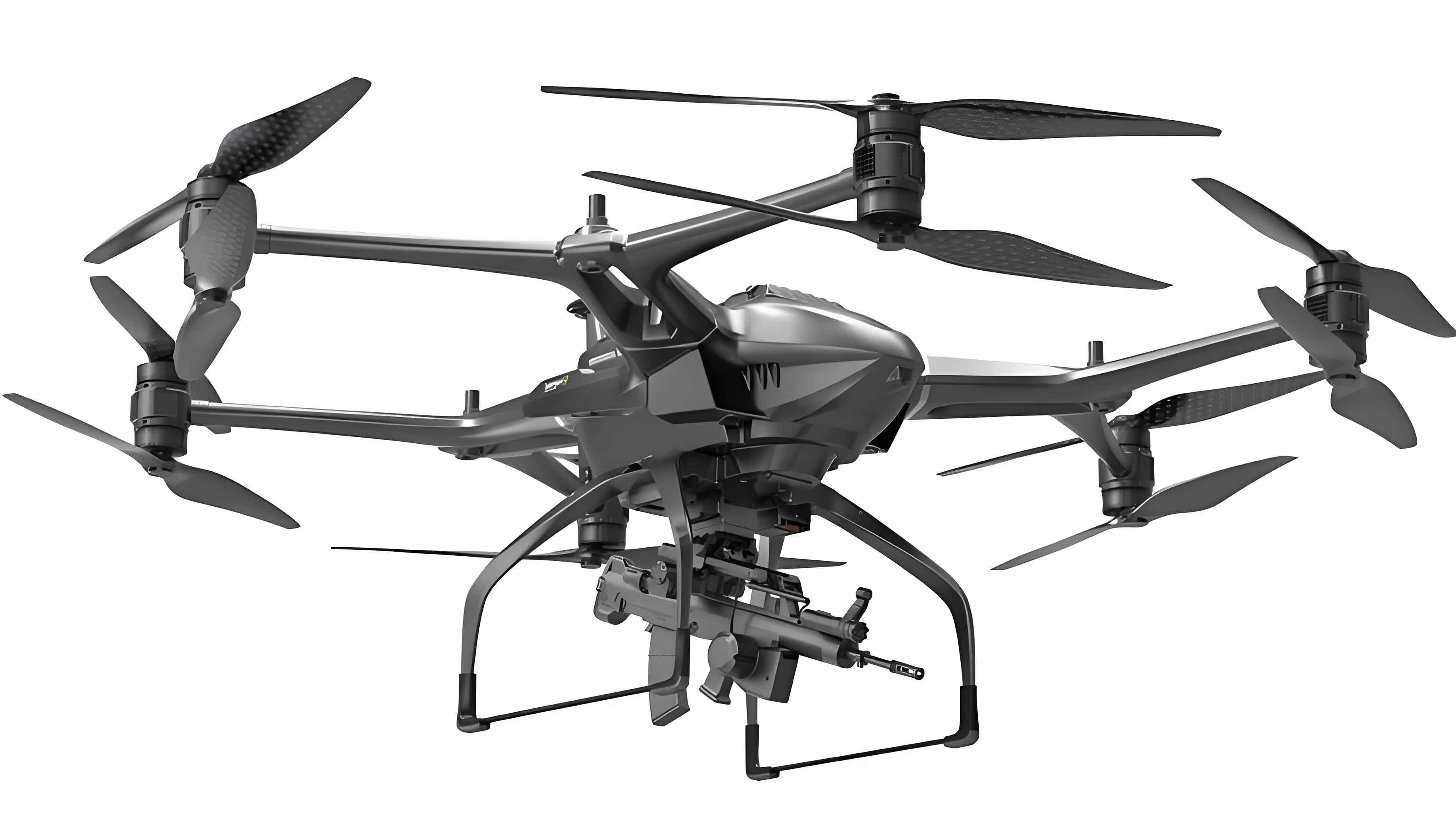
The offensive capabilities of military drones have expanded beyond support roles into direct combat. Two primary types dominate: self-destructive attack drones, like anti-radiation variants that home on enemy emissions, and reusable unmanned combat aerial vehicles (UCAVs) controlled remotely for air-to-ground or air-to-air missions. From my perspective, UCAVs offer significant advantages—reduced casualties, political risks, and the ability to penetrate hostile zones with various payloads. Compared to manned fighters, they can achieve higher agility factors, expressed as: $$A_g = \frac{T}{W} \cdot \frac{L}{D}$$, where \(T\) is thrust, \(W\) weight, \(L\) lift, and \(D\) drag. Nations like the UK, France, and the U.S. are actively developing UCAV demonstrators, with projections that by 2040, they may dominate fighter fleets alongside fourth-generation aircraft.
| Country | Project/Model | Key Specifications | Roles | Expected Service Timeline |
|---|---|---|---|---|
| United Kingdom | Taranis UCAV | Stealth design, autonomous systems | Deep strike, reconnaissance | Under testing, potential post-2030 deployment |
| France | nEUROn Demonstrator | Length: 10m, weight: 7,000 kg, speed: Mach 0.8 | Ground attack, air combat | Flight tests ongoing |
| United States | X-47B / Unmanned Tactical Fighter | Carrier-based, payload: 2,000 kg | Suppression of enemy air defenses, strike | Trials in progress, operational by 2035 |
Looking ahead, the convergence of stealth, endurance, miniaturization, and attack prowess will redefine aerial warfare. Military drones are poised to become the backbone of future fleets, with UCAVs potentially outnumbering manned aircraft by mid-century. The technological trajectory can be summarized by a composite metric for drone effectiveness: $$E_{drone} = \alpha S + \beta T + \gamma M + \delta A$$, where \(S\) is stealth coefficient, \(T\) endurance, \(M\) miniaturization factor, and \(A\) attack capability, with weights \(\alpha, \beta, \gamma, \delta\) reflecting mission priorities. As these systems evolve, they will not only augment but also replace traditional platforms, ensuring dominance in contested environments.
In my analysis, the proliferation of military drones underscores a paradigm shift toward automated, risk-averse combat. From stealthy penetrators to micro scouts, each variant addresses specific tactical gaps. For instance, endurance optimization involves balancing fuel mass \(m_f\) with structural weight \(m_s\), given by: $$m_{total} = m_{empty} + m_{payload} + m_f$$, where \(m_{empty} = m_{structure} + m_{systems}\). Innovations in lightweight composites and energy storage are key enablers. Moreover, the networking of military drones into swarms could amplify effectiveness, with coordination algorithms minimizing collision risks and maximizing coverage.
The economic and strategic implications are profound. Military drones reduce lifecycle costs compared to manned aircraft, as they eliminate life-support systems and training overhead. A simplified cost model might be: $$C_{lifecycle} = C_{R&D} + C_{production} + C_{operation} \cdot t$$, where \(t\) is service years. With nations accelerating investments, the global market for military drones is expanding rapidly, fostering innovation in sensors, communication links, and artificial intelligence for autonomous decision-making.
Ethical and legal considerations also arise, particularly for autonomous strike capabilities. As a proponent of responsible use, I emphasize that military drones must operate under stringent rules of engagement, with human oversight retained for critical decisions. The debate often centers on proportionality and distinction, principles encoded in international humanitarian law. Nonetheless, the tactical advantages—such as real-time intelligence from enduring platforms—are irrefutable.
To illustrate the multi-role nature of modern military drones, consider the following performance matrix across key attributes:
| Attribute | Stealth Drones | Long-Endurance Drones | Micro Drones | UCAVs |
|---|---|---|---|---|
| Primary Mission | Penetration/Interception | Surveillance/Reconnaissance | Special Operations/Scouting | Combat/Strike |
| Typical Size | Medium to Large | Large | <15 cm wingspan | Medium to Large |
| Endurance Range | 10-30 hours | 24+ hours to months | 30 minutes to 2 hours | 6-20 hours |
| Stealth Level (RCS reduction) | High (up to -40 dBsm) | Medium to Low | Very High (negligible) | High (integrated) |
| Attack Capability | Air-to-air missiles | Limited or none | Micro payloads possible | Multi-weapon stations |
| Example Technologies | RAM, shape design | Solar power, fuel cells | Nanomaterials, micro-electromechanical systems | AI pilots, data fusion |
In conclusion, the trajectory of military drones is set toward greater autonomy, resilience, and versatility. As these systems mature, they will increasingly dictate the tempo and outcome of conflicts, from high-intensity wars to counter-insurgency operations. The synergy between advancements in materials science, propulsion, and computing will fuel this evolution, ensuring that military drones remain at the forefront of defense innovation for decades to come.